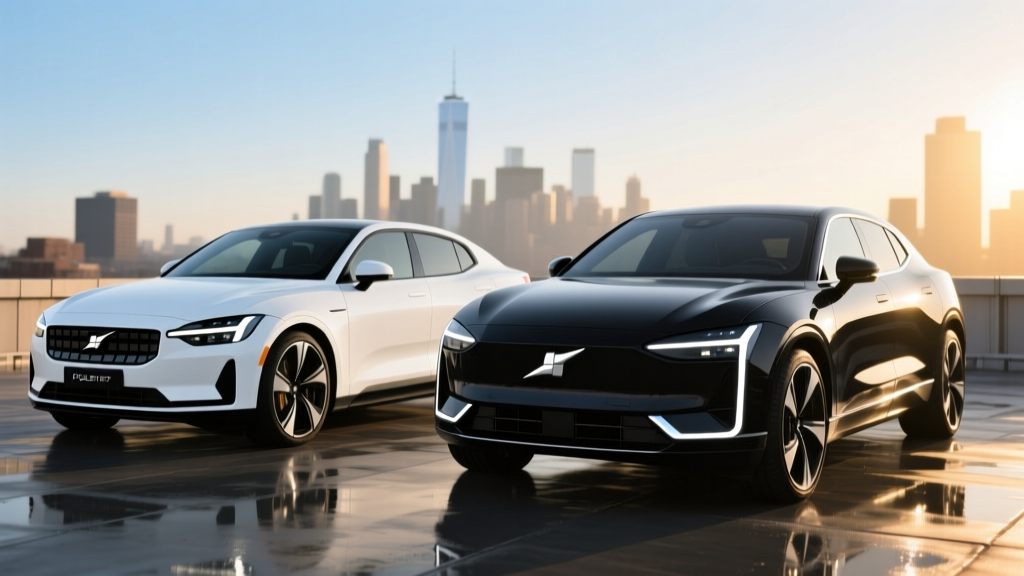
If you've seen the minimalist gold-badge EVs on the road and wondered who makes Polestar cars, the answer sits at the intersection of Scandinavian design and Chinese industrial scale. Polestar is a standalone premium electric-vehicle brand headquartered in Gothenburg, Sweden, jointly owned by Volvo Cars and its parent company Zhejiang Geely Holding Group. Volvo Cars holds a controlling stake, while Geely provides the manufacturing footprint, supply chain, and platform engineering that underpin every Polestar model.
Unlike legacy automakers retrofitting gas platforms, Polestar was born electric. Every production model since the Polestar 2 in 2019 has been a battery-electric vehicle (BEV) built on dedicated or semi-dedicated EV architectures shared across the Geely-Volvo ecosystem. For 2026, the brand fields three core models in the U.S. — the Polestar 2 sedan/fastback, the Polestar 3 SUV, and the Polestar 4 coupe-SUV — with the Polestar 5 grand tourer and Polestar 6 roadster slated as future halo products.
Below, we profile the 2026 U.S. lineup with the exact numbers buyers need: EPA range, battery chemistry, DC fast-charge curves, real-world efficiency, pricing, and federal tax credit eligibility under current IRS §30D rules.
Polestar 2: The Volume Seller
The Polestar 2 remains the brand's most accessible model and its direct answer to the Tesla Model 3. For 2026, it rides on Volvo's Compact Modular Architecture (CMA) and is available in both single-motor rear-wheel drive and dual-motor all-wheel drive configurations.
| Spec | Standard Range SM | Long Range SM | Long Range DM |
|---|---|---|---|
| EPA Range | 276 mi | 320 mi | 304 mi |
| Battery (usable) | 69 kWh (LFP) | 82 kWh (NMC) | 82 kWh (NMC) |
| Drivetrain | RWD | RWD | AWD (Dual Motor) |
| Horsepower | 299 hp | 299 hp | 421 hp (476 w/ Perf. Pack) |
| 0-60 mph | 5.9 sec | 5.9 sec | 4.3 sec (3.8 w/ Perf. Pack) |
| Efficiency | 114 MPGe | 118 MPGe | 105 MPGe |
| Max DC Charge | 135 kW | 200 kW | 200 kW |
| 10-80% DC Time | ~28 min | ~26 min | ~26 min |
| Level 2 Rate | 11 kW | 11 kW | 11 kW |
| Base MSRP | $42,900 | $47,400 | $52,900 |
Charging Speed and Curve Behavior
The Long Range models accept up to 200 kW at a DC fast charger, but like most NMC packs, the charge curve tapers significantly past 80% State of Charge (SoC). You'll hit 10-80% in approximately 26 minutes at a 350 kW Electrify America or Tesla Supercharger (with NACS adapter, standard on 2026 models). The LFP Standard Range pack tops out at 135 kW — adequate for road trips but noticeably slower on 250+ mile stretches.
At home on a 48-amp Level 2 charger (11.5 kW), expect to add roughly 37 miles of range per hour of charging, or a full overnight replenishment from near-empty in about 8.5 hours.
Interior, Cargo, and Tech
The Polestar 2's interior is distinctly Scandinavian: vegan upholstery standard, a portrait-oriented 11.2-inch center display running Google built-in (Maps, Assistant, Play Store), and a 12.3-inch driver cluster. Cargo space measures 14.4 cu ft behind the rear seats and 40.5 cu ft with the 60/40 split folded — less than a Model Y but competitive with the BMW i4 and Hyundai Ioniq 6. Rear legroom is 35.7 inches, adequate for adults on shorter trips but snug for taller passengers.
The optional Pilot Pack adds adaptive cruise with stop-and-go, Pilot Assist (SAE Level 2 lane centering), and a 360-degree camera. Note: this is a Level 2 driver-assist system requiring active hands-on supervision — not autonomous driving.
Polestar 3: The Electric SUV Contender
The Polestar 3 is the brand's first purpose-built SUV, riding on the same Scalable Product Architecture (SPA2) that underpins the Volvo EX90. Manufactured in Chengdu, China, with U.S.-bound production shifting to Volvo's Ridgeville, South Carolina plant, the Polestar 3 targets the luxury midsize electric SUV segment occupied by the BMW iX, Mercedes EQE SUV, and Tesla Model X.
| Spec | Long Range DM | Performance DM |
|---|---|---|
| EPA Range | 315 mi | 285 mi |
| Battery (usable) | 107 kWh (NMC) | 107 kWh (NMC) |
| Drivetrain | AWD (Dual Motor) | AWD (Dual Motor) |
| Horsepower | 489 hp | 523 hp |
| 0-60 mph | 4.7 sec | 4.2 sec |
| Efficiency | 89 MPGe | 82 MPGe |
| Max DC Charge | 250 kW | 250 kW |
| 10-80% DC Time | ~23 min | ~23 min |
| Base MSRP | $69,900 | $75,900 |
The Polestar 3 features a standard air suspension, a 14.5-inch center touchscreen, and an available Bowers & Wilkins 25-speaker audio system. Cargo volume is 17.1 cu ft behind the second row and approximately 50 cu ft with seats folded, plus a small front trunk (frunk) for charging cables. The interior materials and build quality are a clear step above the Polestar 2, with real wood and wool-blend textile options.
Polestar 4: The Coupe-SUV Wildcard
The Polestar 4 eliminates the traditional rear window entirely, replacing it with a high-definition camera feed displayed on an interior screen. This design choice enables a sloping roofline and 300+ mile range without compromising rear headroom. Built on Geely's Sustainable Experience Architecture (SEA) at the Hangzhou Bay factory in China, the Polestar 4 slots between the 2 and 3 in price but leans sportier in execution.
| Spec | Long Range SM | Long Range DM |
|---|---|---|
| EPA Range | 325 mi | 290 mi |
| Battery (usable) | 100 kWh (NMC) | 100 kWh (NMC) |
| Drivetrain | RWD | AWD (Dual Motor) |
| Horsepower | 272 hp | 544 hp |
| 0-60 mph | 6.8 sec | 3.5 sec |
| Efficiency | 102 MPGe | 91 MPGe |
| Max DC Charge | 200 kW | 200 kW |
| 10-80% DC Time | ~27 min | ~27 min |
| Base MSRP | $54,900 | $59,900 |
The dual-motor Polestar 4 is genuinely quick — 3.5 seconds to 60 mph puts it in Porsche Cayenne Turbo territory — but the single-motor version is the efficiency and range play. Rear-seat passengers get 37.8 inches of legroom thanks to the flat floor and absence of a rear glass mechanism. Cargo space is 18.2 cu ft behind the rear seats.
Federal Tax Credit Eligibility for Polestar
Federal EV tax credit eligibility under IRS §30D is where Polestar buyers must pay close attention. The rules have tightened considerably, and eligibility depends on MSRP caps, buyer income limits, battery component sourcing, and critical mineral requirements.
| Model | Base MSRP | MSRP Cap | §30D Eligible? | Effective Price (if eligible) |
|---|---|---|---|---|
| Polestar 2 Std Range SM | $42,900 | $55,000 (sedan) | Partial ($3,750)* | ~$39,150 |
| Polestar 2 LR SM | $47,400 | $55,000 (sedan) | Partial ($3,750)* | ~$43,650 |
| Polestar 2 LR DM | $52,900 | $55,000 (sedan) | Partial ($3,750)* | ~$49,150 |
| Polestar 3 LR DM | $69,900 | $80,000 (SUV) | Likely $0** | $69,900 |
| Polestar 4 LR SM | $54,900 | $80,000 (SUV) | Partial ($3,750)* | ~$51,150 |
*Partial credit reflects meeting critical minerals requirements but not full battery component sourcing thresholds for vehicles manufactured in China. **The Polestar 3 currently fails battery component sourcing requirements due to Chinese manufacturing. Verify current status at fueleconomy.gov before purchasing.
Income caps apply: Modified adjusted gross income must not exceed $150,000 (single), $225,000 (head of household), or $300,000 (joint). The credit can now be transferred to the dealer at point of sale as an immediate discount. Always confirm eligibility with your tax professional and the IRS before signing a purchase agreement.
Warranty and Long-Term Ownership
Polestar provides a competitive warranty package across its lineup:
- Limited Vehicle Warranty: 4 years / 50,000 miles
- Battery & Powertrain Warranty: 8 years / 100,000 miles (covers battery capacity retention below 70% of original)
- Corrosion Warranty: 12 years, unlimited miles
- Roadside Assistance: 4 years / unlimited miles
The 70% capacity retention threshold is industry-standard, matching Tesla, Hyundai, and BMW. For context, most NMC batteries degrade to roughly 90% capacity after 100,000 miles under normal use, and LFP packs (Polestar 2 Standard Range) tend to degrade even more slowly. The real ownership advantage is Polestar's inclusion of 2 years of scheduled maintenance and over-the-air (OTA) software updates that can improve efficiency and add features post-purchase.
Strengths
- Distinctive Scandinavian design and premium interior materials
- Google built-in infotainment is intuitive and well-integrated
- Strong DC fast-charge speeds (200–250 kW) on Long Range models
- Competitive real-world range across the lineup (250–325 mi EPA)
- NACS port standard for 2026 — native Tesla Supercharger access
- OTA updates and 2 years included maintenance
Drawbacks
- Limited U.S. service center network compared to Tesla or BMW
- Chinese manufacturing currently limits federal tax credit eligibility
- Cargo space in Polestar 2 trails key competitors (Model Y, Ioniq 5)
- Rear visibility in Polestar 4 takes adjustment (camera-based rearview)
- Performance Pack pricing pushes Polestar 2 into Polestar 4 territory
- Brand awareness and resale value still lag established luxury marques
Who Should Buy a Polestar?
Choose Polestar if: You want a premium EV with Scandinavian-minimalist design, Google-native infotainment, and strong fast-charging capability — and you're willing to trade some service-center convenience and tax-credit maximization for a less ubiquitous badge than Tesla or BMW.
The Polestar 2 suits urban commuters and couples who need 275+ miles of real-world range, appreciate build quality, and don't regularly haul four adults long distances. The Standard Range LFP model is a smart pick for buyers who plan to own the car 8+ years and want maximum battery longevity.
The Polestar 3 suits families upgrading from a Volvo XC90 or Audi e-tron who want three-row-adjacent cargo space, air suspension comfort, and a luxury interior. The South Carolina production shift may eventually unlock full tax credit eligibility — worth monitoring.
The Polestar 4 suits driving enthusiasts who find the Model Y too common and the BMW i4 too conservative. The dual-motor version's 3.5-second 0-60 is supercar territory, while the single-motor delivers 325 miles of range for daily driving.
Frequently Asked Questions
Who makes Polestar cars and where are they built?
Polestar is a Swedish-headquartered EV brand jointly owned by Volvo Cars and China's Geely Holding Group. The Polestar 2 is manufactured in Luqiao, China. The Polestar 4 is built in Hangzhou Bay, China. The Polestar 3 initially launched from Chengdu, China, with production transitioning to Volvo's plant in Ridgeville, South Carolina. The upcoming Polestar 5 will be built in Chongqing, China.
What is the real-world range of the Polestar 2?
The 2026 Polestar 2 Long Range Single Motor carries an EPA rating of 320 miles. In real-world highway driving at 70-75 mph, expect 250-275 miles. In cold weather (below 30°F), plan for 240-270 miles. The Standard Range LFP model's 276-mile EPA rating translates to roughly 220-240 miles on the highway.
How fast does a Polestar charge at home and on the road?
On DC fast chargers, the Polestar 2 Long Range peaks at 200 kW (10-80% in ~26 minutes), the Polestar 3 at 250 kW (~23 minutes), and the Polestar 4 at 200 kW (~27 minutes). At home on a 48-amp Level 2 charger (11.5 kW), all models add approximately 35-40 miles of range per hour, fully replenishing overnight.
Does Polestar qualify for the $7,500 federal EV tax credit?
Currently, most Polestar models qualify for only a partial $3,750 credit or no credit at all under IRS §30D, due to battery component sourcing rules tied to Chinese manufacturing. The Polestar 3 may gain eligibility once South Carolina production begins. Always verify at fueleconomy.gov and consult a tax professional. Income caps ($150K single / $300K joint) and MSRP caps ($55K sedan / $80K SUV) also apply.
Is Polestar worth buying vs. Tesla, BMW, or Hyundai?
Polestar competes on design, build quality, and Google-native tech rather than price or charging network dominance. Against the Tesla Model 3, the Polestar 2 offers a more premium interior but less cargo space and no proprietary fast-charge network (though NACS access now bridges this gap). Against the BMW i4, it's similarly priced but more distinctive. Against the Hyundai Ioniq 6, it costs more but delivers superior materials. If tax credit maximization is your priority, the U.S.-built Tesla Model 3 or Hyundai Ioniq 5 currently offer a clearer path to the full $7,500 credit.
How reliable are Polestar vehicles?
Polestar benefits from Volvo's engineering and Geely's manufacturing scale. The Polestar 2, in production since 2019, has shown solid reliability in owner surveys, with most complaints centered on software glitches (largely resolved via OTA updates) rather than powertrain issues. The 8-year/100,000-mile battery warranty provides long-term peace of mind. Long-term data on the Polestar 3 and 4 is still limited given their recent launch.
Sources: fueleconomy.gov (EPA range and efficiency data), IRS §30D Clean Vehicle Credits, Polestar USA official specifications.