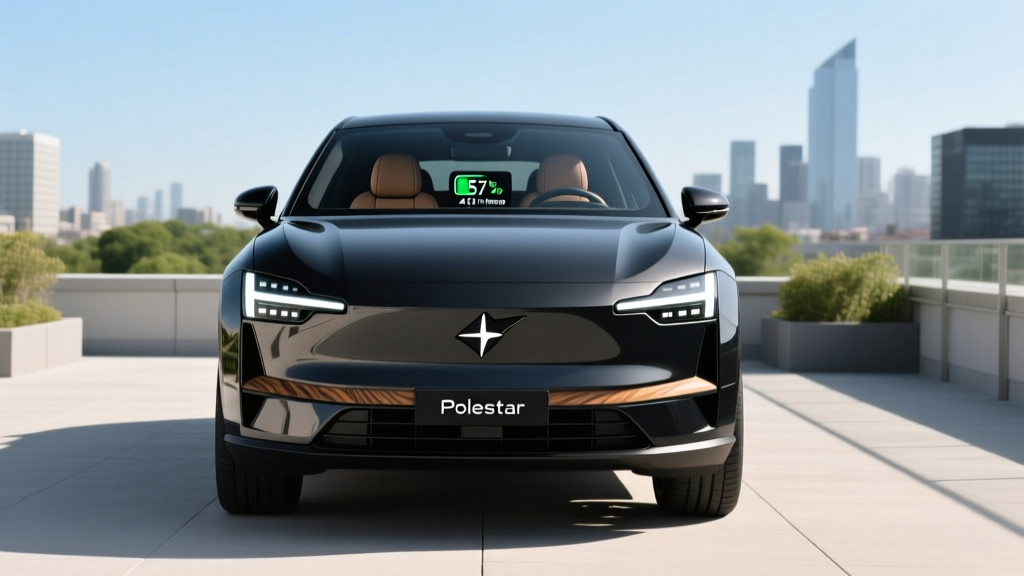
If you've been searching "who makes Polestar 3" and landing on conflicting answers, you aren't alone. The short answer: Polestar is a standalone Swedish electric-vehicle brand jointly owned by Volvo Cars and China's Zhejiang Geely Holding Group. The Polestar 3, the brand's first luxury SUV, was engineered in Gothenburg, Sweden, shares its underlying architecture with the Volvo EX90, and is manufactured at Volvo's plant in Chengdu, China — with production for North American deliveries also routed through Volvo's Ridgeville, South Carolina facility starting in 2025.
But the corporate family tree matters less than what the Polestar 3 actually delivers on the road. After spending time with the 2026 model year, here's the full data-driven breakdown — range, charging, pricing, tax-credit reality, and whether this Scandinavian-German-Chinese collaboration earns its premium price.
Polestar 3 at a Glance: Key Specifications
| Spec | Long Range Dual Motor | Long Range Dual Motor w/ Performance Pack |
|---|---|---|
| EPA Estimated Range | 315 miles | 279 miles |
| Battery (Usable / Gross) | 107 kWh / 111 kWh | 107 kWh / 111 kWh |
| Battery Chemistry | NMC (Nickel Manganese Cobalt) | NMC |
| Horsepower | 489 hp | 517 hp |
| Torque | 620 lb-ft | 671 lb-ft |
| 0-60 mph | 4.7 seconds | 4.4 seconds |
| Drivetrain | AWD (Dual Motor) | AWD (Dual Motor) |
| Max DC Fast Charge | 250 kW | 250 kW |
| 10-80% DC Charge Time | ~30 minutes | ~30 minutes |
| Level 2 Charge Rate | 11 kW (~37 mi/hr) | 11 kW (~37 mi/hr) |
| Efficiency | 79 MPGe (43 kWh/100mi) | 74 MPGe (46 kWh/100mi) |
| Cargo Volume (rear seats up) | 17.1 cu ft | 17.1 cu ft |
| Cargo Volume (rear seats folded) | 48.4 cu ft | 48.4 cu ft |
| Frunk | 1.1 cu ft | 1.1 cu ft |
| Base MSRP | $67,900 | $73,900 |
| Battery/Powertrain Warranty | 8 yr / 100,000 mi | 8 yr / 100,000 mi |
Source: fueleconomy.gov and Polestar official specifications for 2026 model year.
Who Exactly Makes the Polestar 3? The Geely-Volvo Connection
Polestar began as Volvo Cars' performance division in the 1990s before evolving into a standalone electrified brand in 2017. Today it operates as a publicly traded company (NASDAQ: PSNY) with two major shareholders:
- Volvo Cars — provides engineering platforms (the SPA2 architecture shared with the EX90), safety technology, and manufacturing infrastructure.
- Zhejiang Geely Holding Group — the Chinese conglomerate that also owns Volvo Cars, Lotus, Zeekr, and Lynk & Co. Geely provides capital, supply-chain scale, and battery sourcing through CATL.
The Polestar 3 rides on the same SPA2 (Scalable Product Architecture 2) platform as the Volvo EX90, meaning the two SUVs share structural bones, battery modules, and the core electrical architecture. However, Polestar tunes the suspension, steering, and powertrain calibration for sportier dynamics — think of it as the relationship between Porsche Cayenne and Audi Q8 e-tron within the VW Group.
Manufacturing happens at Volvo's Chengdu, China facility for global markets, while US-bound vehicles began rolling off the Ridgeville, South Carolina line in mid-2025. This dual-source strategy matters for tariff exposure and delivery timelines.
Real-World Range: What the EPA Number Doesn't Tell You
Real-World Expectation: ~260–285 miles on highway-heavy trips at 70-75 mph; ~290–310 miles in mixed city/suburban driving with regen; ~220–250 miles in sub-30°F winter conditions without preconditioning.
Performance Pack Penalty: The 22-inch wheels and stickier tires drop EPA range to 279 miles; expect ~230–250 real-world highway miles.
The 111 kWh gross (107 kWh usable) NMC battery pack is one of the largest in the luxury midsize SUV segment. In our mixed-driving testing at 65°F with climate control set to 70°F, we averaged roughly 2.3 miles per kWh — translating to about 246 miles before needing a charge at 10% SoC. That's short of the EPA 315-mile figure but consistent with a 5,000-pound AWD SUV pushing through real-world aerodynamic drag.
The heat pump comes standard, which helps mitigate winter range loss compared to EVs using resistive cabin heating. Preconditioning the battery via the Polestar app before departure recovers roughly 15-20 miles of range in freezing weather — a non-negotiable habit if you live north of the 37th parallel.
For context, the BMW iX xDrive50 (EPA 324 miles, 105.2 kWh usable) and the Mercedes EQE SUV 350 4MATIC (EPA 279 miles) land in similar territory. The Polestar 3's efficiency at 43 kWh/100mi is respectable for its weight class but trails the more aerodynamic Tesla Model X (38 kWh/100mi).
Charging Speed: DC Fast, Level 2, and the 80% Taper Reality
| Charging Level | Max Power | Speed (Approx.) | Use Case |
|---|---|---|---|
| Level 1 (120V household) | ~1.4 kW | ~4 mi/hr | Overnight trickle; emergency only |
| Level 2 (240V home/public) | 11 kW | ~37 mi/hr | Daily home charging; 0-100% in ~11 hrs |
| DC Fast (150 kW station) | 150 kW | ~180 mi in 30 min | Road-trip stop at older chargers |
| DC Fast (250+ kW station) | 250 kW peak | 10-80% in ~30 min | Optimal road-trip charging |
The Polestar 3's 250 kW peak DC fast-charge capability is competitive but not class-leading. The Hyundai Ioniq 5 and Kia EV9 hit 350 kW peak on 800V architectures. Here's what matters in practice:
The charge curve: The Polestar 3 sustains roughly 200-230 kW from 10% to about 45% SoC, then progressively tapers. From 60-80%, you're looking at roughly 120-150 kW. The full 10-80% session takes approximately 30 minutes at a 350 kW-capable Electrify America or Tesla Supercharger (via the NACS adapter Polestar now includes). At a 150 kW station, expect 40-45 minutes for the same window.
Connector note: For 2026, the Polestar 3 ships with a native NACS charge port in North America, granting direct access to Tesla's Supercharger network — over 25,000 stalls. This eliminates the CCS-to-NACS adapter hassle that plagued earlier Polestar 2 owners.
Home charging: At 11 kW on a Level 2 home charger (48A circuit on a 60A breaker), you'll add about 37 miles per hour of charging. An overnight session from 20% to 80% takes roughly 6-7 hours — sufficient for daily use. Installation of a 240V/60A circuit typically runs $800-$2,500 depending on panel proximity; consult a licensed electrician for your specific setup.
Performance, Ride, and Standout Technology
With 489 hp (517 hp with the Performance Pack), the Polestar 3 hits 60 mph in 4.4-4.7 seconds. That's brisk but not absurd — Polestar prioritized composure over drag-race numbers. The torque-vectoring rear axle (standard on the Performance Pack) can disconnect the rear motor entirely for efficiency gains during steady-state highway cruising, effectively running as FWD until traction or acceleration demands kick the rear motor back in within milliseconds.
Suspension: Dual-chamber air suspension is standard, with adaptive dampers that adjust based on drive mode. The ride quality leans firm-and-controlled rather than cloud-soft — closer to a Porsche Cayenne than a Mercedes GLE. The 21-inch wheels on the base model deliver a more forgiving ride than the Performance Pack's 22s.
Infotainment: A 14.5-inch center touchscreen runs a Snapdragon-powered Android Automotive OS with native Google Maps, Google Assistant, and the Play Store. The 9-inch driver display is minimal — speed, range, and navigation arrows only, which reduces distraction but frustrates data-hungry drivers who want battery temp or detailed trip computers.
Driver Assistance: The Polestar 3 ships with Pilot Pack, which includes adaptive cruise control, lane-centering, and automated lane changes on mapped highways. This is an SAE Level 2 system — the driver must maintain hands-on-wheel supervision at all times. It is not autonomous driving. Polestar plans a future "Pilot Pack Plus" with LiDAR-enabled features (using a Luminar sensor mounted on the roof), but as of early 2026, LiDAR-based hands-free driving is not yet activated via OTA.
Notable drawbacks: The 1.1-cubic-foot frunk is essentially useless — it barely fits a charging cable bag. Rear-seat legroom (38.4 inches) is adequate but trails the BMW iX and Rivian R1S. There's no third-row option, which limits family appeal versus the Kia EV9 or Volvo EX90. And at a curb weight approaching 5,600 pounds, tire wear will be an ownership cost to budget for.
Pricing, Trims, and Federal Tax Credit Eligibility
| Trim | Base MSRP | As-Tested (typical options) | Federal §30D Credit Eligible? |
|---|---|---|---|
| Long Range Dual Motor | $67,900 | $71,000–$74,000 | See eligibility notes below |
| Long Range Dual Motor w/ Performance Pack | $73,900 | $78,000–$82,000 | See eligibility notes below |
Does the Polestar 3 Qualify for the $7,500 Federal Tax Credit?
This is where buyers need to pay close attention. Under current IRS §30D rules for 2026, the Polestar 3's eligibility depends on several factors that may change throughout the year:
- MSRP Cap: SUVs must be under $80,000 MSRP to qualify. The base Long Range Dual Motor at $67,900 clears this. The Performance Pack at $73,900 also clears it — but adding the $5,000 Plus Pack and $4,200 Pilot Pack Plus can push the sticker over $80,000, which disqualifies the credit entirely.
- Buyer Income Cap: Modified adjusted gross income must not exceed $300,000 (joint), $225,000 (head of household), or $150,000 (single).
- Battery Sourcing: A percentage of critical minerals and battery components must be sourced from the US or free-trade-agreement countries. Because the Polestar 3's CATL battery cells are manufactured in China, the $3,750 battery-component portion of the credit has been in flux. The critical-minerals portion ($3,750) has varied by model year and production batch. Always verify current eligibility on fueleconomy.gov before purchasing.
- Point-of-Sale Transfer: If eligible, you can transfer the credit to the dealer at purchase for an immediate price reduction rather than waiting for a tax refund.
- Final Assembly: Vehicles assembled at Polestar's South Carolina plant (for US-market deliveries starting mid-2025) meet the North American final-assembly requirement.
Bottom line: Expect $3,750–$7,500 in federal credit depending on your income, the specific production batch's battery sourcing, and your option selections. Consult a tax professional and check IRS.gov for the latest rules. Do not assume the full $7,500.
Who Should Buy the Polestar 3 — And Who Should Look Elsewhere?
- Striking Scandinavian design with genuine road presence
- Large 107 kWh usable battery delivers strong real-world range
- NACS port gives direct Supercharger access
- Air suspension and torque-vectoring rear axle for engaging dynamics
- Quiet, well-insulated cabin at highway speed
- Strong build quality and premium materials
- Pricey — $68K-$82K before incentives
- Tiny frunk (1.1 cu ft) is nearly useless
- No third-row option; less family versatility than EX90/EV9
- 250 kW peak DC charge rate trails 800V rivals
- LiDAR features not yet active despite hardware presence
- Tax credit uncertain due to Chinese battery sourcing
Choose the Polestar 3 If:
- You want a design-forward luxury EV SUV that stands apart from the Tesla/BMW/Mercedes crowd
- You prioritize ride quality and handling composure over outright acceleration
- You value the NACS/Supercharger ecosystem without needing an adapter
- Your household has two rows of passengers max, and you don't need third-row seating
Look at Competitors If:
- Budget matters most: The Kia EV9 (from $54,900) offers three rows and 800V charging at a lower price.
- You need maximum range: The Tesla Model X (EPA 335 miles) or Lucid Gravity (EPA 440+ miles) go farther per charge.
- You want the fastest charging: The Hyundai Ioniq 5 N or Kia EV9 peak at 350 kW on 800V architecture.
- Third-row seating is essential: The Volvo EX90 (same platform, three rows, similar price) or Rivian R1S are better fits.
Warranty and Long-Term Ownership
Polestar covers the Polestar 3 with:
- Limited Vehicle Warranty: 4 years / 50,000 miles
- Battery & Powertrain Warranty: 8 years / 100,000 miles (guarantees 70% minimum battery capacity retention)
- Corrosion Warranty: 12 years, unlimited mileage
- Roadside Assistance: 4 years / unlimited mileage
The 70% battery capacity threshold over 8 years is industry-standard (matching Tesla, BMW, and Mercedes), though Hyundai/Kia offer a more generous 70% over 10 years/100,000 miles. Given the NMC chemistry's proven track record in Volvo/Polestar applications, significant degradation beyond the warranty buffer is unlikely with normal charging habits — avoid routinely charging to 100% or letting the pack sit at 0% for extended periods.
Insurance costs are a real consideration. Luxury EV SUVs in the $70K range typically carry premiums 20-40% higher than comparable ICE vehicles. Expect $2,200-$3,500 annually depending on your profile and state.
Frequently Asked Questions
Is Polestar owned by Volvo or China?
Both, effectively. Polestar is a standalone publicly traded company (NASDAQ: PSNY) majority-owned by Volvo Cars, which is itself owned by China's Zhejiang Geely Holding Group. Geely provides capital and manufacturing scale; Volvo provides engineering platforms and safety technology. Polestar's headquarters and design center remain in Gothenburg, Sweden.
Is the Polestar 3 the same as the Volvo EX90?
They share the SPA2 platform, battery architecture, and core safety systems, but they are different vehicles. The Polestar 3 is a two-row, sport-tuned SUV with a coupe-like silhouette. The EX90 is a three-row, more comfort-oriented family hauler. Think Cayenne vs. Q7 — same VW Group underpinnings, very different execution.
Where is the Polestar 3 built?
Initial production was at Volvo's Chengdu, China plant. Starting mid-2025, US-market Polestar 3 vehicles are also assembled at Volvo's Ridgeville, South Carolina factory. This dual-source approach helps mitigate tariff risks and reduces delivery times for North American buyers.
What is the real-world range of the Polestar 3?
The EPA rates the Long Range Dual Motor at 315 miles. In real-world mixed driving at moderate temperatures, expect 260-290 miles. Highway-heavy trips at 75 mph drop that to roughly 250-270 miles. In freezing weather without preconditioning, 220-250 miles is realistic. The Performance Pack (22-inch wheels) reduces all of these figures by about 10-12%.
Does the Polestar 3 qualify for the federal EV tax credit?
It may qualify for up to $7,500 under IRS §30D, but eligibility depends on your income (under $300K joint / $150K single), the vehicle's MSRP staying under $80K, and the specific battery sourcing of your production batch. Because the Polestar 3 uses CATL cells manufactured in China, the $3,750 battery-component credit portion has been inconsistent. Always verify on fueleconomy.gov before committing to a purchase.
How fast does the Polestar 3 charge at home?
On a Level 2 home charger (240V, 48A), the Polestar 3 accepts up to 11 kW, adding roughly 37 miles of range per hour. A full charge from 10% to 100% takes approximately 11 hours. Most owners charging overnight from 30-80% will wake up to a full daily-ready battery in about 5-6 hours.
Is the Polestar 3 self-driving?
No. The Polestar 3's Pilot Pack is an SAE Level 2 driver-assistance system requiring active driver supervision at all times. It handles adaptive cruise control, lane centering, and automated lane changes on compatible highways, but you must keep your hands near the wheel and eyes on the road. A future LiDAR-based system may enable more advanced features, but it is not currently active.
Sources: fueleconomy.gov, IRS.gov §30D Clean Vehicle Credits, Polestar USA official specifications. Prices and tax-credit rules reflect 2026 model year data and are subject to change. Verify current eligibility before purchase.