The Short Answer: Who Makes the Lucid Automobile?
Lucid automobiles are designed, engineered, and manufactured by Lucid Group, Inc., an American electric-vehicle company headquartered in Newark, California. The company was originally founded in 2007 as Atieva, a battery-technology firm focused on EV powertrains, before pivoting to full vehicle production and rebranding as Lucid Motors in 2016. In 2021, Lucid went public via a SPAC merger and is now listed on the NASDAQ under the ticker LCID.
Lucid's production facility — dubbed AMP-1 — is located in Casa Grande, Arizona. This vertically integrated factory handles stamping, body-in-white assembly, paint, battery pack assembly, and final vehicle production under one roof. As of 2026, Lucid also operates an expanding international footprint, including a factory under construction in King Abdullah Economic City, Saudi Arabia, backed by significant investment from Saudi Arabia's Public Investment Fund (PIF), which holds a majority stake in the company.
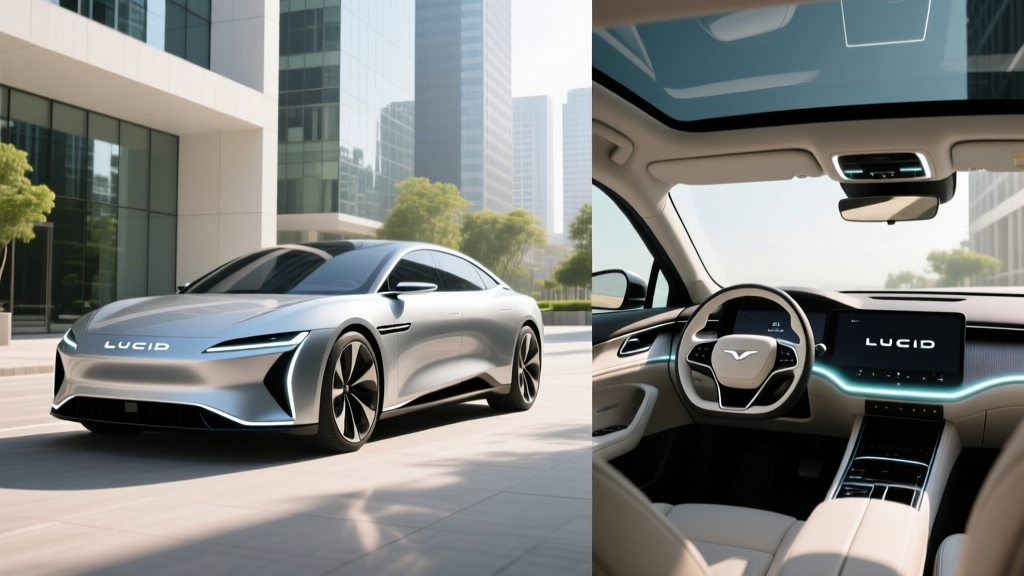
The company's current flagship product is the Lucid Air, a luxury electric sedan that competes directly with the Tesla Model S, Mercedes-Benz EQS, and BMW i7. A luxury SUV, the Lucid Gravity, began production in late 2024 and is now in customer hands for the 2025 and 2026 model years.
2026 Lucid Air Lineup: Trims, Pricing, and Tax Credit Eligibility
For 2026, the Lucid Air sedan is offered in several configurations spanning from a value-oriented single-motor model to the extreme-performance Sapphire. Here's how the lineup breaks down:
| Trim | Drivetrain | HP | EPA Range | Base MSRP |
|---|---|---|---|---|
| Air Pure | RWD (single motor) | 430 hp | 419 mi | $69,900 |
| Air Touring | AWD (dual motor) | 620 hp | 425 mi | $87,400 |
| Air Grand Touring | AWD (dual motor) | 1,050 hp | 516 mi | $125,600 |
| Air Sapphire | AWD (tri-motor) | 1,234 hp | 427 mi | $249,000 |
Federal Tax Credit Eligibility (§30D)
Under the current IRS §30D rules, the Lucid Air Pure may qualify for up to $7,500 in federal EV tax credits, but eligibility is conditional:
- MSRP cap: Sedans must be priced at or below $55,000 to qualify. The Air Pure starts at $69,900, which exceeds the sedan cap. As of 2026, Lucid Air trims do not qualify for the new-vehicle §30D credit due to pricing above the threshold.
- Buyer income cap: Modified adjusted gross income must not exceed $150,000 (single), $225,000 (head of household), or $300,000 (joint).
- Battery sourcing: Critical minerals and battery component requirements phase in progressively; Lucid has been working to localize supply chains, but final eligibility depends on the specific vehicle's battery provenance.
- Point-of-sale transfer: If eligible, the credit can be applied at purchase rather than at tax filing — but only if the vehicle itself qualifies.
Bottom line: Most Lucid Air buyers will not qualify for the federal new-vehicle credit due to the MSRP cap. Always verify current eligibility on irs.gov and consult a tax professional before purchasing.
Battery, Range, and Real-World Efficiency
Range Reality Check
EPA sticker (Air Grand Touring): 516 miles
Real-world highway expectation: ~400–440 miles at 70–75 mph
Cold-weather (below 32°F): Expect 15–25% range reduction, yielding roughly 310–370 miles depending on cabin heating demand and battery preconditioning.
The Lucid Air uses lithium-ion battery packs with NMC (nickel manganese cobalt) chemistry, chosen for its high energy density — a critical factor in achieving the Air's class-leading range. Battery capacities vary by trim:
| Trim | Usable Battery (kWh) | Chemistry | MPGe (combined) | kWh/100 mi |
|---|---|---|---|---|
| Air Pure | 88 kWh | NMC | 136 MPGe | 25 |
| Air Touring | 112 kWh | NMC | 131 MPGe | 26 |
| Air Grand Touring | 112 kWh | NMC | 131 MPGe | 26 |
| Air Sapphire | 118 kWh | NMC | 115 MPGe | 29 |
Lucid's efficiency advantage comes from its proprietary miniaturized drive units — compact electric motors that are smaller, lighter, and more efficient than most competitors'. The Air Grand Touring achieves roughly 4.5 miles per kWh, which is exceptional for a 5,000+ lb luxury sedan. For context, the Mercedes EQS 450+ manages about 3.5 mi/kWh, and the Tesla Model S Long Range sits around 3.8 mi/kWh.
Source: fueleconomy.gov for official EPA figures.
Charging Speed: DC Fast Charging and Home Level 2
Lucid's 900V electrical architecture enables some of the fastest DC charging in the luxury-sedan segment. Here's what to expect across charging scenarios:
| Charging Level | Power / Rate | Speed | Notes |
|---|---|---|---|
| Level 1 (120V) | ~1.4 kW | ~4 mi/hr | Emergency/trickle only |
| Level 2 (240V, 48A) | 11.5 kW | ~45 mi/hr | Home overnight charge: ~10 hrs (0–100%) |
| DC Fast Charge (peak) | Up to 300 kW | 10–80% in ~20 min (Grand Touring) | Requires 350 kW CCS station; preconditioning essential |
| DC Fast Charge (sustained) | ~150–200 kW avg | ~25–30 min (10–80%) | Real-world average accounting for charge-curve taper |
Understanding the Charge Curve
The Air Grand Touring's peak 300 kW rate is achievable only under ideal conditions: a 350 kW CCS-compatible station (like Electrify America or EVgo), battery preconditioned to optimal temperature (the car does this automatically when you navigate to a charger), and a low starting state of charge (10–15%). As the battery fills past 50–60%, the charge rate tapers significantly — this is normal for all lithium-ion packs and protects long-term battery health. Expect the 80–100% portion to add another 20+ minutes. For daily driving, charging to 80% is both faster and better for long-term battery longevity.
Connector and Network Compatibility
As of 2026, Lucid Air vehicles use the CCS1 connector for DC fast charging and the J1772 connector for Level 2 AC charging. Lucid has announced NACS adapter support, enabling access to Tesla Supercharger stations — a significant network expansion. Confirm adapter availability with your dealer at time of purchase.
Performance and Driving Dynamics
The Lucid Air lineup spans a remarkable performance range:
| Trim | 0–60 mph | Top Speed | Drivetrain |
|---|---|---|---|
| Air Pure | 5.0 sec | 145 mph | Rear-wheel drive |
| Air Touring | 3.4 sec | 157 mph | Dual-motor AWD |
| Air Grand Touring | 3.0 sec | 168 mph | Dual-motor AWD |
| Air Sapphire | 1.89 sec | 205 mph | Tri-motor AWD |
The Sapphire's 1.89-second 0–60 time makes it one of the quickest production sedans ever built, rivaling hypercars at a fraction of their price. But the more relevant everyday figure is the Grand Touring's 3.0-second sprint — effortlessly quick for highway merging and passing, delivered with the smooth, vibration-free character unique to electric drivetrains.
Lucid's adaptive air suspension (standard on Touring and above) provides a compliant ride that isolates occupants from road imperfections while maintaining composed body control through corners. The steering is precise if somewhat light — tuned for luxury rather than sporty feedback.
Interior, Cargo, and Technology
The Air's cabin reflects its California origins: airy, minimalist, and screen-dominant. A 34-inch curved glass canopy display spans the driver's instrument cluster and infotainment system, supplemented by a lower touchscreen for climate and secondary controls.
Dimensions and Space
| Measurement | Value |
|---|---|
| Front legroom | 42.4 in |
| Rear legroom | 37.6 in |
| Trunk (rear) | 22.1 cu ft |
| Frunk (front trunk) | 10.0 cu ft |
| Total cargo | 32.1 cu ft |
| Wheelbase | 116.5 in |
For a sedan, the Air's cargo volume is generous — the 22.1 cu ft trunk plus 10.0 cu ft frunk gives you 32.1 cu ft total, more than many midsize SUVs offer behind their second row. Rear-seat legroom is adequate for adults but slightly tighter than the Mercedes EQS, which benefits from a dedicated EV platform with a longer wheelbase relative to its exterior.
Driver Assistance: DreamDrive Pro
Lucid's driver-assistance suite, called DreamDrive Pro, includes adaptive cruise control, lane-centering assist, automatic emergency braking, blind-spot monitoring, and a 360-degree camera system. The system uses a combination of cameras, radar, and LiDAR sensors.
SAE Automation Level: Level 2
DreamDrive Pro is an SAE Level 2 driver-assistance system. The driver must remain fully engaged, keep hands on the wheel, and monitor the road at all times. This is not a self-driving system. Lucid has not announced a hands-free highway driving feature comparable to GM's Super Cruise or Ford's BlueCruise as of early 2026.
Standout Tech Features
- Surreal Sound by Dolby Atmos: Available 21-speaker immersive audio system
- Over-the-air updates: Continuous feature and performance improvements
- Phone-as-key: Bluetooth-based passive entry and start
- EV routing: Built-in navigation with automatic battery preconditioning for DC fast chargers
Notable Drawbacks
- Touchscreen-heavy interface: Limited physical buttons; climate and media controls require the lower touchscreen
- No hands-free driving mode: Competitors like BMW (Highway Assistant) and GM (Super Cruise) offer hands-off Level 2 on mapped highways
- Service center coverage: Lucid's service network is still growing; some owners face long waits or must use mobile service
- Insurance costs: Premium luxury EV with expensive body panels and battery; expect higher-than-average premiums
Warranty and Battery Longevity
| Coverage | Term |
|---|---|
| Basic vehicle | 4 years / 50,000 miles |
| Battery & powertrain | 8 years / 100,000 miles |
| Battery capacity retention | ≥70% of original capacity over 8 yr / 100,000 mi |
Lucid's 8-year/100,000-mile battery warranty is industry-standard for luxury EVs and matches Tesla's coverage on the Model S. The 70% capacity retention threshold means that if your battery degrades below 70% of its original kWh within the warranty period, Lucid will repair or replace it. In practice, NMC batteries in well-managed thermal systems (like the Air's liquid-cooled pack) typically degrade 8–12% over the first 100,000 miles based on industry-wide data from sources like Geotab's fleet degradation studies.
For maximum battery longevity, Lucid recommends setting daily charge limits to 80% and only charging to 100% when you need maximum range for a trip. The Air's preconditioning system and active thermal management help minimize degradation during DC fast charging.
Who Should Buy the Lucid Air?
Decision Framework
Choose the Lucid Air if:
- You want the longest EPA range of any production sedan (Grand Touring at 516 mi)
- You prioritize efficiency — the Air's mi/kWh is best-in-class for luxury sedans
- You value a spacious, well-built interior with a large frunk and trunk
- You want sub-4-second 0–60 performance without sacrificing daily comfort
- You have reliable home Level 2 charging access
Look elsewhere if:
- You need hands-free highway driving (consider BMW i7 with Highway Assistant or Mercedes EQS with Drive Pilot)
- You need a large dealer/service network in your area (Tesla and legacy luxury brands have broader coverage)
- Your budget is under $65,000 — the Air Pure starts at $69,900 and doesn't qualify for the federal new-vehicle credit
- You need towing capability — the Air sedan is not rated for towing; consider the Lucid Gravity SUV
Lucid Air vs. Key Competitors
| Spec | Lucid Air Grand Touring | Tesla Model S LR | Mercedes EQS 450+ | BMW i7 xDrive60 |
|---|---|---|---|---|
| EPA Range | 516 mi | 402 mi | 390 mi | 318 mi |
| Battery (kWh) | 112 | 100 | 108 | 102 |
| 0–60 mph | 3.0 sec | 3.1 sec | 5.3 sec | 4.5 sec |
| Peak DC Charge | 300 kW | 250 kW | 200 kW | 195 kW |
| Base MSRP | $125,600 | $79,990 | $104,400 | $124,200 |
| Federal Credit | No (MSRP cap) | No (MSRP cap) | No (MSRP cap) | No (MSRP cap) |
The Air Grand Touring dominates on range and efficiency, but the Model S offers access to the Supercharger network and a lower entry price. The EQS and i7 lean harder into traditional luxury brand cachet and dealer service infrastructure. Your choice depends on which trade-off matters most to you.
Pros
- Best-in-class EPA range (516 mi on Grand Touring)
- Outstanding efficiency (~4.5 mi/kWh)
- Spacious trunk + frunk (32.1 cu ft total)
- 900V architecture enables 300 kW peak DC charging
- Refined ride quality with air suspension
- Strong 0–60 across all trims
Cons
- No federal tax credit eligibility (MSRP exceeds cap)
- Limited service center network in many regions
- No hands-free driving feature available
- Touchscreen-dominant interior controls
- Higher insurance costs than comparable ICE sedans
- Brand is still young — long-term resale value is unproven
Frequently Asked Questions
What is the real-world range of the Lucid Air?
The EPA rates the Air Grand Touring at 516 miles. In real-world highway driving at 70–75 mph, expect roughly 400–440 miles. In cold weather (below freezing), plan for 310–370 miles depending on conditions and whether you precondition the battery. The Air Pure's 419-mile EPA rating translates to approximately 330–360 real-world highway miles.
How fast does the Lucid Air charge?
On a 350 kW CCS DC fast charger with a preconditioned battery, the Air Grand Touring can peak at 300 kW and charge from 10–80% in approximately 20 minutes. However, sustained average rates are closer to 150–200 kW, so plan on 25–30 minutes in typical conditions. At home on a Level 2 (240V/48A) charger, expect about 45 miles of range per hour, or roughly 10 hours for a full charge.
How much does the Lucid Air cost after tax credits?
The 2026 Air Pure starts at $69,900, the Touring at $87,400, the Grand Touring at $125,600, and the Sapphire at $249,000. None of these trims qualify for the $7,500 federal §30D new-vehicle tax credit because they exceed the $55,000 MSRP cap for sedans. Some states offer additional rebates or incentives — check your state's energy office or fueleconomy.gov's tax center for details.
Does the Lucid Air qualify for the federal EV tax credit?
No. Under current IRS §30D rules, new electric sedans must have an MSRP at or below $55,000 to qualify. All Lucid Air trims exceed this threshold. The §30D credit also has buyer income limits ($150K single / $300K joint) and battery-sourcing requirements. Always verify current rules at irs.gov before making a purchase decision.
Is the Lucid Air worth buying vs. the Tesla Model S or Mercedes EQS?
If range and efficiency are your top priorities, the Air Grand Touring is objectively superior — no other luxury sedan comes close to 516 EPA miles. If you value charging-network convenience, the Tesla Model S and its Supercharger access may be more practical for road trips. If brand heritage, dealer service, and hands-free driving matter most, the Mercedes EQS or BMW i7 may be better fits. Test-drive all three before deciding.
Where is Lucid headquartered and where are its cars built?
Lucid Group, Inc. is headquartered in Newark, California. Vehicles for the North American market are manufactured at AMP-1 in Casa Grande, Arizona. An additional factory in Saudi Arabia is under construction to serve Middle Eastern and potentially European markets.