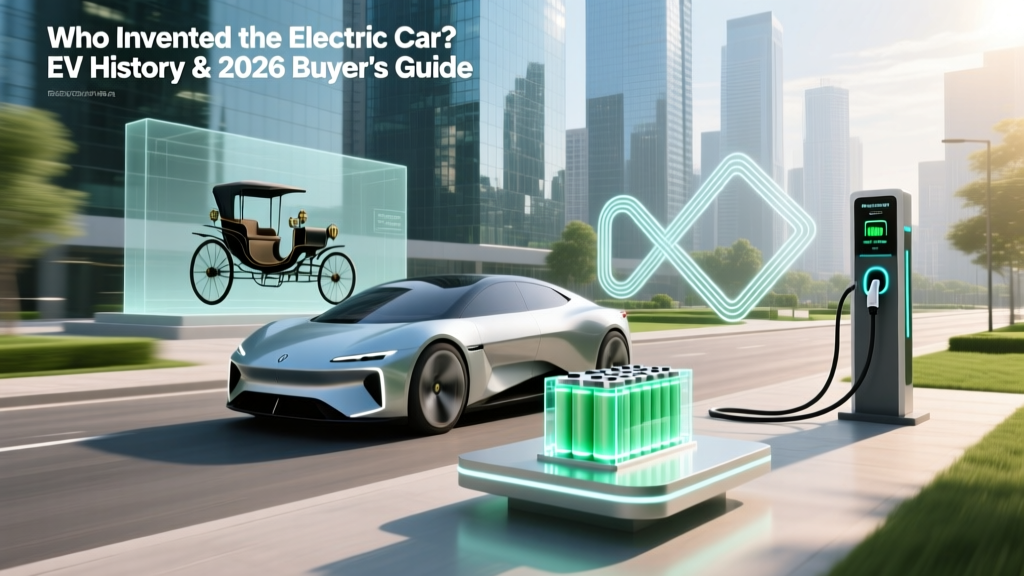
Quick Answer: Who Invented the Electric Car?
The electric car wasn't invented by a single person. Scottish inventor Robert Anderson built the first crude electric carriage between 1832 and 1839. Practical electric vehicles emerged in the 1880s–1890s through the work of Thomas Parker (UK, 1884), William Morrison (US, 1890), and others. By 1900, electric cars made up roughly a third of all automobiles on American roads before gasoline engines and cheap oil sidelined them for decades. The modern EV era restarted with the Tesla Roadster in 2008 and accelerated with mass-market models like the Nissan Leaf (2010) and Chevrolet Bolt (2017).
If you landed here wondering about the history of the electric car, you're probably weighing whether to buy one today. This guide connects the 190-year arc of EV development to the concrete numbers that matter in 2026: EPA range, charging speeds, real-world costs, and how modern EVs stack up against gas and hybrid alternatives.
From Robert Anderson to 2026: A Brief Timeline of EV Innovation
Understanding where EVs came from helps explain why today's lithium-ion battery packs and DC fast-charging networks are such a departure from earlier attempts.
- 1832–1839: Robert Anderson (Scotland) demonstrates a non-rechargeable electric carriage.
- 1884: Thomas Parker (London) builds a practical electric car using rechargeable batteries.
- 1890: William Morrison (Iowa) creates the first successful US electric vehicle — a six-passenger wagon capable of 14 mph.
- 1900: EVs account for ~28% of all US car production (source: U.S. Department of Energy). They are quiet, clean, and popular in cities.
- 1908–1920s: Ford's Model T and the expansion of gasoline infrastructure push EVs into obsolescence.
- 1996: GM launches the EV1, a modern battery-electric car later discontinued and crushed.
- 2008: Tesla Roadster debuts with a 244-mile EPA range on lithium-ion cells, reigniting serious EV development.
- 2010: Nissan Leaf and Chevrolet Volt launch — the Leaf becomes the first mass-market global BEV.
- 2026: Over 40 million EVs are on roads worldwide. Models like the Hyundai Ioniq 5, Tesla Model Y, and Chevrolet Equinox EV offer 300+ miles of range, 10–80% DC fast charging in under 20 minutes, and MSRPs starting below $35,000 after incentives.
What took nearly two centuries to mature now compresses into a single ownership decision. Let's look at the numbers.
2026 EV Ownership: What First-Time Buyers Need to Know
Today's EVs are fundamentally different from the limited-range compliance cars of the 2010s. Here's what a first-time buyer should anchor on:
- Battery capacity (kWh): This is the energy stored — think of it as the "fuel tank." A 2026 Hyundai Ioniq 5 carries a 77.4 kWh usable battery (NMC chemistry).
- Charging power (kW): This is the rate of energy delivery — the "hose size." Peak DC fast charging on the Ioniq 5 reaches 240 kW on an 800V architecture.
- Real-world range vs. EPA: The EPA rates the 2026 Ioniq 5 at 310 miles. Expect ~250–270 miles on sustained highway driving, and as low as 220 miles in sub-freezing temperatures. Cold weather slows electrochemical reactions and draws energy for cabin heating.
- 10–80% charge time: Approximately 18 minutes at a 250+ kW charger. Charging slows significantly above 80% to protect the battery — a full 10–100% session takes closer to 35 minutes.
- Home charging: A Level 2 home charger (typically 7.7–11.5 kW on a 240V circuit) adds 25–40 miles of range per hour and fully recharges most EVs overnight.
The single biggest ownership differentiator is home charging access. If you can install a Level 2 charger, daily EV ownership is nearly frictionless — you wake up with a full battery every morning. If you rely solely on public charging, costs rise and convenience drops.
EV vs. Gas vs. Hybrid: 2026 Cost Comparison
Let's compare three representative 2026 vehicles over a 5-year ownership period at 15,000 miles/year:
| Category | 2026 Hyundai Ioniq 5 SEL (BEV) | 2026 Toyota Camry LE (Gas) | 2026 Toyota RAV4 Prime (PHEV) |
|---|---|---|---|
| Base MSRP | $44,900 | $30,500 | $44,500 |
| Fed. Tax Credit (§30D) | Up to $7,500* | $0 | Up to $7,500* |
| Effective Starting Price | ~$37,400 | $30,500 | ~$37,000 |
| EPA Efficiency | 114 MPGe / 30 kWh/100mi | 32 MPG combined | 94 MPGe (EV) / 38 MPG (gas) |
| 5-Year Energy Cost (75k mi) | ~$3,750 (home charging at $0.14/kWh) | ~$9,375 ($3.50/gal avg) | ~$4,800 (mix of electric & gas) |
| 5-Year Maintenance | ~$1,500 | ~$3,500 | ~$3,000 |
| EPA Range / EV-Only Range | 310 mi | ~480 mi (15.8 gal tank) | 42 mi EV / 600+ mi total |
| Battery Warranty | 10 yr / 100,000 mi | N/A | 10 yr / 150,000 mi |
*Federal EV tax credit eligibility under IRS §30D depends on buyer income caps ($150K single / $300K joint), vehicle MSRP caps ($55K cars / $80K SUVs), and battery-critical-mineral sourcing requirements. Check current rules at irs.gov before purchasing.
The BEV wins on energy and maintenance costs but carries a higher sticker and demands charging access. The PHEV splits the difference — 42 miles of electric commuting with a gas backup for road trips. The gas car is cheapest upfront but costs the most to operate long-term.
Breaking Down the Real Costs: Purchase, Charging, Insurance & Maintenance
EV ownership economics extend beyond MSRP. Here's where the money actually goes:
Purchase Price & Incentives
The 2026 EV market spans from the ~$29,000 Nissan Leaf S (149-mile range) to the ~$90,000+ BMW iX M60. The sweet spot for most buyers falls between $35,000 and $50,000, where models like the Chevrolet Equinox EV (315 mi EPA, starting ~$34,900 after credit) and Tesla Model Y (310 mi, ~$44,990 before credit) compete. Many states offer additional rebates — California's CVRP provides up to $7,000 for income-qualified buyers, for example — but verify local programs through official state resources.
Charging Costs: Home vs. Public
- Home Level 2 (avg. $0.14/kWh): ~$0.04–0.05 per mile. A full 77 kWh charge costs roughly $10.80.
- Public DC fast charging (avg. $0.35–0.50/kWh): ~$0.10–0.15 per mile. Comparable to or slightly above gas on a per-mile basis.
- Public Level 2 networks (avg. $0.20–0.30/kWh): ~$0.06–0.09 per mile.
Bottom line: home charging makes EVs dramatically cheaper to fuel. Exclusive reliance on public DC fast charging erodes most of the cost advantage.
Insurance
EV insurance premiums average 15–25% higher than equivalent gas vehicles, primarily due to higher repair costs for battery packs and specialized body structures. A 2026 Model Y might cost $2,200–$2,800/year to insure versus $1,600–$2,100 for a comparable gas crossover. Get quotes before buying — the spread varies significantly by insurer and state.
Maintenance
This is where EVs shine. No oil changes, no transmission fluid, no spark plugs, no exhaust system. Brake pads last significantly longer thanks to regenerative braking (often 100,000+ miles). Expect to spend on tire rotation, cabin air filters, windshield washer fluid, and wiper blades. Annual maintenance averages $300–$400 versus $700–$900 for a gas car.
Common EV Myths vs. Facts
| Myth | Fact (with data) |
|---|---|
| "EVs don't have enough range." | Multiple 2026 models exceed 300 miles EPA. The Lucid Air Grand Touring reaches 516 miles. For context, the average American drives 39 miles/day (FHWA). |
| "Batteries need replacing every few years." | Modern NMC and LFP batteries are engineered for 200,000+ miles with <10% degradation. Federal law mandates 8-year/100,000-mile battery warranties. Many EVs show 90%+ State of Health (SoH) at 150,000 miles. |
| "EVs are worse in cold weather." | Range loss is real — expect 15–30% reduction in sub-freezing temps — but preconditioning (warming the battery while plugged in) and heat pumps (standard on many 2026 models) significantly mitigate this. EVs also start instantly in cold, unlike gas engines. |
| "The grid can't handle EVs." | Most EV charging happens overnight during off-peak hours. A 2026 study by the National Renewable Energy Laboratory found that projected 2030 EV adoption requires ~5–10% additional grid capacity, manageable with smart charging and infrastructure investment. |
| "Charging takes too long." | At a 250 kW DC fast charger, a 2026 Ioniq 5 goes from 10–80% in ~18 minutes. That's a rest stop, not a roadblock. And 80%+ of charging happens at home while you sleep. |
Decision Framework: Which Electrified Vehicle Fits Your Life?
Choose a BEV (battery-electric vehicle) if:
- You have home charging access (garage, driveway, or landlord-approved outlet)
- Your daily commute is under 100 miles round-trip
- You want the lowest per-mile operating cost and minimal maintenance
- You take road trips fewer than 6–8 times per year (or are willing to plan DC fast-charging stops)
Choose a PHEV (plug-in hybrid) if:
- You can charge at home but also take frequent long road trips
- You want electric commuting (25–45 miles) with gas-engine flexibility
- You live in an area with sparse public charging infrastructure
- You're not ready to fully commit to battery-electric but want to reduce fuel use
Choose a conventional HEV (hybrid, non-plug-in) if:
- You have no access to any charging (apartment, street parking)
- You want better fuel economy without changing your fueling habits
- You drive high miles and want proven, low-complexity technology
Stick with gas for now if:
- You tow heavy loads frequently (trailers over 5,000 lbs — EV towing cuts range 30–50%)
- You live in a rural charging desert and cannot install home charging
- Your budget is strictly under $25,000 and you need a new vehicle (the used EV market is more viable here)
Frequently Asked Questions
Was Tesla the first electric car company?
No. Tesla (founded 2003) popularized the modern long-range EV with the 2008 Roadster, but electric vehicles predate Tesla by over 170 years. Companies like Detroit Electric, Baker Electric, and Columbia produced thousands of EVs in the early 1900s. GM's EV1 (1996) was also a significant precursor to Tesla's market entry.
Why did electric cars disappear for nearly a century?
Three factors converged: Henry Ford's mass-produced Model T (1908) made gas cars affordable, the discovery of cheap Texas crude oil lowered fuel costs, and the electric starter (1912) eliminated the dangerous hand-crank that had been a major advantage for EVs. By the 1930s, electric cars were essentially extinct from the consumer market.
What's the cheapest EV I can buy new in 2026?
The 2026 Nissan Leaf S starts at approximately $28,140 (before incentives), offering 149 miles of EPA range. The Chevrolet Equinox EV 2LT starts around $33,600 with 315 miles of range. After the §30D federal credit (if eligible), effective prices can drop significantly. Check current eligibility requirements at fueleconomy.gov.
How long do EV batteries actually last?
Data from fleet operators and long-term owners shows most modern NMC and LFP batteries retain 88–95% of their original capacity after 100,000 miles. Full battery replacement is rare and typically costs $5,000–$15,000 depending on the vehicle, but most owners will sell or trade the car before needing one. Federal warranty requirements mandate coverage for at least 8 years / 100,000 miles with a minimum 70% capacity retention threshold.
Do I need to upgrade my electrical panel for a home charger?
Possibly. A Level 2 charger typically requires a 240V, 40–60 amp dedicated circuit. If your home's electrical panel is already near capacity (common in older homes with 100A service), a panel upgrade to 200A may be necessary — adding $1,500–$3,000 to installation costs. Always consult a licensed electrician for a site-specific assessment before purchasing equipment.
Are EVs really better for the environment?
Over their lifetime, yes — even accounting for battery manufacturing emissions and grid electricity sources. The Union of Concerned Scientists has consistently found that EVs produce fewer greenhouse gas emissions than comparable gas cars in every US region, including coal-heavy grids. As the grid decarbonizes, that advantage grows. However, it's honest to acknowledge that EV manufacturing (especially battery production) has a higher initial carbon footprint than building a gas car — the "break-even" point typically arrives between 20,000 and 40,000 miles of driving.
The Bottom Line: 190 Years of Progress, One Decision Ahead
From Robert Anderson's non-rechargeable carriage in 1832 to a 2026 Ioniq 5 that adds 200 miles of range during a 20-minute rest stop, the electric car's arc has been long but accelerating. Today's EVs are faster, cheaper to operate, and more practical than at any point in their history — but they still require honest assessment of your charging access, driving patterns, and budget.
Use the decision framework above, pull real numbers for your specific commute and electricity rate, and test-drive at least two models back-to-back. The right electrified vehicle in 2026 is the one that fits your life — not the one that generates the most hype.