Who Builds Rivian? The Short Answer
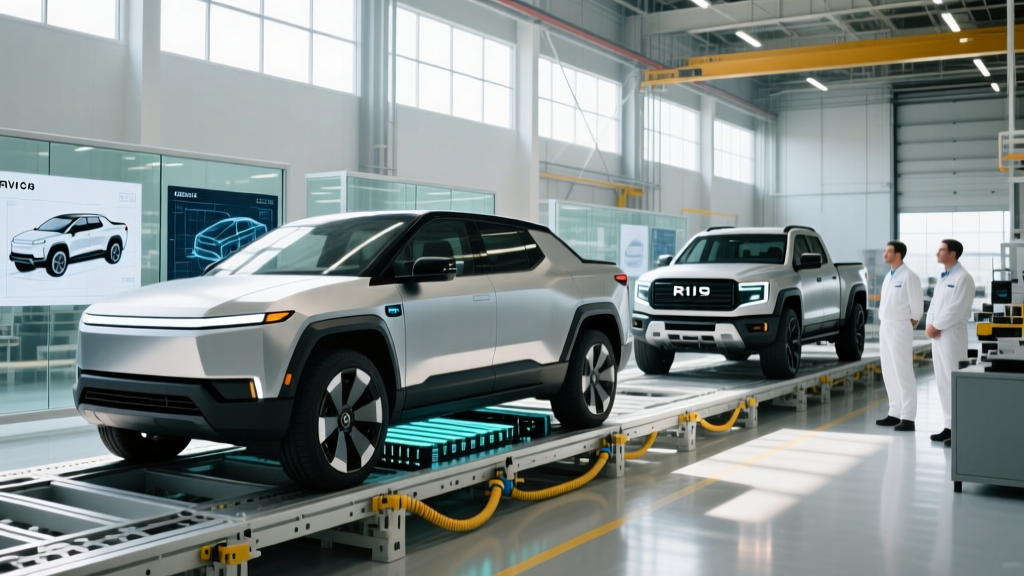
Rivian vehicles are built by Rivian Automotive, Inc., an American electric-vehicle manufacturer headquartered in Irvine, California. All production takes place at a single, company-owned assembly plant in Normal, Illinois — a 3.3-million-square-foot facility originally constructed for Mitsubishi/Diamond-Star Motors in the 1980s and purchased by Rivian in 2017. Unlike startups that outsource manufacturing (Fisker's Magna-Steyr deal, early Canoo plans), Rivian vertically integrates stamping, body-in-white, paint, battery-pack assembly, and final vehicle assembly under one roof.
The company was founded in 2009 by MIT-trained engineer RJ Scaringe under the name Mainstream Motors, later Avenir Automotive, before settling on Rivian. It went public in November 2021 (NASDAQ: RIVN) and remains majority-influenced by Amazon, which holds a significant stake and is also Rivian's largest commercial customer for the EDV (Electric Delivery Van).
Where Exactly Are Rivians Made?
The Normal, Illinois plant sits on a 264-acre campus roughly 130 miles southwest of Chicago. As of the 2026 model year, it produces four consumer vehicles:
- R1S — three-row electric SUV (competes with Tesla Model X, Kia EV9)
- R1T — four-door electric pickup (competes with Ford F-150 Lightning, Chevrolet Silverado EV)
- R2 — midsize crossover (production began 2026, sharing the Normal plant before a dedicated Georgia facility comes online)
- EDV — commercial delivery van built exclusively for Amazon and other fleet customers
Rivian's second consumer plant, a $5 billion facility in Stanton, Georgia, broke ground in 2024 and is slated to begin R2 production at scale by late 2026/early 2027. Until then, every Rivian you can buy rolls out of Normal.
2026 Rivian Lineup: Specs, Range, and Pricing
Below is a consolidated look at the consumer models you can order today. Battery chemistry varies by pack: the Standard pack uses LFP (lithium iron phosphate) cells, while the Large and Max packs use NMC (nickel manganese cobalt) from suppliers including Samsung SDI and LG Energy Solution.
| Model / Pack | Battery (usable kWh) | Chemistry | EPA Range (mi) | MPGe (city/hwy) | 0-60 mph | Drivetrain | Base MSRP |
|---|---|---|---|---|---|---|---|
| R1S Standard | ~92 kWh | LFP | 270 | 139 / 115 | 6.0 s | Dual-Motor AWD | $75,900 |
| R1S Large | ~128 kWh | NMC | 352 | 138 / 113 | 4.5 s | Dual-Motor AWD | $84,400 |
| R1S Max | ~149 kWh | NMC | 410 | 132 / 108 | 3.4 s | Tri-Motor AWD | $99,900 |
| R1T Standard | ~92 kWh | LFP | 270 | 137 / 112 | 6.0 s | Dual-Motor AWD | $69,900 |
| R1T Large | ~128 kWh | NMC | 352 | 135 / 110 | 4.5 s | Dual-Motor AWD | $78,400 |
| R1T Max | ~149 kWh | NMC | 420 | 130 / 106 | 3.4 s | Tri-Motor AWD | $93,900 |
Sources: fueleconomy.gov, Rivian spec sheets. MSRP excludes $1,800 destination. Tri-Motor R1S/R1T produce up to 850 hp.
Real-World Range: What the EPA Sticker Doesn't Tell You
EPA Sticker: R1T Large Pack = 352 miles
Real-World Expectation: ~285–310 miles highway (70–75 mph), ~240–260 miles highway in sub-freezing weather, ~330+ miles mixed city driving with regen.
Rivian's boxy, truck/SUV aerodynamics (Cd ≈ 0.30–0.34) punish highway efficiency more than a sleeker sedan like the Lucid Air or Tesla Model S. In our experience and consistent with third-party testing, expect a 10–15% reduction from EPA on sustained highway trips, and a 20–30% reduction when combining highway speeds with sub-32°F temperatures — even with the heat pump Rivian added for 2025+. The LFP Standard pack is the most range-sensitive to cold, losing more capacity temporarily than NMC at very low State of Charge in freezing conditions.
For R1T owners who tow, plan on 150–200 miles of effective range when pulling a 5,000-lb trailer — Rivian's 11,000-lb max tow rating (R1T) is mechanically impressive but range-punishing.
Charging Speed: DC Fast, Home Level 2, and the Curve
| Charging Level | Standard (LFP) | Large (NMC) | Max (NMC) |
|---|---|---|---|
| DC Fast Peak kW | 200 kW | 220 kW | 220 kW |
| 10–80% DC Time | ~30 min | ~30 min | ~36 min |
| Level 2 Home (kW) | 11.5 kW | 11.5 kW | 11.5 kW |
| Level 2 Miles/Hr | ~25 mi/hr | ~25 mi/hr | ~25 mi/hr |
| Level 1 (120V) | ~3 mi/hr | ~3 mi/hr | ~3 mi/hr |
Rivian uses the NACS (Tesla-style) connector natively on 2025+ models, granting direct access to Tesla Superchargers without an adapter — a major practical advantage over CCS-only trucks like the F-150 Lightning. Peak DC rates of 200–220 kW are strong but not class-leading (Hyundai Ioniq 5 peaks at 240 kW; Lucid Air at 300 kW). The Max pack's 149 kWh capacity means 10–80% takes longer in absolute time despite similar peak power.
Charge-curve reality: Rivian holds peak kW from roughly 10–40% SoC, then tapers progressively. Above 80%, rates drop to ~50 kW, which is why road-trip strategy should target 10–80% hops rather than topping off. Battery preconditioning engages automatically when you navigate to a charger in the infotainment system — skip it and you'll see 80–120 kW peaks instead of 200+.
Tax Credits, Pricing, and What You Actually Pay
Federal EV tax credit eligibility for Rivian is nuanced and changes with IRS sourcing rules. Under IRS §30D, the key 2026 constraints are:
- MSRP cap: SUVs/pickups must sticker ≤ $80,000 (vans/cars ≤ $55,000)
- Buyer income cap: MAGI ≤ $150,000 single / $300,000 married filing jointly
- Battery sourcing: Critical minerals and battery components must meet phased-in thresholds from FTA-partner countries — a moving target annually
- Point-of-sale transfer: Eligible buyers can apply the credit at purchase, reducing the out-of-pocket price
| Trim | MSRP (+ dest.) | Under $80K Cap? | Est. After $7,500 Credit* |
|---|---|---|---|
| R1T Standard Dual-Motor | $71,700 | Yes | ~$64,200 |
| R1S Standard Dual-Motor | $77,700 | Yes | ~$70,200 |
| R1T Large Dual-Motor | $80,200 | Borderline | Depends on options |
| R1S Large / Max | $86,200–$101,700 | No | Full MSRP |
| R1T Max Tri-Motor | $95,700 | No | Full MSRP |
*Credit eligibility depends on buyer income, battery-sourcing compliance for the build month, and MSRP after destination but before most options. Verify with a tax professional and the IRS Clean Vehicle report at the point of sale.
Warranty, Ownership Costs, and Reliability
Rivian's warranty package is competitive with legacy automakers and slightly more generous than Tesla:
- Battery & Drive Unit: 8 years / 175,000 miles, with ≥70% capacity retention guaranteed
- Bumper-to-Bumper: 5 years / 60,000 miles
- Corrosion: 5 years / unlimited miles
The 175,000-mile battery warranty is one of the longest in the segment (Tesla is 8yr/120K for Model S/X, 8yr/100K for Model Y; Ford is 8yr/100K). Early R1T/R1S builds (2022–2023) had teething issues with software, suspension bushings, and panel gaps, but 2025+ builds have shown markedly improved fit and finish based on owner forums and service-bulletin frequency.
Insurance costs run 15–25% higher than comparable gas trucks, reflecting repair complexity and parts pricing. Depreciation has been steeper than the F-150 Lightning in the used market, partly due to early-adopter pricing and rapid MSRP cuts Rivian implemented in 2024.
Tech, Interior, and What Sets Rivian Apart
Rivian's software stack is proprietary and frequently updated OTA. Highlights include:
- Rivian Waypoints: Built-in adventure route planner with campsite overlays and elevation-aware range estimation
- Driver+ (Level 2 ADAS): Hands-on-wheel highway assist with auto lane change — competent but a generation behind Tesla FSD Supervised and GM Super Cruise in hands-free miles
- Gear Tunnel (R1T only): 11 cu ft lockable pass-through storage between cab and bed — unique in the truck segment
- Camp Kitchen (option): Slide-out induction kitchen integrated into the Gear Tunnel
- Powered tonneau + frunk: R1T's 11 cu ft front trunk and powered bed cover are class-leading
Interior space is generous: R1S offers three rows with 34.5/36.5/30.0 inches of legroom and up to 104 cu ft of cargo with both rear rows folded. R1T has a 54-inch bed (shorter than a full-size F-150's 66-inch) but compensates with the Gear Tunnel and frunk.
Who Should Buy a Rivian (and Who Shouldn't)
Pros
- Class-leading off-road capability (8.9–14.9 in. ground clearance, quad-motor tank turns on Max)
- Native NACS = direct Supercharger access
- Gear Tunnel and camp-ready options have no truck equivalent
- 8yr/175K battery warranty
- Strong OTA update cadence
Cons
- Highway range drops noticeably vs EPA at 75+ mph
- Driver+ ADAS lags Tesla FSD / GM Super Cruise
- Towing crushes range (150–200 mi with 5K trailer)
- Service centers still sparse in Mountain West and rural South
- Most trims exceed $80K MSRP cap, disqualifying from federal credit
Best for: Adventure-oriented families, outdoorsy truck buyers who value storage innovation over maximum bed length, and buyers in states with Rivian service coverage who want a single-plant American-built EV.
Look elsewhere if: You need max towing range (Silverado EV or F-150 Lightning Extended), hands-free Level 2+ highway driving (GM Super Cruise), or the lowest possible cost per mile (Hyundai Ioniq 5, Tesla Model Y).
FAQ: Rivian Build & Ownership Questions
Is Rivian made in China?
No. Every Rivian consumer vehicle is assembled in Normal, Illinois, USA. Some battery cells have historically been sourced from Samsung SDI (South Korea) and LG Energy Solution (South Korea/US plants), not Chinese suppliers, which helps with §30D tax-credit critical-mineral compliance.
Does Rivian qualify for the $7,500 federal tax credit?
It depends on trim and buyer. The R1T Standard ($71,700) and R1S Standard ($77,700) fall under the $80,000 SUV/pickup MSRP cap and can qualify if the buyer's MAGI is within limits and the battery's critical-mineral/component sourcing meets that build month's IRS threshold. Higher trims generally exceed the cap. Always confirm via the IRS Clean Vehicle report at the point of sale.
How does Rivian compare to Tesla on reliability?
Early Rivian builds (2022–2023) had more reported issues than mature Tesla models, but 2025+ Rivian quality has improved. Tesla benefits from years of high-volume iteration; Rivian benefits from over-engineered mechanicals and a longer battery warranty (175K vs 120K miles on Model S/X). J.D. Power and Consumer Reports data for 2025 model year show both brands in the middle-to-lower tier for initial quality, typical for complex EVs.
Can I charge a Rivian at Tesla Superchargers?
Yes — 2025 and newer Rivians ship with a native NACS port. Model-year 2022–2024 Rivians with CCS ports can use Tesla Superchargers via the official Rivian NACS adapter (included or available through Rivian). No other adapter is needed.
Who owns Rivian?
Rivian is a publicly traded company (NASDAQ: RIVN). Largest shareholders include Amazon (~17% stake), T. Rowe Price, Vanguard, and BlackRock. Founder RJ Scaringe retains significant voting control via super-voting shares. Volkswagen previously held a large stake and invested ~$2.7B but fully divested by 2024.