Why the White-on-White Tesla Model Y Dominates Order Sheets
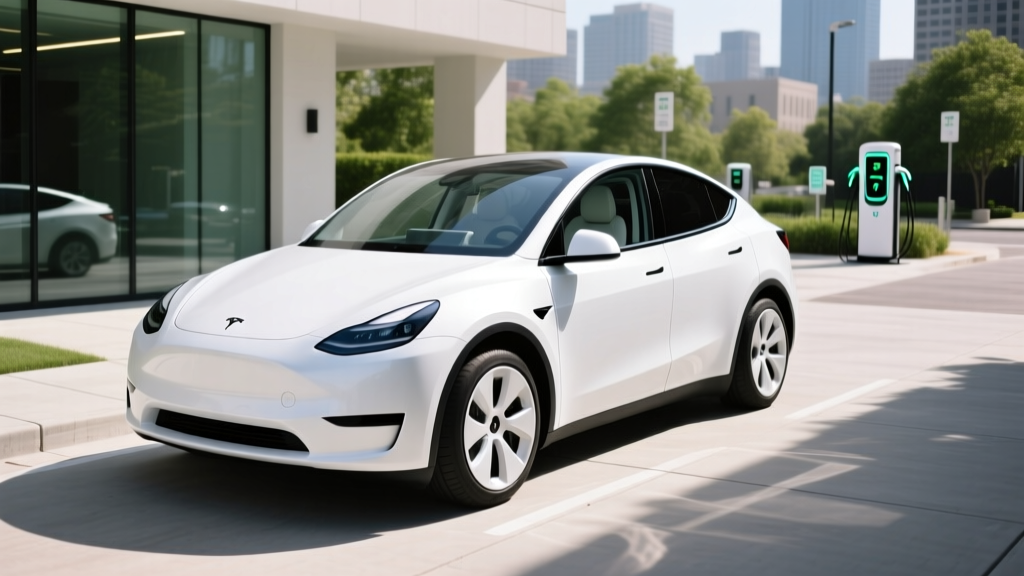
Scroll through any Tesla delivery lot or EV enthusiast forum and one configuration appears with striking frequency: a Pearl White Multi-Coat exterior paired with the optional White & Black premium interior. The "white Tesla with white interior" look has become something of a cultural signature for the brand — clean, minimalist, and photogenic. But beyond aesthetics, does this configuration hold up where it matters for daily ownership?
This review covers the 2026 Tesla Model Y Long Range AWD — the volume-selling variant that balances range, performance, and price. We break down the exact EPA range, real-world efficiency, charging speeds, pricing after federal tax credits, and whether the white interior is worth the $1,000 upcharge over the standard black cabin.
| Spec | Value |
|---|---|
| EPA Range | 320 miles |
| Battery (usable) | ~75 kWh, NMC chemistry |
| Drivetrain | Dual-motor AWD |
| Horsepower | 384 hp (combined) |
| 0–60 mph | 4.8 seconds |
| Peak DC Fast Charge | 250 kW (Supercharger V3) |
| 10–80% DC Charge Time | ~27 minutes |
| Level 2 Home Charge Rate | 11.5 kW (~44 mi/hr) |
| MPGe (combined) | 122 MPGe |
| Efficiency | 28 kWh/100 mi |
| Cargo (rear seats up) | 30.2 cu ft |
| Cargo (rear seats folded) | 72.0 cu ft |
| Base MSRP | $44,990 |
| Battery Warranty | 8 years / 120,000 miles |
EPA Range vs. Real-World Miles: What You'll Actually Get
The 2026 Model Y Long Range AWD carries an EPA-estimated 320 miles of range. That figure comes from the updated Juniper-generation platform, which improved aerodynamic efficiency and thermal management over the pre-2025 model. But EPA numbers assume a mix of city and highway driving at moderate temperatures — conditions rarely sustained for an entire charge cycle.
- EPA sticker: 320 miles
- Mixed city/highway (65–75°F): ~285–305 miles
- Sustained highway (75 mph, 85°F): ~265–280 miles
- Cold weather (30°F, highway): ~225–250 miles (heat pump mitigates but doesn't eliminate loss)
- Worst case (15°F, mountain pass, loaded): ~200–220 miles
Source: fueleconomy.gov, real-world owner data aggregated from TeslaFi and Recurrent Auto.
The Model Y's heat pump — standard since the 2021 refresh — is one of the best in the segment at preserving range in cold weather. Where competitors without heat pumps can lose 35–40% of range at freezing temperatures, the Model Y typically loses 20–25%. That's still a meaningful reduction on a 300-mile road trip in January, so plan charging stops accordingly.
For daily commuting with home charging, the 320-mile EPA figure is more than sufficient for most drivers. The average American drives 37 miles per day, meaning most owners will charge at home every 5–7 days and rarely touch public charging infrastructure except on road trips.
Charging Speed: Supercharger Network Advantage
Charging speed remains one of Tesla's strongest competitive advantages, and not just because of the vehicle hardware. The Supercharger network's reliability and density mean the Model Y's 250 kW peak charge rate is actually achievable at thousands of locations nationwide — not just in laboratory conditions.
| Charge Level | Power | Speed (mi/hr) | Use Case |
|---|---|---|---|
| Level 1 (120V household) | ~1.4 kW | ~5 mi/hr | Emergency / overnight trickle |
| Level 2 (240V, 48A Wall Connector) | 11.5 kW | ~44 mi/hr | Daily home charging (full in ~7 hrs) |
| DC Fast (Supercharger V3) | 250 kW peak | ~162 mi in 15 min | Road trips; 10–80% in ~27 min |
| DC Fast (Supercharger V4) | Up to 250 kW | Similar to V3 | Newer stations with cable management |
Understanding the charge curve: The Model Y does not sustain 250 kW for the entire session. Peak power is available roughly between 10–30% state of charge (SoC). From 30–60%, the rate tapers to approximately 150–180 kW. Above 80%, it drops sharply to protect the NMC battery, often falling below 50 kW. This is why Tesla (and every EV manufacturer) quotes 10–80% times rather than 0–100%. Charging from 80–100% at a Supercharger can add another 25–30 minutes — plan accordingly on road trips and charge only to 80% unless you need the full battery.
For home charging, the Tesla Wall Connector at 48 amps on a 60-amp circuit delivers 11.5 kW. That translates to roughly 44 miles of range per hour, or a full charge from 10% in about 7 hours. Most owners plug in each evening and wake up with a full battery. Installation costs for a 240V/60A circuit typically range from $500 to $2,000 depending on panel proximity and local permitting — always get a quote from a licensed electrician before purchasing equipment.
With the 2026 Model Y's NACS (North American Charging Standard) port, you also gain native access to the growing number of non-Tesla networks adopting the connector, plus CCS adapters are no longer necessary at Electrify America and other legacy CCS stations that have begun adding NACS cables.
Performance, Efficiency, and Daily Drivability
The Long Range AWD pairs a permanent-magnet motor on the rear axle with an induction motor up front. Combined output is 384 horsepower, delivering a 4.8-second 0–60 mph time. That's quick by any measure, but the more relevant everyday metric is the instant torque delivery from a stop — the Model Y pulls away from intersections with authority that makes merging and passing effortless.
Efficiency is rated at 122 MPGe combined (28 kWh per 100 miles) per the EPA. In practice, expect 26–30 kWh/100mi depending on driving style and conditions. Aggressive acceleration and sustained 80+ mph highway speeds push consumption toward the upper end; gentle city driving with regen braking set to "Standard" can dip below 25 kWh/100mi.
The Juniper generation also improved ride quality with revised suspension tuning and additional sound insulation. Road noise is noticeably lower than the pre-2025 Model Y, and the ride over broken pavement is more composed — though it still leans slightly firm compared to a Hyundai Ioniq 5 or Ford Mustang Mach-E.
Pricing, Tax Credits, and the White Interior Upcharge
The 2026 Model Y Long Range AWD starts at $44,990 (including destination). The Pearl White Multi-Coat paint is a $1,500 option, and the White & Black premium interior adds $1,000. That puts a white-on-white Model Y LR AWD at approximately $47,490 before incentives.
| Item | Cost |
|---|---|
| Base MSRP (LR AWD) | $44,990 |
| Pearl White Multi-Coat paint | +$1,500 |
| White & Black premium interior | +$1,000 |
| Destination fee | Included |
| As-configured MSRP | $47,490 |
| Federal §30D tax credit (if eligible) | Up to −$7,500 |
| Effective price (with full credit) | ~$39,990 |
Federal tax credit eligibility is not automatic. Under current IRS §30D rules, the $7,500 credit requires meeting several conditions simultaneously:
- MSRP cap: SUVs/vans must be ≤$80,000 — the Model Y qualifies at all trims.
- Buyer income cap: Modified AGI ≤$150,000 (single), ≤$300,000 (joint), ≤$225,000 (head of household).
- Battery sourcing: A percentage of critical minerals and battery components must be sourced from the US or free-trade-agreement countries. These thresholds increase annually. Check the latest DOE/FuelEconomy eligible vehicle list for current Model Y qualification status, as supply chain changes can shift eligibility month to month.
- Point-of-sale transfer: As of 2024, you can transfer the credit to the dealer at purchase, reducing your out-of-pocket cost immediately rather than waiting for a tax refund.
- VIN verification: The dealer must verify the vehicle's VIN and battery sourcing at the time of sale through the IRS Energy Credits Online portal.
The white interior itself warrants a practical note. Tesla's White & Black premium seats use a vegan leather material that resists staining better than many expect — most spills wipe clean with a damp cloth. However, white seats do show denim dye transfer from new dark jeans, and the white dashboard trim can create glare in direct sunlight for some drivers. The aesthetic payoff is a cabin that feels significantly more open and airy than the black interior, especially paired with the panoramic glass roof.
Cargo Space, Passenger Room, and Practicality
The Model Y's crossover form factor is its practicality ace. With 30.2 cubic feet behind the rear seats and 72.0 cubic feet with them folded, it competes favorably with the Hyundai Ioniq 5 (27.2 / 59.3 cu ft) and the Ford Mustang Mach-E (29.7 / 60.4 cu ft). The rear hatch opening is wide and low, making it easy to load bulky items.
Front and rear legroom is generous: 41.8 inches up front and 37.4 inches in the rear. The flat floor (no transmission tunnel) means the middle rear seat is genuinely usable for an adult on shorter trips, though the seat cushion is slightly narrower than the outboard positions.
The front trunk (frunk) adds additional storage for charging cables, a small bag, or groceries — a practical advantage the Mach-E also offers but the Ioniq 5 lacks.
Technology, Autopilot, and What It Can't Do
The Model Y's 15.4-inch center touchscreen runs Tesla's latest software, which includes navigation with real-time Supercharger routing, streaming media, a robust trip planner, and over-the-air updates that regularly add features. The Juniper refresh eliminated the turn signal stalk (signals are now on the steering wheel) and added rear-seat ventilation controls on a small rear display.
Standard Autopilot includes Traffic-Aware Cruise Control and Autosteer — a capable Level 2 system for highway driving. Full Self-Driving (Supervised) is available as a $8,000 option or $99/month subscription and adds automatic lane changes, Navigate on Autopilot, and city street driving assistance.
Both Autopilot and FSD (Supervised) are SAE Level 2 driver-assistance systems. The driver must remain attentive, keep hands on the steering wheel (or demonstrate attention via the cabin camera), and be prepared to take over immediately. These are not self-driving systems. Level 4 autonomous driving (no driver required) is currently available only in geofixed robotaxi services like Waymo in select cities. Never disengage your attention while using Autopilot or FSD.
Notable tech drawbacks: The Model Y still lacks Apple CarPlay and Android Auto — all navigation and media run through Tesla's proprietary system. While the built-in navigation is excellent, drivers who prefer Waze, Google Maps on their phone, or specific music apps will find this limiting. Bluetooth audio streaming works, but the integration isn't as seamless as CarPlay.
- Class-leading Supercharger network access
- 320-mile EPA range with strong real-world efficiency
- Excellent cargo space and practical crossover layout
- 250 kW DC fast charging; 10–80% in ~27 min
- Strong heat pump for cold-weather range retention
- OTA updates continuously improve the vehicle
- White interior creates an open, premium cabin feel
- No Apple CarPlay or Android Auto
- Stalkless turn signals require an adjustment period
- Ride quality firm on rough roads vs. some competitors
- FSD (Supervised) remains Level 2 despite the name
- Insurance costs run 15–25% higher than comparable ICE crossovers
- White interior shows denim dye transfer initially
Who the White-on-White Model Y Suits Best
- You want a daily-driver EV with road-trip capability and the most reliable public charging network available.
- You value cargo practicality and crossover ride height without stepping up to the larger, pricier Model X.
- You charge primarily at home and want to wake up to a full battery every morning.
- The minimalist, screen-centric interior appeals to you more than physical buttons and knobs.
- You want the airy, Instagram-worthy aesthetic that the white-on-white configuration delivers.
- You need Apple CarPlay/Android Auto (look at the Hyundai Ioniq 5 or Kia EV6).
- You prioritize a softer ride over sporty handling (Ford Mustang Mach-E or Ioniq 5).
- You want a traditional instrument cluster and physical controls.
- You need more than 320 miles of range for frequent long-distance routes without charging stops (consider the Lucid Air or upcoming higher-range options).
Frequently Asked Questions
What is the real-world range of the white Tesla Model Y?
The 2026 Model Y Long Range AWD is EPA-rated at 320 miles. In real-world mixed driving at moderate temperatures, expect 285–305 miles. Sustained highway driving at 75 mph drops that to roughly 265–280 miles, and cold-weather highway driving at 30°F or below typically yields 225–250 miles despite the standard heat pump.
How fast does the Model Y charge at home and on the road?
At home on a Level 2 Tesla Wall Connector (240V, 48A), the Model Y charges at 11.5 kW, adding approximately 44 miles of range per hour — a full charge from 10% takes about 7 hours. On a V3 Supercharger, it peaks at 250 kW and charges from 10–80% in roughly 27 minutes, though the rate tapers significantly above 80% SoC.
How much does a white Tesla with white interior cost after tax credits?
A 2026 Model Y LR AWD with Pearl White paint and the White & Black interior comes to $47,490 MSRP. If you meet all IRS §30D requirements (income cap, battery sourcing, MSRP cap), the federal credit can reduce the effective price to approximately $39,990 via point-of-sale transfer. State and utility incentives may reduce cost further — check your local programs.
Does the Model Y qualify for the $7,500 federal EV tax credit?
The Model Y qualifies on MSRP (under the $80,000 SUV cap) at all trims. However, full $7,500 credit eligibility depends on the buyer's income (≤$300K joint / ≤$150K single) and the battery's critical-mineral and component sourcing meeting current-year thresholds. These thresholds tighten annually. Verify current eligibility on irs.gov and the DOE's eligible vehicle list before purchase, as supply chain changes can affect qualification.
Is the white Tesla interior hard to keep clean?
Tesla's vegan leather seats resist most stains and wipe clean easily. The primary concern is denim dye transfer from new dark jeans, which can leave a faint blue tint on the seat bolsters over the first few weeks. Using a leather-safe protectant spray and avoiding brand-new dark denim for the first month mitigates this. The white dashboard trim is more resistant to marks but can create windshield glare in direct sunlight for some drivers.
Is the Model Y worth buying over the Hyundai Ioniq 5 or Ford Mach-E?
The Model Y wins on charging network access, software integration, and cargo volume. The Ioniq 5 offers a more comfortable ride, 800V architecture (faster peak charging on compatible stations), Apple CarPlay, and a more distinctive design. The Mach-E provides a more traditional driving feel and CarPlay support. If Supercharger access and Tesla's ecosystem matter to you, the Model Y remains the segment benchmark. If you value ride comfort and phone integration, test-drive the Ioniq 5 before committing.
What is the battery warranty on the 2026 Model Y?
Tesla covers the Model Y's battery and drive unit for 8 years or 120,000 miles, whichever comes first. The warranty guarantees at least 70% battery capacity retention over that period. If degradation drops below 70% within the warranty window, Tesla will repair or replace the battery at no cost. Real-world data from Recurrent Auto suggests most Tesla batteries retain 88–92% capacity at 100,000 miles under normal use.