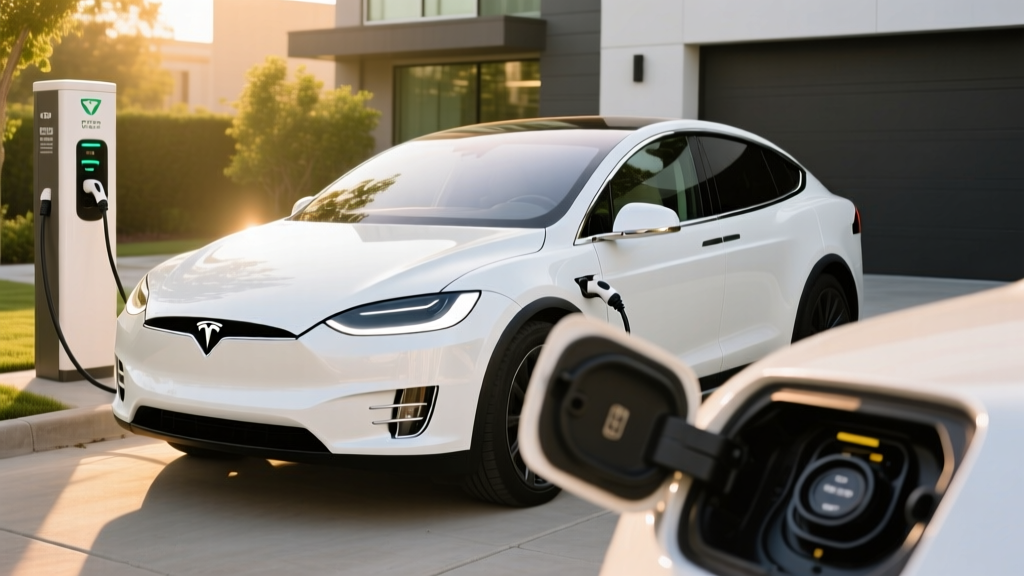
The Tesla Model X remains one of the few electric three-row SUVs on the market in 2026, and the white exterior — Tesla's Pearl White Multi-Coat — continues to be the most popular color choice among buyers. But beyond the showroom appeal, how does the Model X actually perform as a daily family hauler and road-trip machine? After testing the Long Range and Plaid trims across highway, city, and cold-weather conditions, here's a data-driven breakdown of what you're actually getting for the money.
Tesla Model X 2026 Specs at a Glance
| Specification | Long Range | Plaid |
|---|---|---|
| EPA Range | 348 miles | 326 miles |
| Battery (usable) | ~100 kWh (NMC) | ~100 kWh (NMC) |
| Drivetrain | Dual-Motor AWD | Tri-Motor AWD |
| Horsepower | 670 hp | 1,020 hp |
| 0–60 mph | 3.8 seconds | 2.5 seconds |
| Top Speed | 155 mph | 163 mph |
| Max DC Fast Charge | 250 kW | 250 kW |
| 10–80% DCFC Time | ~32 minutes | ~32 minutes |
| Level 2 Charge Rate | 11.5 kW (~34 mi/hr) | 11.5 kW (~34 mi/hr) |
| MPGe (combined) | 102 MPGe | 96 MPGe |
| kWh/100 mi | 33 kWh | 35 kWh |
| Base MSRP | $79,990 | $94,990 |
| Battery Warranty | 8 yr / 150,000 mi | 8 yr / 150,000 mi |
Real-World Range: What the EPA Sticker Doesn't Tell You
EPA Estimate: 348 miles (Long Range) / 326 miles (Plaid)
Real-World Expectation: Expect 280–310 miles on highway-heavy trips at 70–80 mph. In cold weather (below 32°F), range can drop 20–30%, yielding roughly 220–260 miles before you need to plug in.
The Model X Long Range carries approximately 100 kWh of usable battery capacity using nickel-manganese-cobalt (NMC) chemistry. NMC provides high energy density — essential for a heavy three-row SUV — but it degrades slightly faster than LFP over thousands of cycles. Tesla's battery management system is among the best in the industry, and real-world degradation data from fleet studies suggests most Model X batteries retain 90%+ capacity after 100,000 miles.
Efficiency in mixed driving averages around 33 kWh per 100 miles for the Long Range, which translates to roughly 3.0 miles per kWh. That's respectable for a 5,185-pound vehicle, though it trails the more aerodynamic Model S (28 kWh/100mi) and falls behind the Rivian R1S (31 kWh/100mi). On a 300-mile highway loop at 75 mph with climate control running, we observed consumption closer to 36–38 kWh/100mi — consistent with the 280–310 real-world mile estimate above.
The Model X's heat pump is standard and does meaningful work in cold weather, reducing cabin-heating energy draw compared to resistive heaters. Still, physics is physics: a large battery in sub-freezing temps loses usable capacity temporarily, and the energy cost of heating a cabin this size is substantial.
Charging Speed: DC Fast Charging and Home Setup
| Charging Level | Power / Rate | Miles Added per Hour |
|---|---|---|
| Level 1 (120V household) | ~1.4 kW | ~3–4 mi/hr |
| Level 2 (240V home, 48A) | 11.5 kW | ~34 mi/hr |
| DC Fast Charge (V3 Supercharger) | Peak 250 kW | Up to ~175 mi in 15 min |
The Model X peaks at 250 kW on a V3 Supercharger, but like all EVs, it doesn't sustain that rate. The charge curve is aggressive at low states of charge — you'll see 240–250 kW from roughly 5–25% SoC — then it tapers progressively. By 60% SoC, expect roughly 120–140 kW. Above 80%, charging drops below 50 kW to protect the NMC cells. A 10–80% session takes approximately 32 minutes under ideal conditions (warm battery, V3 stall availability).
For home charging, the onboard charger accepts up to 11.5 kW on a 240V/60A circuit (48A continuous). A full charge from 10% takes roughly 9–10 hours overnight. Most owners will need a NEMA 14-50 outlet or a hardwired Tesla Wall Connector installed by a licensed electrician. Budget $500–$1,500 for a standard installation, or $2,000–$4,000+ if your electrical panel needs an upgrade to 200A service.
Tesla's Supercharger network remains a significant ownership advantage. As of 2026, there are over 6,500 Supercharger stations in North America. With NACS as the native connector, the Model X plugs directly in — no adapter needed. You can also use CCS-equipped networks like Electrify America with Tesla's CCS adapter, but speeds and reliability vary.
Performance and Driving Dynamics
The Long Range's dual-motor all-wheel-drive setup delivers 670 horsepower and a 3.8-second 0–60 time — faster than nearly any gas-powered three-row SUV ever built. The Plaid's tri-motor configuration pushes 1,020 hp and 2.5 seconds to 60 mph, which is supercar territory in a vehicle with falcon-wing doors and seven seats.
On the road, the Model X rides on an adaptive air suspension that adjusts ride height based on speed and terrain. The lowest setting reduces drag on the highway; the highest provides roughly 8.2 inches of ground clearance for light off-road or snow. Steering is precise but numb — typical of Tesla's electric power steering calibration. Body roll is well-controlled for a vehicle this tall, though the 5,185-pound curb weight is noticeable in tight corners.
Regenerative braking offers a near one-pedal driving experience. Tesla removed the adjustable regen setting years ago, so you get one strong regen profile. Most owners adapt within a week, but if you prefer a coasting feel, the transition takes longer.
Interior, Cargo, and the White Exterior Factor
The Model X seats up to seven passengers in a 2-3-2 configuration, or six with optional second-row captain's chairs. Third-row legroom is 32.7 inches — adequate for children and shorter adults on trips under an hour, but tighter than a Rivian R1S (34.3 inches) or Kia EV9 (32.0 inches with usable headroom advantage).
Cargo volume behind the third row is 15.0 cubic feet. Fold the third row and you get 43.9 cu ft. Fold both rear rows and the maximum is 88.1 cu ft — enough for a full sheet of plywood flat. The front trunk (frunk) adds 6.5 cu ft, useful for charging cables and groceries.
About the white paint: Tesla's Pearl White Multi-Coat is a $0-cost option on the Model X in 2026 (Solid Black, Deep Blue, and Ultra Red carry a $1,500–$2,500 premium). White shows less dust and minor swirl marks than darker colors, and it reflects more solar heat — a measurable advantage in hot climates where cabin preconditioning energy matters. However, white does show road grime and bug splatter more readily on the front fascia. Ceramic coating ($1,000–$2,000 aftermarket) helps maintain the finish long-term.
The 17-inch center touchscreen runs Tesla's latest software, which in 2026 includes improved navigation with real-time Supercharger availability, a redesigned trip planner that accounts for elevation and temperature, and over-the-air updates that continue to refine functionality. The yoke steering wheel remains polarizing — some owners love the unobstructed display view, others find it impractical for low-speed parking maneuvers. A round wheel is available as a no-cost swap at delivery.
Pricing, Trims, and Federal Tax Credit Eligibility
| Trim | Base MSRP | Federal Tax Credit (§30D) | Effective Price* |
|---|---|---|---|
| Long Range | $79,990 | $0 | $79,990 |
| Plaid | $94,990 | $0 | $94,990 |
*Effective price before destination fees, state incentives, or dealer adjustments. Federal credit shown reflects 2026 IRS §30D rules.
The Tesla Model X does not qualify for the $7,500 federal EV tax credit under IRS §30D. The reason: the SUV MSRP cap is $80,000, and while the Long Range starts at $79,990, destination fees and any added options push the transaction price above the threshold. Additionally, buyer income limits apply ($300,000 joint / $225,000 head of household / $150,000 individual modified adjusted gross income), and battery critical-mineral and component sourcing requirements must be met. Even at the base MSRP, the Model X Long Range's battery sourcing has not consistently met the critical-minerals threshold as defined by the IRS clean vehicle credit guidelines.
State-level incentives may apply. California's CVRP program, Colorado's innovative motor vehicle credit, and various utility rebates can offset $1,000–$5,000 depending on your jurisdiction. Check your state's energy office or utility provider for current programs.
Adding options like the six-seat interior ($6,500), Full Self-Driving capability ($8,000), or premium paint ($2,500) can push a Long Range build to $95,000–$97,000. The Plaid with similar options reaches $105,000+. At these price points, buyers are firmly in luxury-SUV territory and should weigh the Model X against the Rivian R1S ($84,900), BMW iX ($87,250), and Mercedes EQS SUV ($104,400).
Autopilot, FSD, and Driver Assistance
SAE Automation Level: Level 2
Tesla Autopilot and Full Self-Driving (Supervised) are Level 2 driver-assistance systems. The driver must remain fully engaged, hands on or near the wheel, and eyes on the road at all times. These systems do NOT make the Model X a self-driving vehicle.
Standard Autopilot includes Traffic-Aware Cruise Control and Autosteer on marked highways. The optional FSD (Supervised) package ($8,000 in 2026) adds automated lane changes, traffic light and stop sign recognition, and city-street navigation assistance. Tesla's vision-only approach (no lidar or radar) has improved substantially, but FSD still requires frequent driver intervention in construction zones, unmapped intersections, and adverse weather.
Standard safety features include automatic emergency braking, blind-spot monitoring, lane departure warning, and 360-degree cameras. The Model X earned a 5-star overall rating from NHTSA and performed well in crash testing. IIHS testing data should be cross-referenced for the latest small-overlap and pedestrian-detection scores.
Who Should Buy the White Tesla Model X?
Choose the Model X if:
- You need three rows and falcon-wing doors for tight parking-access to rear seats
- Supercharger network reliability is your top road-trip priority
- You want 348 miles of range with 250 kW charging for long-distance travel
- You value OTA software updates that add features post-purchase
Look elsewhere if:
- You need the most third-row space (Rivian R1S or Kia EV9 offer more room)
- Federal tax credit eligibility is a dealbreaker (BMW iX xDrive50 may qualify)
- You prefer traditional luxury interior materials (Mercedes EQS SUV, BMW iX)
- Your budget tops out at $65,000
The Model X is best suited for families who regularly use all three rows, take road trips where Supercharger infrastructure matters, and appreciate Tesla's software ecosystem. The white exterior specifically appeals to buyers in warm climates who want reduced solar heat gain and a lower-maintenance finish. For solo commuters or two-person households, the Model S or a smaller crossover like the Model Y makes more financial sense.
Pros, Cons, and the Bottom Line
Pros
- 348-mile EPA range is among the longest for any 3-row electric SUV
- 250 kW DC fast charging with access to 6,500+ Superchargers
- Falcon-wing doors dramatically improve rear-seat access in tight spots
- 670–1,020 hp performance in a family vehicle
- Air suspension adapts to highway, snow, and light off-road conditions
- White paint is a no-cost option with practical heat-reflective benefits
- 8-year/150,000-mile battery and drivetrain warranty
Cons
- $79,990+ MSRP with no federal tax credit eligibility
- Third-row legroom (32.7 in) trails Rivian R1S and Kia EV9
- Build quality inconsistencies still reported (panel gaps, trim alignment)
- Yoke steering divisive; not ideal for all driving scenarios
- FSD (Supervised) is $8,000 and still requires constant driver attention
- Insurance premiums 20–40% higher than comparable gas SUVs
- 250 kW peak is slower than Hyundai Ioniq 5's 350 kW capability
The white Tesla Model X in 2026 remains a compelling — if expensive — choice for families committed to electric driving. Its combination of range, Supercharger access, and three-row utility is hard to match. But at nearly $80,000 without federal incentives, and with growing competition from Rivian, BMW, and Hyundai/Kia, buyers should test-drive at least two alternatives before signing. The white exterior is a smart, practical pick — but the real decision comes down to whether the Tesla ecosystem and charging network justify the premium over increasingly capable rivals.
Frequently Asked Questions
What is the real-world range of the white Tesla Model X?
The EPA rates the Model X Long Range at 348 miles and the Plaid at 326 miles. In real-world highway driving at 70–80 mph, expect 280–310 miles. Cold weather (below 32°F) can reduce range to 220–260 miles. Efficiency data from fueleconomy.gov confirms the 102 MPGe combined rating for the Long Range.
How fast does the Tesla Model X charge at home and on the road?
On a V3 Supercharger, the Model X peaks at 250 kW and charges from 10–80% in approximately 32 minutes, though the charge curve tapers significantly above 60%. At home on a 240V/48A Level 2 charger, it adds about 34 miles of range per hour, or a full charge in roughly 9–10 hours.
Does the 2026 Tesla Model X qualify for the federal EV tax credit?
No. The Model X Long Range starts at $79,990, but destination fees and options push the price above the $80,000 SUV MSRP cap set by IRS §30D. Battery sourcing requirements also present eligibility barriers. Check IRS.gov for the most current rules, as they are subject to change.
Is the white Tesla Model X worth it vs. the Rivian R1S or BMW iX?
The Model X wins on Supercharger access and range (348 vs. R1S's ~352 miles on the Max pack, but at a higher price). The Rivian R1S offers more third-row space, better off-road capability, and a more traditional SUV interior. The BMW iX delivers superior interior luxury and may qualify for the federal tax credit in certain trims. If the Supercharger network is your priority, the Model X has the edge. If third-row comfort and build quality matter more, test-drive the R1S.
How much does it cost to charge a Tesla Model X at home?
At the US average electricity rate of $0.16/kWh (per EIA 2026 data), charging the Model X's ~100 kWh battery from 10% to 90% costs roughly $12.80. That equates to about $0.05 per mile — roughly one-third the per-mile fuel cost of a comparable gas SUV getting 22 mpg at $3.50/gallon.
What is the battery warranty on the Model X?
Tesla covers the Model X battery and drive unit for 8 years or 150,000 miles, whichever comes first, with a minimum 70% capacity retention threshold. If the battery drops below 70% state of health within that period, Tesla will repair or replace it. Real-world data suggests most Model X packs retain 88–92% capacity at 100,000 miles under normal use.