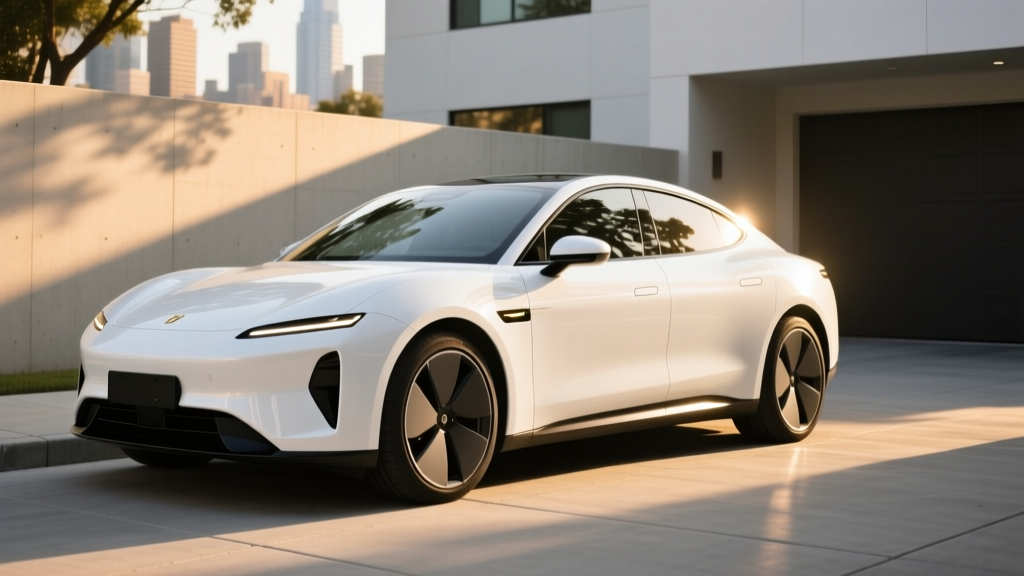
If you're shopping for a white electric car in 2026, you're likely weighing aesthetics against practical benefits. The short answer: a white EV exterior can reduce cabin heat soak by up to 10-15°F compared to black, which lowers air conditioning load and can preserve 1-3% of range in hot climates. White also tends to hold resale value better and hides light dust and swirl marks. However, color alone won't overcome a poorly planned charging setup or a battery chemistry mismatch for your driving needs. Below, we quantify the real advantages and trade-offs of choosing white, then layer in the full EV ownership picture so you can decide with confidence.
Quick Answer: Does White Improve EV Range?
Yes, but modestly. A white or light-colored EV reduces solar heat absorption, cutting cabin temperatures by roughly 10-15°F in direct sunlight versus black. This reduces HVAC energy draw, yielding an estimated 1-3% range improvement in hot, sunny climates (e.g., Arizona, Texas, Southern California). On a 300-mile EPA-rated EV, that translates to roughly 3-9 extra miles per charge. The thermal benefit also slightly reduces battery cooling load when parked. White is not a substitute for a heat pump, preconditioning, or proper garage parking — but it's a meaningful marginal gain in sunbelt states.
The Physics: How Color Affects EV Efficiency
Vehicle color influences thermal dynamics, which directly affect an EV's energy consumption. Dark surfaces absorb up to 90% of visible and infrared light, converting it to heat. White surfaces reflect roughly 80% of that energy. For an EV, this matters in two ways:
- Cabin cooling load: A hotter cabin requires more A/C compressor runtime, drawing from the traction battery. Studies by the National Renewable Energy Laboratory (NREL) have shown that solar-reflective glazing and light-colored exteriors can reduce cabin temperatures significantly, lowering HVAC energy use.
- Battery thermal management: While the battery pack is insulated and actively cooled, a cooler overall vehicle thermal mass reduces the burden on the thermal management system, especially during DC fast charging in hot weather.
Real-world impact: If you live in Phoenix and commute 40 miles round-trip in July, a white EV might save you 5-8 miles of range per charge versus the same model in black. In Seattle or Minneapolis, the difference is negligible. This is a climate-dependent optimization, not a universal advantage.
White EV Resale Value & Market Demand
White has been the most popular new-car color globally for over a decade, according to Axalta's annual color popularity reports. For EVs specifically, white carries additional associations: clean, modern, tech-forward (think early Tesla Model S and Nissan Leaf marketing). This translates to measurable resale advantages:
- Broader buyer pool: White appeals across demographics, reducing time-to-sale on the used market.
- Fleet and lease returns: Many fleet EVs are ordered in white, normalizing the color in the used-EV market and supporting residual values.
- Paint correction costs: White paint shows fewer swirl marks and light scratches than black or dark gray, reducing detailing costs before resale.
However, specialty colors (e.g., Tesla's Ultra Red, Hyundai's Digital Teal) can command premiums among enthusiasts. If you plan to keep the car 8+ years, color-driven resale differences shrink as the vehicle ages and mileage dominates valuation.
Real Costs of EV Ownership: White or Not
Color is a secondary decision. The primary economics of EV ownership in 2026 hinge on purchase price, charging infrastructure, energy costs, maintenance, and insurance. Here's a concrete breakdown for a mid-range EV (e.g., Tesla Model Y Long Range, Hyundai Ioniq 5, Ford Mustang Mach-E) versus a comparable gas-powered crossover:
| Category | EV (e.g., Model Y LR) | Gas Crossover (e.g., Toyota RAV4) |
|---|---|---|
| Purchase Price (MSRP) | $46,000 | $33,000 |
| Federal Tax Credit (§30D) | -$3,750 to $7,500* | $0 |
| Effective Purchase | $38,500 - $42,250 | $33,000 |
| Energy/Fuel (5 yrs, 75k mi) | $3,750 - $5,250** | $9,375*** |
| Maintenance (5 yrs) | $1,500 | $3,500 |
| Insurance (5 yrs avg) | $9,500 | $7,000 |
| Estimated Depreciation | $18,000 | $14,000 |
| Total 5-Year Cost | $71,250 - $76,500 | $66,875 |
*§30D credit eligibility depends on MSRP caps ($55,000 sedans / $80,000 SUVs/trucks), buyer income limits ($150K single / $300K joint), and battery critical-mineral sourcing. Point-of-sale transfer available. Verify at IRS.gov.
**EV energy cost assumes $0.14/kWh national average, 3.5 mi/kWh efficiency. Home charging is cheaper; DC fast charging is more expensive.
***Gas cost assumes $3.50/gallon, 28 MPG combined.
The EV's higher upfront cost and insurance premiums are partially offset by fuel and maintenance savings. The break-even point typically arrives around year 4-6, depending on your local electricity rates, mileage, and whether you qualify for the full tax credit. Color choice (white vs. other) affects resale value by roughly $500-$1,500 over 5 years — meaningful but not decisive.
EV vs. Gas vs. Hybrid: Which Powertrain Fits You?
| Factor | BEV (Battery Electric) | PHEV (Plug-in Hybrid) | HEV (Standard Hybrid) |
|---|---|---|---|
| Best For | Home charging access, <300 mi daily, tech-forward buyers | Short electric commutes + long road trips, no range anxiety | High mileage, no charging access, maximum MPG |
| EPA Range (Electric) | 250-400 mi | 25-45 mi (electric only) | N/A (gas only) |
| Fuel/Energy Cost per Mile | $0.04 - $0.06 (home) | $0.03 (electric) / $0.12 (gas) | $0.10 - $0.12 |
| Maintenance | Very low (no oil, fewer moving parts) | Moderate (gas engine + electric system) | Low-moderate |
| Upfront Cost | $35,000 - $80,000+ | $35,000 - $55,000 | $28,000 - $45,000 |
| Tax Credit Eligibility | Up to $7,500 (§30D) | Up to $7,500 (§30D, if battery ≥7 kWh) | None |
| Cold Weather Impact | 20-30% range loss | Minimal (gas engine provides heat) | Minimal |
If you have reliable home charging (Level 2, 240V) and your daily driving stays under 250 miles, a BEV is the lowest-cost long-term option. If you frequently drive 400+ miles in a day or live in an apartment without charging access, a PHEV like the Toyota RAV4 Prime (42 mi electric range, 38 MPG gas) bridges the gap. A standard HEV like the Toyota Camry Hybrid (52 MPG combined per fueleconomy.gov) is the simplest, lowest-risk choice if you just want efficiency without plug-in complexity.
First-Time EV Buyer Checklist: What You Must Know
If/Then Decision Framework
- If you can install a Level 2 home charger (240V, 32-48A): Buy a BEV. Home charging is 50-70% cheaper than public DC fast charging and eliminates range anxiety for daily use.
- If you rent or live in a condo without charging access: Consider a PHEV or wait until public charging infrastructure improves in your area. Relying solely on DC fast charging is expensive ($0.30-$0.50/kWh) and accelerates battery wear if done exclusively.
- If you live in a cold climate (sub-20°F winters): Prioritize an EV with a heat pump (e.g., Tesla Model Y, Hyundai Ioniq 5, Kia EV6) and expect 20-30% range reduction. Preconditioning while plugged in is essential.
- If you tow or haul frequently: Check the EV's towing capacity (e.g., Ford F-150 Lightning: 7,700-10,000 lbs) and note that towing can cut range by 40-50%.
- If you want the lowest total cost: Target a used EV eligible for the §25E used-EV credit (up to $4,000, income-capped, vehicles under $25,000).
Home Charging Installation: The Real Costs
Most first-time EV buyers underestimate the cost and complexity of home charging setup. Here's what to budget:
- Level 2 charger hardware: $400 - $700 (e.g., ChargePoint Home Flex, Emporia Vue, Tesla Wall Connector)
- Electrical panel upgrade (if needed): $1,500 - $3,000 (older homes with 100A service may need a 200A upgrade)
- Electrician labor + permit: $800 - $2,000 (varies by region, run length, and local code)
- Total typical install: $1,200 - $2,500 if panel is sufficient; $3,000 - $5,000 if panel upgrade is required
Always get a quote from a licensed electrician before purchasing an EV. Some utilities offer rebates ($200-$500) for Level 2 installations — check with your provider.
Common EV Misconceptions — Fact-Checked
| Myth | Fact |
|---|---|
| "EV batteries need replacement every 5 years." | Most EV batteries are warrantied for 8 years / 100,000 miles (capacity retention ≥70%). Real-world degradation is typically 10-15% over 8 years. Replacement costs $5,000 - $20,000 if out of warranty, but full replacements are rare. |
| "Charging an EV takes hours." | Level 2 home charging adds 25-40 miles per hour (overnight is sufficient for most). DC fast charging (150-350 kW) can add 100-200 miles in 15-25 minutes. The 10-80% charge time for a Hyundai Ioniq 5 at a 350 kW charger is roughly 18 minutes. |
| "EVs are worse for the environment due to battery mining." | Lifecycle analyses by the Union of Concerned Scientists and ICCT show that EVs produce fewer emissions than gas cars over their lifetime, even accounting for battery production. The grid is also getting cleaner each year. |
| "White paint fades faster." | Modern clear-coat formulations (post-2010) resist UV fading well. White actually shows oxidation and clear-coat failure less visibly than dark colors. Regular washing and waxing (or ceramic coating) protect any color. |
| "You can't drive an EV in the rain or through a car wash." | EV battery packs are sealed to IP67 or IP6K9K standards. They are fully waterproof for normal driving conditions, including heavy rain, puddles, and car washes. |
Choosing the Right White EV in 2026
If you've decided on a white electric car, here are three strong options across price segments, with key specs:
- Budget ($30K-$40K): Chevrolet Equinox EV 2LT — EPA 319 mi, 85 kWh NMC battery, 150 kW peak DC charge (10-80% in ~30 min), $33,600 MSRP. Eligible for up to $7,500 §30D credit (verify sourcing requirements).
- Mid-Range ($40K-$55K): Tesla Model Y Long Range — EPA 320 mi, ~75 kWh NMC, 250 kW peak DC (10-80% in ~25 min at V3 Supercharger), $46,000 MSRP. NACS connector native (widest charging network access).
- Premium ($55K+): Hyundai Ioniq 5 Limited AWD — EPA 290 mi, 84 kWh NMC, 350 kW peak DC (10-80% in ~18 min at compatible chargers), $57,000 MSRP. 800V architecture enables the fastest charging in its class.
For each, white is typically a no-cost or low-cost ($0-$500) paint option. Confirm availability with the manufacturer, as some trims restrict color choices.
Frequently Asked Questions
Does a white EV stay cooler in summer?
Yes. A white exterior can reduce cabin temperatures by 10-15°F compared to black in direct sunlight. This reduces A/C energy draw and marginally improves range (1-3%) in hot climates. Pair with solar-reflective window tint and a sunshade for maximum benefit.
Is white harder to keep clean?
White shows less dust, pollen, and light swirl marks than black or dark gray. However, it shows road tar, bug splatter, and brake dust more visibly. A ceramic coating ($500-$1,500 professional application) makes maintenance easier for any color.
Do white EVs cost more to insure?
Insurance premiums are based on vehicle model, trim, driver history, and location — not color. A white Tesla Model Y costs the same to insure as a black one. Expect EV insurance to be 15-30% higher than comparable gas cars due to repair costs and parts pricing.
What's the best white EV for hot climates?
Prioritize models with a heat pump (standard on Tesla Model Y, Hyundai Ioniq 5, Kia EV6) and strong thermal management. White paint helps, but the heat pump and battery preconditioning are far more impactful for range preservation in Arizona, Texas, or Florida summers.
Can I get a tax credit on a white EV?
Color doesn't affect tax credit eligibility. The §30D federal credit (up to $7,500 for new EVs, up to $4,000 for used under §25E) depends on MSRP caps, buyer income, battery sourcing, and assembly location. Verify current rules at IRS.gov and confirm with a tax professional before purchasing.