The Straight Answer
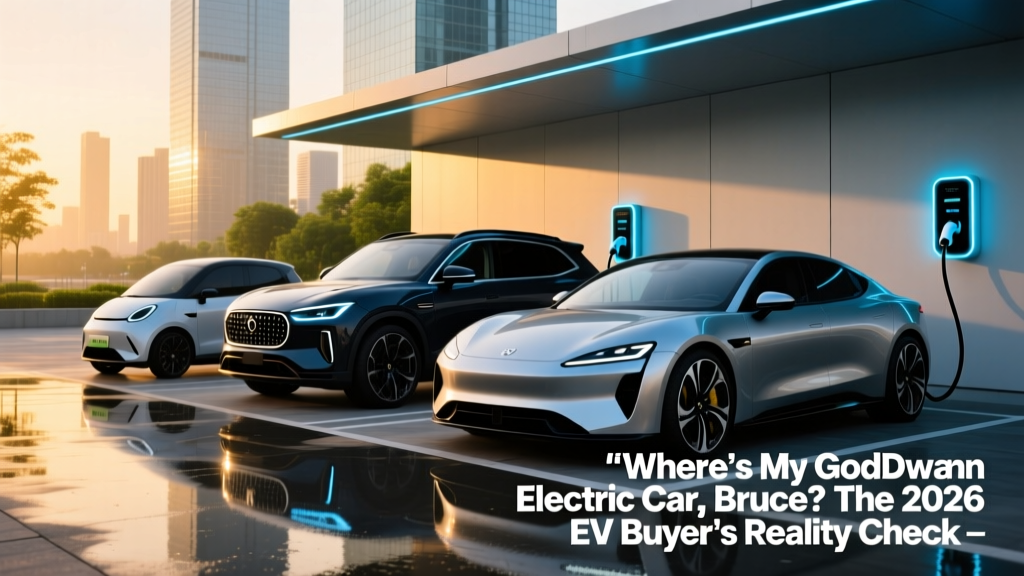
If you're asking "where's my goddamn electric car, Bruce?" — you're not alone. The phrase, popularized by a viral 2023 video, captured the frustration of promised EVs that never materialized at affordable prices. Here's the 2026 reality: EVs are widely available now, but the landscape has shifted. Budget models like the Chevrolet Equinox EV start at $33,600 (before potential tax credits), mid-range staples like the Tesla Model Y begin at $44,990, and the used EV market offers credible options under $25,000. However, several highly publicized startups (Fisker, Canoo) collapsed, some legacy automakers delayed or canceled affordable models, and the sub-$30,000 new EV segment remains thin. Your EV is out there — but you need to know exactly what's buyable today, what costs, and what the real trade-offs are versus gas or hybrid alternatives.
What Happened to All the Affordable EVs Promised?
The "where's my goddamn electric car" frustration peaked when several automakers announced $25,000–$30,000 EVs between 2021 and 2023 that either never launched, got canceled, or arrived significantly more expensive. Here's what actually happened by 2026:
- Fisker Ocean: Fisker Inc. filed for bankruptcy in mid-2024. The Ocean SUV is dead. No parts support, no software updates. Avoid used examples.
- Chevrolet Equinox EV: Actually launched. Starts at $33,600 for the 2LT FWD trim with an EPA-estimated 319 miles of range. This is the closest thing to the "affordable EV" promise that materialized.
- Tesla's $25,000 car: Still not available as a standalone model. Tesla pivoted to robotaxi ambitions. The most affordable new Tesla remains the Model 3 at $38,990 (Standard Range, EPA 272 mi).
- Volkswagen ID.2 / ID.1: Announced for Europe, not confirmed for the US market as of 2026.
- Nissan Leaf successor: The next-gen Leaf is expected for 2027 model year, pricing unconfirmed. The current Leaf (discontinued after 2025) used the outdated CHAdeMO connector and max 226-mile range.
The honest summary: the EV market in 2026 has real, buyable vehicles from $33,000 to $100,000+, but the mythical $25,000 new EV with 300-mile range and DC fast charging still doesn't exist in the US market. Used EVs, however, have filled that gap — a 2022–2023 Hyundai Ioniq 5 or Tesla Model 3 can be found for $22,000–$28,000 with reasonable battery health.
EV vs. Gas vs. Hybrid: The Real Cost Breakdown
The decision isn't just "electric or not." It's electric vs. hybrid vs. gas — and the math depends heavily on your driving pattern, electricity rate, and how long you keep the vehicle. Here's a 5-year total cost of ownership comparison for a typical commuter driving 12,000 miles/year, using national averages:
| Cost Factor | Chevy Equinox EV 2LT ($33,600) | Toyota RAV4 Hybrid XLE ($33,425) | Toyota RAV4 Gas LE ($30,425) |
|---|---|---|---|
| Purchase Price (MSRP) | $33,600 | $33,425 | $30,425 |
| Federal Tax Credit (§30D) | Up to $7,500 (if eligible) | $0 | $0 |
| Effective Purchase Price | ~$26,100 | $33,425 | $30,425 |
| Fuel/Energy (5 yrs, 60k mi) | $3,600 (home charging @ $0.16/kWh) | $5,850 (39 MPG combined @ $3.25/gal) | $8,125 (30 MPG combined @ $3.25/gal) |
| Maintenance (5 yrs) | ~$1,500 | ~$3,200 | ~$3,800 |
| Insurance (5 yrs avg) | ~$9,500 | ~$7,800 | ~$7,500 |
| 5-Year Total | ~$40,700 | ~$50,275 | ~$49,850 |
Critical caveats on this table: The EV's tax credit eligibility depends on your income (≤$150K single / ≤$300K joint), the vehicle meeting battery-sourcing requirements, and MSRP caps ($55,000 for sedans, $80,000 for SUVs/trucks). Check current rules at IRS.gov §30D. Insurance is typically 15–25% higher for EVs due to repair costs and battery replacement risk. Home charging cost assumes a national average of $0.16/kWh and the Equinox EV's efficiency of ~3.0 mi/kWh (roughly 33 kWh/100mi). If you rely exclusively on public DC fast charging at $0.40–$0.60/kWh, your 5-year energy cost jumps to $7,200–$10,800, erasing much of the fuel savings.
Real-World Range and Charging: What the EPA Sticker Doesn't Tell You
EPA range estimates are a starting point, not a guarantee. Here's what actual 2026 EV buyers need to understand about range and charging in practice:
EPA vs. Real-World Range Expectations
| Vehicle | EPA Range | Highway (70 mph) | Cold Weather (20°F) | Combined Real-World |
|---|---|---|---|---|
| Chevy Equinox EV 2LT | 319 mi | ~255 mi | ~220 mi | ~270 mi |
| Tesla Model 3 LR AWD | 341 mi | ~285 mi | ~245 mi | ~300 mi |
| Hyundai Ioniq 5 SEL | 303 mi | ~250 mi | ~210 mi | ~265 mi |
| Ford Mustang Mach-E Premium | 320 mi | ~260 mi | ~225 mi | ~275 mi |
Highway driving at sustained 70+ mph reduces range 15–20% vs. EPA. Cold weather (below freezing) with cabin heating can reduce range 25–35%. Vehicles with heat pumps (Tesla, Hyundai/Kia) lose less in cold than those with resistive heaters.
Charging speed reality check: Automakers advertise peak DC fast-charge rates (e.g., "up to 250 kW"), but that peak is sustained for only a small portion of the session. The charge curve tapers significantly above 80% State of Charge (SoC) to protect battery health. Here's what to actually expect:
| Vehicle | Battery (kWh usable) | Peak DC Rate (kW) | 10–80% Time | 80–100% Time | Level 2 Rate (kW) |
|---|---|---|---|---|---|
| Chevy Equinox EV | 85 kWh (NMC) | 150 kW | ~34 min | ~45 min | 11.5 kW |
| Tesla Model 3 LR | 75 kWh (NMC) | 250 kW | ~22 min | ~35 min | 11.5 kW |
| Hyundai Ioniq 5 | 77.4 kWh (NMC) | 240 kW | ~18 min | ~30 min | 10.9 kW |
| Ford Mach-E ER | 91 kWh (NMC) | 150 kW | ~38 min | ~50 min | 10.5 kW |
On a road trip, plan for 20–35 minute stops every 180–230 miles (real-world). That's meaningfully longer than a 5-minute gas stop, but most drivers combine it with food and restroom breaks. The Ioniq 5's 800V architecture gives it a genuine charging advantage — if you road-trip frequently, this matters more than EPA range.
Home Charging Access: The Make-or-Break Factor
Here's the uncomfortable truth that EV marketing glosses over: EV ownership is dramatically better with home charging and dramatically harder without it. If you can install a Level 2 home charger, you'll do 90%+ of your charging at home, at the cheapest rates, and never visit a public charger except on road trips. If you can't charge at home, you need to honestly assess whether an EV fits your life right now.
Home Level 2 installation cost breakdown (2026):
| Component | Low End | High End | Notes |
|---|---|---|---|
| Level 2 Charger (hardware) | $350 | $750 | ChargePoint Home Flex, Emporia, Wallbox |
| Electrician labor | $500 | $1,800 | Depends on panel proximity, conduit run |
| Permit & inspection | $50 | $300 | Varies by municipality |
| Panel upgrade (if needed) | $1,500 | $4,000 | Required if panel is 100A or maxed out |
| Total (no panel upgrade) | $900 | $2,850 | Most homes with 200A panels |
| Total (with panel upgrade) | $2,400 | $6,850 | Older homes, 100A service |
A Level 2 charger at 48 amps / 11.5 kW adds roughly 30–44 miles of range per hour of charging — enough to fully replenish any EV overnight on a standard 8–10 hour window. The federal §30C tax credit covers 30% of home charger equipment and installation costs, up to $1,000, subject to census-tract eligibility.
If you live in an apartment, condo, or street-park, your options narrow: workplace charging, public Level 2 networks (ChargePoint, EVgo), or DC fast-charging dependency. None of these are dealbreakers, but they add friction, cost, and time. A PHEV (plug-in hybrid) like the Toyota RAV4 Prime (42 miles electric-only, then 38 MPG gas) may be the more practical electrified choice if home charging isn't possible.
Common EV Misconceptions — Corrected With Data
| Myth | Fact (with data) |
|---|---|
| "EV batteries need replacing every 5 years" | Modern NMC and LFP batteries degrade ~1.5–2.5% per year in normal use. A 2026 EV should retain 85–90% capacity at 100,000 miles. Federal law mandates battery warranties of at least 8 years/100,000 miles (10 years/150,000 miles in CARB states). Full replacements cost $8,000–$18,000 out of warranty, but are rarely needed. |
| "EVs are worse in cold weather" | Range drops 20–35% in sub-freezing temps — real, but manageable with preconditioning and a heat pump. EVs start instantly in cold (no cranking), and cabin heat is available without idling. Plug in overnight and precondition while connected to preserve range. |
| "The power grid can't handle EVs" | Most EV charging happens overnight during off-peak hours when grid demand is lowest. A single EV charging at 7.2 kW draws roughly the same as a clothes dryer. Utilities are upgrading distribution, but localized transformer upgrades are needed in high-EV-adoption neighborhoods. |
| "EVs are slower and less powerful" | Even budget EVs produce instant torque. The $33,600 Equinox EV makes 213 hp and hits 0–60 in ~7.8 seconds — comparable to a gas RAV4. A Tesla Model 3 Performance does 0–60 in 2.9 seconds for $52,990. |
| "You can't take an EV on a road trip" | The Tesla Supercharger network has 25,000+ stalls in North America. Electrify America, EVgo, and ChargePoint operate thousands of DC fast chargers along interstates. With 18–35 minute charge stops every ~200 miles, a 600-mile trip adds ~1–1.5 hours vs. gas. Planning apps like A Better Routeplanner handle this automatically. |
| "All EVs qualify for the $7,500 tax credit" | As of 2026, only specific models meet §30D battery-sourcing and critical-mineral requirements. Eligible vehicles include select trims of the Tesla Model Y, Ford F-150 Lightning, Chevy Equinox EV, and others. Income caps ($150K single/$300K joint) and MSRP caps apply. Verify at fueleconomy.gov. |
The Decision Framework: Should You Buy an EV Now?
Choose Your Path
BUY A BEV (full electric) NOW if:
- You can install a Level 2 charger at home (garage, driveway, or dedicated parking with electrical access)
- Your daily driving is under 80 miles round-trip (covers 95%+ of American commutes)
- You have a second gas/hybrid vehicle for rare long trips, OR you're willing to plan 20–30 min charge stops on road trips
- You qualify for the §30D tax credit (income under caps, vehicle meets sourcing rules)
- You live in a region with reliable public DC fast-charging infrastructure (most metro areas, coasts, major interstates)
BUY A PHEV (plug-in hybrid) if:
- You can't install home charging but want electric commuting (PHEVs work fine on gas alone)
- You regularly drive 300+ miles in a day through rural areas with sparse charging
- You live in extreme cold climates (-20°F regular) where range loss is most punishing
- You want to reduce fuel consumption without any range compromise — the RAV4 Prime gives 42 mi electric, then 38 MPG indefinitely
WAIT or STICK WITH GAS if:
- You street-park with zero access to home, workplace, or reliable public charging
- Your budget is strictly under $25,000 and you need a new vehicle (the used EV market has options, but selection is limited at this price)
- You tow heavy loads frequently (EV towing range drops 40–50%, though the F-150 Lightning and Rivian R1T handle moderate towing)
What First-Time EV Buyers Must Know Before Signing
If you've decided an EV is right for you, here are the practical details that catch new owners off guard:
- kW vs. kWh — know the difference. kWh (kilowatt-hours) is your battery's energy capacity — like the size of a gas tank. kW (kilowatts) is charging power — like the flow rate of a gas pump. A 75 kWh battery charged at 150 kW doesn't take 30 minutes; the charge curve tapers. This is the #1 confusion point for new EV buyers.
- NACS is winning the connector war. Tesla's North American Charging Standard (NACS) has been adopted by Ford, GM, Rivian, Hyundai, Kia, and most major automakers starting 2025. If you buy a non-Tesla EV with a CCS port, you'll likely need a NACS adapter (usually included or ~$200) to access Tesla Superchargers, which are the most reliable public network.
- Insurance will cost more. Budget 15–25% higher premiums vs. a comparable gas car. Get quotes before purchasing — the difference can be $400–$900/year depending on the model and your state.
- Tire wear is faster. EVs are 15–25% heavier than gas equivalents and deliver instant torque. Expect tire replacement 10,000–15,000 miles sooner than on a gas car. Budget for EV-rated tires (higher load index, low rolling resistance) at $200–$350 per tire.
- Preconditioning matters. Most EVs let you warm or cool the battery before fast charging or departure. Using this feature (usually via the app) significantly improves charge speed in cold weather and preserves range. It's the single most underused EV feature.
- Check the battery warranty specifics. All EVs carry a minimum 8-year/100,000-mile battery warranty, but the capacity-retention threshold varies. Most manufacturers guarantee 70% capacity — meaning if your battery drops below 70% within the warranty period, they'll replace or repair it. Read the fine print for your specific model.
Frequently Asked Questions
Is it too early to buy an EV in 2026?
No. Current-generation EVs from established automakers (Tesla, Hyundai/Kia, GM, Ford, BMW) use mature battery and charging technology with proven reliability. The main risk is buying from an unproven startup — stick with brands that have dealer networks and parts supply chains. Battery degradation data from 2018–2023 models shows 85–92% capacity retention at 100,000 miles for well-managed NMC packs, and LFP batteries (used in base Tesla Model 3 and some others) show even slower degradation.
What's the cheapest new EV I can buy in 2026?
The Nissan Leaf was discontinued after 2025. The cheapest new EVs for 2026 include the Chevrolet Equinox EV 2LT at $33,600 (319 mi EPA), the Tesla Model 3 Standard Range at $38,990 (272 mi EPA), and the Hyundai Kona Electric at ~$34,000 (261 mi EPA). If you qualify for the full $7,500 §30D credit and can take it as a point-of-sale reduction, effective prices can drop to $26,100–$31,500.
Should I buy a used EV instead?
Used EVs are excellent value in 2026 because depreciation has been steep. A 2022 Tesla Model 3 Long Range can be found for $24,000–$28,000 with 30,000–50,000 miles and ~90% battery health. A 2022–2023 Hyundai Ioniq 5 runs $22,000–$27,000. The used EV federal credit (§25E) offers up to $4,000 on vehicles priced at $25,000 or less, subject to income caps. Always request a battery health report (available via the vehicle's telemetry or a dealer diagnostic scan) before purchasing.
Will I save money going electric?
If you charge at home at average electricity rates ($0.12–$0.20/kWh), yes — fuel savings of $600–$1,200/year vs. a 30 MPG gas car are typical for 12,000 miles/year of driving. Add reduced maintenance (no oil changes, fewer brake replacements due to regenerative braking) and you save $800–$1,500/year. However, higher insurance, potential home charger installation, and faster tire wear offset some savings. Over 5 years, most home-charging EV owners come out $3,000–$8,000 ahead vs. gas, depending on the vehicle and local energy costs.
What if I need to tow or haul?
EVs can tow, but range drops dramatically — expect 40–50% range reduction when towing near max capacity. The Ford F-150 Lightning (EPA 230–320 mi unloaded) drops to ~120–170 miles towing 5,000+ lbs. The Rivian R1T and Chevrolet Silverado EV offer similar trade-offs. If you tow frequently and long-distance, a diesel or hybrid truck remains more practical until charging infrastructure thickens further along truck routes.