Rivian has carved out a distinct niche in the electric-vehicle market by building adventure-ready trucks and SUVs that rival legacy automakers in capability while outpacing most startups in build quality. But for shoppers researching the brand, one practical question keeps surfacing: where are Rivian cars made? The answer matters not just for patriotic purchasing decisions, but for understanding supply-chain resilience, quality control, and federal tax-credit eligibility under the Inflation Reduction Act's domestic-manufacturing requirements.
This guide covers Rivian's manufacturing footprint in detail, then dives into a full spec-driven review of the current R1T pickup and R1S SUV lineup — including real-world range, charging performance, pricing after incentives, and how these vehicles stack up against the Ford F-150 Lightning, Tesla Cybertruck, and Chevrolet Silverado EV.
Where Are Rivian Cars Made? The Normal, Illinois Factory
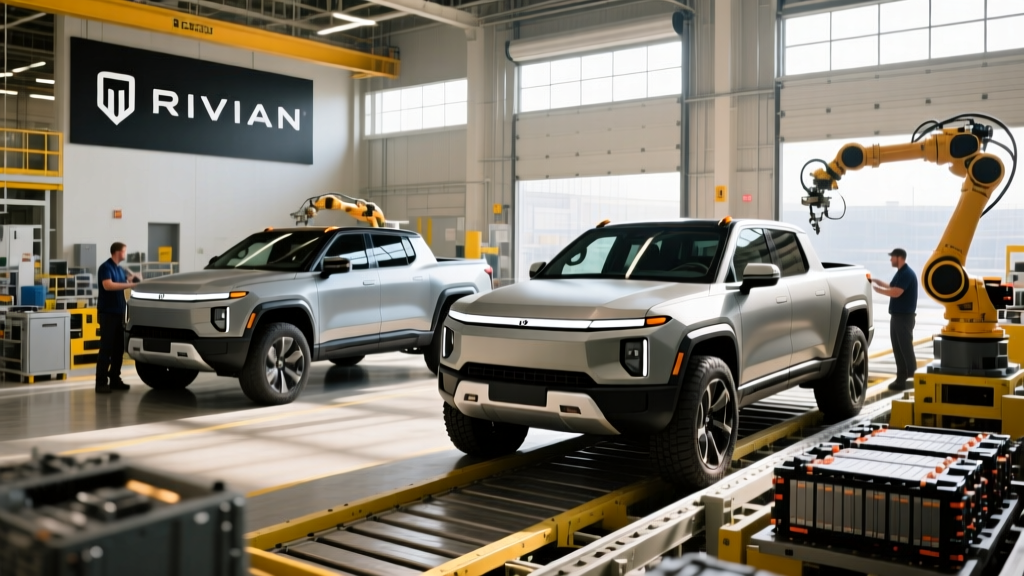
Every Rivian vehicle sold today rolls off the assembly line at the company's manufacturing plant in Normal, Illinois. This 3.3-million-square-foot facility — originally a Mitsubishi/Diamond-Star Motors plant — was acquired by Rivian in 2017 and extensively retooled for electric-vehicle production. It is currently the sole production site for all Rivian consumer vehicles: the R1T pickup, R1S three-row SUV, and the EDV (Electric Delivery Van) built for Amazon.
Key facts about the Normal, Illinois factory:
- Location: 13101 Kostner Ave, Normal, IL 61761
- Size: ~3.3 million sq ft of manufacturing, body, paint, and assembly space
- Capacity: Rated for approximately 150,000 vehicles annually (with expansion potential to ~200,000+)
- Workforce: Over 9,000 employees as of late 2025
- Production start: R1T began September 2021; R1S followed in 2022
- Vertical integration: Battery pack assembly, drive unit assembly, and stamping all occur on-site
Rivian's decision to manufacture entirely in the United States is strategically significant. Under the IRS §30D federal EV tax credit rules, vehicles must undergo final assembly in North America to qualify. Because every Rivian is built in Illinois, all eligible trims clear this hurdle. The battery-sourcing and critical-minerals requirements are a separate calculation — more on that in the pricing section below.
Future Production: The Stanton, Georgia Plant
Rivian has announced a second factory in Stanton, Georgia, backed by approximately $5 billion in investment. This facility is planned to produce the upcoming R2 midsize SUV and R3 compact crossover. As of early 2026, the Georgia plant is under construction with production expected to begin in 2028. Until then, Normal, Illinois remains the sole source for all Rivian vehicles you can order today.
2026 Rivian R1T: Full Spec Review
The R1T is a midsize electric pickup that competes on capability rather than sheer size. At roughly 217 inches long, it slots between compact trucks and full-size half-tons — think of it as an electric Toyota Tacoma in footprint, with Ford F-150 Lightning in performance. For the 2026 model year, Rivian continues to offer the Dual-Motor, Performance Dual-Motor, and Tri-Motor configurations on its second-generation "Gen 2" platform introduced for 2025.
| Spec | Dual-Motor | Performance Dual-Motor | Tri-Motor |
|---|---|---|---|
| EPA Range (Standard Battery) | ~270 mi | ~255 mi | N/A |
| EPA Range (Large Battery) | ~352 mi | ~340 mi | ~328 mi |
| EPA Range (Max Battery) | ~420 mi | ~410 mi | ~390 mi |
| Battery Usable Capacity | Standard ~92 kWh (LFP) / Large ~113 kWh (NMC) / Max ~149 kWh (NMC) | ||
| Horsepower | 533 hp | 665 hp | 850 hp |
| 0-60 mph | 4.5 sec | 3.4 sec | ~2.9 sec |
| Drivetrain | AWD (Dual-Motor) | AWD (Dual-Motor) | AWD (Tri-Motor) |
| Max Tow Rating | 11,000 lbs | 11,000 lbs | 11,000 lbs |
| Peak DC Fast Charge | ~200 kW | ~220 kW | ~220 kW |
| 10-80% DC Charge Time | ~28 min (Large) | ~25 min (Large) | ~25 min (Large) |
| Level 2 Home Charge Rate | 11.5 kW (~25 mi/hr) | ||
| Efficiency (Large Batt.) | ~2.0-2.2 kWh/mi (~73-79 MPGe combined) | ||
| Base MSRP | $69,900 | $75,900 | $99,900 |
The R1T Large Battery Dual-Motor carries an EPA-estimated 352 miles. In real-world highway driving at 70-75 mph, expect approximately 280-310 miles depending on temperature, terrain, and payload. In cold weather (below 32°F), range can drop 15-25%, bringing effective highway range to roughly 240-270 miles. Towing a 5,000-lb trailer cuts range roughly in half — plan for 150-180 miles between charges when hauling. The Max Battery pack extends the safety margin substantially, but the physics of a 7,000-lb truck pushing air at highway speed cannot be cheated.
2026 Rivian R1S: SUV Specs at a Glance
The R1S shares the R1T's skateboard platform, powertrains, and battery options but wraps them in a three-row SUV body. It is one of very few electric vehicles offering genuine three-row seating with competitive range. The second-generation R1S received significant weight reductions, updated thermal management, and the new Tri-Motor option for 2025 that continues into 2026.
| Spec | Dual-Motor | Performance Dual-Motor | Tri-Motor |
|---|---|---|---|
| EPA Range (Large Battery) | ~340 mi | ~330 mi | ~315 mi |
| EPA Range (Max Battery) | ~410 mi | ~395 mi | ~380 mi |
| 0-60 mph | 4.6 sec | 3.5 sec | ~3.0 sec |
| Horsepower | 533 hp | 665 hp | 850 hp |
| Passenger Capacity | 7 (2+3+2) or 6 (2+2+2 captain's chairs) | ||
| Cargo (behind 3rd row) | ~10.6 cu ft | ||
| Cargo (3rd row folded) | ~46.7 cu ft | ||
| Cargo (all rows folded) | ~83.5 cu ft | ||
| Front Headroom / Legroom | 40.8 in / 41.3 in | ||
| 2nd-Row Legroom | 38.2 in | ||
| 3rd-Row Legroom | 30.4 in | ||
| Base MSRP | $74,900 | $79,900 | $104,900 |
The R1S's third row is best suited for children or occasional use — the 30.4 inches of legroom is tight for adults on longer trips. However, for families needing three rows most days, it remains the only fully electric option with over 300 miles of EPA range in this segment. Competitors like the Kia EV9 offer three rows at a lower price point but with less range and off-road capability.
Charging Performance: DC Fast, Level 2, and the Rivian Adventure Network
Rivian's Gen 2 platform supports CCS1 DC fast charging natively, with a NACS adapter available for access to Tesla Supercharger stations. The charging experience is a critical ownership variable, so here is the exact breakdown by level:
| Charging Level | Power | Miles Added per Hour | Notes |
|---|---|---|---|
| Level 1 (120V household) | ~1.4 kW | ~3-4 mi/hr | Emergency/trickle only |
| Level 2 (240V, 48A home) | 11.5 kW | ~25 mi/hr | Full charge in ~10-13 hrs (Large batt.) |
| DC Fast Charge (peak) | 200-220 kW | ~700+ mi/hr (peak) | 10-80% in ~25-28 min |
| DC Fast Charge (sustained avg.) | ~130-150 kW | ~450-550 mi/hr (avg.) | Charge curve tapers significantly above 80% |
A critical nuance: the advertised peak DC rate of 200-220 kW is achieved only in a narrow state-of-charge window (roughly 10-35% SoC with preconditioning enabled). The charge curve tapers progressively — by 60% SoC you may see 120-140 kW, and above 80% the rate drops sharply to protect battery health. On a road trip, plan your stops around 10-80% sessions of approximately 25 minutes rather than attempting full charges.
Home charging setup: Rivian recommends a 60-amp circuit with a 48-amp Level 2 wall connector for optimal daily charging. A licensed electrician will typically charge $800-$2,000 for installation depending on panel proximity and whether a service upgrade (to 200A) is needed. Most R1T/R1S owners report waking up to a full battery every morning, making home charging the primary "refueling" method.
Rivian also operates the Rivian Adventure Network, a growing network of proprietary DC fast chargers at outdoor destinations (national parks, ski resorts, trailheads). These chargers peak at 200+ kW and are reserved for Rivian owners via the vehicle's built-in navigation. As of early 2026, over 50 Adventure Network sites are operational, supplementing CCS and NACS public infrastructure.
Pricing, Trims, and Federal Tax Credit Eligibility
Rivian positions the R1T and R1S as premium adventure vehicles, and pricing reflects that. Here is the current MSRP landscape and how the federal tax credit factors in:
| Model / Trim | Base MSRP | As-Tested Typical | §30D Credit Eligible? |
|---|---|---|---|
| R1T Dual-Motor (Standard) | $69,900 | $73,000-$78,000 | Yes (if under $80K MSRP cap) |
| R1T Dual-Motor (Large) | $75,900 | $79,000-$85,000 | Yes (base under $80K cap) |
| R1T Tri-Motor (Max) | $99,900 | $105,000-$115,000 | No (exceeds $80K truck cap) |
| R1S Dual-Motor (Large) | $79,900 | $83,000-$90,000 | Yes (under $80K SUV cap) |
| R1S Tri-Motor (Max) | $104,900 | $110,000-$120,000 | No (exceeds $80K SUV cap) |
- MSRP caps: Trucks (R1T) must be ≤$80,000 MSRP; SUVs/vans (R1S) must be ≤$80,000 MSRP. Tri-Motor trims exceed this.
- Buyer income caps: Modified AGI ≤$300,000 (joint) / ≤$225,000 (head of household) / ≤$150,000 (single).
- Battery sourcing: A percentage of critical minerals and battery components must be sourced from the US or FTA partners. Rivian's US assembly helps, but battery cell sourcing varies — confirm current-year compliance on IRS.gov's qualified vehicle list before purchasing.
- Point-of-sale transfer: Eligible buyers can transfer the up-to-$7,500 credit to the dealer at purchase, reducing the out-of-pocket price immediately.
Always verify eligibility with a tax professional and the latest IRS guidance — rules and qualified-model lists are updated periodically.
For the Dual-Motor configurations that fall under the $80,000 MSRP cap, qualifying buyers can see the effective starting price of an R1T drop from $69,900 to approximately $62,400 after the full $7,500 credit. That places the R1T in a compelling position against a comparably equipped Ford F-150 Lightning Lariat or a loaded Chevrolet Silverado EV.
Technology, Driver Assists, and Standout Features
Rivian's tech stack is entirely proprietary — no carryover parts from legacy suppliers. The 15.6-inch center touchscreen runs Rivian's custom OS with embedded navigation, over-the-air updates, and a built-in trip planner that accounts for charging stops, elevation, temperature, and payload.
Driver assistance: Rivian's Driver+ system provides adaptive cruise control, lane-centering, and automatic lane changes on divided highways. This is an SAE Level 2 system — the driver must remain attentive with hands on or near the wheel at all times. It is not self-driving. In our experience, Driver+ is competent for highway cruising but less aggressive than Tesla's Autopilot or GM's Super Cruise in lane-change confidence. Rivian has been incrementally improving the system via OTA updates.
Standout features unique to Rivian:
- Gear Tunnel (R1T): A lockable, full-width pass-through compartment between the cab and bed — roughly 11 cu ft — perfect for skis, camping gear, or groceries. No other pickup offers this.
- Camp Kitchen: An available slide-out kitchen module that integrates with the Gear Tunnel, featuring an induction cooktop, sink, and utensil storage.
- Powered tonneau cover: Available on the R1T, integrated with the bed and operable from the key fob or app.
- Four-motor air suspension: Standard adaptive air suspension with up to 14.9 inches of ground clearance (Max Clearance mode) for serious off-road use.
- Vehicle-to-Home (V2H) capability: Rivian has announced V2H functionality allowing the vehicle to power home circuits during outages, though full rollout depends on compatible home energy hardware.
- Phone-as-key: Bluetooth Low Energy (BLE) proximity unlock with no physical fob required.
Notable drawbacks:
- Infotainment lacks Apple CarPlay and Android Auto — Rivian insists its native system is sufficient, but many buyers expect smartphone mirroring.
- Service center network is still growing; some owners in rural areas face long tow distances for warranty work.
- Third-row space in the R1S is tight for adults.
- Insurance premiums tend to run 15-25% higher than comparable ICE trucks due to repair costs and parts availability.
Warranty Coverage
Rivian's warranty package is competitive with the EV segment:
- Basic vehicle: 5 years / 60,000 miles
- Battery & drive unit (powertrain): 8 years / 175,000 miles
- Battery capacity retention: Rivian warrants that the battery will retain at least 70% of its original capacity over the 8-year/175,000-mile term
- Corrosion: 5 years / unlimited miles
- Roadside assistance: 5 years / 60,000 miles
The 175,000-mile powertrain coverage is generous — it exceeds the federal minimum of 8 years/100,000 miles and matches or beats most competitors. The 70% capacity retention threshold is industry standard, though some buyers may wish for a higher guarantee. For reference, fueleconomy.gov lists the R1T Large Battery at 73 MPGe combined; real-world efficiency will vary with driving style and climate.
Rivian vs. Competitors: Is It Worth Buying?
- Class-leading off-road capability (air suspension, 14.9" clearance)
- Gear Tunnel is a genuinely unique utility feature
- Built in the USA — supports §30D tax credit eligibility
- Up to 420 miles EPA range (Max Battery R1T)
- Tri-Motor offers supercar-level acceleration in a truck
- Strong OTA update cadence improving the vehicle over time
- Adventure Network adds exclusive destination charging
- High starting price — most trims over $70K
- No Apple CarPlay / Android Auto
- Third-row R1S space is limited for adults
- Service network still expanding in rural areas
- Towing significantly reduces range (expect ~50% loss)
- Insurance costs above segment average
- DC fast charge peak is good but not class-leading vs. 800V competitors
Choose the R1T if: You want a midsize electric pickup with genuine off-road chops, need the Gear Tunnel for adventure gear, value US manufacturing, and your budget accommodates a $70K+ truck. It's ideal for outdoor enthusiasts, weekend warriors, and those who tow occasionally but commute daily.
Choose the R1S if: You need three rows for family hauling, want electric daily driving with weekend trail capability, and don't need the open bed of a pickup. It's the only long-range electric 3-row SUV with serious off-road credentials.
Look elsewhere if: You need a full-size truck bed (F-150 Lightning, Silverado EV), want the lowest possible price (Ford Maverick, base Tesla Model Y), require Apple CarPlay, or live far from a Rivian service center and cannot tolerate potential downtime logistics.
Frequently Asked Questions
Where exactly are Rivian vehicles manufactured?
All Rivian R1T pickups, R1S SUVs, and EDV delivery vans are manufactured at the company's factory in Normal, Illinois, USA. A second factory in Stanton, Georgia, is under construction and expected to begin producing the R2 and R3 models around 2028.
What is the real-world range of the Rivian R1T?
The EPA rates the R1T Dual-Motor Large Battery at approximately 352 miles. In real-world highway driving at 70+ mph, expect 280-310 miles in mild weather, dropping to 240-270 miles in freezing temperatures. The Max Battery variant extends this to roughly 340-360 real-world highway miles in favorable conditions.
How fast does the Rivian R1T charge at home and on the road?
On a Level 2 home charger (240V, 48A), the R1T charges at 11.5 kW, adding approximately 25 miles of range per hour — a full charge takes 10-13 hours depending on battery size. On DC fast chargers, peak rates reach 200-220 kW, with 10-80% taking approximately 25-28 minutes for the Large Battery pack.
Does the Rivian R1T qualify for the $7,500 federal tax credit?
Dual-Motor trims with a base MSRP under $80,000 can qualify for the full $7,500 federal EV tax credit under IRS §30D, provided the buyer meets income limits (≤$300K joint / ≤$150K single) and the vehicle meets battery-sourcing requirements. Tri-Motor and Max Battery configurations exceed the $80,000 MSRP cap for trucks and do not qualify. Always verify current eligibility on IRS.gov and consult a tax professional.
Is the Rivian R1T worth buying over the Ford F-150 Lightning?
The R1T excels in off-road capability, unique utility (Gear Tunnel), acceleration, and build quality. The F-150 Lightning offers a larger bed, more established dealer/service network, Pro Power Onboard for job-site use, and a lower starting price. If off-road adventure and innovation matter most, the R1T wins. If you need a traditional work truck with maximum dealer support, the Lightning is the safer bet. For detailed specs, see the EPA's data at fueleconomy.gov.
What battery chemistry does Rivian use?
Rivian's Standard Battery pack uses LFP (lithium iron phosphate) chemistry, which offers excellent cycle life and can be charged to 100% daily without degradation concerns. The Large and Max Battery packs use NMC (nickel manganese cobalt) chemistry for higher energy density, which is better suited for maximizing range but benefits from daily charge limits around 80-90% for longevity.
Does Rivian have its own charging network?
Yes. The Rivian Adventure Network places DC fast chargers (200+ kW) at outdoor destinations — national parks, ski areas, and trailheads. As of 2026, over 50 sites are operational. Rivian owners also have access to CCS public chargers (Electrify America, EVgo, ChargePoint) and can use a NACS adapter for Tesla Supercharger stations.