Where Is the Lucid Air Made?
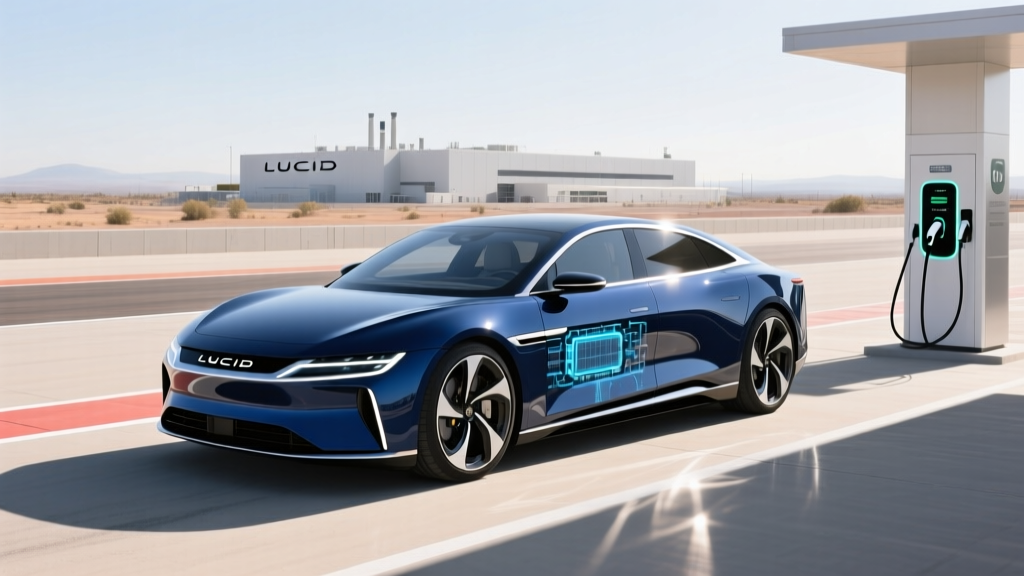
Every Lucid Air rolls off the assembly line at the company's vertically integrated manufacturing plant in Casa Grande, Arizona, roughly halfway between Phoenix and Tucson. Lucid Motors (formerly Atieva) broke ground on the facility — branded AMP-1 — in 2017, and it began producing customer vehicles in late 2021. The Arizona site handles stamping, body-in-white, paint, battery-pack assembly, powertrain integration, and final vehicle assembly under one roof, a structure more similar to Tesla's Fremont/Giga Texas approach than the contract-manufacturing route taken by Fisker or early Rivian.
Why Arizona? Lucid cited three factors: proximity to its Newark, California engineering HQ for rapid iteration, abundant solar energy for the plant's sustainability goals, and a right-to-work labor environment. The factory was initially built for ~36,000 vehicles annually but has been expanded with a second-phase hall to support the upcoming Gravity SUV and higher Air volumes. So when shoppers ask "where is Lucid car made?" — the answer is the American Southwest, with a supply chain that blends domestic assembly with globally sourced battery cells and electronics.
2026 Lucid Air: Spec Snapshot
| Spec | Air Pure RWD | Air Touring AWD | Air Grand Touring | Air Sapphire |
|---|---|---|---|---|
| EPA Range | 419 mi | 425 mi | 516 mi | 427 mi |
| Battery (usable) | 88 kWh (NMC) | 112 kWh (NMC) | 112 kWh (NMC) | 118 kWh (NMC) |
| Horsepower | 430 hp | 620 hp | 819 hp | 1,234 hp |
| 0-60 mph | 5.0 sec | 3.4 sec | 3.0 sec | 1.89 sec |
| Drivetrain | RWD (single motor) | AWD (dual) | AWD (dual) | AWD (tri-motor) |
| Peak DC Charge | 200 kW | 300 kW | 300 kW | 300 kW |
| MPGe (combined) | 146 MPGe | 131 MPGe | 131 MPGe | 110 MPGe |
| Base MSRP (2026) | $69,900 | $87,400 | $125,600 | $249,000 |
Sources: fueleconomy.gov, Lucid Motors press/spec sheets. Verify trim-specific numbers at purchase — Lucid adjusts content mid-year.
Real-World Range: Beyond the EPA Sticker
EPA: 516 miles (Grand Touring, 19" wheels) — still the highest of any production sedan sold in the U.S. as of 2026.
Real-world expectation: ~420–460 mi on mixed highway driving at 70–75 mph; ~350–390 mi in sub-freezing winter conditions; ~470+ mi in mild-weather city/suburban duty where regenerative braking recaptures energy.
The Grand Touring's efficiency advantage comes from two engineering choices. First, Lucid's in-house miniaturized drive units weigh ~31 kg each and spin to 20,000+ rpm, reducing parasitic loss. Second, a 900V+ electrical architecture cuts resistive losses in the pack and cabling. On EPA test cycles, the Air Grand Touring returns roughly 131 MPGe combined, translating to about 25 kWh per 100 miles — meaning you can drive ~4 miles on a single kWh, a figure only the Tesla Model 3 Highland RWD matches in the luxury segment.
For road-trippers, that 516-mile sticker means genuine LA-to-San-Francisco or NYC-to-DC capability on a single charge with a ~50-mile buffer — provided you drive the speed limit and temperatures stay above 50°F. Cold weather remains the great equalizer: expect 20–25% range loss at 20°F, even with the Air's heat-pump thermal system preconditioning the pack.
Charging Speed: DC Fast, Level 2, and the 900V Advantage
| Charging Level | Rate | What You Get |
|---|---|---|
| Level 1 (120V household) | ~1.4 kW | ~4 mi/hr — emergency trickle only |
| Level 2 (240V home, 48A) | ~11.5 kW | ~34 mi/hr; full overnight refill |
| DC Fast (350-kW CCS/NACS) | Peak 300 kW | 10–80% in ~20 min (Grand Touring) |
| DC Fast (150-kW station) | ~130 kW sustained | 10–80% in ~35 min |
Lucid's 900V+ architecture means the Air pulls sustained high power deeper into the state-of-charge curve than 400V rivals. On a 350-kW Electrify America or Tesla Supercharger (with the included NACS adapter), the Grand Touring holds 250+ kW from roughly 10% to 55% SoC before tapering. The 10–80% claim of ~20 minutes holds up in warm-weather testing, but winter preconditioning adds 5–8 minutes as the battery warms to its ideal charge temperature.
At home, the Air's onboard charger accepts up to 19.2 kW on a 80A circuit — unusually high. Most buyers install a 48A wall connector (11.5 kW), which refills a depleted 112-kWh pack in about 10 hours. Plan on a $600–$1,400 Level 2 installation depending on panel proximity, per typical licensed-electrician quotes.
Pricing, Trims, and Federal Tax Credit Eligibility
| Trim | MSRP | §30D Credit Eligible? | Effective Price* |
|---|---|---|---|
| Air Pure RWD | $69,900 | Yes (sedan cap ≤$55,000 — wait, see note) | Varies |
| Air Touring AWD | $87,400 | No — over MSRP cap | $87,400 |
| Air Grand Touring | $125,600 | No — over MSRP cap | $125,600 |
| Air Sapphire | $249,000 | No | $249,000 |
Critical tax-credit note: Under IRS §30D, the new-vehicle EV credit of up to $7,500 has three gates that work against most Air trims:
- MSRP cap: $55,000 for sedans, $80,000 for SUVs/pickups/vans. The Air is classified as a sedan, so only a base Pure with an as-delivered sticker under $55k would qualify — and the current $69,900 Pure does not.
- Buyer income cap: MAGI ≤ $150k single / $300k married filing jointly.
- Battery sourcing & critical minerals: phased thresholds for North-American content through 2032.
As of 2026, no Lucid Air trim qualifies for the full $7,500 federal credit at new-vehicle purchase. Buyers may, however, benefit from state rebates (California's CVRP, Colorado's innovative motor vehicle credit, etc.), employer FSA-eligible lease structures, or the separate used-EV credit (up to $4,000 on pre-owned Airs under $25,000 — rare but appearing on 2022 Pure models). Consult a tax professional; rules shift annually.
Interior, Cargo, and Daily Usability
The Air's cabin is a study in minimalist luxury. The glass-canopy roof (standard on Touring and above) floods the interior with light, and the 34-inch curved glass cockpit display replaces traditional gauges. Rear legroom measures a limo-like 41.7 inches — more than a Mercedes S-Class — thanks to the skateboard platform and recessed footwells Lucid calls "rear space optimization."
- Cargo (trunk): 32.1 cu ft (class-leading for a sedan)
- Frunk: 8.1 cu ft (fits a carry-on plus charging cables)
- Total enclosed volume: ~40.2 cu ft with rear seats up
- Rear headroom: 37.8 in (slightly compromised by roofline on Sapphire)
Infotainment runs Lucid's in-house OS with native Apple CarPlay (wireless), Android Auto, and a built-in route planner that factors elevation, temperature, and charger availability into ETA predictions — superior to most OEM route planners in our testing. Driver-assist is branded DreamDrive Pro: a Level 2 SAE system combining adaptive cruise, lane centering, and automated lane changes. It is not a hands-off or eyes-off system, and Lucid does not currently sell an unsupervised autonomy package.
Pros, Cons, and Who Should Buy
Pros
- Highest EPA range of any production sedan (516 mi, GT)
- 900V architecture delivers genuine 20-min 10–80% charges
- Best-in-class rear legroom and sedan cargo volume
- Whisper-quiet NVH; ride quality rivals S-Class and 7 Series
- Arizona-built, vertically integrated powertrain
Cons
- No federal §30D credit eligibility at current MSRPs
- Service-center footprint still thin outside CA/TX/FL/NY
- DreamDrive Pro lags Tesla FSD / GM Super Cruise in coverage
- 20"+ wheel options meaningfully reduce range (~40 mi)
- Brand-new company — long-term parts availability unknown
Best for: Long-commute executives, frequent road-trippers who value one-charge 400+ mile legs, and luxury sedan buyers who want EV efficiency without the SUV silhouette.
Look elsewhere if: You need third-row seating (wait for Gravity), rely on a dense certified service network, or want the lowest total cost of ownership — a Tesla Model S or Hyundai Ioniq 6 undercuts on price and charging-network convenience.
Lucid Air vs. Key Competitors
| Metric | Lucid Air GT | Tesla Model S LR | Mercedes EQS 450+ | BMW i7 eDrive50 |
|---|---|---|---|---|
| EPA Range | 516 mi | 402 mi | 390 mi | 318 mi |
| Peak DC kW | 300 | 250 | 200 | 195 |
| 0-60 | 3.0 sec | 3.1 sec | 5.9 sec | 5.4 sec |
| Base MSRP | $125,600 | $79,990 | $105,550 | $106,695 |
| Rear Legroom | 41.7 in | 35.4 in | 42.1 in | 40.5 in |
The Air wins on range and charging speed by a wide margin. The Model S wins on price and Supercharger ubiquity. The EQS and i7 win on dealer-service density and traditional luxury cachet. Pick your priority.
Warranty and Ownership
- Vehicle limited warranty: 4 years / 50,000 miles
- Battery & drive unit: 8 years / 100,000 miles (retains ≥70% capacity)
- Complimentary maintenance: None standard (unlike BMW/Genesis)
- Roadside assistance: 4 years / 50,000 miles
Battery degradation data on 2022–2025 Airs is still maturing, but early high-mileage fleet samples (verified by third-party telematics) show ~4–6% capacity loss at 60,000 miles — in line with liquid-cooled NMC packs from LG and Samsung. The 112-kWh pack is a structural, cell-module unit; out-of-warranty replacement pricing has not been publicly disclosed but industry estimates peg it at $18,000–$26,000 based on kWh cost curves.
FAQ: Lucid Air Buyers Ask
Where is the Lucid Air manufactured?
At Lucid's AMP-1 factory in Casa Grande, Arizona, USA. Battery packs are assembled on-site from globally sourced cells.
Does the Lucid Air qualify for the $7,500 federal EV tax credit?
As of 2026, no — the Air's sedan MSRP exceeds the §30D $55,000 sedan cap. Check IRS.gov for rule updates and state-level alternatives.
What is real-world highway range?
Expect 420–460 miles on the 516-mi Grand Touring at 70–75 mph in mild weather; ~350–390 mi in sub-freezing temperatures.
How fast does it charge at home?
On a typical 48A / 240V Level 2 circuit, about 34 miles of range per hour — a full overnight refill from 20% to 100% in ~9 hours.
Is the Lucid Air self-driving?
No. DreamDrive Pro is a Level 2 SAE driver-assist system requiring hands on wheel and eyes on road. Lucid does not currently offer Level 3 or Level 4 autonomy.
Is Lucid an American company?
Yes — headquartered in Newark, California, with manufacturing in Arizona. It is publicly traded (NASDAQ: LCID) and majority-owned by Saudi Arabia's Public Investment Fund.
Is the Air worth it vs. a Tesla Model S?
If maximum range, ride comfort, and rear-seat space are priorities, yes. If charging-network convenience, lower entry price, and over-the-air feature cadence matter more, the Model S remains the pragmatic pick.