Rivian's origin story is inseparable from its hometown. While most legacy automakers scatter production across dozens of global plants, Rivian has bet everything on a single, massive facility in the American Midwest. If you've been searching for where is Rivian made, the short answer is Normal, Illinois — a town of roughly 53,000 in the heart of corn country that now produces some of the most capable electric adventure vehicles on the road.
But the "where" matters less than the "how well." In this review, we break down Rivian's U.S. manufacturing footprint and then put the current-generation R1S SUV and R1T pickup through the full spec-sheet wringer: EPA range versus real-world highway miles, DC fast-charging curves, LFP battery strategy, §30D tax credit eligibility, and the ownership math that decides whether these trucks earn a spot in your driveway.
Rivian's Manufacturing Home: Normal, Illinois
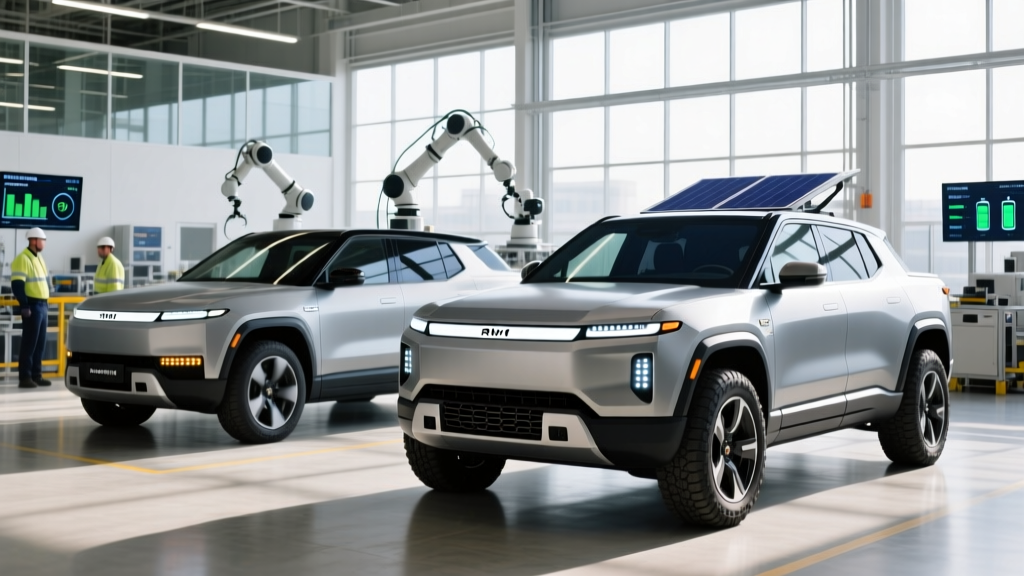
Rivian's sole production facility occupies the former Mitsubishi Motors plant at 101 Rivian Motorway in Normal, Illinois. The company purchased the 3.3-million-square-foot factory in 2017 for $8 million and has since invested over $3 billion in retooling, automation, and battery-pack assembly lines. As of early 2026, the plant employs approximately 9,000 workers across three shifts and has a stated annual capacity of roughly 150,000 vehicles, though actual output depends on supply-chain conditions and demand.
Every Rivian R1S and R1T sold in North America rolls off this single assembly line. Battery packs are assembled on-site from cylindrical cells, and the company has progressively brought more component sourcing in-house, including drive-unit assembly. Rivian's upcoming second factory — a $5 billion facility in Stanton, Georgia — was originally slated for 2026 production but has faced delays. Until that plant comes online, Normal remains the exclusive source of all Rivian consumer vehicles.
The company also produces the Electric Delivery Van (EDV) for Amazon at a dedicated section of the Normal plant, which accounts for a significant share of total output.
2026 Rivian R1S and R1T: The Current Lineup at a Glance
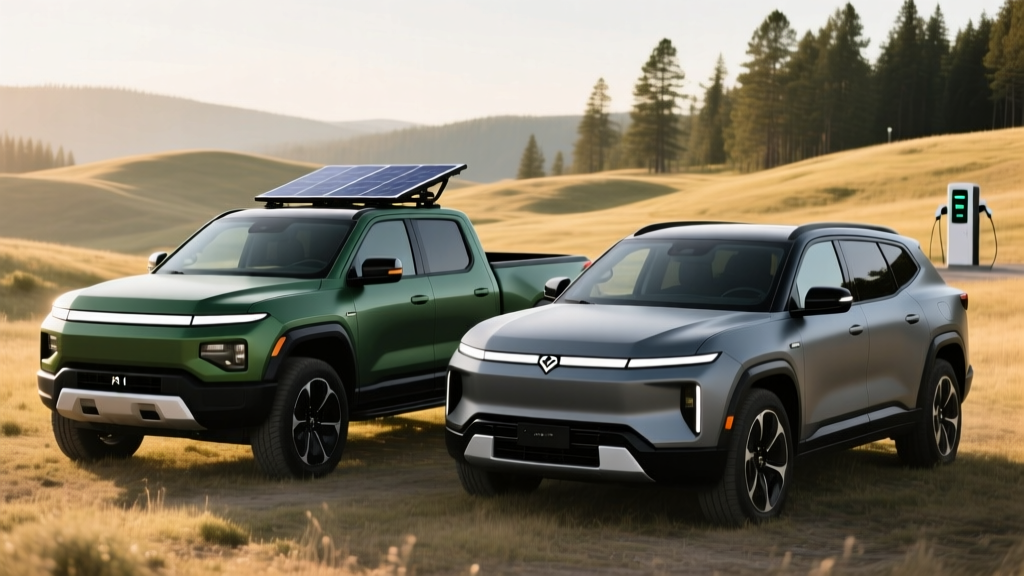
For the 2026 model year, Rivian offers the R1S (three-row SUV) and R1T (crew-cab pickup) in parallel configurations. Both share the same skateboard platform, battery options, and powertrain architecture. Rivian simplified its lineup for Gen 2 (introduced mid-2024 and carried forward), moving to dual-motor and tri-motor variants while dropping the original quad-motor setup.
| Spec | Dual-Motor (Standard) | Dual-Motor Performance | Tri-Motor (R1T only) |
|---|---|---|---|
| Drivetrain | AWD | AWD | AWD |
| Horsepower | 533 hp | 665 hp | 850 hp |
| 0-60 mph | 4.5 sec | 3.4 sec | 2.9 sec |
| Battery (usable) | 92 kWh (LFP) / 106 kWh (NMC) | 106 kWh (NMC) / 141 kWh (Max) | 141 kWh (Max NMC) |
| EPA Range (R1S) | 270 mi (Std) / 352 mi (Large) | 352 mi (Large) | N/A (R1T only) |
| EPA Range (R1T) | 270 mi (Std) / 352 mi (Large) | 352 mi (Large) / 420 mi (Max) | 420 mi (Max) |
| Max DC Charge Rate | 200 kW | 220 kW | 220 kW |
| 10-80% DC Time | ~28 min (Large) | ~25 min (Large) | ~38 min (Max) |
| Towing Capacity | 7,700 lb (R1S) / 11,000 lb (R1T) | 7,700 lb / 11,000 lb | 11,000 lb |
| Base MSRP (R1S) | $75,900 | $81,400 | N/A |
| Base MSRP (R1T) | $69,900 | $75,400 | $99,900 |
Real-World Range: What the EPA Sticker Doesn't Tell You
- Highway cruising (70-75 mph, 72°F): Expect ~290-310 miles. Aerodynamic drag on the boxy SUV shape hits hard above 70 mph.
- Cold weather (32°F, highway): Range drops to approximately 230-260 miles. Rivian's heat pump mitigates cabin-heat draw, but battery chemistry still loses efficiency.
- City/mixed driving (moderate temps): 330-352 miles is achievable thanks to generous regenerative braking.
- Towing (R1T, 5,000 lb trailer): Expect roughly 160-180 miles — cut the sticker range nearly in half.
The R1T with the Max Pack (141 kWh NMC) posts an impressive 420-mile EPA figure, but that pack adds roughly $10,000 to the price and adds significant weight. In our experience, the Max Pack's real-world highway range lands around 350-370 miles in fair weather. The charging curve also tapers noticeably above 80%, making the last 20% of the Max Pack painfully slow on road trips — plan your stops around the 10-80% window.
Efficiency for the R1S Dual-Motor Large sits at roughly 74 MPGe combined (per fueleconomy.gov), translating to about 45 kWh per 100 miles. The R1T runs slightly less efficiently due to the open bed and marginally different aero, at roughly 70 MPGe combined.
Charging Speed: DC Fast Charging and Home Level 2
Rivian's Gen 2 vehicles use the NACS (Tesla-style) charge port as standard, giving native access to the Tesla Supercharger network — a significant advantage over CCS-only vehicles now that the Supercharger network dominates U.S. DC fast-charging infrastructure. Rivian owners can also use Electrify America, EVgo, and other networks via adapter or native CCS support on earlier builds.
| Charging Level | Power | Miles Added per Hour | Notes |
|---|---|---|---|
| Level 1 (120V household) | ~1.4 kW | ~3-4 mi/hr | Emergency/trickle only; ~100+ hours for full charge |
| Level 2 (240V, 48A home charger) | 11.5 kW | ~27-30 mi/hr | Full overnight charge in ~10-12 hours; requires 60A circuit |
| Level 2 (240V, 32A portable) | 7.7 kW | ~18-20 mi/hr | Works on NEMA 14-50 outlet; ~15 hours for full charge |
| DC Fast Charge (peak) | 200-220 kW | ~600-700 mi/hr (at peak) | Peak rate sustained only to ~40% SoC; tapers above 60% |
| DC Fast Charge (10-80%) | Average ~140 kW | — | 25-28 min (Large); 38 min (Max) — plan around the taper |
A critical nuance for new Rivian owners: the Max Pack's 141 kWh battery takes considerably longer to charge from 10-80% than the Large Pack, despite the same peak kW rate. The larger battery's charge curve flattens earlier to protect cell longevity. If your typical road-trip leg is 250 miles, the Large Pack's faster charge cycle may actually get you back on the road sooner than the Max, even though the Max holds more total energy.
For home charging, Rivian sells its own Wall Charger (11.5 kW / 48A) for approximately $750. Professional installation of a 60-amp dedicated circuit typically runs $800-$2,000 depending on your electrical panel's capacity and proximity to the garage. If your panel is maxed out at 100A or 150A, a panel upgrade to 200A can add $1,500-$3,500. Always consult a licensed electrician for final specifications.
Pricing, Trims, and Federal Tax Credit Eligibility
Rivian's pricing positions the R1S and R1T firmly in the premium segment, competing with the Tesla Model X, BMW iX, Ford F-150 Lightning (higher trims), and the Chevrolet Silverado EV. Here's how the lineup breaks down before incentives:
| Model / Trim | Base MSRP | Typical As-Tested | §30D Credit Eligibility |
|---|---|---|---|
| R1T Dual-Motor Standard | $69,900 | $74,000-$78,000 | Up to $7,500 (subject to sourcing/income rules) |
| R1T Dual-Motor Performance Large | $75,400 | $82,000-$90,000 | Up to $7,500 (subject to sourcing/income rules) |
| R1T Tri-Motor Max | $99,900 | $105,000-$115,000 | Exceeds $80,000 truck MSRP cap — NOT eligible |
| R1S Dual-Motor Standard | $75,900 | $80,000-$85,000 | Exceeds $80,000 SUV MSRP cap — NOT eligible |
| R1S Dual-Motor Performance Large | $81,400 | $88,000-$96,000 | Exceeds $80,000 SUV MSRP cap — NOT eligible |
- MSRP caps: $80,000 for SUVs (R1S), $80,000 for pickup trucks (R1T). Any configuration above these thresholds is ineligible.
- Buyer income caps: AGI must not exceed $150,000 (single), $225,000 (head of household), or $300,000 (married filing jointly).
- Battery sourcing: A percentage of critical minerals and battery components must be sourced from the U.S. or free-trade-agreement partners. These percentages increase annually. Verify current-year requirements at irs.gov.
- Point-of-sale transfer: Eligible buyers can transfer the credit to the dealer at purchase, reducing the upfront price rather than waiting for a tax refund.
- Rivian-specific note: Only the R1T Dual-Motor configurations priced at or below $80,000 MSRP potentially qualify. The R1S, classified as an SUV, exceeds the cap in nearly all configurations. Consult a tax professional for your specific situation.
The R1T Dual-Motor Standard at $69,900 is the clear tax-credit play — if your income qualifies and the battery-sourcing requirements are met for the specific build month, you could see a $7,500 point-of-sale reduction bringing the effective price to approximately $62,400. That transforms the value equation significantly against the Ford F-150 Lightning and Chevrolet Silverado EV.
Interior, Cargo, and Standout Technology
The R1S offers three rows of seating with room for up to seven passengers. Second-row legroom measures 38.5 inches, while the third row fits adults on shorter trips at 30.2 inches of legroom. Cargo volume behind the third row is 10.6 cubic feet, expanding to 46.7 cu ft with the third row folded and 91.6 cu ft with both rear rows down.
The R1T provides 54.4 cubic feet of bed volume (4.5-foot bed) and a distinctive 11.0-cubic-foot front trunk (frunk) — one of the largest in the EV truck segment. The R1T's gear tunnel (optional on some trims) adds another 11.7 cu ft of lockable, pass-through storage behind the rear seats.
Standout tech features:
- Rivian Driver+ (Level 2 ADAS): Hands-on highway assist with automatic lane changes. Competent but not class-leading versus Ford BlueCruise or GM Super Cruise in hands-off capability.
- 15.6-inch central touchscreen with a custom Rivian OS — snappy, well-designed, but no Apple CarPlay or Android Auto. Rivian insists its native interface handles navigation, media, and vehicle controls without phone mirroring.
- Four-motor tank turns (Tri-Motor): The tri-motor configuration enables tight-radius pivoting useful on trails. Not available on dual-motor trims.
- Integrated air compressor (optional): Built-in 150-psi compressor for tire inflation and camp gear — a genuine adventure differentiator.
- Camp Kitchen (R1T option): Slide-out electric kitchen with induction cooktop, sink, and utensil storage. ~$5,000 option that's unique in the truck segment.
Notable drawbacks:
- No phone projection (CarPlay/Android Auto) — a dealbreaker for some buyers accustomed to familiar interfaces.
- Service center network remains thin outside major metros; mobile service helps but can't handle major repairs.
- Insurance costs run 15-30% higher than comparable ICE trucks due to repair complexity and parts pricing.
- The R1S third row is tight for adults on longer journeys.
Pros
- Class-leading 420-mile max EPA range (R1T Max Pack)
- Native NACS/Supercharger access — the best public charging experience available
- Genuine off-road capability with 14.9 inches of ground clearance (max)
- 11,000-lb towing capacity (R1T) with integrated trailer-brake controller
- Unique adventure features (gear tunnel, camp kitchen, air compressor)
- Built in the USA — single-factory quality control
- Over-the-air updates continue adding features post-purchase
Cons
- R1S mostly ineligible for §30D credit due to $80K SUV MSRP cap
- No Apple CarPlay or Android Auto
- Max Pack charging taper makes road-trip top-offs slow
- Thin service-center footprint outside coastal and major metro areas
- Premium pricing — even the base R1T starts near $70K
- Insurance premiums significantly above segment average
Battery Chemistry, Warranty, and Long-Term Ownership
Rivian uses two battery chemistries across its lineup. The Standard Pack employs LFP (lithium iron phosphate) cells — lower energy density but superior cycle life and tolerance for daily 100% charging. If you're a commuter who can charge at home every night and rarely road-trips, the LFP Standard Pack is the smartest longevity play. Rivian recommends charging LFP to 100% regularly, unlike NMC.
The Large and Max Packs use NMC (nickel manganese cobalt) chemistry for higher energy density. These packs should be stored at 80-90% for daily use and charged to 100% only before long trips to minimize degradation.
Warranty coverage:
- Battery: 8 years / 175,000 miles (whichever comes first), with a capacity-retention threshold of 70% — meaning Rivian warrants the pack will retain at least 70% of original capacity within the warranty period.
- Powertrain: 8 years / 175,000 miles.
- Bumper-to-bumper: 5 years / 60,000 miles.
Rivian's battery warranty is competitive with Tesla (8 yr / 150,000 mi on Model Y) and exceeds Ford's 8 yr / 100,000 mi on the F-150 Lightning. The 175,000-mile threshold reflects confidence in the pack's longevity, though real-world degradation data on Gen 2 packs is still accumulating.
Who Should Buy a Rivian — And Who Should Look Elsewhere
Choose the Rivian R1T if:
- You need a genuine pickup truck with real towing capacity (11,000 lb) and a usable bed, not just a truck badge on a crossover.
- You regularly venture off-pavement — ski trips, trailheads, camping — and need ground clearance and all-terrain capability.
- You want native Supercharger access and can charge at home with a Level 2 setup.
- The R1T Dual-Motor Standard at ~$62,400 (after credit) fits your budget and use case.
Choose the Rivian R1S if:
- You need three rows for family hauling and the $80K+ price tag (without a tax credit) doesn't deter you.
- You value the adventure-ready platform and don't want a traditional luxury SUV like the BMW iX or Volvo EX90.
Look elsewhere if:
- You want Apple CarPlay or Android Auto — Rivian won't offer it.
- You live far from a Rivian service center and can't tolerate mobile-service-only support for major issues.
- You need a budget-friendly electric truck — the Ford F-150 Lightning Pro starts considerably lower.
- You want hands-off, eyes-off highway driving — Rivian's Driver+ is Level 2 and requires hands on the wheel.
Frequently Asked Questions
Where is Rivian made?
All Rivian R1S and R1T consumer vehicles are manufactured at the company's factory in Normal, Illinois. This is Rivian's only production facility for consumer vehicles as of early 2026. The Amazon Electric Delivery Van is also produced at this location.
What is the real-world range of the Rivian R1T?
The R1T with the Large Pack (106 kWh NMC) carries a 352-mile EPA rating. In real-world highway driving at 70-75 mph in moderate temperatures, expect approximately 290-320 miles. Cold weather (below freezing) reduces this to roughly 240-270 miles. The Max Pack (141 kWh) achieves 420 miles EPA but realistically delivers 350-370 highway miles in fair conditions.
How fast does the Rivian charge at home and on DC fast chargers?
At home on a 48A Level 2 charger (11.5 kW), the R1T adds approximately 27-30 miles of range per hour, fully charging overnight in 10-12 hours. On DC fast chargers, the Large Pack peaks at 220 kW and charges from 10-80% in about 25 minutes. The Max Pack takes roughly 38 minutes for the same 10-80% window due to its larger capacity and earlier charge-curve taper.
Does the Rivian R1T qualify for the $7,500 federal EV tax credit?
The R1T Dual-Motor Standard ($69,900 MSRP) and some Dual-Motor Performance configurations below the $80,000 truck MSRP cap can qualify for up to $7,500 under IRS §30D, provided the buyer meets income limits ($150K single / $300K joint) and the vehicle's battery meets critical-mineral and component-sourcing requirements for the build date. The R1T Tri-Motor Max ($99,900) exceeds the MSRP cap and does not qualify. The R1S, classified as an SUV, exceeds the $80,000 SUV cap in nearly all trims. Always verify current eligibility at irs.gov and consult a tax professional.
Is the Rivian worth buying over the Ford F-150 Lightning or Tesla Cybertruck?
The R1T wins on off-road capability, adventure-specific features (gear tunnel, camp kitchen, air compressor), and build quality. The F-150 Lightning offers a lower entry price, a larger service network, and a more traditional truck layout with a bigger bed. The Cybertruck undercuts on price (AWD at ~$80K) and offers a stainless-steel exoskeleton, but its polarizing design, limited service history, and panel-gap reputation deter some buyers. If adventure use and Supercharger access are priorities, the R1T is the strongest pick. If you need fleet-friendly pricing and a massive dealer network, the Lightning still leads.
What battery chemistry does Rivian use?
Rivian uses LFP (lithium iron phosphate) cells in the Standard Pack, offering longer cycle life and tolerance for daily 100% charging at the cost of lower energy density. The Large and Max Packs use NMC (nickel manganese cobalt) for greater range per kWh but require more careful charge management (store at 80-90% daily, charge to 100% only before trips).
Does Rivian offer Apple CarPlay or Android Auto?
No. Rivian uses its proprietary infotainment system exclusively across all models. The native system is responsive and well-integrated with vehicle functions, but buyers who rely on phone-mirroring for navigation or media should test-drive and evaluate the Rivian interface before purchasing.
Sources: EPA range and efficiency data via fueleconomy.gov; federal tax credit rules via IRS §30D; manufacturer specifications via Rivian.com. All pricing and specs reflect the 2026 model year as of publication and are subject to change. Verify tax credit eligibility with a qualified tax professional before purchase.