The Short Answer: Rivians Are Built in Normal, Illinois
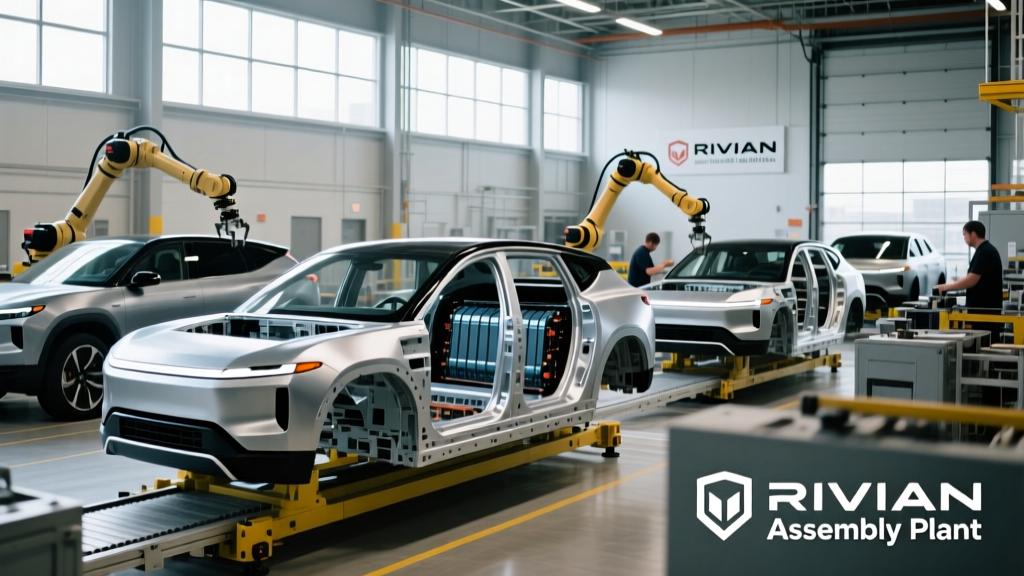
If you've been searching where are Rivians manufactured, the answer is straightforward: every Rivian R1S SUV and R1T pickup sold today rolls off an assembly line in Normal, Illinois — a college town roughly 130 miles southwest of Chicago. Rivian acquired the plant, formerly a Mitsubishi Diamond-Star Motors facility, in 2017 and retooled it for electric-vehicle production. The site spans approximately 3.3 million square feet of floor space and includes body, paint, powertrain, and general-assembly shops under one roof.
Unlike several EV startups that contract-manufacture through Magna or Valmet, Rivian owns and operates its factory outright. That matters for quality control, production pacing, and how quickly the company can push over-the-air (OTA) updates or mid-year spec revisions into the build stream. As of the 2026 model year, Normal is the sole source of consumer Rivians, though Rivian's planned second plant in Stanton, Georgia — announced in late 2024 — is expected to eventually produce the smaller, more affordable R2 and R3 line.
2026 Rivian R1S & R1T: Core Specs at a Glance
Before we dig into the manufacturing story, here's what the Normal, Illinois line is actually producing. Rivian restructured its powertrain lineup for 2025 and carried the architecture into 2026, offering three battery sizes across dual-motor and tri-motor configurations.
| Spec | Dual-Motor Standard | Dual-Motor Max | Tri-Motor Max |
|---|---|---|---|
| Drivetrain | AWD (dual motor) | AWD (dual motor) | AWD (tri motor) |
| Horsepower | 533 hp | 533 hp | 850 hp |
| 0–60 mph | 4.5 sec | 4.5 sec | 2.9 sec |
| Battery (usable) | ~92 kWh (LFP) | ~128 kWh (NMC) | ~128 kWh (NMC) |
| EPA Range (R1S) | 270 mi | 352 mi | 321 mi |
| EPA Range (R1T) | 270 mi | 352 mi | 321 mi |
| Max DC Fast Charge | 200 kW | 220 kW | 220 kW |
| 10–80% DCFC Time | ~28 min | ~30 min | ~30 min |
| Level 2 Home Charge | 11.5 kW (~25 mi/hr) | 11.5 kW (~25 mi/hr) | 11.5 kW (~25 mi/hr) |
| Towing (max) | 7,700 lb | 7,700 lb | 7,700 lb |
| Base MSRP (R1S) | $75,900 | $83,400 | $99,900 |
| Base MSRP (R1T) | $69,900 | $77,400 | $93,900 |
Sources: fueleconomy.gov, Rivian official specs.
Real-World Range: What the EPA Sticker Doesn't Tell You
EPA sticker (Dual-Motor Max R1S): 352 miles
Real-world highway (70 mph, 65°F): ~280–300 miles
Real-world cold weather (30°F, highway): ~230–260 miles
Tri-Motor Max penalty: Subtract ~30 miles vs. Dual-Motor Max due to added weight and a less aero-efficient tri-motor drive unit.
Rivian's boxy truck and SUV shapes prioritize interior volume and ground clearance over aerodynamic efficiency. At highway speeds, the R1S and R1T consume roughly 42–48 kWh/100 mi depending on configuration — significantly thirstier than a Tesla Model Y (~28 kWh/100 mi) but competitive with the Ford F-150 Lightning and GMC Hummer EV.
If your commute is mostly city and suburban, regen-heavy driving pushes real-world numbers closer to the EPA sticker. Road-trippers averaging 75–80 mph in winter should plan around 220–250 miles between DC fast-charge stops.
Charging Speed: The Normal-Built Pack's Curve
Rivian's 2025+ battery architecture supports peak DC fast-charge rates up to 220 kW on the Max pack and 200 kW on the Standard (LFP) pack. Like all lithium-ion packs, the charge curve tapers significantly above 80% state of charge. Here's what that looks like in practice:
| Charging Level | Power / Rate | Time / Miles Added |
|---|---|---|
| Level 1 (120V outlet) | ~1.4 kW | ~3 mi/hr — emergency use only |
| Level 2 (240V home, 48A) | 11.5 kW | ~25 mi/hr; full charge in ~11 hr |
| DC Fast (10–80%) | Peak 220 kW | ~30 min (Max), ~28 min (Standard) |
| DC Fast (80–100%) | Tapers to <50 kW | Add another ~35–45 min |
Home charging note: Rivian's onboard charger maxes out at 11.5 kW (48 amps). To get that rate you need a hardwired Level 2 wall connector on a 60-amp breaker. A NEMA 14-50 outlet on a 50-amp circuit delivers roughly 9.6 kW, adding ~21 miles per hour — still sufficient for overnight replenishment. Factor in $500–$1,500 for electrician labor and permitting; add $1,500–$3,000 if your panel needs a 200-amp upgrade.
Rivian vehicles use the NACS (Tesla-style) connector natively on 2025+ models, granting direct access to Tesla Superchargers without an adapter — a significant real-world advantage over CCS-only EVs in rural corridors.
Efficiency, Performance, and the Tri-Motor Question
The Dual-Motor Max R1S returns roughly 2.1–2.3 kWh/mi (about 73–79 MPGe combined, per EPA data). The Tri-Motor, despite its 850 hp and sub-3-second 0–60 time, drops to around 68 MPGe combined because of the extra motor mass and more aggressive thermal management demands.
For most buyers, the Dual-Motor Max is the sweet spot: 533 hp is more than adequate for merging and mountain passes, the 352-mile EPA range is class-leading among three-row electric SUVs, and the price stays below the critical $80,000 MSRP threshold that affects federal tax-credit eligibility for SUVs.
Inside the Normal, Illinois Factory
The Normal plant is more than an assembly hall — it's a vertically integrated campus. Key production facts:
- End-of-line battery pack assembly: Rivian receives cells from suppliers (Samsung SDI for NMC; CATL-sourced LFP cells for the Standard pack) and assembles structural battery packs on-site.
- Drive-unit manufacturing: The dual- and tri-motor drive units are assembled in-house, including the oil-cooled permanent-magnet motors.
- Skateboard architecture: The R1S and R1T share a common skateboard chassis, allowing the same line to flex between SUV and truck builds based on order mix.
- Capacity: Rivian has incrementally expanded throughput; the plant can produce roughly 150,000 vehicles annually across both models at peak, though actual output depends on demand and supply-chain pacing.
Rivian has also invested in an on-site battery recycling partnership and solar canopies over employee parking — small signals, but they matter to buyers who weigh manufacturing footprint alongside tailpipe emissions.
Pricing, Trims, and Federal Tax Credit Eligibility
Here's where the MSRP caps of the IRS §30D federal tax credit become relevant. Under current rules, SUVs (including the R1S) must have an MSRP at or below $80,000 to qualify; trucks (R1T) are capped at the same $80,000 limit. Buyer adjusted gross income must not exceed $150,000 (single), $225,000 (head of household), or $300,000 (joint). The vehicle must also meet critical-mineral and battery-component sourcing thresholds, which tighten each year. Full rules are published at IRS.gov.
| Configuration | MSRP | §30D Eligible? | Effective Price (w/ max credit) |
|---|---|---|---|
| R1T Dual-Motor Standard | $69,900 | Yes (if income/sourcing met) | ~$62,400 |
| R1T Dual-Motor Max | $77,400 | Yes (if income/sourcing met) | ~$69,900 |
| R1T Tri-Motor Max | $93,900 | No (MSRP > $80k cap) | $93,900 |
| R1S Dual-Motor Standard | $75,900 | Yes (if income/sourcing met) | ~$68,400 |
| R1S Dual-Motor Max | $83,400 | No (MSRP > $80k cap) | $83,400 |
| R1S Tri-Motor Max | $99,900 | No (MSRP > $80k cap) | $99,900 |
Buyers can elect to transfer the credit to the dealer at point of sale, reducing the purchase price directly. Always confirm current-year sourcing compliance with your dealer before signing — a vehicle that qualified in 2025 may not in 2026 if battery-component thresholds tightened.
Cargo, Passenger Space, and Daily Livability
The R1S offers three rows with seating for seven. Behind the third row, cargo volume is roughly 10.4 cu ft; fold the third row and you get about 46.7 cu ft; fold both rear rows for a max of 104.7 cu ft. Front and second-row legroom are generous (41.3 and 39.5 inches respectively), though the third row is best reserved for children on longer trips.
The R1T pickup provides a 4.5-foot bed (extendable with the mid-gate down to over 6 feet), a front trunk (frunk) of ~11 cu ft with a drainable bin — handy for tailgating or muddy gear — and the signature Gear Tunnel on longer-bed configurations for secure, lockable cross-body storage.
Standout Tech, Driver Assists, and Drawbacks
Rivian's in-house software stack is one of its strongest differentiators. The 15.6-inch center display runs a custom Linux-based OS with over-the-air updates, native trip planning that accounts for elevation and temperature, and a camp-mode that maintains HVAC overnight. The Driver+ system is a SAE Level 2 driver-assist suite — it includes adaptive cruise, lane-centering, and highway assist, but requires the driver to remain engaged at all times. It is not self-driving.
Driver+ is SAE Level 2: You must keep your hands on the wheel and eyes on the road. Hands-free operation is not supported, unlike GM Super Cruise or Ford BlueCruise on mapped highways.
Notable drawbacks: The R1S and R1T still lack Apple CarPlay and Android Auto — Rivian insists on its native stack, which frustrates some buyers. Service-center density remains thinner than Tesla's, especially outside major metros. And the vehicle's height (over 73 inches for the R1S) can rule out older parking garages.
Warranty and Long-Term Ownership
Rivian provides a 5-year/60,000-mile bumper-to-bumper limited warranty and an 8-year/120,000-mile battery and drive-unit warranty, covering packs that degrade below 70% of original capacity. That 120,000-mile powertrain term is competitive with the broader EV market, though Tesla's 8-year/150,000-mile coverage on Model X is slightly longer.
Replacement battery packs for the Max configuration are estimated in the $18,000–$25,000 range out of warranty — a figure worth factoring into 10-year ownership projections if you plan to keep the vehicle past the warranty window.
Who the Rivian R1S and R1T Are For
Choose the R1S if: You need a three-row electric SUV with genuine off-road capability (up to 14.9 inches of ground clearance in Max mode), 352 miles of EPA range, and family-friendly cargo space — and you're willing to trade some efficiency for adventure readiness.
Choose the R1T if: You want an electric pickup that tows 7,700 pounds, fits a standard garage (barely), and offers the Gear Tunnel and frunk as practical differentiators over the F-150 Lightning.
Look elsewhere if: You prioritize maximum MPGe and low running costs (Tesla Model Y or Hyundai Ioniq 5), need hands-free highway driving (GM Super Cruise), or want a lower entry price under $55,000.
Pros and Cons at a Glance
Pros
- Class-leading EPA range on Dual-Motor Max (352 mi)
- Genuine off-road hardware: quad-corner air suspension, tank turns
- Native NACS connector — no adapter for Superchargers
- Strong OTA software cadence, trip-planning built in
- U.S.-built in Normal, Illinois — supports §30D sourcing rules
Cons
- No Apple CarPlay or Android Auto
- Efficiency trails car-based EVs (~42–48 kWh/100 mi highway)
- Tri-Motor and Max-pack R1S exceed $80k MSRP cap — no federal credit
- Service-center footprint still growing outside major metros
- Driver+ is Level 2 only — no hands-free highway mode
Frequently Asked Questions
Where are Rivians manufactured?
Every consumer Rivian R1S and R1T is built at Rivian's owned-and-operated factory in Normal, Illinois. A second plant in Stanton, Georgia is planned for future R2/R3 production but is not yet operational.
What is the real-world range of the Rivian R1S and R1T?
The EPA rates the Dual-Motor Max at 352 miles. Expect ~280–300 miles on highway road trips at 70 mph in mild weather, and ~230–260 miles in freezing temperatures. The Tri-Motor sacrifices roughly 30 miles for its extra performance.
How fast does a Rivian charge at home and on the road?
On a 240V Level 2 home charger, Rivian's 11.5-kW onboard charger adds about 25 miles of range per hour. At a DC fast charger, the Max pack peaks at 220 kW and reaches 10–80% in roughly 30 minutes before tapering above 80%.
Does the Rivian R1S or R1T qualify for the federal EV tax credit?
The Dual-Motor Standard trims of both the R1T ($69,900) and R1S ($75,900) fall under the $80,000 MSRP cap and can qualify for up to $7,500 under IRS §30D — provided the buyer meets income limits and the vehicle satisfies battery-sourcing requirements. Max-pack and Tri-Motor configurations exceed the cap and are ineligible. Always verify current-year rules at IRS.gov.
Is a Rivian worth buying over a Tesla Model X or Ford F-150 Lightning?
If you value off-road capability, adventure-oriented features (Gear Tunnel, frunk, air suspension), and U.S. manufacturing, Rivian earns its premium. If efficiency, hands-free driving tech, or a lower entry price are your priorities, the Model Y or F-150 Lightning may be a better fit.
What battery chemistry does Rivian use?
The Standard pack uses LFP (lithium iron phosphate) chemistry — heavier but longer-lasting and less dependent on nickel/cobalt supply chains. The Max pack uses NMC (nickel manganese cobalt) for higher energy density and longer range.