Where Are Rivians Built? Inside the Normal, Illinois EV Factory
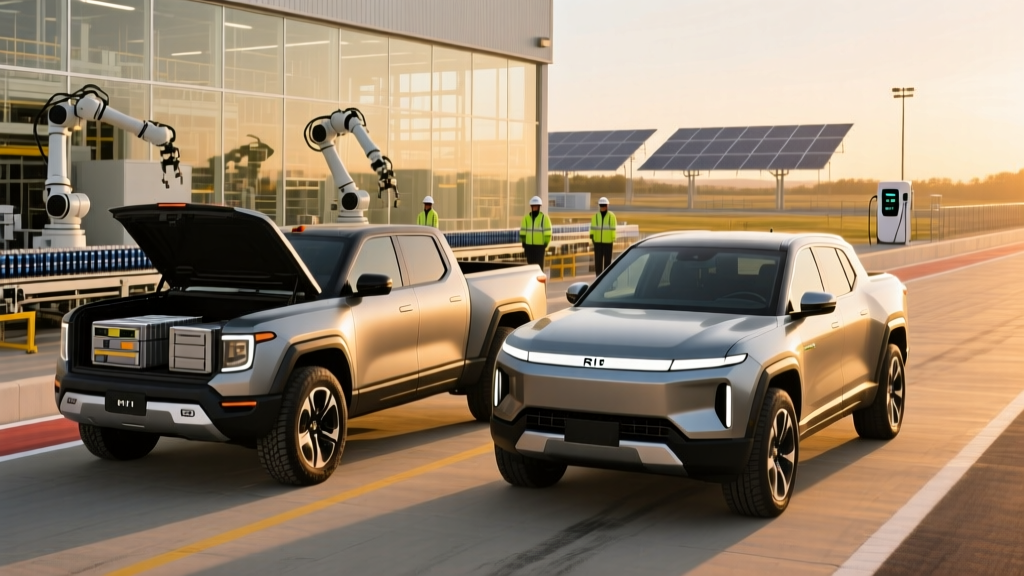
Every Rivian R1T pickup and R1S SUV rolling onto American roads shares one birthplace: a 3.3-million-square-foot manufacturing complex in Normal, Illinois. This facility — originally a Mitsubishi/Diamond-Star plant that Rivian purchased in 2017 — is the sole production source for all Rivian consumer vehicles worldwide. There is no second plant, no overseas assembly, and no contract-manufacturing arrangement. When you ask "where are Rivians built," the answer is a single ZIP code: 61761.
The Normal factory handles stamping, body welding, paint, battery pack assembly, powertrain integration, and final vehicle assembly under one roof. Rivian also assembles its commercial Electric Delivery Vans (EDVs) for Amazon and other fleet customers at this same site, though those vehicles run on a separate production line. As of early 2026, the plant operates on a single-shift basis with an annual capacity estimated at roughly 150,000 vehicles, though Rivian has publicly stated plans for a second, higher-volume facility (often referred to as its Georgia plant) to eventually handle more affordable models.
Why does manufacturing origin matter to a buyer? Under the current IRS §30D federal tax credit rules, battery-component and critical-mineral sourcing requirements heavily influence whether a vehicle qualifies. Rivian's domestic assembly is a baseline advantage, but the battery-cell supply chain determines the final credit outcome. We'll break that down in the pricing section below.
2026 Rivian R1T & R1S: Core Spec Table
The 2026 model year carries forward the "Gen 2" architecture Rivian introduced for the 2025 refresh, which consolidated the dual-motor and tri-motor powertrains, updated the battery pack options, and simplified the software stack. Here are the hard numbers buyers need.
| Spec | R1T Dual-Motor (Standard) | R1T Dual-Motor (Max Pack) | R1T Tri-Motor |
|---|---|---|---|
| EPA Range | 270 mi | 420 mi | 380 mi |
| Battery (usable) | ~92 kWh (LFP) | ~141 kWh (NMC) | ~141 kWh (NMC) |
| Horsepower | 533 hp | 533 hp | 850 hp |
| 0–60 mph | 4.5 sec | 4.5 sec | 2.9 sec |
| Drivetrain | AWD (dual-motor) | AWD (dual-motor) | AWD (tri-motor) |
| Max DC Fast Charge | 200 kW | 220 kW | 220 kW |
| 10–80% DC Time | ~28 min | ~30 min | ~30 min |
| Level 2 Home Charge | 11.5 kW (~25 mi/hr) | 11.5 kW (~25 mi/hr) | 11.5 kW (~25 mi/hr) |
| Towing Capacity | 11,000 lb | 11,000 lb | 11,000 lb |
| Base MSRP | $69,900 | $83,900 | $99,900 |
The R1S SUV shares the same powertrain and battery options with slightly lower range figures (roughly 5–10 miles less per pack due to increased weight and frontal area). Pricing for the R1S starts at $74,900 for the Dual-Motor Standard.
Real-World Range: What the EPA Sticker Doesn't Tell You
- Highway (70 mph, 75°F): Expect ~320–340 miles. The R1T's boxy aerodynamics and 6,700+ lb curb weight hit efficiency hard at sustained speed.
- Cold weather (20°F, highway): Plan for ~250–280 miles. Lithium-ion chemistry loses 25–35% range in sub-freezing temps, even with the R1T's heat pump preconditioning.
- Towing (5,000 lb trailer): Range drops to roughly 180–210 miles. Aerodynamic drag from a trailer doubles energy consumption.
- City/commuter (mixed, 75°F): 380–410 miles is achievable thanks to regenerative braking and lower average speeds.
Rivian's 420-mile Max Pack figure is legitimate for the EPA test cycle, but truck buyers should plan real trips around the ~320-mile highway reality. The Standard Pack's 270-mile EPA rating translates to roughly 200–220 miles on an interstate road trip — enough for daily commuting with home charging, but tight for long-distance travel without route planning. The EPA's fueleconomy.gov listing confirms the combined MPGe ratings at 73 MPGe for the Dual-Motor and 70 MPGe for the Tri-Motor, which equates to roughly 46–48 kWh per 100 miles driven.
Charging Speed: DC Fast Charging and Home Level 2
Rivian uses the NACS (North American Charging Standard) connector on all 2026 models, giving native access to Tesla Supercharger stalls — a significant network advantage over CCS-equipped competitors. Here is what the charging experience looks like in practice.
| Charging Level | Power / Rate | Miles Added per Hour | Notes |
|---|---|---|---|
| Level 1 (120V household) | ~1.4 kW | ~3 mi/hr | Emergency/trickle only |
| Level 2 (240V home, 48A) | 11.5 kW | ~25 mi/hr | Full overnight charge in 8–12 hrs depending on pack |
| DC Fast (peak) | 200–220 kW | ~550 mi/hr (at peak) | Peak sustained for ~15 min; tapers significantly above 80% SoC |
Charging-curve reality check: Rivian's 220 kW peak applies only between roughly 10–40% state of charge on the Max Pack. Above 60%, the rate drops to ~120 kW, and above 80% it falls below 50 kW to protect battery longevity. A 10–80% session on a 350 kW-capable charger takes approximately 30 minutes for the Max Pack and 28 minutes for the Standard Pack. If you routinely charge only to 80% for daily use (recommended for NMC packs), a 20–80% top-up at a Supercharger takes roughly 22 minutes.
For home charging, Rivian recommends a hardwired 60-amp circuit delivering 48 amps continuous to the vehicle. A full Standard Pack charge (92 kWh) takes about 8.5 hours; the Max Pack (141 kWh) requires roughly 12.5 hours. Most owners charging overnight from a 20–80% daily window will need 5–7 hours.
2026 Pricing, Trim Levels, and Federal Tax Credit Eligibility
Rivian simplified its trim structure for 2026 into three tiers: Dual-Motor Standard, Dual-Motor Max, and Tri-Motor. Adventure and Ascend packages add cosmetic and convenience features but do not change powertrain specs. Here is what you will actually pay.
| Trim | Base MSRP | As-Tested (typical) | §30D Credit Eligibility | Effective Price (est.) |
|---|---|---|---|---|
| Dual-Motor Standard | $69,900 | $73,500 | Up to $3,750 (partial) | ~$66,150 – $69,750 |
| Dual-Motor Max Pack | $83,900 | $89,000 | Up to $3,750 (partial) | ~$80,150 – $85,250 |
| Tri-Motor | $99,900 | $106,000 | $0 (exceeds MSRP cap) | $99,900 – $106,000 |
Federal tax credit breakdown (§30D rules, 2026): The full $7,500 credit requires meeting both a battery-component test (100% North American assembly of battery components) and a critical-minerals test (sourcing from the U.S. or FTA partners). As of the 2026 model year, Rivian's battery cells are sourced from Samsung SDI, which has manufacturing operations in South Korea (an FTA partner) and the U.S. (Georgia cell plant ramping). Rivian's Dual-Motor Standard and Max Pack configurations under the $80,000 truck MSRP cap have qualified for a partial credit of $3,750 (meeting one of the two sourcing tests), though exact eligibility depends on the production batch and the latest IRS qualified-vehicle list. The Tri-Motor at $99,900 exceeds the $80,000 MSRP cap for trucks and is ineligible regardless of sourcing.
Buyer income caps also apply: modified adjusted gross income must not exceed $150,000 (single), $225,000 (head of household), or $300,000 (joint). The credit can be transferred to the dealer at point of sale as an instant discount, or claimed on your tax return. Consult a tax professional for your specific situation.
Interior Space, Cargo, and Daily Practicality
The R1T's 54-inch bed is shorter than a full-size truck's, but Rivian compensates with the Gear Tunnel — a 11.6-cubic-foot pass-through compartment between the cab and bed that locks and is weatherproof. Combined with the 11-cubic-foot front trunk (frunk), total enclosed cargo capacity reaches roughly 50 cubic feet with the tonneau cover closed.
Passenger space is generous for a midsize truck: front legroom measures 41.3 inches, rear legroom 38.2 inches. The rear bench fits three adults, though the middle seat is narrow. The R1S three-row SUV offers 12.0 cubic feet behind the third row, 46.7 cubic feet with the third row folded, and 91.6 cubic feet with both rear rows down — competitive with the Tesla Model X and more practical than most three-row EVs.
Infotainment runs on Rivian's proprietary 15.6-inch center display with native navigation, over-the-air updates, and a built-in Wi-Fi hotspot. There is no Apple CarPlay or Android Auto — a deliberate choice that frustrates some buyers. Driver assistance includes Rivian's Highway Assist (SAE Level 2), which provides adaptive cruise control and lane-centering but requires continuous driver supervision. It is not a hands-free system like GM's Super Cruise or Ford's BlueCruise.
Pros and Cons: An Honest Assessment
Pros
- Class-leading 420-mile Max Pack range for an electric pickup
- Native NACS connector with full Supercharger network access
- Gear Tunnel and frunk provide more enclosed cargo space than any competitor
- 11,000-lb towing capacity with integrated trailer brake controller
- Over-the-air updates continuously improve functionality
- Built in the USA (Normal, IL) — supports domestic manufacturing
Cons
- Tri-Motor pricing exceeds $100K and is ineligible for federal tax credit
- No Apple CarPlay or Android Auto
- Highway range drops significantly due to boxy aero and 6,700+ lb weight
- Highway Assist requires hands-on-wheel — no hands-free driving mode
- Service center network still limited outside major metro areas
- Only one factory — production delays can cascade to delivery timelines
Who Should Buy a Rivian R1T or R1S?
The Rivian R1T is the right truck for outdoor-active households who need genuine off-road capability, 11,000-lb towing, and enclosed cargo storage but also want daily-driver refinement and lower running costs than a gas truck. It is not the right choice for fleet buyers prioritizing lowest cost per mile, or for those who need an 8-foot bed for commercial use.
The R1S suits families needing three rows and electric drivetrains who find the Tesla Model X too expensive and the Kia EV9 too car-like. It excels on ski trips, camping weekends, and school runs alike — provided you have Level 2 home charging and accept the ~320-mile highway range reality.
Warranty and Battery Longevity
Rivian provides an 8-year/175,000-mile battery and drive-unit warranty that guarantees at least 70% capacity retention over the coverage period. The bumper-to-bumper warranty runs 5 years/60,000 miles. These terms are competitive with Tesla's 8-year/150,000-mile coverage and slightly more generous on mileage. Rivian's LFP Standard Pack is expected to show slower long-term degradation than the NMC Max Pack, as LFP chemistry tolerates regular 100% charging and has a longer cycle life — a practical advantage for daily commuters who charge to full every night.
Frequently Asked Questions
Are any Rivians built outside the United States?
No. Every Rivian R1T, R1S, and Electric Delivery Van is manufactured at the company's facility in Normal, Illinois. There are no overseas assembly plants or contract-manufacturing partners.
What is the real-world highway range of the Rivian R1T?
The EPA rates the R1T Dual-Motor Max Pack at 420 miles, but real-world highway driving at 70 mph in moderate temperatures yields approximately 320–340 miles. In cold weather (below 30°F), expect 250–280 miles. Standard Pack owners should plan around 200–220 highway miles.
How fast does the Rivian R1T charge on a DC fast charger?
The R1T Max Pack peaks at 220 kW and charges from 10–80% in approximately 30 minutes on a capable charger. The Standard Pack peaks at 200 kW with a 10–80% time of about 28 minutes. Charging slows substantially above 80% to protect battery health.
Does the 2026 Rivian R1T qualify for the $7,500 federal EV tax credit?
Partially. The Dual-Motor Standard and Max Pack trims under the $80,000 MSRP cap have qualified for $3,750 (meeting one of two battery-sourcing requirements). The Tri-Motor at $99,900 exceeds the truck MSRP cap and is ineligible. Buyer income caps also apply. Check the IRS qualified vehicles list for the latest eligibility.
Is the Rivian R1T worth buying over the Ford F-150 Lightning or Chevy Silverado EV?
The R1T wins on range (420 vs. 320 miles for the Lightning's Max Range), off-road capability, and cargo innovation (Gear Tunnel). The F-150 Lightning offers a lower entry price and a more established dealer service network. The Silverado EV targets fleet and commercial buyers with a longer bed. For outdoor-lifestyle buyers who prioritize range and adventure features, the R1T remains the segment leader. For budget-focused truck buyers, the Lightning is harder to beat.
Does Rivian offer hands-free driving?
No. Rivian's Highway Assist is an SAE Level 2 driver-assistance system that requires continuous hands-on-wheel supervision. It does not offer hands-free operation like GM's Super Cruise or Ford's BlueCruise on mapped highways.