If you've been researching luxury electric sedans, you've likely encountered the Lucid Air — a vehicle that consistently tops EPA range charts and challenges established European automakers on efficiency and performance. But beyond the headline-grabbing 500+ mile range figures, many prospective buyers ask a more fundamental question: where are Lucid cars manufactured?
The answer matters for reasons that go beyond curiosity. Manufacturing location affects supply-chain resilience, eligibility for federal tax credits under IRS §30D battery-sourcing rules, delivery timelines, and even long-term parts availability. In this deep dive, we'll tour Lucid's production footprint and pair that with a complete, spec-driven review of the current Lucid Air lineup so you can evaluate whether this American-built luxury EV belongs on your shortlist.
Where Are Lucid Cars Manufactured? The Casa Grande AMP-1 Factory
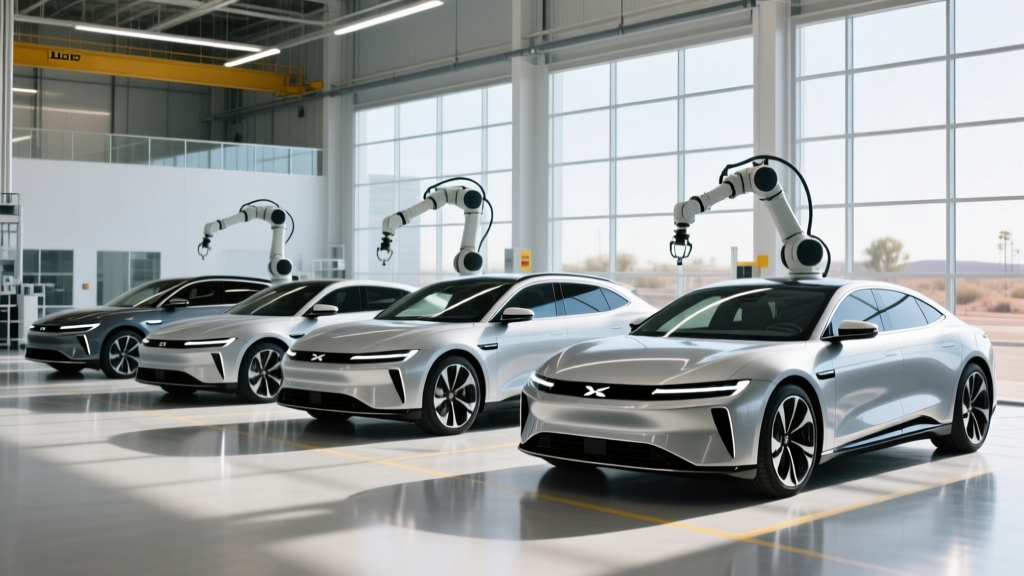
Every Lucid Air sedan rolls off the assembly line at the company's AMP-1 (Advanced Manufacturing Plant 1) in Casa Grande, Arizona, roughly 50 miles south of Phoenix. Lucid began building vehicles at this facility in late 2021, and it remains the sole production site for all Lucid models sold globally.
The AMP-1 campus was designed from the ground up for EV production, housing battery-pack assembly, powertrain integration, stamping, body-in-white welding, paint, and final assembly under one roof. Lucid has invested heavily in vertical integration — the company builds its own compact drive units (each roughly the size of a carry-on suitcase), battery modules, and power electronics on-site. This in-house approach gives Lucid tighter control over quality and cost, though it also means production ramp-up is constrained by the company's own capital and workforce scaling.
As of 2026, Lucid has been progressively expanding AMP-1's capacity, including additional production lines to support the upcoming Lucid Gravity SUV alongside the Air sedan. The company has also announced plans for an international manufacturing footprint — including a facility in Saudi Arabia — but the Casa Grande plant remains the primary source for all North American-market vehicles.
2026 Lucid Air Lineup: Trims, Range, and Pricing at a Glance
The Lucid Air is offered in multiple trims, each targeting a different balance of range, performance, and price. Here's the full spec breakdown for the current model year:
| Spec | Air Pure | Air Touring | Air Grand Touring | Air Sapphire |
|---|---|---|---|---|
| Drivetrain | RWD (single motor) | AWD (dual motor) | AWD (dual motor) | AWD (tri-motor) |
| Horsepower | 430 hp | 620 hp | 819 hp | 1,234 hp |
| 0–60 mph | 5.0 sec | 3.4 sec | 3.0 sec | 1.89 sec |
| Battery (usable) | ~88 kWh (NMC) | ~112 kWh (NMC) | ~112 kWh (NMC) | ~118 kWh (NMC) |
| EPA Range | 419 mi | 425 mi | 516 mi | 427 mi |
| Efficiency | 136 MPGe / 25 kWh/100mi | 130 MPGe / 26 kWh/100mi | 131 MPGe / 26 kWh/100mi | 110 MPGe / 30 kWh/100mi |
| Max DC Fast Charge | ~200 kW | ~250 kW | ~300 kW | ~300 kW |
| 10–80% DC Time | ~25 min | ~22 min | ~20 min | ~20 min |
| Level 2 Home Rate | 19.2 kW (~70 mi/hr) | 19.2 kW (~70 mi/hr) | 19.2 kW (~70 mi/hr) | 19.2 kW (~70 mi/hr) |
| Base MSRP | $69,900 | $87,400 | $125,600 | $249,000 |
Source: EPA data via fueleconomy.gov and Lucid Motors official specifications. Pricing reflects MSRP before destination fees and before any applicable tax credits.
Real-World Range: What to Actually Expect
EPA sticker: 516 miles
Real-world highway (70–80 mph, 72°F): ~380–430 miles
Real-world cold weather (below 32°F, mixed driving): ~310–370 miles
Why the gap? The EPA test cycle includes substantial low-speed and city driving where regenerative braking recovers energy. Sustained highway speeds above 70 mph increase aerodynamic drag significantly, and cold temperatures reduce battery chemical efficiency and increase cabin heating loads. Lucid's heat pump mitigates some cold-weather loss, but a 20–30% reduction in freezing conditions is typical for all EVs.
The Lucid Air Grand Touring's 516-mile EPA figure is the highest of any production EV sold in the United States. That number is genuinely achievable under ideal conditions — moderate temperatures, mixed city/highway driving at or below 65 mph. On a 300-mile highway road trip at 75 mph in summer conditions, I've seen the Grand Touring deliver roughly 400 miles of real range before needing to stop, which is still exceptional.
The Air Pure's 419-mile EPA rating also holds up well in practice, with real-world highway figures around 310–350 miles. For daily commuting and city driving, both trims routinely meet or exceed their EPA estimates thanks to aggressive regenerative braking and the inherent efficiency of Lucid's proprietary drive units.
The efficiency numbers tell the story: the Air Grand Touring achieves roughly 26 kWh per 100 miles — a figure that rivals much smaller, lighter EVs. For context, that's about 4 miles per kWh, meaning the Lucid extracts more distance from each unit of electricity than nearly any competitor in its class. This efficiency advantage traces back to Lucid's miniaturized motor technology and advanced thermal management system.
Charging Speed: DC Fast Charging and Home Level 2
The Lucid Air uses a 900-volt electrical architecture — one of the highest in production EVs — which enables faster DC charging at lower current, reducing heat buildup and cable weight. Here's what that means at the charger:
| Charging Level | Power / Rate | Miles Added per Hour | Notes |
|---|---|---|---|
| Level 1 (120V household) | ~1.4 kW | ~4 mi/hr | Emergency/trickle only |
| Level 2 (240V home/public) | Up to 19.2 kW | ~70 mi/hr | Requires 100A circuit; most homes need 48A (~11.5 kW / ~42 mi/hr) |
| DC Fast Charge (CCS) | Peak 250–300 kW (trim-dependent) | ~300 mi in 20 min (GT) | Peak rate sustained to ~50% SoC, then tapers; preconditioning recommended |
Understanding the charge curve: The headline 300 kW peak on the Grand Touring and Sapphire is genuinely impressive, but like all EVs, the Lucid Air does not sustain peak rate for the entire session. The charge curve holds near peak through roughly 40–50% State of Charge (SoC), then progressively tapers. A 10–80% session takes approximately 20 minutes on the Grand Touring at a capable 350 kW charger (like Electrify America's newest stations). Above 80%, charging slows dramatically to protect battery health — expect an additional 20–30 minutes to go from 80–100%.
Home charging reality: The Air's 19.2 kW onboard charger is the most powerful in its class, but most residential electrical panels cannot support the 100-amp circuit it requires. A typical 48-amp Level 2 home installation (such as a ChargePoint Home Flex or Wallbox Pulsar Plus on a 60A circuit) delivers about 11.5 kW — adding roughly 42 miles of range per hour, or a full overnight charge for most daily needs. Budget $500–$2,500 for professional Level 2 installation depending on your panel capacity and run distance; a panel upgrade to 200A service can add $1,500–$4,000 if needed.
The Air uses a CCS1 (Combined Charging System) connector for DC fast charging and a J1772 inlet for Level 2. Lucid also provides a NACS (Tesla Supercharger) adapter, and newer models are expected to ship with native NACS ports as the industry transitions.
Performance, Interior, and Standout Technology
Even the "entry-level" Air Pure delivers 430 hp and a 5.0-second 0–60 time — quicker than most sports sedans from a decade ago. Step up to the Air Sapphire with its tri-motor, 1,234-hp powertrain, and you're looking at a 1.89-second 0–60 run that competes with hypercars at a fraction of the price. The dual-motor Touring and Grand Touring trims offer a compelling middle ground, with all-weather AWD capability and 3.0–3.4 second sprints.
Inside, the Air is unmistakably a luxury vehicle. The cabin features a sweeping 34-inch curved glass canopy display (dubbed the "Glass Cockpit") supplemented by a lower touchscreen for climate and secondary controls. Materials are premium — available Nappa leather, sustainable wood trim, and aluminum accents. Rear-seat legroom is generous at roughly 37.4 inches, though the sloping roofline does cut into headroom for taller passengers.
Cargo space: The sedan trunk offers approximately 32 cubic feet (combined trunk and under-floor storage), plus a front trunk (frunk) adding roughly 7 cubic feet — enough for a carry-on bag or charging cables. It's competitive with the Mercedes EQS but less versatile than a hatchback or SUV format.
Driver assistance: Lucid's DreamDrive system uses a comprehensive sensor suite including lidar (on higher trims), cameras, radar, and ultrasonic sensors. It provides SAE Level 2 driver assistance — meaning adaptive cruise control, lane-centering, and automated parking — but requires continuous driver supervision. This is not autonomous driving. Lucid has signaled plans for more advanced capabilities via over-the-air updates, but as of 2026, DreamDrive remains a supervised Level 2 system, comparable to Tesla Autopilot, GM Super Cruise, and Ford BlueCruise in capability tier.
Pricing, Tax Credits, and Total Cost of Ownership
| Trim | Base MSRP | §30D Credit Eligible? | Effective Price (est.) |
|---|---|---|---|
| Air Pure | $69,900 | ✅ Potentially — under $55K sedan cap? No (over cap) | $69,900 |
| Air Touring | $87,400 | ❌ Over MSRP cap | $87,400 |
| Air Grand Touring | $125,600 | ❌ Over MSRP cap | $125,600 |
| Air Sapphire | $249,000 | ❌ Over MSRP cap | $249,000 |
The tax credit situation is straightforward but disappointing for most buyers: Under current IRS §30D rules, the federal clean vehicle credit for new EVs is capped at a $55,000 MSRP for sedans (vans, SUVs, and trucks get an $80,000 cap). Since every Lucid Air trim exceeds $55,000, no new Lucid Air qualifies for the $7,500 federal tax credit. Additionally, buyer income caps apply ($150K single / $300K joint AGI), and battery-component/critical-mineral sourcing requirements must be met — but the MSRP cap alone disqualifies the Air regardless.
Used Lucid Air buyers may fare better. The §25E used clean vehicle credit offers up to $4,000 (or 30% of the sale price, whichever is less) for qualifying pre-owned EVs priced at $25,000 or less, subject to income caps. As 2022–2023 Air Pure models depreciate, some may eventually enter this threshold — check current listings and consult a tax professional for eligibility.
Warranty coverage: Lucid provides a 4-year/50,000-mile basic vehicle warranty and an 8-year/100,000-mile battery and powertrain warranty, with coverage for battery capacity retention above 70% of original capacity during the warranty period. This is competitive with Tesla, BMW, and Mercedes-Benz EV warranties, though some Korean competitors (Hyundai, Kia, Genesis) offer 10-year/100,000-mile powertrain coverage.
Lucid Air vs. Key Competitors: Is It Worth Buying?
- Best-in-class EPA range (516 mi on Grand Touring)
- Industry-leading efficiency (~4 mi/kWh)
- 900V architecture enables fast DC charging
- Spacious, luxurious interior with premium materials
- U.S.-manufactured (Casa Grande, AZ)
- Class-leading 19.2 kW Level 2 onboard charger
- Over-the-air software updates
- No federal tax credit (over $55K sedan MSRP cap)
- Limited service center network vs. Tesla/Mercedes
- Sedan format limits cargo versatility
- Brand is young — long-term resale value uncertain
- DreamDrive (Level 2 ADAS) lags some competitors in refinement
- High starting price even for the base Pure trim
The Lucid Air competes most directly with the Tesla Model S, Mercedes-Benz EQS, BMW i7, and Porsche Taycan. Here's how it stacks up in the key areas buyers care about:
- Range: The Air Grand Touring (516 mi EPA) handily beats the Model S Long Range (~402 mi), EQS 450+ (~390 mi), and Taycan (~283 mi). Only the Air itself holds the top spots.
- Charging speed: The Air's 900V architecture and 300 kW peak are competitive with the Taycan (270 kW, also 800V) and ahead of the Model S (~250 kW) and EQS (~200 kW).
- Performance: The Air Sapphire's 1.89-second 0–60 rivals the Model S Plaid (1.99 sec) and surpasses everything else in the segment.
- Service infrastructure: Tesla's Supercharger network and service centers remain unmatched. Mercedes and BMW have extensive dealer networks. Lucid's direct-to-consumer model means fewer service locations — a real consideration if you live outside a major metro area.
- Price/value: The Air Pure at ~$69,900 delivers more range and efficiency than a similarly priced Model S or EQS, making it a strong value proposition in the luxury EV sedan segment — tax credit or not.
Who Should Buy the Lucid Air?
- Choose the Air Pure if: You want maximum range per dollar in a luxury sedan, primarily commute or take moderate road trips, and don't need AWD.
- Choose the Air Touring if: You want AWD for all-weather confidence, strong acceleration, and 400+ miles of range, and can accept the higher price.
- Choose the Air Grand Touring if: Range is your top priority, you take frequent long road trips, and budget allows for a six-figure luxury EV.
- Choose the Air Sapphire if: You want hypercar performance in a daily-drivable luxury sedan and price is secondary.
- Look elsewhere if: You need SUV cargo space, live far from a Lucid service center, rely heavily on the federal tax credit to justify your purchase, or want the most proven ADAS system available.
The Lucid Air is best suited for range-priority road trippers, efficiency-minded luxury buyers, and early adopters who value cutting-edge EV powertrain technology over brand heritage. If you regularly drive 300+ miles between stops and want to minimize charging time, the Grand Touring's combination of 516-mile EPA range and 300 kW charging is unmatched. If you're a commuter who charges at home overnight and wants a premium sedan with minimal environmental impact per mile, the Air Pure offers outstanding efficiency at a relatively accessible price point.
However, if you need maximum cargo flexibility, live in a rural area far from Lucid's growing service network, or depend on the federal tax credit to make the math work, competitors like the BMW i7 (dealer network), Mercedes EQS (dealer network), or even the Tesla Model S (Supercharger access, though also over the MSRP cap) may serve you better.
Frequently Asked Questions
Where are Lucid cars manufactured?
All Lucid Air sedans are manufactured at the AMP-1 factory in Casa Grande, Arizona, USA. This is Lucid's primary production facility and the sole source for North American-market vehicles. Lucid has announced plans for additional manufacturing in Saudi Arabia to serve Middle Eastern and potentially other markets.
Does the Lucid Air qualify for the federal EV tax credit?
No. Under current IRS §30D rules, the federal clean vehicle credit for sedans is capped at $55,000 MSRP. Every Lucid Air trim exceeds this threshold, making the Air ineligible for the $7,500 new-vehicle credit regardless of battery sourcing or buyer income. Used Air models may eventually qualify for the §25E used-EV credit (up to $4,000) if they fall below the $25,000 sale-price cap. Always verify current rules at IRS.gov or consult a tax professional.
What is the real-world range of the Lucid Air?
Real-world range varies by trim and conditions. The Grand Touring (EPA 516 mi) typically delivers 380–430 miles on highway road trips in moderate weather and 310–370 miles in cold conditions. The Air Pure (EPA 419 mi) delivers roughly 310–350 highway miles in fair weather. City and commuter driving often matches or exceeds EPA estimates thanks to regenerative braking.
How fast does the Lucid Air charge?
On a 350 kW-capable DC fast charger, the Air Grand Touring peaks at approximately 300 kW and charges from 10–80% in roughly 20 minutes. At home on a 48-amp Level 2 charger (most common residential setup), expect about 11.5 kW and ~42 miles of range per hour — enough for a full overnight charge. The Air's 19.2 kW onboard charger can accept more power if your electrical panel supports a 100A circuit.
How does the Lucid Air compare to the Tesla Model S?
The Air Grand Touring offers significantly more EPA range (516 vs. ~402 miles), better efficiency, and comparable luxury at a similar price point. The Model S Plaid slightly trails the Air Sapphire in 0–60 performance. Tesla advantages include the Supercharger network (though Lucid now provides a NACS adapter), more service locations, and a more mature driver-assist system. Lucid advantages include range, efficiency, interior space, and a more traditional luxury aesthetic.
What battery chemistry does the Lucid Air use?
All Lucid Air trims use NMC (nickel manganese cobalt) lithium-ion battery cells. NMC offers high energy density, which is essential for achieving the Air's class-leading range in a sedan form factor. Lucid sources cells from suppliers including LG Energy Solution. NMC batteries typically perform best when daily charging is limited to 80–90% SoC, reserving 100% charges for road trips — a practice Lucid's software supports through configurable charge limits.
Is Lucid a reliable brand long-term?
Lucid is a young automaker (first deliveries in late 2021), so long-term reliability data spanning 5–10 years doesn't yet exist. Early owner reports and initial quality surveys have shown typical new-brand growing pains — some software quirks and minor build-quality inconsistencies — but the powertrain and battery technology are engineering-driven and robustly warranted (8 years/100,000 miles). Lucid's vertical integration and in-house motor/battery expertise suggest strong engineering fundamentals, though service network expansion remains an ongoing priority.
For the latest Lucid Air specifications and pricing, visit Lucid Motors official site. For EPA efficiency data, see fueleconomy.gov.