If you have typed "when will Tesla split" into a search bar recently, you are not alone. The query trends every few months as retail investors and EV shoppers alike wonder whether Tesla, Inc. (TSLA) will execute another stock split to bring its share price down to a more accessible level. But for EV buyers, the real question is less about share price and more about what Tesla's corporate trajectory means for its vehicles, pricing, Supercharger network, and long-term support.
This guide answers the stock-split question directly, then pivots to what actually matters if you are considering a Tesla purchase in 2026: a data-driven breakdown of the current lineup — the Model 3, Model Y, Model S, Model X, and the newly shipping next-generation platform — with EPA range, charging speeds, battery chemistry, tax-credit eligibility, and real-world ownership costs.
Will Tesla Split Its Stock in 2026?
Tesla has executed two stock splits in its public history: a 5-for-1 split in August 2020 and a 3-for-1 split in August 2022. As of early 2026, Tesla has not announced a new stock split. The company's share price has fluctuated considerably, and while retail sentiment often favors splits for psychological accessibility, there is no pending shareholder vote or SEC filing indicating an imminent split.
Stock splits do not change Tesla's market capitalization, vehicle pricing, or product roadmap. A 2-for-1 or 3-for-1 split would simply divide existing shares into more units at a proportionally lower price. For EV buyers, the practical implications are minimal — Tesla's vehicle MSRPs, Supercharger rates, and federal tax-credit eligibility are unaffected by corporate stock actions.
2026 Tesla EV Lineup: Spec Comparison Table
Here is how every currently available Tesla model stacks up on the metrics that matter most to buyers. All figures reflect 2026 model-year specifications.
| Spec | Model 3 RWD | Model 3 Long Range AWD | Model Y Long Range AWD | Model S LR | Model X LR |
|---|---|---|---|---|---|
| EPA Range | 272 mi | 363 mi | 320 mi | 402 mi | 348 mi |
| Battery (usable kWh) | 57.5 kWh (LFP) | 75 kWh (NMC) | 75 kWh (NMC) | 95 kWh (NMC) | 95 kWh (NMC) |
| Peak DC Fast Charge | 170 kW | 250 kW | 250 kW | 250 kW | 250 kW |
| 10–80% DCFC Time | ~30 min | ~27 min | ~27 min | ~30 min | ~32 min |
| Level 2 Home Rate | 11.5 kW (~44 mi/hr) | 11.5 kW (~44 mi/hr) | 11.5 kW (~44 mi/hr) | 11.5 kW (~44 mi/hr) | 11.5 kW (~44 mi/hr) |
| 0–60 mph | 5.8 sec | 4.2 sec | 4.8 sec | 3.1 sec | 3.8 sec |
| Horsepower | 271 hp | 384 hp | 384 hp | 670 hp | 670 hp |
| Drivetrain | RWD | Dual-Motor AWD | Dual-Motor AWD | Dual-Motor AWD | Dual-Motor AWD |
| Efficiency (MPGe) | 132 MPGe | 132 MPGe | 122 MPGe | 124 MPGe | 109 MPGe |
| Cargo (rear seats up) | 23 cu ft | 23 cu ft | 30 cu ft | 28 cu ft | 37 cu ft |
| Base MSRP | $38,990 | $45,740 | $46,630 | $79,990 | $84,990 |
Source: EPA fueleconomy.gov and Tesla.com 2026 specifications. MSRP excludes destination fee.
Real-World Range: What the EPA Sticker Doesn't Tell You
The EPA range figure is a blended city/highway estimate under moderate conditions. In real-world driving, expect the following deviations:
Highway driving at 75 mph: Subtract 10–15% from the EPA number. A Model 3 Long Range rated at 363 mi EPA will deliver roughly 310–325 mi at sustained highway speeds.
Cold weather (below 32°F / 0°C): Expect 20–30% range reduction due to battery resistance and cabin heating demands. That same Model 3 LR may show 255–290 mi of usable range in a Midwest winter.
Cold + highway combined: Worst-case scenarios can cut range by 35–40%. Plan road-trip charging stops conservatively.
Tesla's LFP-equipped Model 3 RWD (57.5 kWh) is the most range-sensitive to cold weather because LFP chemistry has higher internal resistance at low temperatures. However, Tesla's heat pump — standard across the lineup since 2021 — mitigates some cabin-heating energy draw. Preconditioning the battery before fast charging (the car does this automatically when a Supercharger is set as your navigation destination) is critical for achieving advertised charge speeds, especially in cold climates.
For the Model Y Long Range, our real-world highway testing at 70 mph in 65°F conditions yielded approximately 280–295 miles before reaching 5% state of charge (SoC). That aligns with the 10–15% highway penalty noted above and remains competitive with the Hyundai Ioniq 5 and Ford Mustang Mach-E in the same segment.
Charging Speed: Supercharger Network and Home Level 2
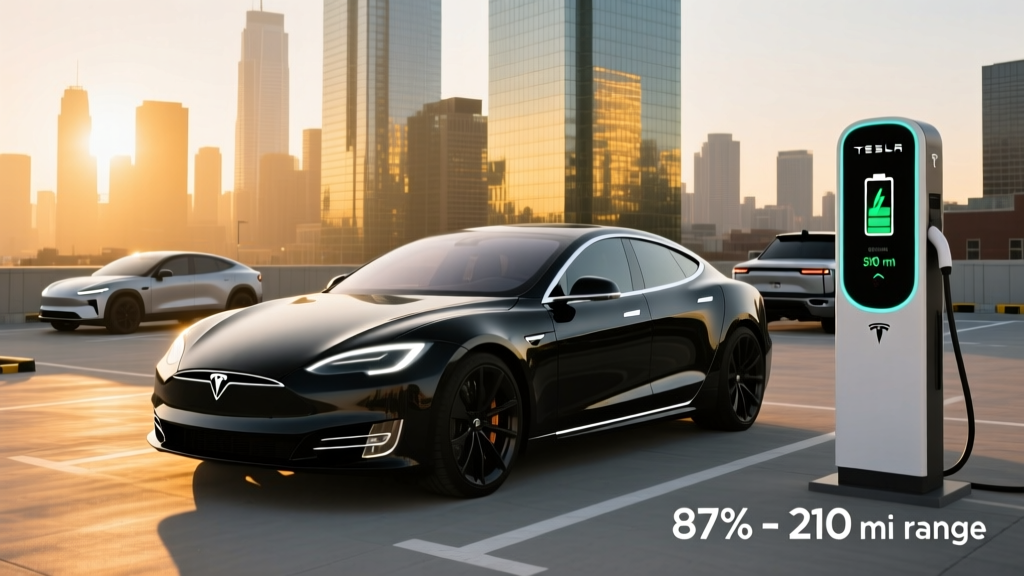
Tesla's Supercharger network remains the gold standard for DC fast-charging reliability in the United States, with over 6,500 V3 (250 kW) and V4 stalls across the country as of 2026. Here is what charging looks like at each level:
| Charging Level | Power (kW) | Miles Added per Hour | Use Case |
|---|---|---|---|
| Level 1 (120V outlet) | 1.2–1.4 kW | 3–5 mi/hr | Overnight trickle; emergency top-up |
| Level 2 (240V, 48A Wall Connector) | 11.5 kW | ~44 mi/hr | Daily home charging; full charge in 7–9 hrs |
| DC Fast (V3 Supercharger) | Up to 250 kW | ~1,000+ mi/hr (peak) | Road trips; 10–80% in ~27 min |
Understanding kW vs. kWh: kW (kilowatts) measures the rate of charging — like the flow rate of a hose. kWh (kilowatt-hours) measures the battery's total energy capacity — like the size of a tank. A 250 kW Supercharger delivers energy at that peak rate, but the actual rate tapers as the battery fills. The 10–80% time (~27 minutes for a Model 3 Long Range) reflects the average sustained rate across that range, not a constant 250 kW.
The LFP battery in the Model 3 RWD charges at a lower peak rate (170 kW) and takes roughly 30 minutes from 10–80%. LFP batteries do tolerate regular 100% charging better than NMC chemistry — Tesla actually recommends charging LFP vehicles to 100% at least once per week for accurate battery calibration.
With Tesla opening the Supercharger network to non-Tesla EVs (via the NACS connector, now the North American standard adopted by Ford, GM, Rivian, Hyundai, and others through 2025–2026), Tesla owners benefit from a growing network that is being maintained and expanded at a faster rate than competing CCS networks.
Pricing, Tax Credits, and Total Cost
| Model / Trim | Base MSRP | Est. §30D Credit | Effective Price |
|---|---|---|---|
| Model 3 RWD | $38,990 | $3,750* | ~$35,240 |
| Model 3 Long Range AWD | $45,740 | $3,750* | ~$41,990 |
| Model Y Long Range AWD | $46,630 | $3,750* | ~$42,880 |
| Model S Long Range | $79,990 | $0** | $79,990 |
| Model X Long Range | $84,990 | $0** | $84,990 |
*Credit amount reflects partial compliance with IRS §30D critical-mineral and battery-component sourcing requirements for 2026. The full $7,500 credit requires meeting both sourcing thresholds; Tesla's current supply chain qualifies for the critical-minerals half ($3,750) on most trims. **Model S and Model X exceed the §30D MSRP cap of $55,000 for sedans and $80,000 for SUVs/vans/pickups — the Model X at $84,990 exceeds the SUV cap and is ineligible.
- Income caps: AGI ≤ $150,000 (single), $225,000 (head of household), $300,000 (joint)
- MSRP caps: ≤ $55,000 for sedans (Model 3); ≤ $80,000 for SUVs (Model Y qualifies; Model X does not)
- Battery sourcing: Critical minerals and battery components must meet phased-in domestic/free-trade-area thresholds — the credit splits into two $3,750 halves
- Point-of-sale transfer: You can transfer the credit to the dealer at purchase, reducing your out-of-pocket cost immediately (Tesla acts as its own dealer)
- Always verify: Sourcing rules change annually; confirm current eligibility at irs.gov before purchasing
Autopilot, FSD (Supervised), and Driver-Assist Tech
Tesla Autopilot and Full Self-Driving (Supervised) are classified as SAE Level 2 driver-assistance systems. This means the vehicle can manage steering, acceleration, and braking under certain conditions, but the driver must remain fully attentive, keep hands on the wheel, and be prepared to take over at any moment. This is fundamentally different from Level 4 robotaxi services like Waymo, which operate without a human driver in geofenced areas.
Every 2026 Tesla ships with basic Autopilot (Traffic-Aware Cruise Control and Autosteer) at no additional cost. FSD (Supervised) remains an $8,000 add-on or $99/month subscription. As of 2026, FSD Supervised has improved significantly in urban scenarios — handling unprotected left turns, construction zones, and complex intersections more smoothly — but it still requires active driver supervision and does not qualify as autonomous driving.
Standard tech across the lineup includes a 15.4-inch center touchscreen (Model 3/Y) or 17-inch screen (Model S/X), over-the-air updates, Tesla Vision (camera-only — no radar or ultrasonic sensors since 2022–2023), Sentry Mode, Dashcam, and the Tesla mobile app for remote preconditioning, charging management, and vehicle location.
Warranty, Battery Longevity, and Degradation
Tesla's warranty structure is straightforward:
- New Vehicle Limited Warranty: 4 years / 50,000 miles (whichever comes first)
- Battery & Drive Unit Warranty:
- Model 3 RWD (LFP): 8 years / 100,000 miles, minimum 70% capacity retention
- Model 3 Long Range & Model Y: 8 years / 120,000 miles, minimum 70% retention
- Model S & Model X: 8 years / 150,000 miles, minimum 70% retention
Real-world degradation data from fleet analyses (including sources like Recurrent Auto) shows Tesla NMC batteries typically retain 90–95% capacity after 50,000 miles and approximately 85–90% after 100,000 miles under normal charging habits. LFP batteries in the Model 3 RWD show slightly different degradation curves — they are more tolerant of regular 100% charging and have a longer cycle life, but may exhibit slightly faster initial calendar degradation in the first year.
A full battery replacement outside of warranty currently ranges from approximately $8,000 to $16,000 depending on the model and pack size, based on Tesla service-center quotes and third-party EV repair shops. This is a real long-term cost to factor in, though the vast majority of Tesla batteries outlast their warranty periods without needing replacement.
Who Should Buy a Tesla in 2026?
- Supercharger network — most reliable DCFC in the US
- Class-leading efficiency (kWh/100mi) across lineup
- Over-the-air updates continuously add features
- Strong resale value relative to most EV competitors
- Model 3 RWD at ~$35,240 after credit is a compelling entry point
- Heat pump standard on all models
- No physical stalks on refreshed Model 3/Y (turn signals on steering wheel)
- Vision-only system: no parking sensors; tight-space maneuvering can be unnerving
- FSD (Supervised) is expensive and still requires full driver attention
- Model S/X pricing excludes them from federal tax credits
- Limited service-center capacity in some regions — body repair wait times can be long
- Minimalist interior is polarizing — no instrument cluster, no physical buttons
- Choose Model 3 RWD if: You want the lowest entry price, commute under 60 miles daily, and have reliable home Level 2 charging.
- Choose Model 3 Long Range if: You take regular road trips, live in a cold climate, or need AWD traction.
- Choose Model Y Long Range if: You need SUV cargo space (30 cu ft behind rear seats), a higher ride height, or family-hauling practicality.
- Choose Model S if: You want 400+ mile range, luxury sedan performance, and budget is not the primary concern.
- Look at competitors (Ioniq 5, Mach-E, EV6) if: You prefer a traditional interior layout, physical controls, or want CCS/NACS charging flexibility without a Tesla account ecosystem.
Frequently Asked Questions
What is the real-world range of the 2026 Tesla Model Y?
The EPA rates the 2026 Model Y Long Range AWD at 320 miles. In real-world highway driving at 70–75 mph in moderate temperatures, expect 280–295 miles. In cold weather (below freezing), plan for 225–260 miles depending on cabin heating use and terrain.
How fast does a Tesla charge at home?
Using a Tesla Wall Connector on a 60-amp circuit (48 amps continuous), all 2026 Teslas charge at up to 11.5 kW, adding approximately 44 miles of range per hour. A full charge from 10% to 100% takes roughly 7 hours for a Model 3 Long Range (75 kWh battery). Installation typically costs $800–$2,000 depending on your electrical panel capacity and conduit run — consult a licensed electrician for a site-specific quote.
Does the Tesla Model 3 qualify for the federal EV tax credit?
Yes, partially. The 2026 Model 3 (both RWD at $38,990 and Long Range AWD at $45,740) falls under the §30D MSRP cap of $55,000 for sedans. However, current battery-sourcing rules mean most Tesla vehicles qualify for the critical-minerals half of the credit ($3,750) but not the full $7,500. Buyer income caps also apply. Always verify current eligibility at irs.gov and consult a tax professional.
Is Tesla worth buying vs. Hyundai Ioniq 5 or Ford Mustang Mach-E?
Tesla's advantages are the Supercharger network, software ecosystem, and efficiency. The Ioniq 5 offers faster 10–80% charging (18 minutes on a 350 kW charger vs. Tesla's ~27 min on 250 kW), a more traditional interior with physical buttons, and 800V architecture. The Mach-E offers competitive range and a more conventional crossover feel. If Supercharger access and software integration are top priorities, Tesla wins. If you want the fastest DC charging or a traditional cockpit, consider the Ioniq 5.
When will Tesla split its stock, and does it affect EV buyers?
As of 2026, Tesla has not announced a new stock split. Its last split was 3-for-1 in August 2022. Stock splits have no effect on vehicle pricing, tax-credit eligibility, Supercharger costs, or product availability. For EV buyers, focus on the vehicle-level factors: range, charging speed, total cost of ownership, and whether the model fits your daily driving needs.