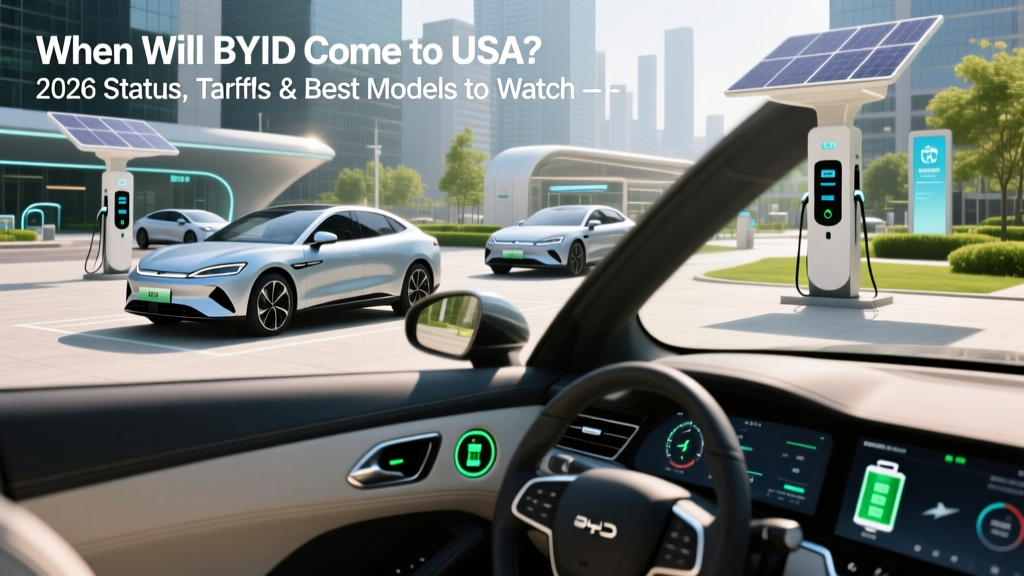
The Short Answer: BYD Is Still Blocked From the US Market in 2026
If you've been tracking the global EV landscape, you already know BYD has surpassed Tesla in total plug-in vehicle sales and is expanding aggressively across Europe, Southeast Asia, Latin America, and Australia. But for American buyers asking when will BYD come to USA, the answer in 2026 remains frustratingly clear: not yet, and not anytime soon without a fundamental shift in US trade policy.
BYD passenger vehicles are effectively locked out of the United States by a wall of tariffs that push the total import duty on Chinese-built EVs to 100% as of 2026. That's not a typo. A BYD Seal that sells for the equivalent of roughly $30,000 in China would carry an additional $30,000 in tariffs before it ever reached a US showroom floor — obliterating the price advantage that makes BYD so competitive elsewhere.
Yet the question persists because BYD's global footprint keeps growing, its technology keeps advancing, and the political landscape can shift. Here's everything you need to know about BYD's US prospects, the models most likely to arrive if barriers fall, and the realistic timeline American EV shoppers should plan around.
Why BYD Can't Sell Cars in the US Right Now
Understanding the BYD blockade requires untangling three separate layers of trade policy that stack on top of each other:
The 100% Tariff Stack (2026)
In May 2024, the Biden administration announced an increase in Section 301 tariffs on Chinese-built electric vehicles from 25% to 100%, effective August 2024. The Trump administration maintained and reinforced this policy through 2025–2026. Combined with the baseline 2.5% auto import duty, the effective tariff on a Chinese-manufactured EV entering the US is 102.5%.
This makes BYD's core value proposition — high-spec EVs at aggressive prices — economically impossible in the US market through direct import.
The Connected Vehicle Ban
In September 2024, the US Department of Commerce proposed rules under the Information and Communications Technology and Services (ICTS) framework to ban Chinese- and Russian-made connected vehicle hardware and software from US roads. The hardware ban takes effect for model year 2027; the software ban applies from model year 2029. Even if tariffs were reduced, BYD's vehicles would face a separate prohibition on their core computing and connectivity platforms.
No Federal Tax Credit Eligibility
Under IRS §30D rules, a new EV must meet North American final assembly requirements to qualify for the up-to-$7,500 federal tax credit. BYD manufactures its vehicles in China, Thailand, Brazil, Hungary, and other locations — none of which satisfy the USMCA-compliant assembly requirement. Even if a BYD somehow cleared the tariff wall, buyers would receive no federal purchase incentive. You can review the current assembly and credit rules at IRS.gov's clean vehicle credit page.
Could BYD Build Cars in the US to Bypass Tariffs?
The most commonly proposed workaround is for BYD to establish a manufacturing plant on US soil, similar to how Toyota, Hyundai, BMW, and Volkswagen manufacture vehicles in the American South and Midwest. In theory, a US-built BYD would avoid the 100% import tariff and potentially qualify for the §30D tax credit.
In practice, this faces enormous obstacles:
- Political opposition: Multiple US lawmakers have introduced legislation specifically aimed at preventing Chinese automakers from building factories in the United States. A BYD plant announcement would trigger significant congressional and state-level resistance.
- National security scrutiny: Any BYD manufacturing investment would face review by the Committee on Foreign Investment in the United States (CFIUS), which has broad authority to block or impose conditions on Chinese investments in critical sectors.
- Supply chain entanglement: BYD's competitive advantage rests on vertical integration — it manufactures its own batteries (the Blade Battery), semiconductors, and motors in China. Replicating this supply chain in the US would take years and billions in investment, eroding the cost advantage.
- Connected vehicle ban still applies: Even a US-assembled BYD using Chinese-sourced connected vehicle hardware or software would be prohibited under the ICTS rule beginning in model year 2027/2029.
As of early 2026, BYD has made no announcement regarding a US manufacturing facility. Executive Vice President Stella Li stated in 2024 interviews that BYD had no plans to enter the US passenger vehicle market, though the company continues to evaluate opportunities globally.
The BYD Models Americans Would Want Most
If trade barriers were to fall — through a trade deal, tariff reduction, or a successful US factory launch — which BYD models would compete in the US market? Here are the most likely candidates, with specs based on current international-market configurations. Note that US-spec EPA testing would likely yield different range figures than the WLTP numbers below.
| Model | Segment | Battery (kWh) | Chemistry | WLTP Range | 0-60 mph | HP | Drivetrain | Est. US MSRP* |
|---|---|---|---|---|---|---|---|---|
| BYD Seal | Midsize sedan | 82.5 kWh | LFP (Blade) | ~354 mi (570 km) | ~5.9s (RWD) / 3.8s (AWD) | 313 (RWD) / 530 (AWD) | RWD or AWD | $38,000–$48,000 |
| BYD Atto 3 (Yuan Plus) | Compact SUV | 60.5 kWh | LFP (Blade) | ~261 mi (420 km) | ~7.3s | 201 | FWD | $30,000–$36,000 |
| BYD Dolphin | Subcompact hatch | 60.4 kWh | LFP (Blade) | ~265 mi (427 km) | ~7.0s | 201 | FWD | $25,000–$32,000 |
| BYD Seal U (Song Plus EV) | Midsize SUV | 87 kWh | LFP (Blade) | ~311 mi (500 km) | ~7.9s | 313 | RWD / AWD avail. | $40,000–$50,000 |
| BYD Han EV | Full-size sedan | 85.4 kWh | LFP (Blade) | ~323 mi (521 km) | ~3.9s (AWD) | 516 (AWD) | AWD | $45,000–$55,000 |
*Estimated US MSRP assumes no tariffs — a hypothetical scenario. With the current 102.5% tariff, these prices would roughly double. Actual EPA range would likely be 10–15% lower than WLTP figures shown.
Charging Specs: What BYD Offers Internationally
BYD's current international models support DC fast charging at rates that are competitive but not class-leading compared to 800V architectures from Hyundai/Kia and Porsche. Here's what to expect:
| Model | Max DC Charge Rate | 10–80% Time | Level 2 AC Rate | Connector (Intl.) |
|---|---|---|---|---|
| BYD Seal | 150 kW | ~26 min | 7–11 kW | CCS2 / GB/T |
| BYD Atto 3 | 88 kW | ~29 min | 7–11 kW | CCS2 / GB/T |
| BYD Dolphin | 88 kW | ~29 min | 7–11 kW | CCS2 / GB/T |
| BYD Seal U | 140 kW | ~28 min | 7–11 kW | CCS2 / GB/T |
| BYD Han EV | 120 kW | ~30 min | 7–11 kW | CCS2 / GB/T |
For the US market, BYD would need to adopt the NACS (Tesla) connector or provide CCS1 compatibility to access the broadest charging networks. Given the industry-wide shift toward NACS in North America — with Ford, GM, Rivian, Hyundai, and others adopting it — a US-bound BYD would almost certainly need NACS integration.
Real-world charging note: BYD's peak DC charge rates of 88–150 kW are sustained for a relatively narrow portion of the charge curve. Expect actual average charging speeds to be lower than peak, especially above 60% State of Charge where LFP chemistry typically tapers aggressively. At a 150 kW charger, the Seal might average closer to 90–100 kW across a full 10–80% session.
BYD vs. The US Competition: Where Would It Fit?
If BYD could sell in the US at its international pricing (i.e., without tariffs), the competitive landscape would look dramatically different. Here's how the BYD Seal — the company's strongest global competitor to the Tesla Model 3 — stacks up against key rivals:
| Spec | BYD Seal (AWD) | Tesla Model 3 LR AWD | Hyundai Ioniq 6 LR AWD | BMW i4 xDrive40 |
|---|---|---|---|---|
| Battery | 82.5 kWh (LFP) | ~75 kWh (NMC) | 77.4 kWh (NMC) | 83.9 kWh (NMC) |
| EPA Range (est.) | ~300 mi* | 341 mi | 316 mi | 282 mi |
| 0–60 mph | 3.8s | 4.2s | 5.1s | 4.5s |
| HP | 530 | 346 | 320 | 396 |
| Max DC Charge | 150 kW | 250 kW | 240 kW | 205 kW |
| 10–80% Charge | ~26 min | ~20 min | ~18 min | ~31 min |
| Base Price (est.) | ~$45,000 | $47,740 | $46,700 | $57,900 |
*BYD Seal EPA range is estimated. The Seal's WLTP rating of 570 km (~354 mi) would likely translate to roughly 280–310 EPA miles, as WLTP tends to overstate range relative to the more stringent EPA test cycle. Actual EPA certification would be required for a definitive figure.
BYD's Warranty and Tech: What International Buyers Get
Warranty Coverage
In markets like Europe and Australia, BYD offers:
- Vehicle warranty: 6 years / 150,000 km (~93,000 miles)
- Battery warranty: 8 years / 200,000 km (~124,000 miles) with a capacity retention threshold of approximately 70%
For the US market, BYD would need to match or exceed the federal minimum battery warranty of 8 years/100,000 miles required for emissions-related components on PZEVs, and would likely target the industry standard of 8 years / 100,000 miles to compete with Tesla, Hyundai, and Ford. Given BYD's confidence in its Blade Battery LFP chemistry — which demonstrates lower degradation rates than many NMC packs — a competitive warranty is likely achievable.
Technology and Driver Assistance
BYD's current international models feature:
- Rotating center display: A signature BYD feature — the 15.6-inch touchscreen can rotate between landscape and portrait orientation, a gimmick that's genuinely useful for navigation
- Infotainment: BYD's DiLink system supports over-the-air updates, wireless Apple CarPlay and Android Auto, and voice control
- Driver assistance: BYD's ADAS suite (marketed as DiPilot) includes adaptive cruise control, lane-keeping assist, automatic emergency braking, and blind-spot monitoring. This is a Level 2 SAE driver-assistance system — the driver must remain fully engaged at all times. It does not offer hands-free driving comparable to GM's Super Cruise or Ford's BlueCruise
- Vehicle-to-Load (V2L): Several BYD models offer V2L capability, allowing you to power external devices (camping equipment, power tools, emergency appliances) directly from the traction battery — a feature US buyers increasingly value
Realistic Timeline: When Could BYD Actually Arrive?
Based on current trade policy, legislative trajectory, and BYD's own public statements, here's a realistic assessment of the timeline for BYD passenger vehicles in the United States:
| Scenario | Probability (2026–2030) | Timeline | Key Requirement |
|---|---|---|---|
| Direct import (China-built) | Near zero | Not feasible under current tariffs | 100% tariff repeal — politically unlikely |
| US factory (greenfield) | Very low | 4–6 years after announcement | CFIUS approval, political will, $5B+ investment |
| Mexico factory → US export | Low (declining) | 3–5 years | USMCA rules tightening; 2024 tariff changes target this route |
| Commercial vehicles only (buses, trucks) | Already limited | Ongoing but restricted | BYD has sold electric buses in the US (Lancaster, CA plant) but faces separate restrictions |
| No US entry | Most likely | Through at least 2030 | Current policy trajectory |
The most probable outcome through 2030 is that BYD does not sell passenger vehicles in the United States. The company's global growth strategy has shifted toward markets where it faces fewer barriers: Europe (with a Hungary factory coming online), Southeast Asia (Thailand factory operational), Latin America (Brazil factory), and the Middle East.
What About BYD's Lancaster, California Factory?
BYD does operate a manufacturing facility in Lancaster, California — but it produces electric buses and commercial trucks, not passenger vehicles. Even this facility has faced significant challenges, including a 2020 Pentagon-related restriction and California's evolving procurement rules that have limited BYD's ability to win public transit contracts. The Lancaster plant is not a pathway to BYD passenger car sales.
What US Buyers Should Do Instead
If you're drawn to BYD's value proposition — well-equipped EVs with competitive range at aggressive prices — here are the closest alternatives currently available in the US market:
✅ Pros of Waiting for BYD
- LFP Blade Battery offers exceptional longevity and safety
- Aggressive pricing could disrupt the US market if tariffs fall
- V2L capability standard on many models
- Strong build quality in latest-generation models
- Rotating display and premium interior at mainstream prices
❌ Cons of Waiting for BYD
- No realistic US availability before 2030 at earliest
- 100% tariff makes direct import economically impossible
- Connected vehicle ban adds a second regulatory barrier
- No US service network or parts supply chain
- No §30D tax credit eligibility even if vehicles arrive
- Charging speeds (88–150 kW) lag behind 800V competitors
If you want BYD-like value today: Consider the Hyundai Ioniq 5 (starting ~$42,000, 311 mi EPA range, 240 kW DC fast charging), the Tesla Model 3 (starting ~$38,990, 341 mi range, 250 kW charging, Supercharger access), or the Chevrolet Equinox EV (starting ~$33,000, 319 mi range). All three are assembled in North America and may qualify for the §30D federal tax credit depending on your income, the specific trim, and battery sourcing — verify current eligibility at fueleconomy.gov.
Frequently Asked Questions
When will BYD come to USA for passenger vehicles?
As of 2026, there is no confirmed timeline for BYD passenger vehicles in the United States. The 100% tariff on Chinese-built EVs, the connected vehicle hardware/software ban (effective MY2027/2029), and lack of North American assembly make market entry economically and legally unfeasible under current policy. The most realistic scenario is no US passenger vehicle sales through at least 2030.
Does BYD qualify for the $7,500 federal EV tax credit?
No. Under IRS §30D rules, a new clean vehicle must undergo final assembly in North America to be eligible for the federal tax credit. BYD vehicles are assembled in China, Thailand, Brazil, Hungary, and other non-USMCA locations. Additionally, the credit has buyer income caps ($150,000 single / $300,000 joint filers), MSRP caps ($55,000 for sedans / $80,000 for SUVs, trucks, and vans), and battery component/critical mineral sourcing requirements that further restrict eligibility. Always verify current rules at IRS.gov or consult a tax professional.
What is BYD's Blade Battery and is it better than other EV batteries?
The Blade Battery is BYD's proprietary lithium iron phosphate (LFP) battery using a cell-to-pack design with elongated blade-shaped cells. LFP chemistry offers longer cycle life (often 3,000+ cycles vs. ~1,500–2,000 for NMC), superior thermal stability (lower fire risk), and tolerance for regular 100% charging. The trade-off is lower energy density, meaning LFP packs are heavier for the same kWh capacity. For daily commuters who charge at home every night, LFP's longevity advantage is significant. For road-trippers needing maximum range per pound, NMC still has an edge.
Can I import a BYD to the US myself?
Practically, no. Even if you could navigate the 102.5% tariff, a grey-market BYD would fail to meet US Federal Motor Vehicle Safety Standards (FMVSS) certification, EPA emissions compliance (yes, EVs have compliance paperwork), and NHTSA import requirements. The vehicle would also lack any US warranty coverage, service network, or parts availability. The cost and legal risk make individual import entirely impractical.
Is BYD bigger than Tesla globally?
By total plug-in electrified vehicle sales (BEVs + PHEVs combined), BYD has surpassed Tesla. In 2025, BYD sold over 4 million new energy vehicles globally. However, Tesla still leads in pure battery-electric vehicle (BEV) sales in most quarters, and Tesla's revenue per vehicle and profit margins remain higher. The comparison depends on whether you count PHEVs — BYD sells roughly as many PHEVs as BEVs, while Tesla sells only BEVs.
Where does BYD sell cars now?
As of 2026, BYD sells passenger vehicles in over 70 countries and regions, including most of Europe (Germany, France, UK, Norway, Sweden, etc.), Australia, New Zealand, Japan, Southeast Asia (Thailand, Indonesia, Malaysia, Philippines), Latin America (Brazil, Mexico, Colombia, Costa Rica), the Middle East (UAE, Israel, Saudi Arabia), and parts of Africa. A factory in Hungary (opening 2025–2026) serves the European market, and a Thailand factory serves ASEAN.