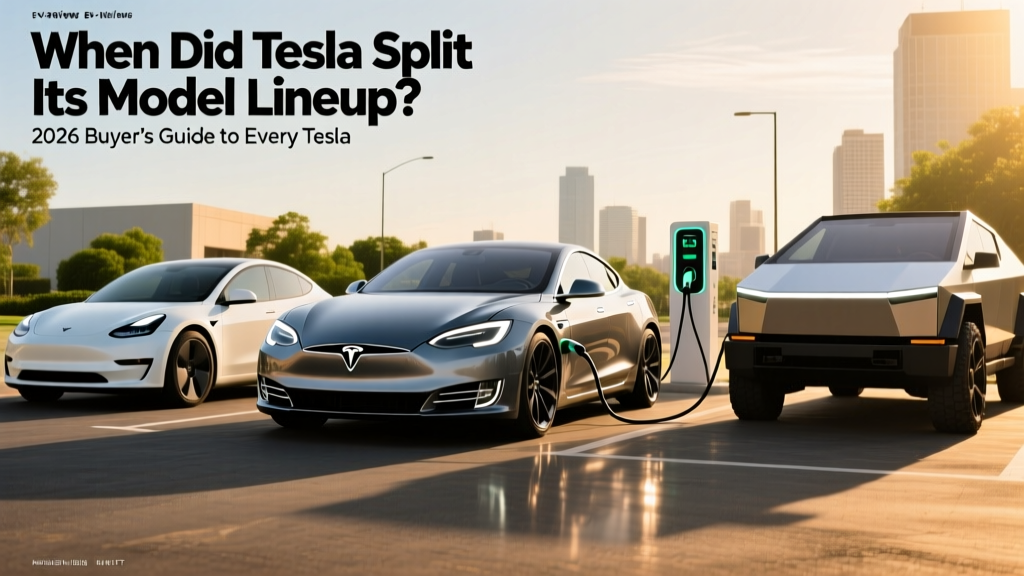
If you've searched "when did Tesla split" and landed here, you're likely noticing something that's become increasingly obvious: Tesla no longer sells a single, simple lineup. What started as a two-car company (Roadster and Model S) has fractured into a segmented portfolio targeting distinct buyer profiles — from the $38,990 commuter in a Model 3 Rear-Wheel Drive to the $100,000+ Cybertruck buyer who wants a statement vehicle with a truck bed. This guide maps the 2026 Tesla lineup so you can find the model that actually fits your life, with the hard numbers Tesla's configurator buries.
The 2026 Tesla Lineup at a Glance
Tesla's current U.S. passenger and truck lineup includes five distinct models, each occupying a specific price and use-case bracket. The "split" wasn't a single event — it evolved through strategic launches: the Model S (2012) established the luxury sedan, the Model X (2015) added the luxury SUV, the Model 3 (2017) cracked the mass market, the Model Y (2020) dominated the crossover segment, and the Cybertruck (2023) carved out an entirely new category. By 2026, these five models serve buyers with fundamentally different needs, budgets, and charging realities.
| Spec | Model 3 RWD | Model Y LR AWD | Model S LR | Model X LR | Cybertruck AWD |
|---|---|---|---|---|---|
| EPA Range | 363 mi | 320 mi | 402 mi | 335 mi | 340 mi |
| Battery (usable, kWh) | ~60 (LFP) | ~75 (NMC) | ~95 (NMC) | ~95 (NMC) | ~123 (NMC, 4680 cells) |
| Peak DC Charge kW | 170 kW | 250 kW | 250 kW | 250 kW | 250 kW |
| 10-80% DCFC Time | ~30 min | ~25 min | ~27 min | ~28 min | ~32 min |
| Level 2 Rate | 11.5 kW / 37 mi/hr | 11.5 kW / 37 mi/hr | 11.5 kW / 37 mi/hr | 11.5 kW / 37 mi/hr | 11.5 kW / 37 mi/hr |
| 0-60 mph | 5.8 sec | 4.8 sec | 3.1 sec | 3.8 sec | 3.9 sec |
| Horsepower | 271 hp | 384 hp | 670 hp | 670 hp | 600 hp |
| Drivetrain | RWD | Dual-Motor AWD | Dual-Motor AWD | Dual-Motor AWD | Dual-Motor AWD |
| Base MSRP | $38,990 | $44,990 | $79,990 | $84,990 | $79,990 |
| MPGe (combined) | 132 MPGe | 122 MPGe | 120 MPGe | 109 MPGe | 70 MPGe |
| Battery Warranty | 8 yr / 100,000 mi | 8 yr / 120,000 mi | 8 yr / 150,000 mi | 8 yr / 150,000 mi | 8 yr / 120,000 mi |
Real-World Range: What the EPA Numbers Don't Tell You
EPA range estimates are standardized laboratory tests — useful for comparison shopping, but not a guarantee of what you'll see on a Tuesday morning commute in January or a 75-mph highway run through the desert. Tesla's real-world range varies significantly based on speed, temperature, terrain, and climate-control usage.
- Model 3 RWD (EPA 363 mi): Expect ~310-330 mi in mixed driving. Highway-only at 75 mph drops this to ~270-290 mi. In sub-freezing weather, plan for 220-260 mi due to LFP chemistry sensitivity to cold.
- Model Y LR AWD (EPA 320 mi): Expect ~275-295 mi mixed. Highway cruising yields ~250-270 mi. Winter driving: ~220-245 mi.
- Model S LR (EPA 402 mi): The longest-range Tesla. Expect ~340-370 mi mixed, ~310-340 mi highway. The large NMC pack and heat pump help in cold weather (~290-330 mi).
- Model X LR (EPA 335 mi): Falcon-wing doors add weight. Expect ~285-310 mi mixed, ~260-280 mi highway. Cold weather: ~230-260 mi.
- Cybertruck AWD (EPA 340 mi): The stainless-steel exoskeleton and poor aerodynamics hurt efficiency. Expect ~280-310 mi mixed, ~250-275 mi highway. Towing a 5,000-lb trailer cuts this roughly in half.
Sources: fueleconomy.gov, Tesla owner forums, and third-party highway-range tests.
The single biggest range variable most buyers ignore is cold weather. Lithium-ion batteries lose efficiency below 40°F, and cabin heating draws significant energy. Tesla's heat pump (standard on all 2026 models) mitigates this compared to resistive heaters, but you'll still see a 20-30% range reduction in sustained sub-freezing conditions. LFP batteries (used in Model 3 RWD) are slightly more affected by cold than NMC packs.
Charging Speed: DC Fast Charging and Home Level 2
Tesla's Supercharger network remains the gold standard for public DC fast charging, but not all Teslas charge at the same speed. The key metric is peak charge rate in kW (power), and how long the vehicle sustains that peak before the charge curve tapers above ~80% State of Charge (SoC).
| Model | Peak DC kW | 10-80% Time | Sustained Peak Window | Level 2 Home (kW / mi per hr) |
|---|---|---|---|---|
| Model 3 RWD | 170 kW | ~30 min | 10-50% SoC | 11.5 kW / 37 mi/hr |
| Model Y LR AWD | 250 kW | ~25 min | 10-45% SoC | 11.5 kW / 37 mi/hr |
| Model S LR | 250 kW | ~27 min | 10-40% SoC | 11.5 kW / 37 mi/hr |
| Model X LR | 250 kW | ~28 min | 10-40% SoC | 11.5 kW / 37 mi/hr |
| Cybertruck AWD | 250 kW | ~32 min | 10-35% SoC | 11.5 kW / 37 mi/hr |
Charging curve reality: The "250 kW" peak on Long Range models is not sustained for the entire session. Most Teslas hold peak rate for roughly 10-45% SoC, then taper progressively. An 80-100% top-off can take as long as the 10-80% session. For road trips, plan your stops around 10-80% windows to minimize time at the charger.
Model 3 RWD caveat: The rear-wheel-drive Model 3 uses an LFP battery with a 170 kW peak — meaning Supercharger sessions take roughly 5 minutes longer than Long Range models. This is a meaningful trade-off for the lower purchase price.
Preconditioning matters: Navigate to a Supercharger using the Tesla navigation system, and the car will pre-warm the battery to optimize charge speed. Arriving at a Supercharger without preconditioning (e.g., using a third-party app to find it) can add 5-10 minutes to your session, especially in cold weather.
Pricing, Trims, and Federal Tax Credit Eligibility
Tesla's pricing shifts periodically — often without notice. As of early 2026, here's where the lineup stands, including the critical IRS §30D federal tax credit landscape.
| Model / Trim | Base MSRP | Federal Credit Eligible? | Est. After-Credit Price | Key §30D Constraints |
|---|---|---|---|---|
| Model 3 RWD | $38,990 | Up to $7,500 | ~$31,490 | MSRP under $55K cap ✓; income caps apply ($150K single / $300K joint); battery sourcing rules |
| Model 3 LR AWD | $47,740 | Up to $7,500 | ~$40,240 | Same caps; verify critical-minerals sourcing for current model year |
| Model Y LR AWD | $44,990 | Up to $7,500 | ~$37,490 | MSRP under $80K SUV cap ✓; income + sourcing rules |
| Model Y Performance | $51,490 | Up to $7,500 | ~$43,990 | Same as LR AWD |
| Model S LR | $79,990 | Not eligible | $79,990 | Exceeds $55K sedan MSRP cap |
| Model X LR | $84,990 | Not eligible | $84,990 | Exceeds $80K SUV MSRP cap |
| Cybertruck AWD | $79,990 | Not eligible | $79,990 | Exceeds $80K truck MSRP cap |
- MSRP Cap: Sedans/wagons must be ≤$55,000; SUVs/pickups/vans must be ≤$80,000.
- Buyer Income Cap: Modified AGI ≤$150,000 (single), $225,000 (head of household), $300,000 (joint).
- Battery Sourcing: Increasing percentages of critical minerals and battery components must be sourced from the U.S. or FTA partners. Full $7,500 requires meeting both thresholds; partial credit ($3,750) if only one is met.
- Point-of-Sale Transfer: Eligible buyers can transfer the credit to the dealer at purchase, reducing the purchase price directly rather than waiting for a tax refund.
- Assembly: Vehicle must undergo final assembly in North America (all U.S.-market Teslas qualify — assembled in Fremont, CA or Austin, TX).
Always verify current eligibility at fueleconomy.gov and consult a tax professional. Rules are subject to legislative change.
Performance and Efficiency by Model
Tesla's performance credentials are well-established, but the 2026 lineup spans a wide efficiency spectrum. The Model 3 RWD is the efficiency champion; the Cybertruck is, frankly, an energy hog by comparison.
Model 3 RWD: 271 hp, 5.8-second 0-60, 132 MPGe combined (~25 kWh/100 mi). This is the Tesla for drivers who prioritize low running costs over neck-snap acceleration. The single-motor RWD layout is lighter and more efficient than any AWD Tesla.
Model Y LR AWD: 384 hp, 4.8-second 0-60, 122 MPGe (~28 kWh/100 mi). The dual-motor AWD system adds traction and performance at a modest efficiency penalty. The Performance trim bumps output to 456 hp and drops 0-60 to 3.5 seconds, but efficiency dips to ~112 MPGe.
Model S LR: 670 hp, 3.1-second 0-60, 120 MPGe. The Plaid variant (1,020 hp, 1.99-second 0-60) exists for those who need supercar acceleration in a sedan, but efficiency drops to ~104 MPGe and range to 359 miles.
Cybertruck AWD: 600 hp, 3.9-second 0-60, but only 70 MPGe (~48 kWh/100 mi). The brick-like aerodynamics and 6,800+ lb curb weight make this the least efficient Tesla by a wide margin. It's fast for a truck, but your electricity cost per mile will be roughly double a Model 3's.
Interior Space, Cargo, and Daily Practicality
The "split" in Tesla's lineup is most visible when you open the trunk — or the frunk.
- Model 3: 23 cu ft trunk, 3.1 cu ft frunk. Rear legroom: 35.3 inches. Adequate for two adults and luggage, but the sloping roofline limits tall cargo. Best for: singles, couples, light commuters.
- Model Y: 30.2 cu ft behind the second row (76.2 cu ft with seats folded), 4.1 cu ft frunk. Rear legroom: 41.6 inches. Available 7-seat option (very tight third row). Best for: families, road-trippers, those who need crossover cargo flexibility.
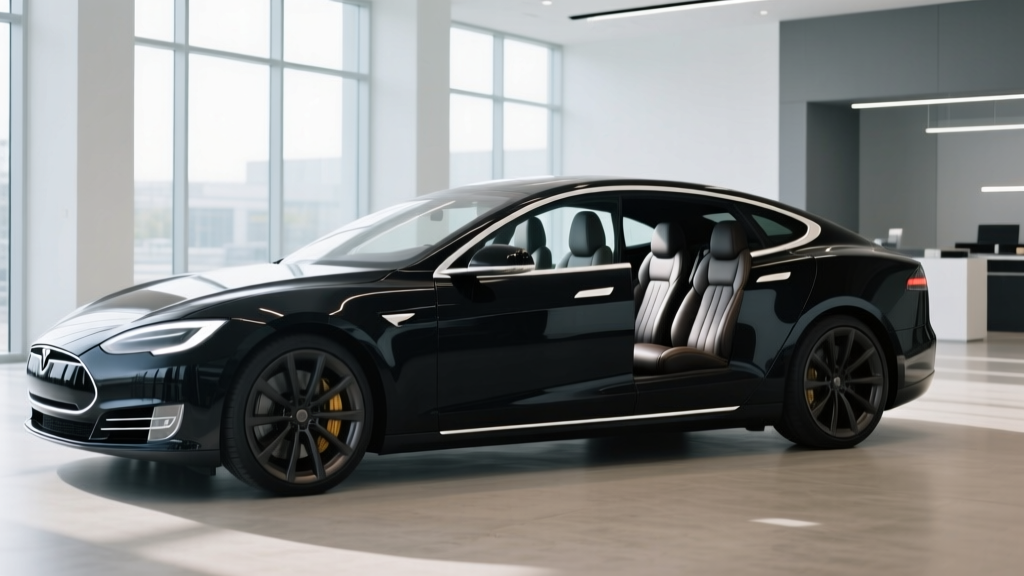
- Model S: 28 cu ft trunk (hatchback-style liftgate), 3.1 cu ft frunk. Rear legroom: 35.4 inches. Premium materials, ventilated seats, rear touchscreen. Best for: luxury sedan buyers who want range and performance.
- Model X: 88 cu ft max cargo (seats folded), falcon-wing rear doors for easy car-seat access. Available 5-, 6-, or 7-seat layouts. Best for: families wanting the premium experience and dramatic door design.
- Cybertruck: 6.5-foot bed with 67 cu ft volume, lockable tonneau, 2,500-lb payload, 11,000-lb towing capacity. Rear legroom: ~38 inches (generous for a crew cab). Best for: truck users, those who need towing/hauling, off-road enthusiasts.
Technology, Driver Assistance, and the FSD Question
Every 2026 Tesla ships with the same core tech stack: a 15.4-inch (Model 3/Y) or 17-inch (Model S/X/Cybertruck) center touchscreen, over-the-air updates, Tesla's app ecosystem, and Basic Autopilot (traffic-aware cruise control and lane centering).
All Tesla driver-assistance features — including Autopilot, Enhanced Autopilot, and Full Self-Driving (Supervised) — are SAE Level 2 systems. The driver must remain fully engaged, hands on or near the wheel, eyes on the road, and ready to take over at any moment. Tesla's FSD is not "self-driving" in any regulatory or practical sense. Only Level 4 services like Waymo operate without a human driver in defined areas.
Full Self-Driving (Supervised) — $8,000 option or $99/month: Adds automatic lane changes, traffic-light and stop-sign recognition, and city-street navigation. It's impressive in well-marked suburban environments but can struggle with construction zones, faded lane markings, and complex intersections. We recommend trying the monthly subscription before committing to the $8,000 purchase.
- Drive without your supervision — you are the driver, legally and practically
- Handle all weather conditions (heavy rain, snow, fog degrade performance)
- Navigate unmapped or poorly marked roads reliably
- Replace attentive driving — NHTSA has investigated multiple incidents involving driver inattention with Level 2 systems
Unique tech features: The Cybertruck offers steer-by-wire (no mechanical connection between yoke and wheels), 48-volt electrical architecture, and Powershare (V2L/V2H capability to power tools or a home during outages). The Model S and X include a rear passenger touchscreen and available yoke steering.
Pros, Cons, and the Verdict: Which Tesla Split Fits You?
- Supercharger network — 6,000+ U.S. stalls, consistently the most reliable DC fast-charging network
- OTA updates that add features post-purchase
- Industry-leading efficiency (Model 3 especially)
- Strong resale value relative to most EV competitors
- No dealership haggling — fixed online pricing
- Over-the-air diagnostics and mobile service for many issues
- Minimalist interior isn't for everyone (no physical buttons, no instrument cluster)
- Service center wait times can stretch weeks in some metro areas
- Panel gaps and build-quality inconsistency (improving but still a complaint)
- No Apple CarPlay or Android Auto
- FSD is expensive and not truly autonomous
- Cybertruck polarizing design limits resale pool
- Daily commuter on a budget → Model 3 RWD. Lowest price, best efficiency, LFP battery (longer cycle life, safe to charge to 100% daily).
- Family needing cargo space → Model Y LR AWD. Best balance of range, space, AWD traction, and tax-credit eligibility.
- Luxury sedan buyer wanting max range → Model S LR. 402 miles EPA, premium interior, 3.1-second 0-60.
- Family wanting luxury SUV + drama → Model X. Falcon-wing doors, up to 7 seats, premium ride.
- Truck user / towing / off-road → Cybertruck AWD. 11,000-lb tow rating, V2L capability, stainless-steel durability.
Frequently Asked Questions
When did Tesla split into different model segments?
Tesla's lineup evolved over more than a decade rather than splitting at a single moment. The Model S launched in 2012 (luxury sedan), Model X in 2015 (luxury SUV), Model 3 in 2017 (mass-market sedan), Model Y in 2020 (mass-market crossover), and Cybertruck in late 2023 (electric truck). By 2026, these five models cover price points from ~$39,000 to ~$100,000+, each targeting a distinct buyer segment.
What is the real-world range of the most popular Tesla?
The Model Y LR AWD (EPA 320 mi) typically delivers 275-295 miles in mixed real-world driving, dropping to ~250-270 miles on highway-only trips at 75 mph, and ~220-245 miles in sustained freezing temperatures. The Model 3 RWD (EPA 363 mi) achieves 310-330 miles mixed, but its LFP battery is more cold-sensitive.
How fast does a Tesla charge at home?
All 2026 Teslas accept 11.5 kW on Level 2 (240V, 48-amp circuit), adding roughly 37 miles of range per hour of charging. A full overnight charge (8-10 hours) replenishes 300-370 miles — more than enough for daily driving. Installation of a Level 2 home charger typically costs $500-$2,000 depending on panel capacity and wiring distance.
Does the Tesla Model Y qualify for the $7,500 federal tax credit?
The Model Y LR AWD ($44,990 MSRP) qualifies for up to $7,500 under §30D, provided the buyer meets income caps ($300,000 joint / $150,000 single) and the vehicle meets current battery-sourcing requirements. The credit can be applied as a point-of-sale reduction. Always verify at fueleconomy.gov before purchasing, as sourcing rules evolve.
Is Tesla's FSD worth the cost?
At $8,000 upfront or $99/month, FSD (Supervised) is a Level 2 driver-assist system — not autonomous driving. It performs well on well-marked highways and some city streets but requires constant driver supervision. We recommend the $99/month subscription to evaluate it in your typical driving conditions before committing to the purchase. It does not currently add $8,000 in resale value.
Which Tesla has the best battery longevity?
The Model 3 RWD uses an LFP (lithium iron phosphate) battery, which offers longer cycle life and can be safely charged to 100% daily without accelerated degradation — unlike NMC packs (used in all other Teslas), which Tesla recommends charging to 80% for daily use. Over 200,000+ miles, LFP batteries are projected to retain ~85-90% capacity. All Tesla batteries carry an 8-year warranty with a minimum 70% capacity retention guarantee.
How does the Cybertruck compare to the Ford F-150 Lightning?
The Cybertruck AWD ($79,990, 340 mi EPA) is more expensive and less efficient than the F-150 Lightning Lariat (~$60,000, 320 mi EPA), but offers higher towing capacity (11,000 vs 7,700 lbs), stainless-steel body durability, and V2L/V2H capability. The Lightning has a more conventional truck design and a broader dealer service network. Neither qualifies for the §30D credit at current MSRPs above the $80K truck cap (Cybertruck) or at certain trim levels (Lightning).
Sources: fueleconomy.gov (EPA range and MPGe data), IRS §30D Clean Vehicle Credits, Tesla.com (manufacturer specifications). Pricing and credit eligibility current as of early 2026 and subject to change.