If you've spent any time in Tesla forums or earnings calls, you've likely encountered the term Dojo — and wondered what a supercomputer has to do with the Model Y sitting in your driveway. The short answer: Dojo is Tesla's custom-built AI training supercomputer, designed from the silicon up to process the billions of video frames collected by Tesla's fleet and improve the neural networks that power Full Self-Driving (Supervised). It doesn't change your car's EPA range or charging speed, but it's the engine behind every over-the-air update that makes Autopilot and FSD behave a little better each month.
This guide explains what Tesla Dojo actually is, how it differs from conventional GPU clusters, where the project stands in 2026, and — critically — what it means for Tesla owners evaluating FSD's $8,000 purchase price or $99/month subscription.
What Is Tesla Dojo, Exactly?
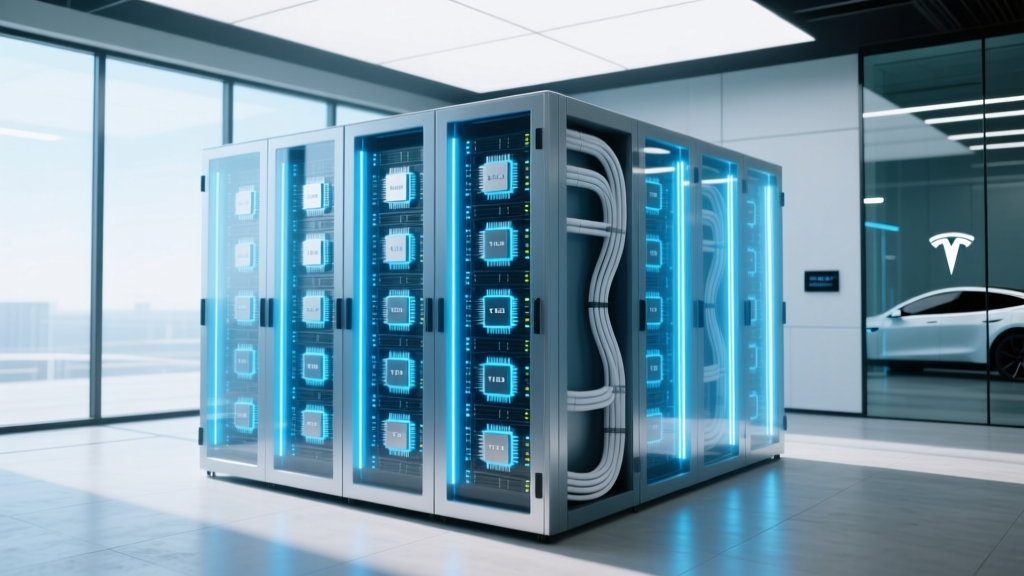
Dojo is a purpose-built machine learning supercomputer that Tesla began developing around 2019 and first detailed at AI Day in August 2021. Unlike traditional data centers that rely on thousands of NVIDIA GPUs (like the H100), Dojo uses Tesla's custom D1 chip, fabricated on TSMC's 7nm process, arranged into unique tiles and trays optimized for a single task: training vision-based neural networks on massive video datasets.
The architecture is designed around Tesla's specific workload — processing front, side, and rear camera video from millions of Tesla vehicles to train the occupancy networks, path planners, and object-recognition models that FSD Supervised relies on. Tesla CEO Elon Musk has described Dojo as a "training supercomputer" rather than a general-purpose AI cluster, meaning it sacrifices versatility for raw throughput on Tesla's particular video-processing pipeline.
Dojo by the Numbers: Architecture and Performance
Here's what we know about Dojo's hardware and how it has evolved through 2026:
| Spec | Detail |
|---|---|
| Custom Chip | Tesla D1 (TSMC 7nm) |
| D1 Chip Performance | ~362 TFLOPS (FP32) per chip |
| Training Tile | 25 D1 chips per tile; ~9 PFLOPS per tile |
| ExaPOD | 120 tiles (3,000 D1 chips); ~1.1 ExaFLOPS (FP32) |
| Primary Workload | Vision neural network training (video) |
| Location | Palo Alto, CA data center |
| Power Draw (ExaPOD) | ~2.4 MW (estimated) |
| Competitor Baseline | Tesla also uses ~100,000 NVIDIA H100 GPUs for parallel training |
The key engineering insight is interconnect bandwidth. Dojo tiles are designed to minimize data-movement bottlenecks that plague conventional GPU clusters when training on video. Where a typical NVIDIA-based cluster must shuttle data between GPUs over standard networking fabric, Dojo's tile architecture allows D1 chips to share data at much higher bandwidth with lower latency — critical when you're processing millions of video clips simultaneously.
How Dojo Connects to Your Tesla's FSD Experience
For Tesla owners, Dojo's impact is indirect but tangible. Here's the pipeline:
- Data collection: Tesla's fleet (millions of vehicles with 8 cameras) captures real-world driving scenarios — edge cases like construction zones, unusual intersections, and rare weather conditions.
- Data ingestion: Selected video clips are uploaded to Tesla's data centers when vehicles connect to Wi-Fi.
- Training on Dojo: These clips are fed into Dojo (and NVIDIA GPU clusters) to train and refine the neural networks that handle perception, prediction, and path planning.
- Validation: Trained models are tested in simulation and shadow mode before deployment.
- OTA update: Improved FSD software is pushed to vehicles over the air.
In practice, this means each FSD Supervised update (v12.x and beyond, which moved to end-to-end neural networks) benefits from faster training cycles. Tesla has claimed that Dojo can reduce training time for certain models from weeks to days, though independent benchmarks are not publicly available.
- It does not make your Tesla drive itself — FSD Supervised remains a Level 2 system requiring constant driver attention.
- It does not improve your car's range, charging speed, or battery health.
- It is not available as a consumer product or cloud service (as of 2026).
- It does not process data from your car in real-time — all training happens on historical uploaded clips.
Dojo vs. NVIDIA GPU Clusters: Why Tesla Built Its Own
Tesla hasn't abandoned NVIDIA hardware. As of 2026, the company operates one of the world's largest H100 GPU clusters (estimated at over 100,000 chips) alongside Dojo. So why invest billions in custom silicon?
| Factor | Tesla Dojo (D1) | NVIDIA H100 Cluster |
|---|---|---|
| Optimization | Purpose-built for video NN training | General-purpose AI training |
| Interconnect | Custom tile-to-tile, high bandwidth | NVLink + InfiniBand networking |
| Cost per FLOP | Lower at scale (Tesla's claim) | Higher; subject to GPU market pricing |
| Supply Risk | Tesla controls silicon roadmap | Dependent on NVIDIA allocation |
| Flexibility | Limited to Tesla's workloads | Broad; any AI framework |
| Availability | Internal only | Commercial cloud (AWS, Azure, etc.) |
The strategic rationale is vertical integration: by owning its training infrastructure, Tesla avoids competing with every other AI company for NVIDIA allocation and can optimize hardware for its specific neural network architecture. The trade-off is enormous upfront R&D cost and the risk that custom silicon falls behind NVIDIA's rapid iteration cycle.
Dojo's 2026 Status: What's Actually Running
Dojo's development has not been linear. Tesla originally projected multiple ExaPODs operational by 2024-2025, but public updates have been sparse. Here's what's confirmed or strongly indicated as of early 2026:
- At least one ExaPOD is operational at Tesla's Palo Alto facility, contributing to FSD training workloads.
- Dojo works in parallel with Tesla's NVIDIA H100 cluster — it has not replaced conventional GPU training.
- Tesla has discussed a Dojo 2 / next-generation D2 chip, though detailed specs and timelines remain unannounced.
- The supercomputer is not offered as a commercial service — unlike AWS Trainium or Google TPUs, you cannot rent Dojo compute time.
Morgan Stanley analysts have estimated Dojo's potential value to Tesla at up to $500 billion if the technology were spun off as a standalone AI training service, but Tesla has shown no indication of pursuing this path. For now, Dojo exists solely to make Tesla vehicles smarter.
What This Means for Tesla Buyers: FSD Value in 2026
If you're considering a new Tesla and weighing whether to add FSD, Dojo's existence is relevant context but not a purchase trigger. Here's the current FSD landscape:
| FSD Option | Cost (2026) | Notes |
|---|---|---|
| FSD Supervised (purchase) | $8,000 one-time | Transfers with vehicle; not eligible for §30D credit separately |
| FSD Supervised (subscription) | $99/month | Cancel anytime; good for testing before committing |
| Basic Autopilot | Included | Traffic-aware cruise + autosteer on highways |
| Enhanced Autopilot | $6,000 | Adds auto lane change, navigate on Autopilot, smart summon, auto park |
Dojo's faster training cycles theoretically accelerate FSD improvement, but Tesla has not announced a timeline for removing the "Supervised" qualifier (which would require regulatory approval for Level 3+ operation). The NHTSA continues to monitor all Level 2 systems, and Tesla's FSD remains under active safety scrutiny.
Our take: If you drive mostly on well-marked highways, Basic Autopilot (included) handles the bulk of driver-assist needs. FSD's value depends heavily on your tolerance for supervision requirements and your route complexity. The $99/month subscription lets you test it without a long-term commitment.
The Bigger Picture: Dojo and Tesla's AI Ambitions
Dojo isn't just about making today's FSD slightly better. Tesla's long-term thesis is that the same video-training infrastructure that improves highway lane changes will eventually enable:
- Robotaxi operations — Tesla's planned (but not yet launched) unsupervised ride-hailing service, which would require Level 4 autonomy in specific geofenced areas.
- Optimus humanoid robot — Tesla's in-development robot that uses similar vision-based neural networks trained on Dojo.
- Insurance and safety scoring — Tesla's real-time driving behavior analysis benefits from the same perception models.
None of these are consumer-available products in 2026 (the robotaxi service remains announced but not operational). But they explain why Tesla has invested so heavily in custom training infrastructure rather than simply renting cloud GPUs.
Frequently Asked Questions
Can I access Tesla Dojo as a consumer or developer?
No. Dojo is an internal Tesla resource used exclusively for training the neural networks that power Autopilot, FSD Supervised, and other Tesla AI projects. It is not available as a cloud service, and Tesla has not announced plans to offer commercial access.
Does Dojo process data from my Tesla in real time?
No. Dojo trains on historical video clips that Tesla vehicles upload when connected to Wi-Fi. Your car's on-board FSD computer (Hardware 4 / AI5) runs inference — executing the trained neural networks — locally in real time. Training happens offline in the data center.
Will Dojo make FSD fully self-driving?
Not by itself. Dojo accelerates the training of better neural networks, but achieving unsupervised (Level 4+) driving requires regulatory approval, demonstrated safety data across billions of miles, and hardware redundancy that goes beyond software improvement. FSD Supervised remains a Level 2 system in 2026.
How is Dojo different from a regular supercomputer?
Conventional supercomputers (like those on the TOP500 list) are designed for scientific simulation — weather modeling, molecular dynamics, nuclear physics. Dojo is optimized for a narrower workload: training deep learning models on video data. Its custom D1 chip and tile interconnect architecture prioritize the high-bandwidth data movement that video training requires, at the expense of general-purpose flexibility.
Does owning a Tesla with FSD help train Dojo?
Indirectly, yes. When you drive with FSD engaged and the system encounters scenarios it handles poorly (or when you intervene), that data may be flagged and uploaded to Tesla for inclusion in future training runs. Tesla's fleet effectively serves as a massive, distributed data-collection network that feeds Dojo's training pipeline.
What happens if Dojo falls behind NVIDIA's next-gen GPUs?
This is the core risk of Tesla's custom-silicon bet. NVIDIA's Blackwell (B200/B300) and future architectures continue to advance rapidly. If Dojo's performance-per-watt or performance-per-dollar falls behind, Tesla can (and does) supplement with NVIDIA GPUs. The company's dual-track approach — Dojo plus H100 clusters — provides a hedge against either path underperforming.
Sources: Tesla AI Day presentations, NHTSA Automated Driving Systems, IRS §30D Clean Vehicle Credit.