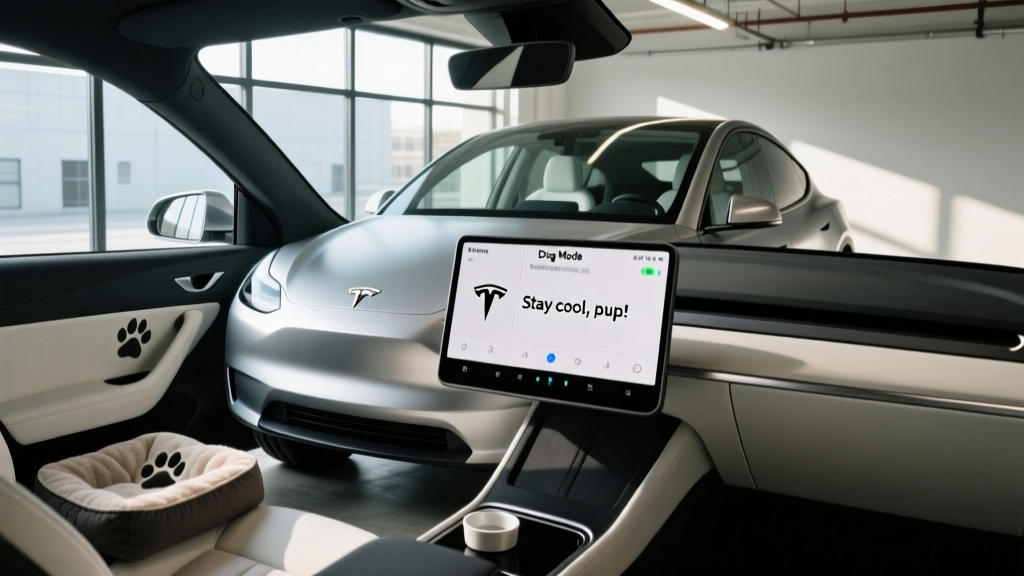
If you've ever seen a Tesla's giant touchscreen displaying a cheerful cartoon dog and a cabin temperature readout through the window, you've witnessed Tesla Dog Mode in action. But beyond the cute animation, Dog Mode is a serious climate-control feature that addresses one of the most anxiety-inducing scenarios for EV owners: leaving a pet in the car. In this guide, we'll break down exactly what Tesla Dog Mode is, how it works, the energy cost of running it, and which current Tesla models support it — alongside the full range, charging, and pricing specs you need to evaluate any Tesla in 2026.
What Is Tesla Dog Mode and How Does It Work?
Tesla Dog Mode is a climate-control setting available on all current Tesla vehicles that maintains a set cabin temperature while the car is parked and the driver is away. When activated, the system:
- Keeps the HVAC system running to hold your chosen temperature (default 72°F / 22°C)
- Displays a prominent message on the touchscreen visible from outside: "My owner will be back soon. Don't worry! The A/C is on and the temperature is [XX]°"
- Prevents the vehicle from automatically powering down or locking out climate controls
- Sends a notification to your Tesla mobile app if the battery drops below 20% State of Charge (SoC)
- Continues running even if the car is locked and you walk away with the key fob or phone key
Dog Mode was introduced via an over-the-air (OTA) software update in early 2019 and has since become a standard feature across the Tesla fleet. It runs off the vehicle's high-voltage traction battery — not the 12V auxiliary battery — meaning it can sustain climate control for hours depending on outside temperature and battery capacity.
Energy Consumption: How Much Range Does Dog Mode Use?
This is the question every EV owner asks. Dog Mode's energy draw depends heavily on ambient temperature, cabin insulation, and whether you're heating or cooling:
- Mild weather (65–80°F): Approximately 1–2 kW draw, consuming roughly 2–5 miles of range per hour
- Hot weather (90–110°F): Approximately 2–4 kW draw, consuming roughly 5–10 miles of range per hour
- Cold weather (below 32°F): Approximately 3–6 kW draw (heat pump dependent), consuming roughly 8–15 miles of range per hour
For context, a Tesla Model Y Long Range with its 75 kWh usable battery and ~300 miles of range could theoretically run Dog Mode in mild weather for 15+ hours before hitting the 20% SoC warning threshold. In extreme cold, that window shrinks to roughly 5–6 hours. Teslas equipped with a heat pump (all current models) are significantly more efficient in cold weather than older vehicles that relied on resistive PTC heaters.
Which Tesla Models Have Dog Mode? (2026 Lineup)
Dog Mode is available on every current-production Tesla — it's a software feature, not a trim-level option. However, the experience varies slightly based on each model's battery size, HVAC hardware, and cabin volume:
| Model | Battery (kWh usable) | Chemistry | EPA Range | Est. Dog Mode Runtime (mild) |
|---|---|---|---|---|
| Model 3 RWD | 57.5 | LFP | 272 mi | ~10–12 hrs |
| Model 3 Long Range AWD | 75 | NMC | 341 mi | ~15–18 hrs |
| Model Y Long Range AWD | 75 | NMC | 308 mi | ~14–16 hrs |
| Model S Long Range | 95 | NMC | 402 mi | ~20+ hrs |
| Model X Long Range | 95 | NMC | 335 mi | ~18–20 hrs |
The larger the battery pack, the longer Dog Mode can sustain climate control. The Model S, with its ~95 kWh usable pack, offers the longest theoretical runtime — an important consideration if you frequently travel with pets and make extended stops.
Tesla Model Y Long Range: Full 2026 Specs (The Most Popular Dog Mode Use Case)
Since the Tesla Model Y is the most popular Tesla for pet-owning families (thanks to its hatchback cargo area and available 7-seat layout), here's the complete spec breakdown for the 2026 Model Y Long Range AWD:
Real-World Expectation: Expect ~260–280 miles on highway trips at 70+ mph. In cold weather (below 30°F), range can drop to ~230–250 miles due to battery resistance and cabin heating demand. City driving with regenerative braking recovers closer to the EPA sticker.
| Specification | 2026 Model Y Long Range AWD |
|---|---|
| Battery Capacity | 75 kWh usable, NMC chemistry |
| EPA Range | 308 miles |
| Efficiency | 122 MPGe combined / 28 kWh/100mi |
| Max DC Fast Charge | 250 kW peak (V3 Supercharger) |
| 10–80% DC Charge Time | ~27 minutes |
| Level 2 Home Charging | 11.5 kW (44 mi/hr) on 48A circuit |
| 0–60 mph | 4.8 seconds |
| Horsepower | 384 hp (dual motor AWD) |
| Drivetrain | Dual Motor All-Wheel Drive |
| Cargo Volume | 30.2 cu ft (rear seats up) / 72.1 cu ft (rear seats folded) |
| Rear Legroom | 41.6 inches |
| Battery Warranty | 8 years / 120,000 miles (min 70% retention) |
| Base MSRP | $47,990 (before incentives) |
Charging Speed Breakdown
| Charging Level | Power (kW) | Miles of Range Added per Hour | Best Use Case |
|---|---|---|---|
| Level 1 (120V household) | ~1.4 kW | ~4 mi/hr | Emergency / overnight trickle |
| Level 2 (240V, 48A Wall Connector) | 11.5 kW | ~44 mi/hr | Daily home charging |
| DC Fast (V3 Supercharger) | 250 kW peak | ~1,000+ mi/hr (peak) | Road trips, 10–80% in ~27 min |
Charging curve reality check: The Model Y peaks at 250 kW only between roughly 10–30% SoC. From 50–80%, the charge rate tapers to 60–100 kW. That's why the 10–80% time is 27 minutes rather than a linear calculation. Always precondition the battery (the car does this automatically when you navigate to a Supercharger) to hit peak charge rates.
Tesla Dog Mode vs. Competitor Pet-Safety Features
Tesla isn't the only automaker offering a pet-friendly parked-climate mode, but its implementation is the most well-known. Here's how it compares:
- Hyundai/Kia (Dog Mode / Pet Mode): Available on Ioniq 5, EV6, EV9, and other recent models. Runs HVAC at a reduced level and monitors cabin temperature. Displays a message on the exterior camera feed via the app.
- Ford (BlueCruise vehicles): Ford's "Pet Mode" on the Mustang Mach-E and F-150 Lightning maintains cabin temperature and shows a message on the SYNC screen.
- Rivian: Offers "Pet Mode" on the R1T and R1S, maintaining climate and displaying a message on the exterior light bar screen — a clever visibility touch.
- Traditional ICE vehicles: Some gas vehicles (like certain Honda and Subaru models) offer a cabin-overheat-protection feature, but these typically run the engine to power the A/C, producing exhaust and requiring fuel.
Tesla's advantage is ecosystem integration: Dog Mode pairs with Sentry Mode (exterior camera recording), the Tesla mobile app (real-time temperature and SoC monitoring), and over-the-air updates that continuously refine the feature. The large 15.4-inch touchscreen also makes the Dog Mode message highly visible to passersby — reducing the chance of a well-meaning bystander breaking your window.
Pricing, Tax Credits, and Ownership Costs
Here's what a 2026 Tesla Model Y Long Range AWD actually costs after incentives:
| Cost Factor | Amount |
|---|---|
| Base MSRP (Model Y LR AWD) | $47,990 |
| Destination Fee | $1,390 |
| Federal §30D Tax Credit (if eligible) | Up to $7,500 (point-of-sale transfer available) |
| Effective Price (with full credit) | ~$41,880 |
- Vehicle MSRP must not exceed $80,000 for SUVs/trucks/vans (Model Y qualifies)
- Buyer AGI must not exceed: $300,000 (joint), $225,000 (head of household), $150,000 (single)
- Battery components must meet domestic content thresholds (phased in through 2026)
- Critical minerals must meet sourcing requirements from the U.S. or FTA partners
- Credit can be transferred to the dealer at point of sale for an instant price reduction
- Always verify current eligibility at IRS.gov — rules change frequently
Ownership economics: At the national average electricity rate of ~$0.16/kWh (EIA data), charging a Model Y from 10–80% at home costs roughly $8.40 — compared to ~$35–45 for an equivalent gasoline SUV at $3.50/gallon. Over 5 years and 75,000 miles, the Model Y's fuel savings alone can offset $8,000–12,000 versus a comparable gas-powered crossover, depending on your local electricity and fuel prices.
Standout Tech and Notable Drawbacks
Pros
- Dog Mode with app monitoring is best-in-class for pet owners
- Access to Tesla Supercharger network — the most reliable DC fast-charging network in North America
- OTA updates continuously add features and improve efficiency
- Class-leading efficiency (122 MPGe) among AWD electric SUVs
- Standard Autopilot (SAE Level 2) with solid highway lane-keeping
- Spacious 30.2 cu ft cargo area with a flat load floor — ideal for pet crates
Cons
- No physical buttons — all controls via touchscreen (hazard lights, glovebox, wiper speed)
- Autopilot is SAE Level 2 only — driver must remain fully engaged at all times
- FSD (Supervised) subscription costs $99/month or $8,000 one-time — still requires driver supervision
- Ride quality on the firm side, especially with 20-inch wheels
- No Apple CarPlay or Android Auto — Tesla's proprietary infotainment only
- Insurance premiums tend to run 15–30% higher than comparable non-Tesla SUVs
Who Should Buy a Tesla (and Who Should Look Elsewhere)?
The Tesla Model Y is ideal for you if:
- You travel with pets regularly and want best-in-class parked-climate safety
- You have access to home Level 2 charging (garage or driveway with a 240V outlet)
- You road-trip frequently and value the reliability of the Supercharger network
- You want a tech-forward EV with continuous OTA improvements
- You need a practical family hauler with 30+ cu ft of cargo space
Look at competitors if:
- You prefer physical buttons and traditional infotainment (consider Hyundai Ioniq 5 or Kia EV6)
- You need Apple CarPlay/Android Auto integration
- You want a more comfortable, compliant ride (consider the Genesis GV60 or BMW iX)
- You need a truck bed or serious towing capacity (consider Rivian R1T or Ford F-150 Lightning)
Frequently Asked Questions
Can Dog Mode drain my Tesla's battery completely?
Tesla's software prevents Dog Mode from draining the battery below 20% SoC. When the battery hits that threshold, the system sends an alert to your Tesla mobile app and may reduce HVAC output to preserve remaining range. You'll receive ample warning before the battery reaches critically low levels. Always start with a reasonable charge — ideally above 40% — if you plan to use Dog Mode for more than an hour.
Does Dog Mode work in extreme heat or cold?
Yes, but with caveats. In extreme heat (above 100°F), the A/C compressor works harder and draws more energy — expect roughly 5–10 miles of range loss per hour. In extreme cold (below 20°F), the heat pump is more efficient than old resistive heaters but still draws 3–6 kW. Tesla recommends using Dog Mode for short stops only in extreme conditions. The cabin will remain safe for pets, but your available driving range will decrease noticeably.
Is Tesla Dog Mode available on the base Model 3?
Yes. Dog Mode is a software feature included on every Tesla model and trim level — including the base Model 3 Rear-Wheel Drive. There is no additional cost or subscription required. The smaller 57.5 kWh LFP battery in the base Model 3 means shorter Dog Mode runtime (~10–12 hours in mild weather vs. 15+ hours in a Long Range model), but it's fully functional.
Does the 2026 Tesla Model Y qualify for the $7,500 federal tax credit?
The Model Y qualifies for the federal §30D tax credit for eligible buyers, but you must meet income caps ($150,000 single / $300,000 joint filer AGI) and the vehicle must meet battery component and critical mineral sourcing requirements. As of 2026, Tesla's U.S.-built vehicles have generally met these thresholds, but eligibility can change as sourcing rules tighten. Always check the latest qualified vehicle list at fueleconomy.gov and consult a tax professional before relying on the credit.
How do I activate Tesla Dog Mode?
Tap the fan icon at the bottom of the touchscreen, then select "Dog" from the climate mode options (alongside "Keep" and "Camp"). Set your desired cabin temperature using the +/- controls. Once activated, you can exit the vehicle and lock it — Dog Mode will continue running. You can monitor cabin temperature and battery SoC remotely through the Tesla mobile app at any time.
What's the difference between Dog Mode, Keep Mode, and Camp Mode?
Dog Mode maintains cabin temperature and displays the pet-safety message on the exterior screen. Keep Mode maintains temperature but does not display an exterior message (useful for keeping food or medication cool). Camp Mode maintains climate, keeps USB ports and the touchscreen powered (for entertainment), and allows you to sleep in the vehicle with continuous airflow. All three draw from the traction battery and send low-SoC alerts to the app.