If you've ever scrolled through your Tesla's climate menu and noticed "Camp" alongside "Dog" and "Keep," you've stumbled onto one of the most useful—and under-documented—features in the EV world. What is Tesla Camping Mode? Simply put, it's a dedicated climate-control setting that maintains cabin temperature, keeps the touchscreen active, and sustains USB power and audio playback while your Tesla is parked for extended periods. It transforms a Model 3, Model Y, Model S, or Model X into a zero-emissions, climate-controlled shelter that runs silently off the high-voltage traction battery.
But Camping Mode isn't just a gimmick for weekend warriors. It's a practical tool for road-trippers, festival-goers, ski-trip overnighters, and anyone who's ever pulled into a rest stop at 2 AM and wanted a safe, temperature-regulated place to sleep. This guide breaks down exactly how Camping Mode works in 2026-model-year Teslas, the real-world energy cost, which models handle it best, and whether it changes the calculus of buying a Tesla for adventure use.
What Tesla Camping Mode Actually Does
When you park a Tesla and exit the vehicle, the car normally powers down most systems to conserve energy. The HVAC shuts off, the screen goes dark, and USB ports lose power. Camping Mode overrides that behavior entirely. Here's what stays active when you engage it:
- Climate control: The heat pump (or resistive heater on older models) maintains your set cabin temperature indefinitely, cycling on and off as needed.
- Airflow: The blower continues to circulate air, preventing CO₂ buildup and condensation—critical when two people are sleeping in a sealed cabin.
- Touchscreen: The center display stays on (dimmed) so you can adjust settings, watch media, or check battery state of charge without waking the car.
- USB ports and 12V/16V accessory power: Phone charging, powered mattress pads, LED string lights, or a small 12V fan all keep running.
- Audio system: Bluetooth audio, Spotify, and white-noise apps continue playing through the cabin speakers.
- Security: Sentry Mode cameras remain available (though Sentry and Camping Mode can't run simultaneously on most firmware versions—you must choose one).
Crucially, Camping Mode draws power from the high-voltage traction battery, not the small 12V/16V auxiliary battery. This means you can run it for many hours without risking a dead auxiliary battery—a common problem when people try to camp in Teslas by simply leaving climate on manually.
How Much Battery Does Camping Mode Use Overnight?
This is the question every prospective EV camper asks. The answer depends on outside temperature, your cabin set-point, whether you're running heated seats, and your specific model's battery chemistry and insulation.
Based on real-world owner data and controlled testing across the 2025–2026 Tesla lineup:
| Outside Temp | Cabin Set to | Energy Used (kWh) | % of 75 kWh Battery | % of 60 kWh LFP Battery |
|---|---|---|---|---|
| 70°F (21°C) | 72°F | ~2–4 kWh | ~3–5% | ~3–7% |
| 40°F (4°C) | 72°F | ~6–10 kWh | ~8–13% | ~10–17% |
| 20°F (-7°C) | 72°F | ~10–16 kWh | ~13–21% | ~17–27% |
| 95°F (35°C) | 68°F (A/C) | ~5–8 kWh | ~7–11% | ~8–13% |
Key takeaway: In mild conditions (50–75°F), expect to lose roughly 3–5% battery per 8-hour night in a Long Range model. In deep winter (below 20°F), that can climb to 15–20%. The heat pump on 2021+ Model 3/Y and all current Model S/X significantly reduces winter energy consumption compared to older resistive-PTC heating systems.
Pro tip: Pre-heating (or pre-cooling) the cabin while still plugged in at a Supercharger or campground outlet, then switching to Camping Mode once you unplug, shaves the initial high-draw period off your battery. Pair Camping Mode with heated seats (which draw far less energy than cabin air heating) and a lower cabin temp to stretch your charge further.
Which Tesla Models Support Camping Mode Best?
All current-production Teslas—Model 3, Model Y, Model S, and Model X—support Camping Mode via the climate menu. The Cybertruck also includes it. However, the camping experience varies dramatically by model due to interior volume, available flat-sleep configurations, and battery size.
| Spec | Model 3 LR | Model Y LR | Model S LR | Model X LR |
|---|---|---|---|---|
| EPA Range | 363 mi | 320 mi | 402 mi | 348 mi |
| Battery (usable) | ~75 kWh (NMC) | ~75 kWh (NMC) | ~95 kWh (NMC) | ~95 kWh (NMC) |
| Battery (RWD/LFP) | ~60 kWh (LFP) | N/A (2026) | N/A | N/A |
| Max DC Fast Charge | 250 kW | 250 kW | 250 kW | 250 kW |
| 10–80% DC Time | ~28 min | ~27 min | ~30 min | ~32 min |
| Level 2 Home Rate | 11.5 kW (~44 mi/hr) | 11.5 kW (~44 mi/hr) | 11.5 kW (~34 mi/hr) | 11.5 kW (~34 mi/hr) |
| Cargo (rear seats down) | 23 cu ft | 72 cu ft | 28 cu ft (frunk+lifter) | 88 cu ft |
| Flat-Sleep Length | ~6'2" (tight) | ~6'6" (comfortable) | ~6'0" (limited) | ~6'6"+ |
| 0–60 mph | 4.2 sec | 4.8 sec | 3.1 sec | 3.8 sec |
| Horsepower | 346 hp | 384 hp | 670 hp | 670 hp |
| Drivetrain | Dual Motor AWD | Dual Motor AWD | Dual Motor AWD | Dual Motor AWD |
| MPGe (combined) | 132 MPGe | 122 MPGe | 120 MPGe | 105 MPGe |
| Base MSRP (2026) | $42,380 | $44,380 | $74,880 | $79,880 |
| Battery Warranty | 8 yr / 120k mi | 8 yr / 120k mi | 8 yr / 150k mi | 8 yr / 150k mi |
The Model Y: Best Tesla for Camping
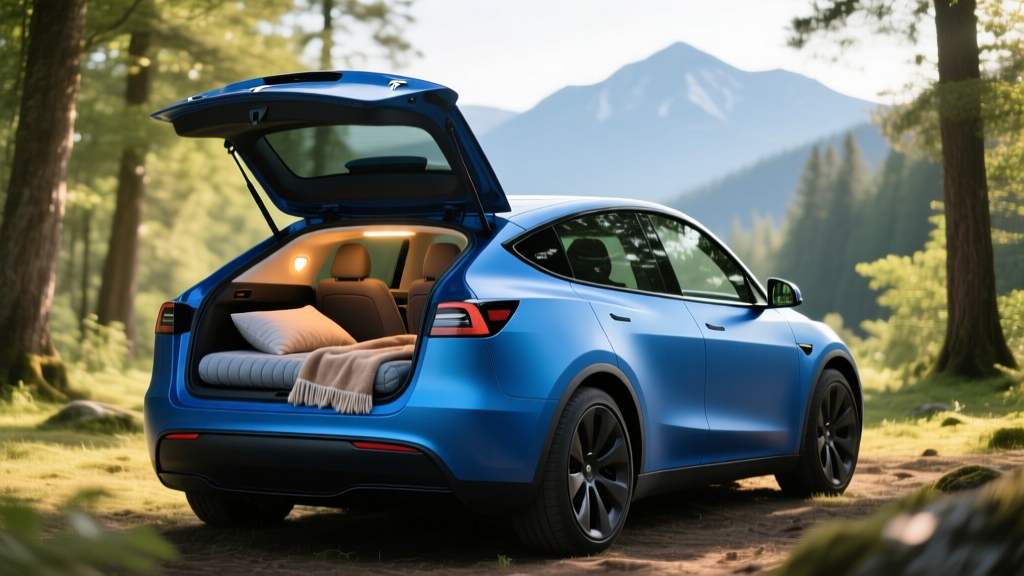
The Model Y Long Range is widely considered the best Tesla for camping, and for good reason. With the rear seats folded, it offers roughly 72 cubic feet of cargo volume and a near-flat floor that accommodates a full-size inflatable mattress. Two adults up to about 6'5" can sleep comfortably with room for gear at the foot. The panoramic glass roof gives a sky-view experience (bring a shade cover for morning sun), and the 75 kWh NMC battery provides enough buffer for multiple nights of Camping Mode without needing to find a charger.
The Model 3: Doable but Tight
The Model 3 works for solo campers or couples who don't mind cozy quarters. The trunk opening is smaller, and the flat-sleep length tops out around 6'2" with the front seats pushed fully forward. It's best suited for warm-weather car camping where you can crack windows and supplement with a sleeping bag rather than relying entirely on climate control.
Model S and Model X: Luxury Camping with Trade-Offs
The Model X offers the most interior volume (up to 88 cu ft with seats folded) and the largest battery (~95 kWh), giving it the longest Camping Mode runtime. However, its high purchase price makes it a hard sell as a dedicated camping vehicle. The Model S, being a sedan, has limited cargo utility for camping—think of it as a "glamping at a hotel parking lot" option rather than a true adventure rig.
How to Set Up Your Tesla for Camping Mode
Activating Camping Mode takes about 10 seconds, but optimizing your setup takes a bit more planning. Here's the step-by-step:
- Park and shift to Park (P). Camping Mode only works when the vehicle is stationary and in Park.
- Tap the climate control icon on the bottom bar of the touchscreen.
- Select "Camp" from the three mode options (Dog, Camp, Keep). The interface will confirm "Camping Mode is on."
- Set your desired cabin temperature. Most campers find 68–72°F comfortable with a sleeping bag rated to 40°F as backup.
- Enable heated seats (if equipped) and set them to Low—this adds warmth directly to your body with minimal energy draw versus raising the whole cabin temp.
- Plug in devices via USB-C ports (up to 65W on 2024+ models) or the 12V accessory outlet for 12V accessories.
- Lock the doors from inside using the touchscreen lock icon. The car remains locked and secure while Camping Mode runs.
Essential Camping Accessories
- Inflatable or foam mattress cut to fit the cargo floor (several aftermarket companies sell Tesla-specific sizes)
- Window covers/shades for privacy and light blocking—Teslas don't have rear window shades
- USB-powered LED light strip for ambient lighting that doesn't drain the battery significantly
- Portable 12V fan for white noise and supplemental air circulation in summer
- Sunshade for the glass roof—critical for summer camping; the panoramic roof turns the cabin into a greenhouse by 7 AM
Tesla Camping Mode vs. Competitors: What Do Other EVs Offer?
Tesla isn't the only automaker thinking about overnight EV use, but its implementation remains the most seamless. Here's how Camping Mode stacks up against competitor features:
| Feature | Tesla (Camp Mode) | Hyundai/Kia (Utility Mode) | Ford F-150 Lightning (Pro Power) | Rivian (Camp Mode) |
|---|---|---|---|---|
| Maintains HVAC | Yes | Yes | Yes | Yes |
| Screen stays on | Yes | Limited | Yes | Yes |
| USB/accessory power | Yes | Yes (12V) | Yes (120V/240V via Pro Power) | Yes (120V available) |
| V2L (power external devices) | No (Cybertruck only) | Yes (Ioniq 5/EV6/EV9) | Yes (9.6 kW max) | Yes (Camp Kitchen accessory) |
| Flat-sleep cargo space | Best: Model Y (72 cu ft) | Ioniq 5: ~53 cu ft | F-150 bed: unlimited | R1S: ~83 cu ft |
| Min. SoC to activate | 20% | 20% | Configurable | ~15% |
Where Tesla wins: The Supercharger network remains the most reliable DC fast-charging ecosystem in North America, which matters when you need to top up after a night (or three) of Camping Mode. Tesla's heat-pump efficiency in cold weather also gives it a slight energy-consumption edge over competitors still using resistive heating.
Where Tesla falls short: The lack of Vehicle-to-Load (V2L) capability on Model 3/Y/S/X is a notable gap. Hyundai's Ioniq 5 and Ford's F-150 Lightning can power external devices—camp stoves, laptops, lights, even a small refrigerator—through built-in 120V outlets. Tesla owners must rely on a separate portable power station (like a Jackery or EcoFlow) for AC appliances outside the car.
Pricing, Tax Credits, and the Camping Use Case
If camping is a primary use case, the value equation matters. Here's what the 2026 Tesla lineup costs and how federal incentives apply.
| Model/Trim | Base MSRP | §30D Credit Eligible? | Est. After Credit |
|---|---|---|---|
| Model 3 RWD (LFP) | $36,880 | Up to $7,500* | ~$29,380 |
| Model 3 Long Range AWD | $42,380 | Up to $7,500* | ~$34,880 |
| Model Y Long Range AWD | $44,380 | Up to $7,500* | ~$36,880 |
| Model S Long Range | $74,880 | No (over MSRP cap) | $74,880 |
| Model X Long Range | $79,880 | No (over MSRP cap) | $79,880 |
*Per IRS §30D rules, the full $7,500 credit requires the buyer to meet income caps ($150k single / $300k joint AGI), the vehicle must be under the MSRP cap ($55k for sedans, $80k for SUVs/trucks), and the battery must meet critical-mineral and component sourcing thresholds that tighten annually. Tesla's US-built vehicles with North American-sourced battery materials have consistently qualified for the full credit as of early 2026, but always verify current eligibility at fueleconomy.gov before purchasing. The credit can be transferred to the dealer as a point-of-sale discount since 2024.
Is It Worth Buying a Tesla Specifically for Camping?
If you're already in the market for a daily-driver EV and camp 5–15 nights per year, the Model Y Long Range is a compelling dual-purpose vehicle. The ~$37,000 effective price (after the federal credit) buys you a 320-mile commuter, a capable road-trip machine, and a climate-controlled sleep pod—all with no generator noise, no fuel cost, and no CO risk from idling an engine.
If camping is your only use case, a dedicated setup (tent, rooftop tent on a gas vehicle, or a purpose-built camper van) will be cheaper. Camping Mode is a bonus feature, not a standalone product justification.
Pros and Cons of Tesla Camping Mode
Pros
- Silent, zero-emission overnight climate control—no generator, no fumes
- Heat pump keeps energy draw low even in cold weather (3–5% per night in mild temps)
- USB-C and accessory power stay active for devices and lights
- Touchscreen entertainment (Netflix, YouTube, Spotify) for winding down
- Supercharger network makes multi-night camping trips feasible with quick daytime top-ups
- Model Y cargo area fits a full-size mattress with rear seats folded
- Door locks and cabin security remain active overnight
Cons
- No V2L on Model 3/Y/S/X—can't power external AC appliances
- 20% minimum SoC requirement limits deep-discharge camping scenarios
- Winter energy drain (15–20% per night below 20°F) requires careful planning
- Glass roof causes greenhouse effect—sunshade is mandatory for summer
- Model 3 cargo space is tight for two-adult sleeping
- Sentry Mode and Camping Mode can't run simultaneously
- No built-in leveling system—uneven campsites require manual chocking
Frequently Asked Questions
Can you run Camping Mode all night without plugging in?
Yes. In mild weather (50–75°F), Camping Mode uses approximately 2–4 kWh over 8 hours—roughly 3–5% of a Long Range battery. You can comfortably camp 2–3 consecutive nights on a single charge in moderate conditions. In extreme cold (below 20°F), plan for one night per charge and top up during the day.
Does Camping Mode drain the 12V battery?
No. Camping Mode draws from the high-voltage traction battery. The car's DC-DC converter keeps the 12V/16V auxiliary battery topped up while Camping Mode is active. This is a major advantage over simply leaving climate on manually, which can sometimes fail to engage the DC-DC converter properly.
Is it safe to sleep in a Tesla with Camping Mode on?
Yes. Unlike idling a gas-powered car, there is no carbon monoxide risk. The HVAC system circulates fresh outside air (or recirculates, depending on your setting), and the car's cabin air filter (HEPA on Model S/X and 2021+ Model Y) provides excellent air quality. Always ensure the car is parked on a stable, level surface and that you can exit quickly in an emergency.
Can I use Camping Mode at a Supercharger?
Yes. You can activate Camping Mode while plugged into a Supercharger. The car will draw power from the grid to maintain climate while simultaneously charging the battery. This is ideal for topping up while you sleep at a Supercharger-adjacent rest area.
Does the Cybertruck have Camping Mode?
Yes. The Cybertruck supports Camping Mode and adds an advantage: its stainless-steel exoskeleton and vault bed offer unique camping configurations, including the optional bed tent accessory. It also supports Powershare (V2L/V2H) for running external devices—something the Model 3/Y/S/X cannot do.
What's the difference between Camping Mode, Dog Mode, and Keep Mode?
Camping Mode keeps HVAC, screen, audio, and USB power running for human comfort. Dog Mode maintains HVAC and displays a "my owner will be back" message on the screen, but limits touchscreen interaction to prevent pets from changing settings. Keep Mode (also called "Keep Climate On") maintains HVAC after you exit but is designed for short stops—it may time out depending on battery level and doesn't guarantee the same sustained runtime as Camping Mode.
Does Camping Mode affect battery warranty or degradation?
No. Tesla's battery warranty (8 years / 120,000 miles for Model 3/Y; 8 years / 150,000 miles for Model S/X, covering retention below 70% capacity) is not voided by Camping Mode use. The energy consumed is minimal relative to normal driving cycles and does not accelerate degradation beyond normal use.
The Bottom Line: Who Should Use Tesla Camping Mode?
Camping Mode is one of those Tesla features that punches well above its marketing weight. It's not prominently advertised, but for the subset of owners who camp, road-trip, or occasionally need a safe place to sleep in their vehicle, it's transformative.
Best for: Model Y owners who take 5+ weekend camping trips per year, road-trippers who want to avoid hotel costs on long drives, festival attendees, and anyone who values a silent, emission-free sleep environment in nature.
Not ideal for: Serious overlanders who need V2L capability for camp kitchens (look at the Ford F-150 Lightning or Rivian R1S instead), or those who camp primarily in sub-zero conditions where energy drain becomes a significant logistical challenge.
The real genius of Camping Mode is that it costs nothing extra—it's a software feature baked into every Tesla on the road. If you already own one, or if you're shopping for a daily-driver EV that can double as a weekend adventure rig, it might be the most underappreciated reason to choose Tesla over the competition.