What Is an EV?
An EV (electric vehicle) — specifically a battery-electric vehicle, or BEV — is a car powered entirely by an electric motor drawing energy from a rechargeable lithium-based battery pack. Unlike gas cars, EVs have no engine, no transmission, no tailpipe, and no oil changes. You refuel by plugging into an electrical source, from a standard 120V wall outlet to a 350 kW DC fast charger. As of the 2026 model year, mainstream EVs deliver 220 to 400+ miles of EPA-estimated range, start around $29,000 before incentives, and cost roughly $0.04 to $0.06 per mile to charge at home on a national-average electricity rate — compared to about $0.12 to $0.15 per mile for a 27-MPG gas car at $3.30/gallon.
How an Electric Vehicle Actually Works
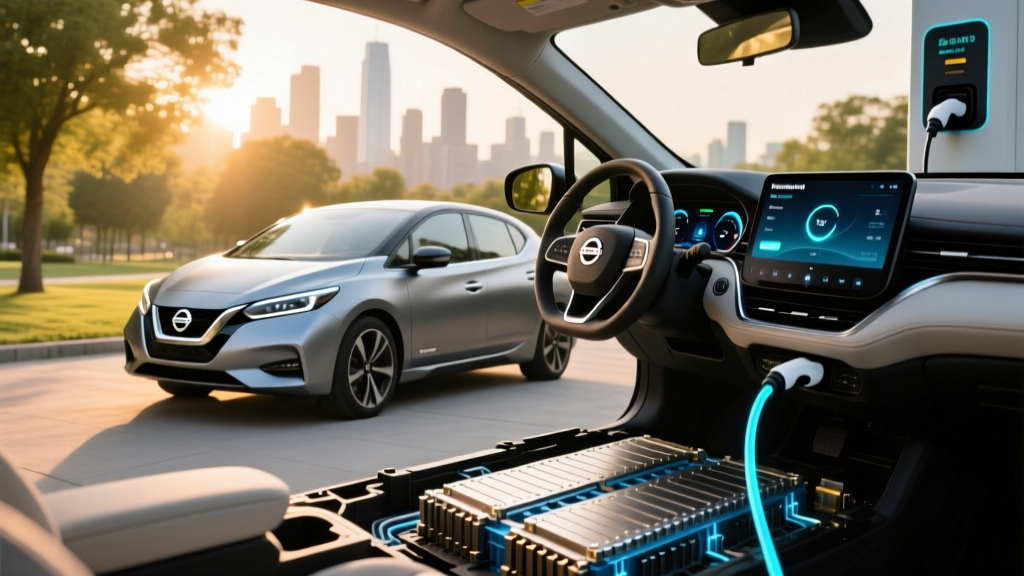
Strip away the marketing, and an EV's powertrain is remarkably simple. A high-voltage battery pack (typically 50 to 110 kWh of usable energy) stores electricity. An inverter converts the battery's DC current to AC for the motor, which turns the wheels. When you lift off the accelerator, the motor reverses direction, acting as a generator that slows the car while sending energy back into the battery — this is regenerative braking, and it's why EVs can often be driven in "one-pedal" mode with minimal use of the friction brakes.
The battery pack uses one of two dominant chemistries:
- NMC/NCA (nickel-based): Higher energy density, lighter weight, better cold-weather performance. Typically degraded faster if held at 100% state of charge daily. Found in most long-range models (Tesla Model 3 Long Range, Hyundai Ioniq 5, Ford Mustang Mach-E Extended Range).
- LFP (lithium iron phosphate): Slightly lower energy density, heavier, but more durable over thousands of cycles and tolerant of daily 100% charging. Increasingly common in standard-range models (Tesla Model 3 RWD, base Ford Mustang Mach-E).
Thermal management is critical. Most modern EVs use liquid cooling and heating loops to keep the battery between roughly 20°C and 40°C. This protects longevity and enables preconditioning — warming the pack before a fast-charge stop so the battery can accept peak kW rates instead of throttling charge speed in cold conditions.
EV vs. Gas vs. Hybrid: The Numbers That Matter
Choosing between a BEV, a conventional hybrid (HEV), a plug-in hybrid (PHEV), and a gas car comes down to your driving patterns and charging access. Here's how the math compares across representative 2026 models:
| Metric | BEV (Tesla Model 3 LR) |
PHEV (Toyota RAV4 Prime) |
HEV (Toyota Camry Hybrid) |
Gas (Honda Accord 1.5T) |
|---|---|---|---|---|
| EPA Range / MPG | 363 mi / 132 MPGe | 42 mi EV + 38 MPG | 51 MPG combined | 30 MPG combined |
| Fuel/Energy Cost per Mile | $0.04 (home) | $0.04 EV / $0.10 gas | $0.07 | $0.11 |
| Annual Fuel (15k mi) | ~$600 | ~$750 | ~$1,050 | ~$1,650 |
| Base MSRP | $47,740 | $46,400 | $30,495 | $29,390 |
| Federal Tax Credit (§30D) | Up to $7,500* | Up to $7,500* | N/A | N/A |
| Maintenance (5-yr est.) | ~$1,800 | ~$3,200 | ~$3,400 | ~$3,800 |
*§30D credit eligibility depends on buyer income caps, MSRP caps ($55k sedans / $80k SUVs/trucks), battery critical-mineral and component sourcing requirements, and point-of-sale transfer rules. Verify current-year rules at IRS.gov.
The BEV's per-mile fuel cost is lowest, but only if you can charge at home on a residential electricity rate. Public DC fast charging at networks like Electrify America or EVgo typically runs $0.35 to $0.55 per kWh, which pushes the per-mile cost to $0.10–$0.16 — comparable to a hybrid. This is why home charging access is the single biggest factor in whether a BEV saves you money.
The Real Costs of EV Ownership
Purchase price and fuel are only part of the picture. Here's a realistic 5-year total cost of ownership (TCO) breakdown for a mid-range BEV driven 15,000 miles per year, compared to a comparable gas sedan:
| Cost Category | BEV ($40k MSRP) | Gas Sedan ($30k MSRP) |
|---|---|---|
| Purchase (after $7,500 credit) | $32,500 | $30,000 |
| Home Charger Install (Level 2) | $1,200 (one-time) | $0 |
| Fuel / Electricity (5 yrs) | $3,000 | $8,250 |
| Maintenance (5 yrs) | $1,800 | $3,800 |
| Insurance (5 yrs, avg.) | $10,500 | $8,500 |
| Depreciation (5 yrs) | $16,000 | $13,500 |
| 5-Year TCO | $65,000 | $64,050 |
Key takeaways from this comparison:
- Energy savings are real: $5,250 less in fuel over five years with a BEV charged primarily at home.
- Maintenance savings are real: No oil changes, fewer brake replacements (regen handles most deceleration), no transmission fluid. Expect to spend on cabin air filters, wiper fluid, tire rotations, and brake fluid checks.
- Insurance is higher: BEV insurance premiums run 15–25% above comparable gas vehicles, driven by higher repair costs for battery-adjacent damage and specialized labor. Always get quotes before purchasing.
- Depreciation varies: EV resale values have been volatile. Price cuts from manufacturers and rapid tech improvements have compressed residuals on some models. Check Kelley Blue Book projected values for specific models.
Charging: What First-Time Buyers Actually Need to Know
Charging speed is measured in kW (kilowatts) — the rate of power delivery. Battery capacity is measured in kWh (kilowatt-hours) — the total energy stored. These are not interchangeable. A 75 kWh battery charged at 7.5 kW (Level 2) takes roughly 10 hours from empty; the same battery at 150 kW (DC fast charging) can go from 10% to 80% in about 25 minutes.
| Charging Level | Power (kW) | Miles Added per Hour | Best For |
|---|---|---|---|
| Level 1 (120V outlet) | 1.0–1.4 kW | 3–5 mi/hr | Overnight top-off, PHEVs, low-mileage drivers |
| Level 2 (240V home/public) | 7.2–11.5 kW | 25–44 mi/hr | Daily home charging, destination charging |
| DC Fast Charging | 50–350 kW | 150–1,000+ mi/hr (peak) | Road trips, quick stops |
The charging curve is not flat. A vehicle rated for "250 kW peak" does not charge at 250 kW for the entire session. DC fast charging follows a taper curve: peak speed is sustained roughly from 10–30% state of charge (SoC), then power steps down progressively. From 80–100%, charging slows dramatically to protect the battery. This is why manufacturers quote 10–80% charge times, not 0–100%.
For example, a 2026 Hyundai Ioniq 5 (84 kWh battery, NMC) peaks at roughly 240 kW on a 350 kW charger and reaches 10–80% in approximately 18 minutes under ideal conditions. In cold weather without adequate preconditioning, that same session could stretch to 30+ minutes.
Connector types in 2026: The North American Charging Standard (NACS), pioneered by Tesla, has been adopted by Ford, GM, Rivian, Volvo, Hyundai/Kia, and most major automakers for new vehicles. CCS1 remains on many 2023–2025 models and is still supported at most public stations via adapters. CHAdeMO is effectively discontinued for new vehicles but remains functional at legacy stations.
Real-World Range: What the EPA Sticker Doesn't Tell You
The EPA range estimate is a standardized laboratory test — useful for comparison, but not a guarantee. Real-world range varies significantly based on conditions:
- Highway driving at 75+ MPH: Expect 15–20% less than the EPA sticker. Aerodynamic drag increases with the square of speed, and EVs have no multi-gear transmission to offset this. A 320-mile EPA vehicle may deliver 255–270 miles at sustained interstate speeds.
- Cold weather (below 30°F): Battery chemistry slows, cabin heating draws 3–6 kW continuously, and regenerative braking is limited on a cold pack. Range loss of 20–35% is typical in sub-freezing conditions. Vehicles equipped with a heat pump (standard on Tesla, Hyundai Ioniq 5/6, many 2026 models) reduce this penalty by 5–10 percentage points compared to resistive heating.
- Elevation and terrain: Mountain passes consume energy climbing, but regen recovers a meaningful portion on descents — typically 30–50% of the climb energy.
- Climate control and accessories: Running AC in extreme heat costs roughly 5–8% of range. Seat heaters and steering wheel heaters use far less energy (~0.1–0.2 kW) than cabin air heating and are a smart efficiency choice in mild cold.
For a daily commute of 30–50 miles round-trip, even a 200-mile real-world range provides a comfortable 3–5x buffer. Range becomes a planning factor primarily on road trips exceeding 200 miles between charging stops.
Common EV Misconceptions, Addressed with Data
| Myth | Fact |
|---|---|
| "EV batteries need replacing every few years and cost $20,000." | Federal law mandates battery warranties of 8 years / 100,000 miles minimum (10 years / 150,000 miles in CARB states). Real-world degradation data from fleet studies shows most packs retain 85–92% capacity after 100,000 miles. Full replacements are rare and typically covered under warranty within the coverage period. (fueleconomy.gov) |
| "The grid can't handle everyone driving EVs." | Most EV charging occurs overnight during off-peak hours when grid capacity is underutilized. A single EV charging at Level 2 (7.2 kW) draws roughly the same as a central AC unit or electric dryer. Utilities are deploying managed charging and time-of-use rates to distribute load. |
| "EVs are worse for the environment because of battery manufacturing." | Lifecycle analyses from Argonne National Laboratory and ICCT consistently show that even on coal-heavy grids, an EV's lifetime emissions are lower than a comparable gas car within 1–2 years of driving. On cleaner grids (wind, solar, nuclear-heavy), the breakeven point is measured in months. |
| "EVs are slow and boring to drive." | Electric motors deliver maximum torque at 0 RPM. A 2026 Tesla Model 3 Performance hits 0–60 in 2.9 seconds with 510 HP. Even mainstream models like the Hyundai Ioniq 5 N produce 641 HP. EVs are also quieter and have a lower center of gravity due to the floor-mounted battery pack, improving handling. |
| "You'll get stranded because chargers are unreliable." | Public charging reliability has improved significantly. Tesla's Supercharger network consistently reports 99%+ uptime. Non-Tesla networks (Electrify America, EVgo, ChargePoint) have faced criticism for broken stalls and payment issues, but infrastructure investments from the NEVI program are upgrading stations. Home charging eliminates daily reliance on public infrastructure entirely for most drivers. |
Do You Qualify for the Federal EV Tax Credit?
The §30D Clean Vehicle Credit can reduce your effective purchase price by up to $7,500 for a new EV or $4,000 for a qualifying used EV. As of 2026, the credit can be transferred to the dealer at point of sale, functioning as an immediate discount rather than a tax-time rebate. However, eligibility is layered with requirements:
- Income caps: Modified adjusted gross income (MAGI) must not exceed $150,000 (single), $225,000 (head of household), or $300,000 (joint).
- MSRP caps: Vans, SUVs, and pickup trucks must have an MSRP at or below $80,000. Sedans and other body styles are capped at $55,000.
- Battery sourcing: A percentage of critical minerals and battery components must be sourced from the U.S. or free-trade-agreement countries. These percentages increase annually, and some otherwise-qualifying vehicles lose partial or full credit as sourcing rules tighten. China-sourced battery components can disqualify a vehicle entirely.
- Final assembly: The vehicle must undergo final assembly in North America.
The qualifying vehicle list changes frequently as manufacturers adjust supply chains. Always verify eligibility on the official fueleconomy.gov tax credit page before committing to a purchase. Consult a tax professional for your specific situation.
Decision Framework: Should You Buy an EV, Hybrid, or Gas Car?
Choose a BEV (Battery-Electric Vehicle) if:
- You have access to Level 2 home charging (garage, driveway, or workplace)
- Your daily driving is under 100 miles round-trip
- You want the lowest per-mile fuel cost and minimal maintenance
- You take road trips fewer than 5–6 times per year (and can plan charging stops)
- You qualify for the §30D tax credit, narrowing the upfront price gap
Choose a PHEV (Plug-In Hybrid) if:
- You can charge at home but regularly drive 200+ miles in a day
- You want 30–45 miles of electric-only commuting with a gas engine backup for longer trips
- You live in a region with sparse DC fast-charging infrastructure
- You want EV-like daily driving without any route planning
Choose an HEV (Conventional Hybrid) if:
- You have no access to home or workplace charging
- You want significantly better fuel economy (45–55 MPG) without any plug-in behavior change
- Your budget is tighter and you don't want the upfront cost of a BEV or PHEV
Stick with a Gas Vehicle if:
- You drive extremely low annual miles (under 5,000), where fuel savings are negligible
- You tow heavy loads regularly (over 7,000 lbs) and need the longest possible range between stops
- You live in an area with extreme cold (regularly below -20°F) and no garage, where EV range loss and charging logistics become significant burdens
Frequently Asked Questions
How long do EV batteries last?
Most modern EV battery packs are engineered for 1,500–3,000+ charge cycles before reaching 70–80% of original capacity. In practical terms, that translates to 200,000–400,000+ miles before significant degradation. The federal warranty mandates coverage against degradation below a specified threshold (typically 70% capacity retention) for at least 8 years or 100,000 miles. Many owners report 90%+ capacity retention well past the warranty period.
Can I charge an EV from a regular household outlet?
Yes — this is Level 1 charging at 120V, delivering about 1.0–1.4 kW. You'll add roughly 3–5 miles of range per hour. For a PHEV with 40 miles of electric range, an overnight Level 1 session is often sufficient. For a BEV with a 75 kWh battery, a full Level 1 charge would take 50+ hours, making it impractical as a primary charging method. Most BEV owners install a 240V Level 2 home charger.
How much does a home Level 2 charger installation cost?
A typical Level 2 home installation (240V, 48-amp hardwired wall connector) costs between $800 and $2,500 total, depending on your electrical panel's proximity to the parking spot, whether a panel upgrade (200A service) is needed, and local permit fees. If your panel is near the garage and has spare capacity, expect the lower end. A full 200A panel upgrade can add $1,500–$3,500. Always get a licensed electrician's assessment before purchasing equipment.
Are EVs more expensive to insure?
Generally, yes. EV insurance premiums run 15–25% higher than equivalent gas vehicles, primarily because collision repairs near the battery pack require specialized labor and parts, and EVs tend to be higher-value vehicles. However, the gap is narrowing as repair networks gain EV experience. Always obtain insurance quotes for specific models before purchasing — premiums vary significantly between insurers and states.
What happens if an EV runs out of charge on the road?
The same thing that happens when a gas car runs out of fuel: you need a tow or a mobile charge. Modern EVs provide extensive range warnings, low-charge routing to the nearest charger, and "turtle mode" that limits speed to extend remaining range. With navigation systems that automatically route through charging stations on long trips, running out of charge is almost always a planning failure, not a technology failure. Roadside assistance services increasingly offer mobile DC charging units for emergency top-ups.
Is an EV actually better for the environment?
Over its full lifecycle — including battery manufacturing — a BEV produces fewer greenhouse gas emissions than a comparable gas car in nearly every U.S. grid region. The breakeven point (where the EV's total emissions fall below the gas car's) typically occurs within 6,000–20,000 miles of driving, depending on your local electricity mix. As grids continue adding renewable generation, the advantage widens over the vehicle's lifetime. Source: Argonne National Laboratory lifecycle analyses.