Quick Answer: What EVs Does Bidoof Give?
Bidoof does not give EVs (Electric Vehicles). In the Pokémon games, Bidoof yields 1 HP Effort Value (EV) when defeated in battle — "EV" in that context stands for Effort Values, a hidden stat-building mechanic, not electric cars. If you're training a Pokémon's HP stat, Bidoof (and its evolution Bibarel) are reliable farming targets found in early routes across several game titles.
However, if you landed here researching actual electric vehicles — perhaps confused by the overlap in terminology — this guide covers everything a first-time EV buyer needs to know in 2026: real costs, range expectations, charging logistics, and how EVs stack up against gas and hybrid alternatives.
The EV Terminology Collision: Effort Values vs. Electric Vehicles
The abbreviation "EV" causes genuine confusion across two massive audiences. In gaming, Effort Values are stat points your Pokémon earns by defeating specific species — Bidoof gives 1 HP EV, Zubat gives 1 Speed EV, and so on. In automotive contexts, EV means a battery-electric vehicle (BEV) powered entirely by an electric motor and rechargeable battery pack.
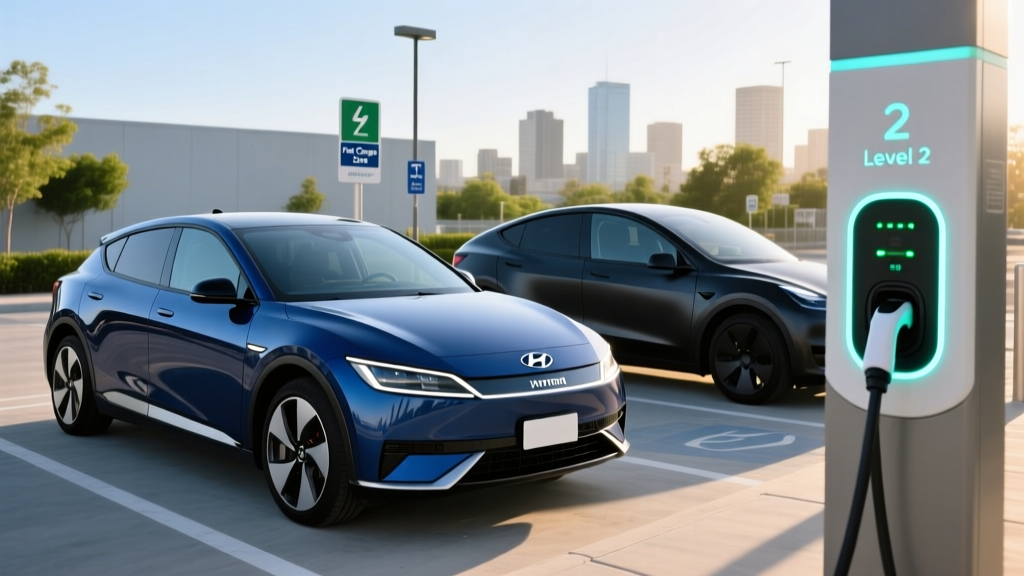
This guide is for the automotive side. If you're a gamer who accidentally wandered in, now you know: Bidoof = 1 HP EV, and no, it won't help you charge a Hyundai Ioniq 5.
Real EV Buying in 2026: What First-Time Buyers Must Know
Transitioning from a gas car to a battery-electric vehicle involves different math than most buyers expect. Here's the concrete data that matters.
Current 2026 EV Landscape by the Numbers
- Average new EV transaction price: ~$48,500 (down from ~$55,000 in 2023, per Kelley Blue Book data)
- Median EPA range: 270–320 miles across popular crossovers and sedans
- Federal tax credit (§30D): Up to $7,500 for qualifying new EVs, subject to MSRP caps ($55,000 sedans / $80,000 SUVs/trucks), buyer income limits ($150K single / $300K joint), and battery sourcing requirements — see the IRS clean vehicle credit page for current eligibility
- Point-of-sale transfer: Since 2024, buyers can transfer the credit to the dealer for an immediate price reduction at purchase
- Used EV credit: Up to $4,000 (30% of sale price) on qualifying pre-owned EVs under $25,000
EV vs. Gas vs. Hybrid: The Real Cost Comparison
Here's a 5-year total cost of ownership comparison for a typical commuter driving 12,000 miles annually. Figures use national averages for electricity ($0.16/kWh), gasoline ($3.40/gallon), and typical maintenance schedules.
| Cost Category | EV (e.g., Tesla Model Y LR) | Gas (e.g., Toyota RAV4 AWD) | PHEV (e.g., Toyota RAV4 Prime) |
|---|---|---|---|
| Base MSRP (2026) | $44,990 | $32,350 | $44,590 |
| Fed. Tax Credit | −$7,500 (if eligible) | $0 | −$7,500 (if eligible) |
| Effective Purchase | $37,490 | $32,350 | $37,090 |
| 5-Yr Fuel/Energy | $3,840 | $9,720 | $5,100 |
| 5-Yr Maintenance | $1,800 | $3,600 | $3,200 |
| 5-Yr Insurance (est.) | $9,000 | $7,200 | $8,100 |
| 5-Year Total | $52,130 | $52,870 | $53,490 |
Sources: fueleconomy.gov, IRS §30D, AAA maintenance surveys. Insurance varies significantly by driver profile and state. Tax credit eligibility depends on income, vehicle sourcing, and MSRP caps.
Key takeaway: The EV wins on 5-year cost if you qualify for the full federal credit and charge primarily at home. Without the credit, the gas RAV4 is cheaper. The PHEV splits the difference — you get 42 miles of electric-only range (per EPA data) for daily commuting, then gas flexibility for road trips.
Range, Charging, and Real-World Ownership Reality
Marketing range numbers and real-world range diverge more than most new EV owners anticipate. Here's the honest breakdown.
EPA Range vs. What You'll Actually Get
An EV rated at 310 miles EPA will typically deliver:
- ~280–300 miles in mild weather, mixed city/highway driving
- ~240–260 miles at sustained 75+ mph highway speeds (aerodynamic drag increases energy consumption sharply)
- ~200–230 miles in freezing temperatures (battery chemistry slows, cabin heating demands energy, and regenerative braking is limited until the pack warms)
This isn't a flaw — it's physics. Gas cars also get worse mileage in cold weather and at high speeds, but the effect is more pronounced in EVs because the energy store is finite and measurable in real time.
Charging Speeds: What the Numbers Mean
| Charging Level | Power (kW) | Miles Added/Hour | Use Case |
|---|---|---|---|
| Level 1 (120V outlet) | 1.2–1.9 kW | 3–5 miles | Overnight top-up; PHEV-friendly |
| Level 2 (240V home) | 7.2–11.5 kW | 25–44 miles | Daily home charging; full overnight recharge |
| DC Fast Charge | 50–350 kW | 150–1,000+ miles/hr (peak) | Road trips; 10–80% in 18–40 min depending on vehicle |
Critical nuance: A car that advertises "250 kW peak charging" doesn't sustain that rate. The charge curve tapers significantly above 80% state of charge to protect battery longevity. A typical session from 10–80% at a fast charger takes 18–30 minutes for modern EVs on compatible stations. That last 20% (80–100%) can take an additional 20–30 minutes — which is why road-trippers plan to charge to 80% and move on.
Home Charging Installation: The Cost Most Buyers Overlook
If you're buying an EV, budget for Level 2 home charging installation:
- Level 2 charger hardware: $350–$700 (ChargePoint Home Flex, Emporia Level 2, Wallbox Pulsar Plus)
- Electrician install (240V/50A circuit): $800–$2,500 if your panel has capacity
- Electrical panel upgrade (if needed): $1,500–$3,500 for older homes with 100A service upgrading to 200A
- Permit/inspection: $50–$300 depending on municipality
Total realistic range: $1,200–$6,000+ depending on your home's electrical infrastructure. Always get a licensed electrician's assessment before purchase.
Common EV Misconceptions: Myth vs. Fact
| Myth | Fact |
|---|---|
| "EV batteries need replacing every few years" | Modern EV batteries are warranted for 8 years/100,000 miles (minimum federal requirement). Real-world degradation averages 10–15% over 8 years. Many packs outlast the vehicle. |
| "EVs are worse for the environment because of electricity generation" | Even on coal-heavy grids, EVs produce fewer lifetime emissions than gas cars (Union of Concerned Scientists data). As grids decarbonize, the advantage grows. |
| "You can't take road trips in an EV" | The US DC fast-charging network exceeds 50,000 ports (Tesla Supercharger, Electrify America, EVgo). With 250+ mile range and 20-minute charge stops, road trips are routine — just slower than gas. |
| "All EVs qualify for the $7,500 tax credit" | Eligibility requires meeting MSRP caps, buyer income limits, battery mineral sourcing rules, and North American assembly. Many popular EVs qualify for partial or no credit. Check the IRS list before buying. |
| "Autopilot / FSD means the car drives itself" | All consumer driver-assist systems (Tesla Autopilot, FSD Supervised, GM Super Cruise, Ford BlueCruise) are SAE Level 2 — the driver must remain attentive and hands-on or eyes-on at all times. No consumer vehicle is self-driving. |
Decision Framework: Should You Buy an EV, Hybrid, or Stick with Gas?
Choose a Battery EV (BEV) If:
- You have reliable home charging access (garage, driveway, or workplace Level 2)
- Your daily commute is under 80 miles round-trip
- You qualify for the federal or state tax credit (reducing effective price by $4,000–$7,500+)
- You want the lowest per-mile fuel cost (~$0.04–$0.06/mile vs. $0.12–$0.18/mile for gas)
- You're willing to plan charging stops on road trips (20–30 min every 2–3 hours)
Choose a Plug-In Hybrid (PHEV) If:
- You want electric commuting (25–45 miles) but gas flexibility for long trips
- You lack reliable home or workplace charging for a full BEV
- You live in an area with sparse DC fast-charging infrastructure
- You frequently drive in extreme cold where BEV range loss is significant
Stick with Gas (or a Standard Hybrid HEV) If:
- You have no access to home or workplace charging and rely on street parking
- You regularly tow heavy loads (towing slashes EV range by 30–50%)
- Your budget is firmly under $30,000 and used EV options don't fit your needs
- You drive in remote areas far from charging infrastructure
Frequently Asked Questions
What does Bidoof give in EVs (Pokémon)?
Bidoof yields 1 HP Effort Value when defeated. This is a game mechanic unrelated to electric vehicles. For EV training HP stats, Bidoof and Bibarel are popular targets due to their common spawn rates in early-game areas.
What's the cheapest EV I can buy new in 2026?
The Nissan Leaf S starts around $28,140 MSRP, offering 149 miles EPA range and a 40 kWh battery. The Chevy Equinox EV LT starts near $33,000 with 315 miles EPA range and qualifies for the full $7,500 federal credit (subject to buyer eligibility), bringing its effective price to ~$25,500.
How much does it cost to charge an EV at home per month?
For 1,000 miles/month at 3.5 miles/kWh efficiency and $0.16/kWh electricity: roughly $45–$50/month. The same distance in a 28 MPG gas car at $3.40/gallon costs ~$121/month. Home charging is 50–65% cheaper per mile.
Do EVs cost more to insure?
Typically yes — 10–25% more than comparable gas vehicles, due to higher repair costs, specialized parts, and battery replacement risk. Shop quotes from EV-friendly insurers (Geico, Progressive, State Farm) before purchasing, as premiums vary significantly by model.
Will an EV's battery need replacing, and what does it cost?
Battery replacement is rare under normal ownership. If needed out of warranty, costs range from $5,000–$20,000+ depending on pack size. Federal warranty mandates require 8 years/100,000 miles of coverage with a minimum 70% capacity retention threshold. Most modern LFP and NMC packs degrade only 1–2% annually.