If you're researching Tesla ownership, one question dominates the decision: what does it cost to charge a Tesla? The answer isn't a single number — it depends on where you charge, which model you drive, your local electricity rates, and how you use the car. In this guide, we break down every charging scenario with exact numbers, real-world efficiency data, and model-specific calculations so you can budget accurately.
We'll also cover the full ownership picture — range, performance, pricing, tax credits, and how Tesla's charging costs compare to gas and rival EVs — because the cost-to-charge question only matters in context.
Tesla Charging Costs: The Short Answer
Here's the quick-reference table most buyers want first. These figures reflect 2026 national averages and Tesla's current Model 3 Long Range AWD efficiency of 26 kWh/100 miles (EPA combined). Your actual costs will vary by state, utility plan, and driving style.
| Charging Method | Avg. Cost per kWh | Cost per Mile (Model 3 LR) | Full 0-100% Cost (75 kWh usable) | Typical Use Case |
|---|---|---|---|---|
| Home Level 1 (120V) | $0.17 (US avg.) | $0.044 | $12.75 | Overnight trickle, under 30 mi/day |
| Home Level 2 (240V) | $0.17 (US avg.) | $0.044 | $12.75 | Daily primary charging |
| Time-of-Use Off-Peak (home) | $0.09-$0.12 | $0.023-$0.031 | $6.75-$9.00 | Scheduled overnight charging |
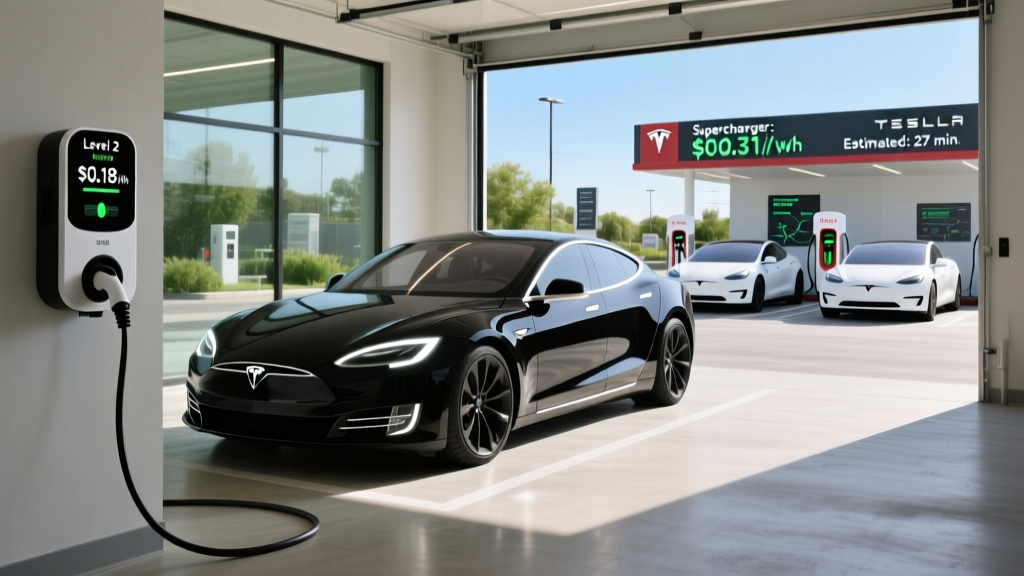
| Tesla Supercharger V3/V4 | $0.30-$0.42 | $0.078-$0.109 | $22.50-$31.50 | Road trips, apartment dwellers |
| Third-Party DC Fast (EA, EVgo) | $0.35-$0.55 | $0.091-$0.143 | $26.25-$41.25 | Non-Tesla network backup |
| Free Destination Charging | $0.00 | $0.00 | $0.00 | Hotels, malls, workplaces |
Key takeaway: Home charging on a standard residential rate costs roughly 4 to 5 cents per mile in a Model 3. Supercharging roughly doubles or triples that. For context, a 30 MPG gas car at $3.40/gallon costs about $0.113 per mile — so even at Supercharger prices, Tesla undercuts gasoline.
Cost to Charge Each Tesla Model (2026 Lineup)
Not all Teslas sip electrons equally. Heavier models with larger batteries and less efficient drivetrains cost more per mile. Here's how the 2026 lineup breaks down using the US average residential rate of $0.17/kWh and typical Supercharger pricing of $0.35/kWh.
| Model | Battery (kWh usable) | EPA Efficiency (kWh/100mi) | Home Cost/Mile | Supercharger Cost/Mile | EPA Range |
|---|---|---|---|---|---|
| Model 3 RWD | 60 (LFP) | 27 | $0.046 | $0.095 | 272 mi |
| Model 3 Long Range AWD | 75 (NMC) | 26 | $0.044 | $0.091 | 363 mi |
| Model 3 Performance | 75 (NMC) | 28 | $0.048 | $0.098 | 341 mi |
| Model Y Long Range AWD | 75 (NMC) | 28 | $0.048 | $0.098 | 320 mi |
| Model Y Performance | 75 (NMC) | 30 | $0.051 | $0.105 | 298 mi |
| Model S Long Range | 95 (NMC) | 32 | $0.054 | $0.112 | 402 mi |
| Model X Long Range | 95 (NMC) | 36 | $0.061 | $0.126 | 348 mi |
Efficiency figures sourced from fueleconomy.gov and Tesla's 2026 EPA filings. Real-world efficiency will be higher (meaning more kWh/100mi and higher cost/mile) in cold weather, at sustained highway speeds above 70 mph, or with roof racks and heavy cargo.
Home Charging vs. Supercharging: The Real Math
The single biggest factor in what it costs to charge a Tesla is where you plug in. Let's model a realistic ownership scenario: 12,000 miles per year, with 85% of charging at home and 15% on Superchargers (road trips and occasional top-ups).
Home (10,200 miles): 10,200 × $0.044 = $448.80
Supercharger (1,800 miles): 1,800 × $0.091 = $163.80
Total annual charging cost: $612.60
Compare to a 28 MPG gas car at $3.40/gal: 12,000 ÷ 28 × $3.40 = $1,457/year
Annual fuel savings: ~$844
State-by-State Electricity Rate Impact
Your home charging cost swings dramatically by location. At 12,000 miles/year in a Model 3 LR (26 kWh/100mi = 3,120 kWh/year):
- Louisiana ($0.10/kWh): $312/year home charging
- National average ($0.17/kWh): $530/year
- California ($0.30/kWh): $936/year — but CA's off-peak EV rates can drop to $0.09-$0.12/kWh overnight, cutting this to $281-$374
- Hawaii ($0.42/kWh): $1,310/year — still competitive with $4.50/gal gas
If your utility offers a time-of-use (TOU) EV plan, scheduling charging between 11 PM and 6 AM can cut your cost per mile nearly in half. Tesla's built-in scheduled charging feature makes this automatic.
Supercharger Pricing: What You'll Actually Pay on Road Trips
Tesla Supercharger rates are not flat — they vary by station, time of day, and region. In 2026, most US Superchargers fall between $0.30 and $0.42 per kWh, with some urban stations in California and the Northeast hitting $0.48/kWh during peak hours.
Tesla has also introduced time-of-use pricing at select high-traffic Superchargers, where off-peak rates can be 20-30% cheaper. The Tesla app shows real-time pricing at every station before you navigate there.
Typical Road-Trip Charging Cost
Consider a Los Angeles to Las Vegas trip (270 miles one way) in a Model 3 Long Range:
- Energy consumed: ~70 kWh (accounting for highway speeds and elevation)
- Supercharger stops needed: 1 (Barstow, adding ~40 kWh)
- Cost at $0.36/kWh: ~$14.40 one way
- Round trip charging: ~$28.80
- Equivalent gas cost (28 MPG car, $3.40/gal): $65.60 round trip
Even exclusively Supercharging, the Tesla costs less than half the gas equivalent. The gap widens further if you charge at home for daily driving.
Charging Speed and Specs: How Fast Can Each Tesla Replenish?
Cost matters, but so does time. Here's the charging-speed breakdown across the 2026 Tesla lineup. Note that kW is power (charge rate) and kWh is energy (battery capacity) — these are not interchangeable.
| Model | Max DC Fast Charge | 10-80% DCFC Time | Level 2 Home (kW) | Miles Added/Hr (L2) | Connector |
|---|---|---|---|---|---|
| Model 3 RWD | 170 kW | ~25 min | 11.5 kW (48A) | ~37 mi/hr | NACS (native) |
| Model 3 Long Range AWD | 250 kW | ~20 min | 11.5 kW (48A) | ~41 mi/hr | NACS (native) |
| Model 3 Performance | 250 kW | ~20 min | 11.5 kW (48A) | ~39 mi/hr | NACS (native) |
| Model Y Long Range AWD | 250 kW | ~22 min | 11.5 kW (48A) | ~39 mi/hr | NACS (native) |
| Model S Long Range | 250 kW | ~27 min | 11.5 kW (48A) | ~34 mi/hr | NACS (native) |
| Model X Long Range | 250 kW | ~28 min | 11.5 kW (48A) | ~31 mi/hr | NACS (native) |
Home Charging Setup Costs
To unlock the cheapest per-mile charging, you need a home Level 2 setup. Here's what that costs:
- Tesla Wall Connector: $420 (hardware)
- Electrician install (240V/60A circuit): $800-$2,500 depending on panel proximity and conduit run
- Electrical panel upgrade (if needed, 100A→200A): $1,500-$3,500
- Permit and inspection: $50-$250
- Total typical install: $1,270-$3,170 (no panel upgrade); $2,770-$6,670 (with panel upgrade)
At $612/year in charging costs (our Model 3 LR example), a basic home install pays for itself in 2-5 years versus exclusive Supercharging — and adds convenience and home value.
2026 Tesla Pricing, Tax Credits, and True Cost of Ownership
Understanding what it costs to charge a Tesla only completes half the picture. Here's what each model costs to buy, and how the federal tax credit applies under current IRS §30D rules.
| Model / Trim | Base MSRP | §30D Credit Eligibility | Effective Price (with credit) |
|---|---|---|---|
| Model 3 RWD | $38,990 | Up to $7,500 (point-of-sale) | ~$31,490 |
| Model 3 Long Range AWD | $42,990 | Up to $7,500 (point-of-sale) | ~$35,490 |
| Model 3 Performance | $52,990 | Up to $7,500 (point-of-sale) | ~$45,490 |
| Model Y Long Range AWD | $44,990 | Up to $7,500 (point-of-sale) | ~$37,490 |
| Model Y Performance | $51,490 | Up to $7,500 (point-of-sale) | ~$43,990 |
| Model S Long Range | $79,990 | $0 (exceeds MSRP cap) | $79,990 |
| Model X Long Range | $84,990 | $0 (exceeds MSRP cap) | $84,990 |
- MSRP cap: Sedans ≤$55,000; SUVs/trucks ≤$80,000
- Buyer income cap (AGI): $150K single / $225K head of household / $300K joint
- Battery sourcing: Critical minerals and battery components must meet escalating domestic-content thresholds (consult IRS guidance for current-year percentages)
- Point-of-sale transfer: Credit can be applied as a down-payment reduction at the dealer, not just a tax-year refund
- VIN verification: Confirm eligibility at fueleconomy.gov before purchase — rules change based on battery sourcing compliance
Five-Year Total Cost of Ownership: Model 3 LR vs. Gas Sedan
Let's put charging costs into a full ownership picture, comparing a Model 3 Long Range AWD ($42,990 MSRP, $35,490 after credit) to a comparably equipped Toyota Camry ($33,000, 28 MPG combined).
| Cost Category | Model 3 LR AWD | Gas Sedan (28 MPG) |
|---|---|---|
| Purchase price (after credit) | $35,490 | $33,000 |
| Fuel / charging (5 years) | $3,063 | $7,286 |
| Maintenance (5 years) | $1,200 | $3,500 |
| Insurance (5 years, avg.) | $9,500 | $7,200 |
| Estimated depreciation | $14,200 | $12,500 |
| 5-Year Total | $63,453 | $63,486 |
The totals are nearly identical — but the Tesla delivers 363 miles of range, 346 hp, instant torque, and access to the Supercharger network. The gas sedan's advantage is lower insurance and depreciation; the Tesla's advantage is dramatically lower fuel and maintenance costs. Your personal TCO depends heavily on your insurance rate (get a quote before buying) and how much you charge at home versus on Superchargers.
Real-World Range: What the EPA Sticker Doesn't Tell You
EPA combined: 363 miles
Highway (75 mph, 70°F): ~290-310 miles
City / mixed (moderate climate): ~330-350 miles
Cold weather (20°F, highway): ~220-260 miles (30-40% reduction)
Cold weather + cabin heat, city: ~260-290 miles
Range loss in cold weather is caused by battery internal resistance increase and cabin heating energy draw. Tesla's heat pump (standard on all 2026 models) mitigates this significantly compared to resistive heaters, but physics still applies. Preconditioning the battery while plugged in recovers some range.
The Model 3 RWD with its 60 kWh LFP battery rates at 272 miles EPA, but expect 210-230 miles on the highway and as low as 170-190 miles in freezing temperatures. The LFP chemistry offers slower degradation and a 100% daily charge recommendation (unlike NMC, which Tesla recommends keeping at 80% for daily use), but the smaller battery means fewer total miles between stops.
For the Model S and Model X, the larger 95 kWh packs deliver genuine 300+ mile real-world highway range — but these heavier vehicles consume more kWh per mile, increasing charging costs proportionally.
Pros, Cons, and Who Should Buy a Tesla in 2026
Pros
- Lowest per-mile charging cost when using home Level 2
- Supercharger network: 6,000+ US stalls, highest reliability of any DC network
- Class-leading efficiency (kWh/100mi) across the lineup
- Over-the-air updates continuously add features
- NACS connector now the industry standard — future-proof
- Strong performance even in base trims (Model 3 RWD: 0-60 in 5.8 sec)
- Minimal scheduled maintenance (no oil, filters, spark plugs)
Cons
- Supercharger-only lifestyle costs 2-3× more than home charging
- Insurance premiums run 20-40% higher than comparable gas cars
- No physical buttons — all controls through the touchscreen
- Model S/X excluded from federal tax credit (MSRP cap)
- Repair costs after collision can be high; body shop network still limited
- FSD (Supervised) is a Level 2 system, not autonomous — driver must remain engaged
- Model 3/Y rear visibility and low ground clearance noted by some owners
Who a Tesla Suits Best
- Home-charging commuters: If you can install a Level 2 charger at home, a Tesla offers the lowest per-mile fuel cost in the EV market and the most reliable road-trip network.
- Tech-forward drivers: Tesla's software, navigation with live Supercharger routing, and OTA updates are industry-leading.
- Performance seekers on a budget: The Model 3 Performance (0-60 in 2.9 seconds, ~$45,490 after credit) offers supercar acceleration at sedan pricing.
- Apartment dwellers without home charging: Proceed with caution. Exclusive Supercharger use is still cheaper than gas, but the cost advantage narrows and convenience drops. Confirm you have reliable Supercharger or workplace charging access first.
- Large families needing 3 rows: The Model X seats up to 7, but at $84,990 with no tax credit, consider the Rivian R1S or Kia EV9 as alternatives.
Tesla Charging Cost FAQ
Is it cheaper to charge a Tesla at home or at a Supercharger?
Home charging is dramatically cheaper. At the US average residential rate of $0.17/kWh, you'll pay about $0.04-$0.05 per mile. Superchargers average $0.30-$0.42/kWh, pushing cost per mile to $0.08-$0.11. Over 12,000 miles/year, that's roughly $530 at home versus $1,080 on Superchargers — a $550 annual difference.
Does Tesla offer free Supercharging in 2026?
Free unlimited Supercharging is no longer included with new Tesla purchases. Some referral programs and promotional periods have offered limited free Supercharging credits (typically 1,000-10,000 miles), but these are not guaranteed. Certain destination chargers at hotels and businesses remain free.
How much does a Tesla add to my electric bill?
Driving 12,000 miles/year in a Model 3 Long Range (26 kWh/100mi) consumes about 3,120 kWh annually. At the $0.17/kWh national average, that adds roughly $530/year or $44/month to your electricity bill. This replaces the ~$1,457 you'd spend on gasoline, for a net monthly savings of about $77.
Can I charge a Tesla on a regular 120V outlet?
Yes, using the Tesla Mobile Connector with a NEMA 5-15 adapter. Level 1 charging delivers about 1.4 kW, adding roughly 3-5 miles of range per hour. A full charge from empty takes 40-60+ hours. This works for low-mileage drivers (under 30 miles/day) or as emergency backup, but a 240V Level 2 circuit is strongly recommended for daily use.
Does charging to 100% damage the Tesla battery?
It depends on the chemistry. The Model 3 RWD uses an LFP (lithium iron phosphate) battery — Tesla recommends charging to 100% regularly to maintain calibration. Models with NMC (nickel manganese cobalt) batteries — Long Range, Performance, Model S, Model X — should be kept at 80% for daily use and only charged to 100% before long trips. All Tesla batteries carry an 8-year/100,000-120,000 mile warranty (varies by model) against degradation below 70% capacity.
How does Tesla charging cost compare to other EVs?
Tesla vehicles are among the most efficient EVs on the market (lowest kWh/100mi), which directly lowers per-mile charging costs versus heavier, less efficient competitors. A Model 3 LR at 26 kWh/100mi costs about 8% less per mile to charge than a Ford Mustang Mach-E (28 kWh/100mi) and 15% less than a Hyundai Ioniq 5 AWD (30 kWh/100mi) at the same electricity rate. The Supercharger network also tends to be cheaper and more reliable than third-party DC networks like Electrify America.
Do Tesla charging costs vary by time of day?
At home, yes — if your utility offers time-of-use rates, off-peak overnight electricity can be 40-60% cheaper than peak afternoon rates. At Superchargers, Tesla has begun rolling out time-of-use pricing at select high-demand stations, with off-peak discounts of 20-30%. The Tesla app displays current pricing at every station.
Editorial note: Electricity rates, Supercharger pricing, and IRS §30D tax credit rules are subject to change. All figures in this guide reflect 2026 data as of publication. Verify current rates with your utility, local Supercharger pricing in the Tesla app, and tax credit eligibility at irs.gov or with a qualified tax professional before purchasing.