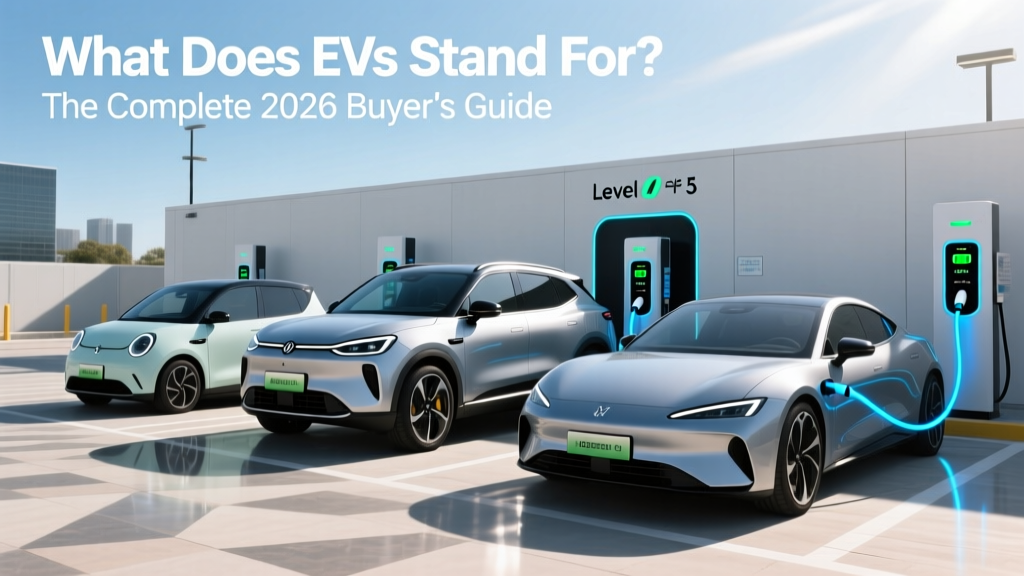
If you're just starting to research electrified cars, you've probably seen the acronym everywhere — on dealership signs, in news headlines, and on your neighbor's charging cable. Here's the direct answer:
What Does EVs Stand For?
EVs stands for "Electric Vehicles." The term broadly covers any vehicle propelled primarily by an electric motor drawing energy from a rechargeable battery pack. In practice, "EV" is used three ways:
- BEV (Battery Electric Vehicle): 100% electric, no gas engine. Examples: Tesla Model Y, Hyundai Ioniq 5, Ford F-150 Lightning.
- PHEV (Plug-in Hybrid Electric Vehicle): Has both a battery/motor and a gas engine. Can plug in for 25–50 miles of electric-only driving before the gas engine takes over. Examples: Toyota RAV4 Prime, Jeep Wrangler 4xe.
- HEV (Hybrid Electric Vehicle): Uses a small battery and motor to assist a gas engine but cannot plug in. Example: Toyota Prius.
When people say "EV" casually, they usually mean a BEV — a fully electric car with no tailpipe.
But knowing the acronym is only the starting point. The real question most shoppers are asking is whether an EV makes financial and practical sense for their specific driving life. Let's get into the numbers.
BEV vs PHEV vs HEV: Which Electrified Vehicle Fits You?
Not every "electric vehicle" is created equal. The three categories differ dramatically in how they're fueled, how far they go on electricity, and what they cost to operate. Here's how they stack up with real 2026 model data:
| Category | Example (2026) | EPA Electric Range | Gas Backup? | Plugs In? | Base MSRP |
|---|---|---|---|---|---|
| BEV | Hyundai Ioniq 5 SE | 303 mi | No | Yes | $42,600 |
| PHEV | Toyota RAV4 Prime | 42 mi electric | Yes (440 mi total) | Yes | $44,900 |
| HEV | Toyota Prius LE | N/A (57 MPGe combined) | Yes (530+ mi) | No | $29,450 |
| Gas (Baseline) | Toyota RAV4 LE (AWD) | N/A (30 MPG combined) | Yes (400 mi) | No | $30,250 |
The key distinction: A BEV eliminates gas entirely but requires charging access. A PHEV gives you a short electric commute with gas-engine insurance for road trips. An HEV improves fuel economy without any lifestyle change. Your choice hinges on your daily miles, charging access, and budget.
The Real Cost of Owning an EV: Purchase, Charging, and Maintenance
Sticker price is only the first line item. The total cost to own an EV over five years includes electricity, maintenance, insurance, and depreciation — and this is where EVs either shine or stumble depending on your situation.
5-Year Cost Comparison: BEV vs Gas Sedan
Let's compare a 2026 Hyundai Ioniq 5 SE (BEV) against a comparably priced 2026 Toyota Camry LE (gas), assuming 15,000 miles/year, $0.16/kWh home electricity, and $3.50/gallon gas:
| Cost Category (5 Years) | Hyundai Ioniq 5 (BEV) | Toyota Camry LE (Gas) |
|---|---|---|
| Purchase Price (MSRP) | $42,600 | $29,995 |
| Federal Tax Credit (§30D) | −$7,500* | $0 |
| Effective Purchase | $35,100 | $29,995 |
| Fuel / Electricity (5 yr) | $3,600 | $8,750 |
| Maintenance (5 yr) | $1,800 | $3,900 |
| Insurance (5 yr avg) | $9,200 | $7,100 |
| 5-Year Total Cost | $49,700 | $49,745 |
*Federal §30D tax credit eligibility requires meeting MSRP caps (under $55,000 for sedans, $80,000 for SUVs/trucks), buyer income limits ($150K single / $300K joint), and battery critical-mineral sourcing requirements. Point-of-sale transfer is available for 2026. Verify current rules at IRS.gov. Credit amounts and eligibility change — consult a tax professional.
The numbers reveal a common pattern: the BEV costs more upfront but recovers through dramatically lower fuel and maintenance costs. Over five years, the totals converge — and beyond year five, the EV pulls ahead as gas and maintenance savings compound.
Where EV Costs Can Surprise You
- Home charging installation: A Level 2 (240V) home charger typically costs $600–$1,500 for the unit plus $800–$3,000 for electrician labor and permits, depending on whether your panel needs an upgrade. Total: $1,400–$4,500.
- Insurance premiums: EVs typically cost 15–25% more to insure than equivalent gas cars due to higher repair costs and specialized parts. Get quotes before buying.
- Public DC fast charging: If you rely on public chargers (Electrify America, EVgo, Tesla Superchargers), expect $0.30–$0.50/kWh — roughly double home charging costs.
- Tires: EVs are heavier and deliver instant torque, wearing tires 20–30% faster. Budget $800–$1,400 for a set of EV-rated tires every 30,000–40,000 miles.
Real-World Range: What the EPA Sticker Doesn't Tell You
EPA range estimates are a useful baseline, but they assume a mix of city and highway driving at moderate temperatures. In practice, your actual range depends heavily on speed, climate, and terrain.
EPA vs Reality: 2026 Hyundai Ioniq 5 SE (303 mi EPA)
- City/mixed driving, 70°F: ~285–305 miles (near EPA)
- Highway at 75 mph, 70°F: ~245–265 miles (15–20% below EPA)
- Highway at 75 mph, 20°F (cold): ~195–225 miles (25–35% below EPA)
- With heat pump (standard on SEL+): Cold-weather loss reduced to ~20–25%
Source: fueleconomy.gov EV range testing methodology and independent real-world testing.
This is why a 300-mile EPA rating is comfortable for most daily commutes (the average American drives 37 miles per day, per the FHWA) but requires planning on long road trips. If you regularly drive in sub-freezing temperatures or take frequent 400+ mile trips, a PHEV may be a more practical choice than a BEV.
Charging Speed: The Number That Actually Matters
Range gets the headlines, but charging speed determines your road-trip experience. Here's what to look for:
| Charging Level | Power (kW) | Miles Added Per Hour | Where You'll Find It | Cost |
|---|---|---|---|---|
| Level 1 (120V) | 1.4 kW | 3–5 mi/hr | Standard wall outlet | ~$0 (home) |
| Level 2 (240V) | 7.2–11.5 kW | 20–40 mi/hr | Home charger, workplaces, malls | $0.12–$0.25/kWh |
| DC Fast Charge | 50–350 kW | 150–1,000+ mi/hr | Highway rest stops, dedicated stations | $0.30–$0.50/kWh |
Important: kW (kilowatts) is the rate of power delivery — like water pressure from a hose. kWh (kilowatt-hours) is the total energy stored in your battery — like the size of the tank. A 77.4 kWh battery charged at 230 kW peak can go from 10–80% in about 18 minutes on the Ioniq 5. But peak speed only lasts briefly; the charge curve tapers significantly above 80% to protect the battery.
Common EV Myths — Addressed With Facts
Misinformation about EVs is widespread. Here's what the data actually shows:
| Myth | Fact (With Data) |
|---|---|
| "EV batteries need replacing every few years." | Federal law mandates battery warranties of at least 8 years / 100,000 miles. Most NMC and LFP batteries retain 85–95% capacity after 100,000 miles. Full replacements (rare) cost $5,000–$20,000 depending on the model. |
| "EVs are worse for the environment because of electricity generation." | Even on coal-heavy grids, an EV produces 50–70% fewer lifetime emissions than a gas car (Union of Concerned Scientists analysis). On clean grids, the gap widens to 75%+. |
| "There aren't enough charging stations." | As of early 2026, the U.S. has over 200,000 public charging ports (AFDC data). However, rural areas and apartment dwellers still face access gaps — this is a real limitation. |
| "EVs can't handle cold weather." | Range drops 20–35% in freezing temps. Preconditioning the battery while plugged in mitigates this. EVs start instantly in cold (no cold-crank issues) and heat pump-equipped models lose less range. |
| "The power grid will collapse if everyone drives EVs." | Most EV charging happens overnight during off-peak hours. A Department of Energy study found that managed charging (smart chargers, time-of-use rates) allows grids to support mass EV adoption without major upgrades. |
Do You Qualify for the Federal EV Tax Credit?
The §30D Clean Vehicle Credit can reduce your effective purchase price by up to $7,500 — but eligibility is far from automatic. Here's the 2026 checklist:
- Vehicle MSRP cap: Under $55,000 for sedans/wagons; under $80,000 for SUVs, trucks, and vans.
- Buyer income cap: Modified AGI under $150,000 (single), $225,000 (head of household), or $300,000 (married filing jointly).
- Battery sourcing: Increasing percentages of critical minerals and battery components must be sourced from the U.S. or free-trade-agreement countries. This requirement tightens annually and disqualifies some models.
- Final assembly: Vehicle must be assembled in North America.
- Point-of-sale transfer: You can transfer the credit to the dealer at purchase, reducing your out-of-pocket cost immediately rather than waiting for tax filing.
The list of qualifying vehicles changes as manufacturers adjust supply chains. Always check the latest eligible-vehicle list at fueleconomy.gov before committing to a purchase.
Decision Framework: Should You Buy a BEV, PHEV, or Stick With Gas?
Choose a BEV (Full Electric) If:
- You have reliable home charging (garage, driveway, or workplace Level 2)
- Your daily driving is under 80 miles round-trip
- You want the lowest per-mile fuel cost (~$0.04–$0.06/mi at home)
- You're willing to plan charging stops on road trips (10–20 min every 200–250 mi)
- You qualify for the §30D tax credit or state incentives
Choose a PHEV (Plug-in Hybrid) If:
- You have home charging but also take frequent long road trips (400+ mi)
- You want electric commuting (25–50 mi range) without range anxiety
- You live in an area with sparse public charging infrastructure
- You want a single-vehicle household solution for mixed driving patterns
Stick With Gas or HEV If:
- You live in an apartment with zero charging access and no workplace charger
- Your budget is under $28,000 and you need a new vehicle
- You regularly tow heavy loads or drive 500+ miles in remote areas
- You live in extreme cold (below −10°F regularly) where range loss exceeds 35%
Frequently Asked Questions
What does EVs stand for in cars?
EVs stands for "Electric Vehicles." In automotive contexts, it refers to vehicles powered by an electric motor and rechargeable battery rather than — or in addition to — a gasoline engine. The three main types are BEV (fully electric), PHEV (plug-in hybrid), and HEV (conventional hybrid).
Is an EV cheaper than a gas car over time?
Typically yes, but it depends on your mileage and electricity rates. At 15,000 miles/year with home charging at $0.16/kWh, a BEV costs roughly $500–$700/year in electricity versus $1,500–$2,000/year in gas for a comparable sedan. Add in lower maintenance (no oil changes, fewer brake replacements due to regenerative braking) and the BEV saves $1,500–$2,500 annually. The break-even point against a gas car's lower purchase price is typically 3–5 years.
How long do EV batteries last?
Most modern EV batteries (both NMC and LFP chemistries) are designed to retain at least 70–80% of their original capacity after 100,000–150,000 miles. Federal law requires manufacturers to warrant batteries for at least 8 years / 100,000 miles against degradation below a stated threshold (typically 60–70% capacity). Many owners report 90%+ capacity retention at 80,000 miles. Complete battery failure is rare.
Can I charge an EV at a regular outlet?
Yes — but slowly. A standard 120V household outlet (Level 1) delivers about 1.4 kW, adding roughly 3–5 miles of range per hour. For a 300-mile-range EV, a full charge from empty takes 60+ hours. Level 1 works if you drive under 30 miles daily and can plug in overnight. Most EV owners install a 240V Level 2 charger for 20–40 miles of range per hour, enabling a full overnight charge.
What happens if my EV runs out of charge on the road?
You'll need a tow to the nearest charger — unlike a gas car where a friend can bring you a jerry can. However, modern EVs provide detailed range estimates, low-battery warnings at 10%, 5%, and 1%, and built-in navigation to the nearest charging station. Running out of charge is almost always a planning failure, not a sudden event. Roadside assistance plans (often included for 3–5 years with new EVs) typically cover towing to a charger.
Are EVs safe in a crash?
Yes. EVs undergo the same NHTSA and IIHS crash testing as gas vehicles. Many EVs score top marks due to their low center of gravity (battery pack under the floor) and large front crumple zones (no engine block). The IIHS has awarded Top Safety Pick+ ratings to multiple EVs including the Hyundai Ioniq 5, Tesla Model Y, and Genesis Electrified GV70. Battery fires in EV crashes are statistically rarer than gas-vehicle fires per 100,000 vehicles sold.