What Does EV Mean? The Quick Answer
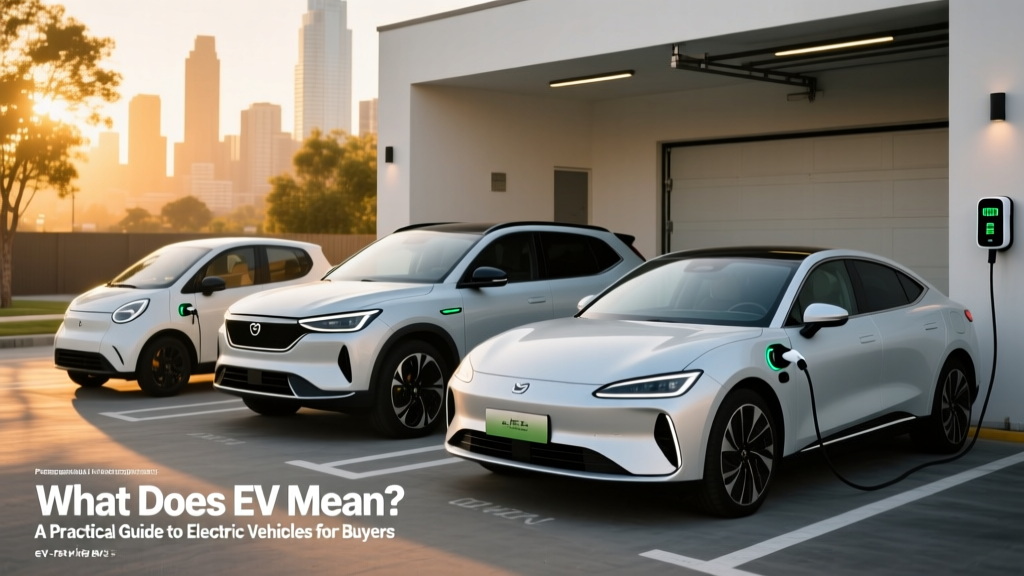
EV stands for Electric Vehicle — any vehicle propelled primarily or entirely by an electric motor powered by a rechargeable battery pack. In everyday use, "EV" most commonly refers to a Battery Electric Vehicle (BEV), which runs 100% on electricity with no gasoline engine. However, the term also broadly encompasses Plug-in Hybrid Electric Vehicles (PHEVs), which pair a battery and electric motor with a gasoline engine, and Hybrid Electric Vehicles (HEVs), which use a small battery to assist a gas engine but cannot be plugged in.
As of 2026, the average new BEV delivers 250–350 miles of EPA-estimated range, charges from 10–80% in roughly 18–30 minutes at a DC fast charger, and costs between $30,000 and $75,000 before incentives. The real question for buyers isn't what EV means in the dictionary — it's whether an EV fits your driving life, your budget, and your charging situation.
The Three Types of Electric Vehicles Explained
Understanding what EV means starts with knowing the three main categories of electrified vehicles. Each serves a different use case, and the differences matter enormously when you're spending $35,000 or more.
| Attribute | BEV (Battery Electric) | PHEV (Plug-in Hybrid) | HEV (Hybrid) |
|---|---|---|---|
| Gasoline engine? | No | Yes | Yes |
| Plug-in charging? | Yes (required) | Yes (optional) | No |
| Electric-only range | 200–400+ mi (EPA) | 25–50 mi (EPA) | 0 mi |
| Battery size (typical) | 55–100 kWh | 10–25 kWh | 1–2 kWh |
| Fuel backup | None | Full gas tank | Full gas tank |
| Federal tax credit (§30D) | Up to $7,500 | Up to $7,500 | Not eligible |
| Example (2026 models) | Hyundai Ioniq 5, Tesla Model Y | Toyota RAV4 Prime, Jeep Wrangler 4xe | Toyota Prius, Honda Accord Hybrid |
BEVs are what most people mean when they say "EV." They offer the lowest operating costs, instant torque, and zero tailpipe emissions, but require reliable access to charging — ideally at home. PHEVs give you 25–50 miles of electric commuting with a gas engine for longer trips, making them ideal if you can charge at home but take frequent road trips. HEVs require no behavioral change; they simply use less gas than a conventional car, typically achieving 45–57 MPG combined.
EV vs. Gas Car: The Real Cost Comparison
What does EV mean for your wallet? The purchase price of a BEV is typically higher than a comparable gas car, but the total cost of ownership often flips within 3–5 years thanks to lower fuel and maintenance costs. Here's a realistic five-year breakdown comparing a mid-range BEV (like a 2026 Hyundai Ioniq 5 SEL, ~$43,000 MSRP) against a popular gas crossover (like a 2026 Toyota RAV4 XLE, ~$33,000 MSRP).
| Cost Category | BEV (Ioniq 5 SEL) | Gas (RAV4 XLE) |
|---|---|---|
| Purchase price (MSRP) | $43,000 | $33,000 |
| Est. federal tax credit (§30D) | –$3,750 to –$7,500* | $0 |
| Fuel / electricity (5 years) | $3,200 (home charging @ $0.14/kWh) | $9,750 (gas @ $3.50/gal, 28 MPG avg) |
| Maintenance (5 years) | $1,500 | $3,500 |
| Insurance (5-year avg) | $7,800 | $6,500 |
| Estimated 5-year depreciation | $18,500 | $14,000 |
| Total 5-year cost (est.) | $60,750 – $64,500 | $66,750 |
*Federal tax credit eligibility under IRS §30D depends on your income, the vehicle's MSRP, and battery component/mineral sourcing. Many 2026 BEVs qualify for $3,750 (partial sourcing) rather than the full $7,500. Check current rules at irs.gov. The credit can be transferred to the dealer at point of sale as an instant discount.
The key takeaway: BEV ownership economics work best when you charge at home at residential electricity rates ($0.10–$0.20/kWh). If you rely exclusively on public DC fast charging ($0.35–$0.55/kWh), your fuel savings narrow considerably — and may even match gas costs on a per-mile basis.
Range, Charging, and Real-World Ownership
What does EV mean in practice on a Tuesday morning commute or a 400-mile holiday road trip? Let's break down the numbers that actually matter.
Range: EPA Sticker vs. Reality
The EPA range estimate is a useful baseline, but real-world range varies significantly based on speed, temperature, terrain, and climate control use. Here's what to expect from a typical 2026 BEV rated at 310 miles EPA:
EPA Estimate: 310 miles
City/suburban driving (moderate temps): ~290–320 miles (regen braking helps)
Highway driving (70–75 mph): ~250–270 miles (aerodynamic drag dominates)
Cold weather (below 30°F, highway): ~200–240 miles (battery chemistry slows, cabin heat draws power)
Hot weather (above 95°F, A/C on): ~270–290 miles
This isn't a flaw — it's physics. Gas cars also lose efficiency in cold weather and at high speeds, but their 12-gallon tanks and 2-minute refueling mask the impact. With an EV, planning around real-world range is part of ownership.
Charging Speeds: kW vs. kWh
This is the single most common point of confusion for new EV buyers:
- kWh (kilowatt-hours) = energy capacity. Think of it as the "gallon" equivalent. A 77 kWh battery holds 77 kWh of energy.
- kW (kilowatts) = power rate. Think of it as the "gallons per minute" flow rate. A 150 kW charger delivers energy faster than a 50 kW charger.
| Level | Power (kW) | Miles Added per Hour | Typical Use Case |
|---|---|---|---|
| Level 1 (120V outlet) | 1.0–1.4 kW | 3–5 mi/hr | Overnight top-up, PHEVs, emergencies |
| Level 2 (240V home/public) | 7.2–11.5 kW | 25–45 mi/hr | Daily home charging, workplace, hotels |
| DC Fast Charge | 50–350 kW | 150–800+ mi/hr (peak) | Road trips, highway corridors |
Critical nuance: DC fast charging speeds follow a charge curve. A vehicle rated for "240 kW peak" does not sustain 240 kW from 10% to 80%. It typically peaks between 10–30% State of Charge (SoC), then tapers progressively. A realistic 10–80% session at a capable charger takes 18–28 minutes for most 2026 BEVs. Above 80%, charging slows dramatically to protect battery longevity — plan to charge to 80% and go, not sit for a full 100%.
Home Charging: The Make-or-Break Factor
Home charging is where EV ownership either shines or struggles. If you can install a Level 2 charger (240V, 32–48 amps), you'll wake up every morning with a full "tank." The typical installation cost breaks down as follows:
- Level 2 charger hardware: $350–$700 (e.g., ChargePoint Home Flex, Emporia Level 2)
- Electrician labor + materials: $500–$2,000 (depends on panel proximity and conduit run)
- Electrical panel upgrade (if needed): $1,500–$3,000 (older homes with 100-amp service may need a 200-amp upgrade)
- Permit and inspection: $50–$300
- Total typical range: $900–$2,500 (without panel upgrade); $2,500–$5,500 (with panel upgrade)
If you cannot charge at home — apartment living, street parking, no garage access — EV ownership is still possible but requires deliberate planning around public charging infrastructure. In that case, a PHEV may be a more practical bridge.
Common EV Misconceptions: Myth vs. Fact
| Myth | Fact |
|---|---|
| "EV batteries need replacing every few years." | Federal law mandates EV battery warranties of at least 8 years / 100,000 miles. Real-world degradation data shows most 2026 BEV batteries retain 85–92% capacity after 100,000 miles. Full replacement costs $8,000–$20,000 but is rarely needed within the vehicle's lifespan. |
| "EVs are worse in cold weather." | Range drops 15–30% in sub-freezing temps — real and measurable. But EVs start instantly in cold (no cranking), and preconditioning (warming the battery while plugged in) recovers much of the loss. Modern heat pumps in vehicles like the Ioniq 5 and Model Y cut cabin-heating energy draw by ~40%. |
| "Charging takes too long." | At home on Level 2, charging is passive — you plug in at night and wake up full. On road trips, a 10–80% DC fast charge takes 18–28 minutes, which aligns with a rest stop. The constraint is trip planning, not time. |
| "The grid can't handle EVs." | Most charging happens overnight during off-peak hours. A single BEV charging at 7.2 kW draws roughly the same as an electric clothes dryer. Utilities manage load through time-of-use rates and managed-charging programs. |
| "EVs produce more emissions than gas cars." | Manufacturing an EV battery creates a larger upfront carbon footprint. However, EPA lifecycle analyses consistently show that over the vehicle's lifetime — even on coal-heavy grids — BEVs produce significantly fewer greenhouse gas emissions than comparable gas vehicles. |
Decision Framework: Is an EV Right for You?
Choose a BEV (full electric) if:
- You can install a Level 2 charger at home or have reliable workplace charging
- Your daily driving is under 80 miles round-trip (covers ~90% of US commutes)
- You take road trips fewer than 4–5 times per year (or are willing to plan DC fast-charge stops)
- You want the lowest per-mile fuel cost ($0.03–$0.05/mile on home electricity vs. $0.12–$0.16/mile on gas)
- You qualify for some or all of the §30D federal tax credit, reducing the effective purchase price
Choose a PHEV (plug-in hybrid) if:
- You can charge at home but regularly drive 200+ miles in a day
- You want electric commuting (25–50 mi) without any range limitation on road trips
- You live in an area with sparse DC fast-charging infrastructure
- You want to reduce gas consumption significantly without fully committing to electric-only
Choose an HEV (standard hybrid) if:
- You have no access to any form of plug-in charging
- You want better fuel economy (45–57 MPG) with zero behavioral change
- You want lower upfront cost and are not focused on electric-only driving
Stick with gas for now if:
- You drive 300+ miles daily in areas with limited charging infrastructure
- You tow heavy loads frequently (EV towing range drops 40–60%)
- Your budget is strictly under $25,000 and you need a newer vehicle (the used EV market is still maturing)
What First-Time EV Buyers Must Know
Beyond the specs and costs, here are the practical ownership realities that no brochure will tell you:
- Preconditioning matters. Most BEVs let you set a departure time while plugged in. The car warms or cools the battery to optimal temperature before you leave, improving range and enabling faster DC charging. Use this feature — it's one of the biggest efficiency gains available.
- Regenerative braking changes how you drive. Most EVs offer adjustable regen. At max settings, you can drive with one pedal — lifting off the accelerator slows the car significantly, recapturing energy. It takes about a week to adapt, and most owners prefer it.
- Insurance tends to cost more. BEV insurance premiums run 15–25% higher than equivalent gas cars, driven by higher repair costs and battery replacement risk. Get quotes before purchasing — the difference can be $200–$400/year.
- Tire wear is faster. EVs are heavier (battery packs add 800–1,500 lbs) and deliver instant torque. Expect to replace tires every 25,000–35,000 miles rather than the 40,000–50,000 typical on gas cars. Budget $800–$1,400 per set.
- Not all DC fast chargers are equal. Networks vary in reliability. Fueleconomy.gov lists EPA range and efficiency data, but for charger availability, check PlugShare or your vehicle's built-in navigation. Tesla's Supercharger network (now open to NACS-equipped non-Tesla EVs) remains the most reliable; Electrify America and EVgo are expanding but have more variable uptime.
- The federal tax credit has strings. Under current IRS §30D rules, the credit phases based on battery component manufacturing (must be North American), critical mineral sourcing, buyer income caps ($150K single / $300K joint), and vehicle MSRP caps ($55K for cars, $80K for SUVs/trucks/vans). Verify eligibility at irs.gov or with a tax professional before assuming you'll receive the full amount.
Frequently Asked Questions
What does EV mean vs. hybrid?
An EV (electric vehicle) runs on electricity from a battery. A full EV (BEV) has no gas engine at all. A hybrid uses both a gas engine and a small electric motor but cannot be plugged in. A plug-in hybrid (PHEV) sits between the two — it can run on electricity alone for 25–50 miles and then switches to gas.
How long do EV batteries last?
Federal law requires a minimum warranty of 8 years / 100,000 miles for EV battery packs (10 years / 150,000 miles in CARB states like California). Real-world data from high-mileage fleets shows most modern NMC and LFP battery packs retain 85–92% of original capacity at 100,000 miles. Replacement is rarely needed within a vehicle's typical 15-year lifespan.
Can I charge an EV with a regular household outlet?
Yes — that's Level 1 charging (120V), which adds about 3–5 miles of range per hour. For a BEV with a 300-mile battery, a full charge from empty would take 60+ hours. Level 1 works for PHEVs (smaller batteries) or as a backup, but a 240V Level 2 installation is strongly recommended for daily BEV use.
Are EVs actually better for the environment?
Over their full lifecycle — manufacturing, driving, and disposal — BEVs produce fewer greenhouse gas emissions than comparable gas vehicles in every US grid region, according to EPA analysis. The advantage grows as the electrical grid incorporates more renewable energy. Battery recycling infrastructure is also scaling, with companies like Redwood Materials recovering 95%+ of critical minerals.
What happens if I run out of charge on the road?
It's rare with modern 250+ mile ranges and built-in navigation that routes you through chargers. But if it happens, most manufacturers include roadside assistance that covers towing to the nearest charger. Unlike running out of gas, you can't walk back with a jerry can — plan your charging stops on long trips.
Is an EV a good choice for cold climates?
EVs work in cold climates — they're popular in Norway, where winters are severe. Expect 15–30% range loss below freezing, especially on highways. The countermeasures are real: preconditioning while plugged in, using a heat pump (standard on many 2026 models), and seat/steering wheel heaters (which draw far less energy than cabin air heating). If you live in Minnesota or Maine and drive 200+ miles daily in winter, a PHEV might be the safer choice.