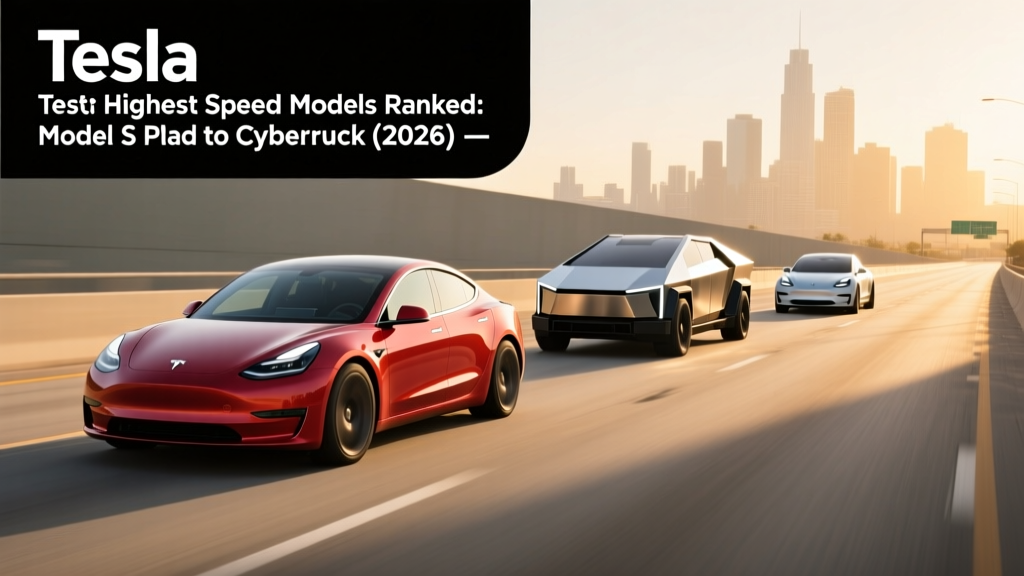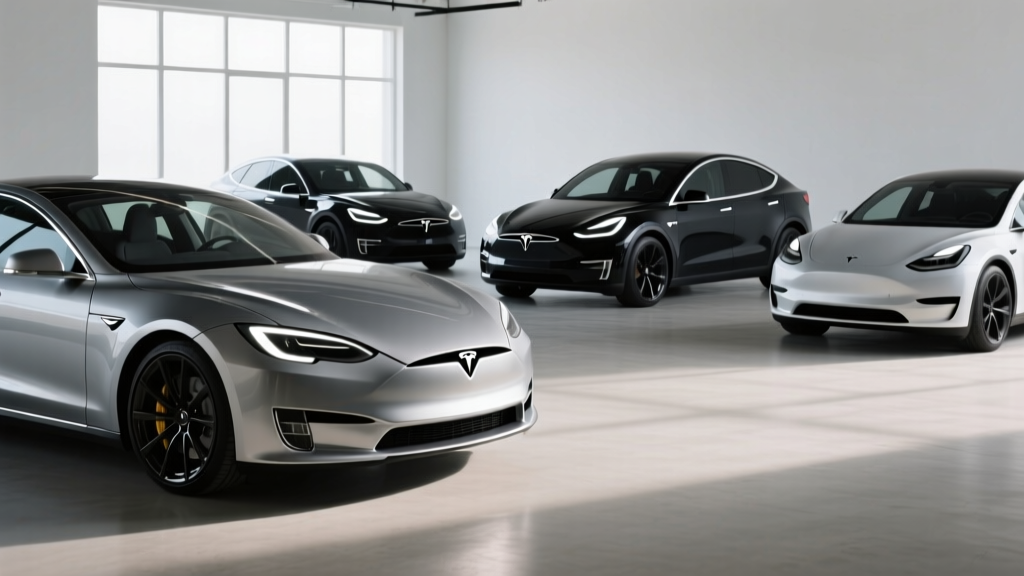
When shoppers research the weight of Tesla vehicles, they're usually trying to answer a practical question: how does all that mass affect the car I'll actually drive every day? Tesla's lineup in 2026 spans from the relatively svelte Model 3 sedan to the 5,000-plus-pound Cybertruck, and curb weight has a direct, measurable influence on EPA range, real-world highway efficiency, tire consumption, braking distances, and even home-charging electricity costs.
This guide breaks down the exact curb weight of every current Tesla model, explains the physics behind why EVs are heavier than comparable gas cars, and translates those pounds into the ownership numbers that matter — range, MPGe, charging times, and long-term running costs. All figures reflect the 2026 model year.
Why Teslas Weigh More Than Gas Cars
A Tesla's battery pack is the single largest contributor to its curb weight. A 75 kWh lithium-ion pack alone weighs roughly 1,050 pounds. Add the steel or aluminum structural enclosure, thermal management hardware, dual motors (on AWD trims), and reinforced suspension components, and you quickly understand why a Model Y Long Range tips the scales at over 4,400 pounds — roughly 800 to 1,000 pounds heavier than a similarly sized gas-powered compact SUV.
This weight penalty isn't unique to Tesla; it applies to every battery-electric vehicle. However, Tesla partially offsets it through two engineering choices:
- Structural battery packs: The 4680-cell packs in the Model Y and Cybertruck serve as stressed chassis members, reducing the need for separate frame rails and saving 100–200 pounds versus older pack designs.
- Gigacastings: Single-piece front and rear underbody castings (at the Austin and Berlin factories) eliminate dozens of welded stampings, trimming weight while increasing torsional rigidity.
Curb Weight of Every 2026 Tesla Model
| Model / Trim | Curb Weight (lbs) | Battery (kWh usable) | Chemistry | Drivetrain |
|---|---|---|---|---|
| Model 3 RWD | 3,862 | 60 | LFP | Rear-Wheel Drive |
| Model 3 Long Range AWD | 4,034 | 79 | NMC | Dual-Motor AWD |
| Model 3 Performance | 4,065 | 79 | NMC | Dual-Motor AWD |
| Model Y Long Range AWD | 4,416 | 79 | NMC | Dual-Motor AWD |
| Model Y Performance | 4,471 | 79 | NMC | Dual-Motor AWD |
| Model S Long Range | 4,561 | 100 | NMC | Dual-Motor AWD |
| Model S Plaid | 4,766 | 100 | NMC | Tri-Motor AWD |
| Model X Long Range | 5,092 | 100 | NMC | Dual-Motor AWD |
| Model X Plaid | 5,390 | 100 | NMC | Tri-Motor AWD |
| Cybertruck AWD | 6,603 | 123 | NMC | Dual-Motor AWD |
| Cybertruck Cyberbeast | 6,843 | 123 | NMC | Tri-Motor AWD |
Source: Tesla Owner's Manuals and fueleconomy.gov.
How Weight Impacts Range and Efficiency
Mass is the enemy of efficiency — but not equally in every driving scenario. Here's how weight actually plays out on the road:
- City driving: Heavier EVs recapture more energy through regenerative braking. A 4,700-lb Model S in stop-and-go traffic can recover 25–30% of the kinetic energy that a lighter car can't. This is why EPA city MPGe ratings for heavy Teslas often exceed their highway numbers.
- Highway driving: At 70+ mph, aerodynamic drag dominates, but rolling resistance from heavier vehicles still matters. Expect a Model X (5,092 lbs) to lose range faster than a Model 3 (3,862 lbs) on sustained interstate runs — roughly 5–8% more consumption per 100 miles at the same speed.
- Cold weather: Battery mass means more thermal energy required to warm the pack. Tesla's heat pump and octovalve system mitigate this, but a heavier pack in sub-freezing temps still results in 15–25% range loss versus mild-weather EPA estimates.
- Tire wear: Heavier EVs consume tires faster. Owners of the Model X and Cybertruck report needing replacement tires 20–30% sooner than gas-vehicle counterparts, adding $200–$400 per year in tire costs.
Real-World Range vs. EPA Estimates
EPA range is measured on a controlled dynamometer cycle. Real-world results vary significantly based on weight-driven factors:
| Model | EPA Range | Highway (70 mph) | Cold Weather (20°F) |
|---|---|---|---|
| Model 3 Long Range AWD | 341 mi | ~290–305 mi | ~255–275 mi |
| Model Y Long Range AWD | 320 mi | ~270–285 mi | ~240–260 mi |
| Model S Long Range | 402 mi | ~340–360 mi | ~300–325 mi |
| Model X Long Range | 335 mi | ~280–300 mi | ~250–270 mi |
| Cybertruck AWD | 340 mi | ~275–295 mi | ~245–265 mi |
Note: Highway figures assume 70 mph on flat terrain, 68°F. Cold-weather figures assume 20°F with cabin heat active. Actual results vary with driving style, elevation, and wind.
Charging Speed: Does Heavier Mean Slower?
A heavier Tesla doesn't charge slower — in fact, larger battery packs (which add weight) can accept higher peak charge rates. The key metric is C-rate: how fast the pack can absorb energy relative to its capacity. Tesla's 2026 models charge as follows:
| Model | Peak DC Fast Charge | 10–80% Time | Level 2 Home Charge Rate | Miles Added per Hour (L2) |
|---|---|---|---|---|
| Model 3 (all trims) | 250 kW | ~25 min | 11.5 kW (48A) | ~44 mi/hr |
| Model Y (all trims) | 250 kW | ~25 min | 11.5 kW (48A) | ~40 mi/hr |
| Model S / X | 250 kW | ~28 min | 11.5 kW (48A) | ~38 mi/hr |
| Cybertruck | 350 kW* | ~20 min | 11.5 kW (48A) | ~32 mi/hr |
*Cybertruck achieves 350 kW peak on V4 Superchargers; most V3 stations deliver up to 250 kW. Charge curve tapers significantly above 80% SoC — expect 80–100% to take as long as 10–80%.
All 2026 Teslas use the NACS (North American Charging Standard) connector natively, giving access to the full Supercharger network — over 6,500 stations in North America as of early 2026. Third-party networks like Electrify America and EVgo also support NACS via adapter or native connector.
Performance: Weight vs. Power
Tesla's dual- and tri-motor setups generate enough torque to make weight feel irrelevant at the stoplight — but mass still shows up in cornering, braking, and sustained track use.
| Model / Trim | 0–60 mph | Horsepower | Top Speed |
|---|---|---|---|
| Model 3 RWD | 5.8 sec | 271 hp | 125 mph |
| Model 3 Long Range AWD | 4.2 sec | 346 hp | 125 mph |
| Model 3 Performance | 2.9 sec | 510 hp | 163 mph |
| Model Y Long Range AWD | 4.8 sec | 384 hp | 135 mph |
| Model Y Performance | 3.5 sec | 456 hp | 155 mph |
| Model S Long Range | 3.1 sec | 670 hp | 155 mph |
| Model S Plaid | 1.99 sec | 1,020 hp | 200 mph |
| Model X Long Range | 3.8 sec | 670 hp | 155 mph |
| Model X Plaid | 2.5 sec | 1,020 hp | 163 mph |
| Cybertruck AWD | 3.9 sec | 600 hp | 130 mph |
| Cybertruck Cyberbeast | 2.6 sec | 845 hp | 130 mph |
Source: Tesla.com official specifications.
Pricing, Tax Credits, and Total Cost
The weight of a Tesla directly affects its price — larger battery packs (more kWh = more mass) are the single biggest cost driver. Here's where the 2026 lineup stands:
| Model / Trim | Base MSRP | §30D Credit Eligible? | Est. After-Credit Price |
|---|---|---|---|
| Model 3 RWD | $38,990 | Yes (up to $7,500) | ~$31,490 |
| Model 3 Long Range AWD | $45,240 | Yes (up to $7,500) | ~$37,740 |
| Model 3 Performance | $52,990 | Yes (up to $7,500) | ~$45,490 |
| Model Y Long Range AWD | $44,990 | Yes (up to $7,500) | ~$37,490 |
| Model Y Performance | $51,490 | Yes (up to $7,500) | ~$43,990 |
| Model S Long Range | $79,990 | No (exceeds MSRP cap) | $79,990 |
| Model S Plaid | $89,990 | No (exceeds MSRP cap) | $89,990 |
| Model X Long Range | $79,990 | No (exceeds MSRP cap) | $79,990 |
| Model X Plaid | $94,990 | No (exceeds MSRP cap) | $94,990 |
| Cybertruck AWD | $79,990 | No (exceeds MSRP cap) | $79,990 |
| Cybertruck Cyberbeast | $99,990 | No (exceeds MSRP cap) | $99,990 |
Federal Tax Credit Rules (IRS §30D) — 2026
Eligibility for the up-to-$7,500 federal EV tax credit depends on multiple factors that change frequently:
- MSRP cap: Sedans (Model 3) must be under $55,000. SUVs/pickups/vans (Model Y, Cybertruck) must be under $80,000.
- Buyer income cap: AGI must not exceed $150,000 (single), $225,000 (head of household), or $300,000 (married filing jointly).
- Battery sourcing: A percentage of critical minerals and battery components must be sourced from the U.S. or free-trade-agreement countries. These percentages increase annually.
- Point-of-sale transfer: Eligible buyers can transfer the credit to the dealer at purchase for an immediate price reduction, rather than waiting for a tax refund.
Always verify current eligibility at IRS.gov and consult a tax professional before purchasing. Rules are subject to legislative change.
Cargo, Passenger Space, and Practicality
Heavier Teslas tend to be larger, which means more interior volume — but not always proportionally. Here's how the lineup compares:
| Model | Front Legroom | Rear Legroom | Cargo (rear seats up) | Cargo (rear seats folded) | Frunk |
|---|---|---|---|---|---|
| Model 3 | 42.7 in | 35.2 in | 23 cu ft | — | 3.1 cu ft |
| Model Y | 41.8 in | 37.0 in | 30 cu ft | 72 cu ft | 4.1 cu ft |
| Model S | 42.4 in | 35.4 in | 28 cu ft | — | 5.3 cu ft |
| Model X | 41.2 in | 38.4 in | 43 cu ft (5-seat) | 88 cu ft | 6.6 cu ft |
| Cybertruck | 41.8 in | 41.2 in | Bed: 43.5 cu ft | — | 7.1 cu ft (frunk) |
Tech, Driver Assistance, and Warranty
Every 2026 Tesla ships with:
- 15.4-inch center touchscreen (Model 3/Y) or 17-inch (Model S/X/Cybertruck) running Tesla's proprietary infotainment OS.
- Over-the-air updates adding features, efficiency improvements, and UI changes without dealer visits.
- Autopilot (standard): Adaptive cruise control, lane centering, automatic emergency braking, and blind-spot monitoring.
- Full Self-Driving Supervised (optional, $8,000 or $99/mo): Adds automatic lane changes, traffic light/stop sign recognition, and city street navigation assist.
Important: Autopilot & FSD Are NOT Self-Driving
All Tesla driver-assist features are SAE Level 2 — meaning the driver must remain fully engaged, hands on the wheel, and eyes on the road at all times. Tesla's "Full Self-Driving" name is misleading; it does not make the car autonomous. Only SAE Level 4 systems (like Waymo's robotaxi service in select cities) operate without a human driver. Never treat any Tesla feature as a substitute for active driving attention.
Warranty Coverage
| Component | Model 3 / Y | Model S / X / Cybertruck |
|---|---|---|
| Basic Vehicle | 4 years / 50,000 mi | 4 years / 50,000 mi |
| Battery & Drive Unit | 8 years / 120,000 mi (RWD) 8 years / 120,000 mi (AWD/Perf) |
8 years / 150,000 mi |
| Battery Retention Guarantee | Minimum 70% capacity | Minimum 70% capacity |
Source: Tesla New Vehicle Limited Warranty.
Who Should Buy Which Tesla?
Decision Framework
- Choose Model 3 RWD if: You're a solo commuter wanting the lightest, most affordable Tesla. At 3,862 lbs, it's the most efficient in the lineup and qualifies for the full $7,500 tax credit.
- Choose Model 3 Long Range if: You need AWD for weather and want 341 miles of EPA range without stepping up to Model S pricing.
- Choose Model Y Long Range if: You're a family needing SUV cargo space (72 cu ft folded) and can accept ~20 fewer EPA miles than the Model 3 LR.
- Choose Model S if: You want flagship luxury, 402 miles of range, and don't mind paying $80K+ with no federal credit.
- Choose Model X if: You need three rows of seating, falcon-wing doors for tight parking, and can live with 5,000+ lbs of curb weight.
- Choose Cybertruck if: You need a truck bed, 11,000-lb towing capacity, and accept that its 6,600+ lb weight and angular shape reduce highway efficiency significantly.
Pros and Cons: The Weight Trade-Off
Pros of Tesla's Weight
- Heavier mass improves regenerative braking energy recapture in city driving
- Larger battery packs (more weight) enable longer EPA range and faster DC charging
- Low center of gravity from under-floor battery reduces rollover risk
- Structural battery packs and gigacastings offset weight while improving rigidity
- Tri-motor and dual-motor AWD trims use weight for superior traction in snow/rain
Cons of Tesla's Weight
- Higher tire wear — expect 20–30% shorter tire life vs. gas vehicles
- Reduced highway efficiency compared to lighter EVs (e.g., Hyundai Ioniq 6, Lucid Air)
- Longer braking distances from 70 mph, especially when loaded
- Heavier models (Model X, Cybertruck) exceed the $80K MSRP cap, disqualifying them from the federal tax credit
- Greater energy consumption in cold weather due to battery thermal mass
- Some parking structures and residential garages have weight limits that may restrict Cybertruck access
Frequently Asked Questions
What is the heaviest Tesla model?
The Cybertruck Cyberbeast is the heaviest Tesla at 6,843 lbs, followed by the standard Cybertruck AWD at 6,603 lbs. Among passenger vehicles, the Model X Plaid weighs 5,390 lbs.
What is the lightest Tesla?
The Model 3 RWD is the lightest current Tesla at 3,862 lbs, thanks to its smaller 60 kWh LFP battery pack and single-motor drivetrain.
Does Tesla weight affect insurance costs?
Yes. Heavier Teslas (Model X, Cybertruck) typically cost 15–25% more to insure than lighter models due to higher repair costs, tire wear, and collision energy. Always get a quote before purchasing.
How much does a Tesla battery weigh?
Tesla battery packs range from approximately 800 lbs (Model 3 RWD, 60 kWh LFP) to over 1,500 lbs (Cybertruck, 123 kWh NMC). The pack typically represents 20–25% of the vehicle's total curb weight.
Does a heavier Tesla use more electricity to charge?
Not directly — charging cost is determined by battery capacity (kWh), not weight. However, heavier Teslas consume more kWh per mile while driving, meaning you'll charge more frequently on long trips. A Cybertruck (123 kWh pack) costs roughly twice as much to fully charge as a Model 3 RWD (60 kWh pack).
Is the Tesla Model Y considered an SUV for tax credit purposes?
Yes. The IRS classifies the Model Y as an SUV, which means it qualifies for the $80,000 MSRP cap (versus $55,000 for sedans like the Model 3). This is why the Model Y Long Range at $44,990 qualifies for the full $7,500 credit.
How does Tesla weight compare to gas-powered competitors?
Teslas are typically 600–1,200 lbs heavier than similarly sized gas vehicles. For example, a Model Y Long Range (4,416 lbs) weighs about 900 lbs more than a Toyota RAV4 (3,615 lbs). However, the Tesla's instant torque and low center of gravity largely mask the weight difference in normal driving.