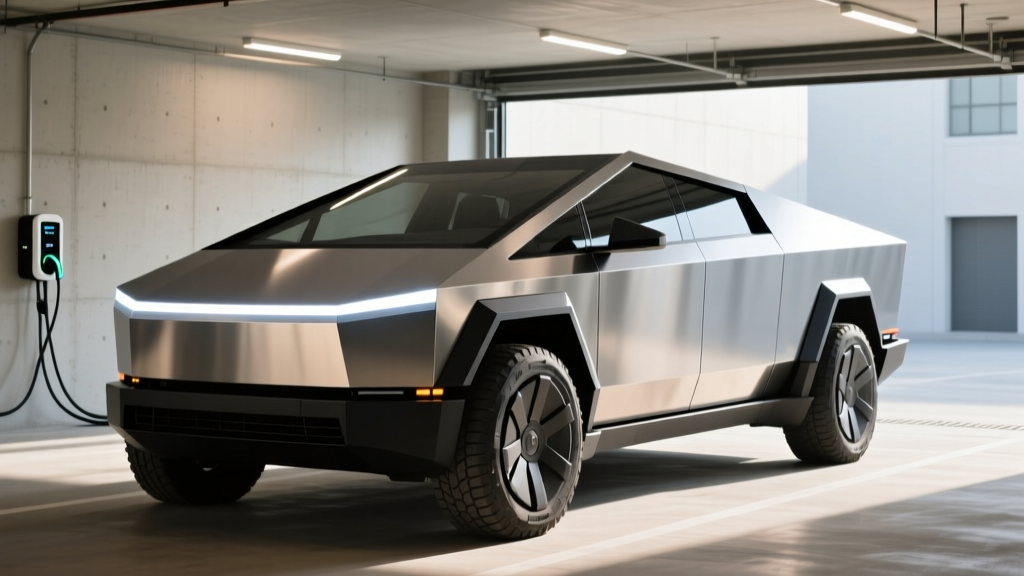
The Tesla Cybertruck is one of the heaviest light-duty pickups on the road — and that mass shapes everything from its real-world range to its tire wear and charging behavior. If you've been searching for the weight of Cybertruck across its 2026 trims, you've landed on the right spec sheet. Below, we unpack curb weight, payload capacity, battery chemistry, charging speeds, and ownership economics so you can decide whether this stainless-steel wedge fits your driveway and your budget.
Quick Verdict: Who Should Buy the 2026 Cybertruck?
The Cybertruck rewards buyers who want a polarizing design, a stainless-steel exoskeleton, and genuine truck utility (11,000-lb towing, 6-foot bed) wrapped around a performance powertrain. It does not reward buyers chasing maximum efficiency per kWh, easy garage parking, or budget pricing. If you tow a boat on weekends and want a daily-driver that hits 60 mph in under 3 seconds (AWD), this is the shortest list in the segment. If range efficiency and low running costs are your priority, the Rivian R1T or Ford F-150 Lightning deliver more miles per dollar of battery.
Cybertruck Weight, Dimensions & Payload by Trim
Mass matters in EVs: heavier vehicles consume more energy per mile, generate more tire heat, and put more strain on suspension components. The Cybertruck's stainless-steel body panels and 48-volt electrical architecture add heft that directly affects EPA range and real-world efficiency. Here is the curb weight breakdown for the 2026 lineup:
| Spec | AWD | Cyberbeast | RWD (2026) |
|---|---|---|---|
| Curb Weight (lbs) | ~6,603 | ~6,850 | ~6,300 (est.) |
| GVWR (lbs) | ~8,900 | ~9,100 | ~8,600 (est.) |
| Max Payload (lbs) | ~2,500 | ~2,300 | ~2,500 (est.) |
| Max Towing (lbs) | 11,000 | 11,000 | 7,500 (est.) |
| Length (in) | 223.6 | 223.6 | 223.6 |
| Bed Length (ft) | 6.0 | 6.0 | 6.0 |
| Ground Clearance (in) | Up to 17.4 | Up to 17.4 | Up to 16.0 |
For context, the Ford F-150 Lightning Extended Range weighs roughly 6,500 lbs, and the Rivian R1T Dual-Motor Max sits near 7,150 lbs. The Cybertruck's mass is substantial but not an outlier in the full-size electric truck class. What is unusual is how that weight concentrates over the rear axle when the bed is empty, which can reduce traction on wet pavement unless you add ballast or rely on the traction-control software.
Battery, Range & Real-World Efficiency
The 2026 Cybertruck uses a structural battery pack with a mix of NMC (nickel manganese cobalt) cells in AWD and Cyberbeast trims, and LFP (lithium iron phosphate) cells in the RWD. NMC provides higher energy density — necessary to offset the Cyberbeast's tri-motor mass — while LFP offers longer cycle life and tolerance for regular 100% charging.
- AWD: EPA 340 mi — Expect ~280–300 mi on a 70-mph highway run; ~230–260 mi in sub-30°F winter conditions without preconditioning.
- Cyberbeast: EPA 320 mi — Expect ~265–285 mi highway; tri-motor drag and extra weight reduce efficiency under load.
- RWD: EPA 250 mi — LFP pack is smaller; real-world highway drops to ~210–225 mi.
Towing at max capacity (11,000 lbs) cuts range roughly in half regardless of trim. Plan charging stops accordingly.
| Metric | AWD | Cyberbeast | RWD |
|---|---|---|---|
| Battery (usable, kWh) | ~123 | ~123 | ~100 (est.) |
| Chemistry | NMC | NMC | LFP |
| EPA Efficiency | 50 MPGe / 68 kWh/100mi | 47 MPGe / 72 kWh/100mi | ~52 MPGe / 65 kWh/100mi |
| EPA Range (mi) | 340 | 320 | 250 |
The EPA's fueleconomy.gov listing confirms the AWD's 340-mile rating, but owners consistently report 280–300 miles in mixed highway driving at 70–75 mph. Cold weather (below freezing) without battery preconditioning can push losses to 25–30%. Tesla's heat pump mitigates cabin-heating drain, but the pack itself still loses efficiency in low temperatures.
Charging Speeds: DC Fast, Level 2 & Home Setup
Charging a 123 kWh NMC pack from 10–80% is where the Cybertruck's mass meets physics. Tesla's V4 Supercharger architecture delivers peak rates that taper as the pack fills and warms.
| Level | Power / Rate | Time or Miles Added |
|---|---|---|
| DC Fast (V4 Supercharger) | Peak ~350 kW | 10–80% in ~18–22 min (with preconditioning) |
| DC Fast (third-party CCS/NACS) | Up to 250 kW | 10–80% in ~30–35 min |
| Level 2 (Tesla Wall Connector, 48A/11.5 kW) | 11.5 kW | ~37 mi/hr; full charge in ~11 hrs |
| Level 1 (120V / 12A) | ~1.4 kW | ~4–5 mi/hr (emergency only) |
Charging-curve reality check: The 350 kW peak only sustains from roughly 10–30% State of Charge (SoC). Above 50%, the rate tapers to ~150 kW, and above 80% it drops below 60 kW to protect the NMC cells. Always precondition the battery via the Tesla app or nav-routed Supercharger stop to hit peak rates. At a 250 kW third-party charger (Electrify America, EVgo), expect a longer 30–35 minute session due to the lower ceiling and potential adapter losses with the CCS-to-NACS adapter.
Performance, Drivetrain & Ride Quality
The Cybertruck's weight is offset by massive torque output. The dual-motor AWD and tri-motor Cyberbeast both use permanent-magnet and induction motor pairing for efficiency and power. Steer-by-wire (no mechanical linkage between wheel and rack) and rear-axle steering tighten the turning circle to a surprisingly car-like 34.0 feet despite the 223.6-inch length.
| Trim | Drivetrain | 0–60 mph | Horsepower | Torque (lb-ft) |
|---|---|---|---|---|
| AWD | Dual-Motor AWD | 3.9 sec | 600 | ~740 |
| Cyberbeast | Tri-Motor AWD | 2.6 sec | 845 | ~1,030 |
| RWD | Single-Motor RWD | ~6.2 sec (est.) | ~350 (est.) | ~450 (est.) |
Ride quality benefits from the adaptive air suspension, which adjusts damping based on load and speed. The 48-volt architecture (a first for a production light-duty truck) powers the steer-by-wire and suspension actuators with less current and thinner wiring, saving weight in the harness even if the truck itself remains heavy. Body roll is well-controlled for a vehicle with a 6,600+ lb curb weight, but the adaptive dampers can feel firm over sharp-edged potholes — a tradeoff of the stainless-steel exoskeleton's rigidity.
Pricing, Tax Credits & Ownership Costs
The 2026 Cybertruck starts at a price that places it in premium-truck territory. Federal tax credit eligibility under IRS §30D depends on MSRP caps, buyer income, and battery-component/critical-mineral sourcing rules that shift annually.
| Trim | Base MSRP | Est. As-Tested | §30D Credit Eligibility |
|---|---|---|---|
| RWD | $60,990 | $64,000–$67,000 | Eligible up to $7,500 if income & sourcing rules met (truck MSRP cap: $80,000) |
| AWD | $79,990 | $85,000–$92,000 | Eligible up to $7,500 — near MSRP cap; verify with tax pro |
| Cyberbeast | $99,990 | $105,000–$115,000 | Exceeds $80,000 truck MSRP cap — NOT eligible for §30D |
- Vehicle MSRP ≤ $80,000 for trucks/vans/SUVs (Cyberbeast exceeds this)
- Buyer AGI ≤ $150,000 single / $300,000 joint filers
- Battery components must meet North American assembly thresholds (increasing yearly)
- Critical minerals must meet sourcing requirements from U.S. or FTA partners
- Credit can be transferred to dealer at point-of-sale as a down-payment reduction
Total cost of ownership reality: The AWD trim, at ~$79,990 before incentives, costs roughly $0.14–$0.16 per mile to charge at home (national average $0.17/kWh, 68 kWh/100mi). Compare that to a gas F-150 at 18 MPG and $3.50/gallon (~$0.19/mi). Savings exist, but the Cybertruck's upfront premium and higher insurance costs (specialty body panels, limited repair network) narrow the gap versus cheaper EV trucks.
Cargo, Interior & Tech
The 6-foot bed (officially the "vault") offers 67 cu ft of volume with the tonneau cover closed. The frunk adds ~7 cu ft of lockable, drainable storage — useful for wet gear or charging cables. Rear-seat legroom measures ~41 inches, adequate for adults on longer trips, though the sloping roofline cuts headroom for passengers over 6'2".
Standout tech:
- 18.5-inch front touchscreen + 9.4-inch rear screen
- Steer-by-wire with variable ratio (fewer turns lock-to-lock at low speed)
- Adaptive air suspension with Extract Mode (lifts 17.4 in for off-road)
- 120V/240V bed and frunk outlets (up to 11.5 kW continuous — powers tools, campsite, or emergency V2H)
- Tesla Autopilot (Level 2 SAE driver-assist — requires active supervision; NOT self-driving)
- FSD (Supervised) available as a $8,000 option or $99/mo subscription
Notable drawbacks: The yoke steering is polarizing and takes weeks to build muscle memory for three-point turns. Panel gaps on early builds have improved, but stainless-steel fingerprinting requires regular cleaning. The wiper blade is a single, large unit that clears a wide arc but can streak in heavy ice buildup. And the angular design, while striking, creates significant wind noise above 75 mph compared to more aerodynamic trucks.
Cybertruck vs. F-150 Lightning vs. Rivian R1T
| Spec | Tesla Cybertruck AWD | Ford F-150 Lightning Lariat ER | Rivian R1T Dual-Motor Max |
|---|---|---|---|
| EPA Range | 340 mi | 320 mi | 410 mi |
| Curb Weight | ~6,603 lbs | ~6,500 lbs | ~7,150 lbs |
| Max Towing | 11,000 lbs | 10,000 lbs | 11,000 lbs |
| 0–60 mph | 3.9 sec | ~4.5 sec | ~3.5 sec |
| Base MSRP | $79,990 | ~$69,995 | ~$87,900 |
| DC Fast Peak | ~350 kW | ~150 kW | ~220 kW |
| Bed Length | 6.0 ft | 5.5 ft | 4.5 ft |
The Cybertruck wins on DC fast-charge speed and bed length. The F-150 Lightning wins on price, dealer service network, and familiarity (conventional steering, proven Pro Power Onboard). The Rivian R1T wins on range, off-road capability (quad-motor option), and build quality, but at a higher MSRP and slower DC charging.
Pros & Cons
- Class-leading DC fast-charge speed (~350 kW peak)
- 11,000-lb towing + 6-foot vault with integrated 120V/240V power
- Stainless-steel exoskeleton resists dents and corrosion
- Steer-by-wire + rear steering = tight turning circle
- Cyberbeast tri-motor performance (2.6 sec 0–60)
- Over-the-air updates continuously add features
- Heavy curb weight reduces real-world efficiency vs. lighter EVs
- Cyberbeast exceeds $80K MSRP cap — no federal tax credit
- Yoke steering polarizing; steep learning curve
- Stainless steel shows fingerprints, requires maintenance
- Limited service-center network for body/panel repair
- Range cuts ~50% when towing at max capacity
FAQ: Weight of Cybertruck & Ownership Questions
What is the curb weight of the 2026 Tesla Cybertruck?
The AWD trim weighs approximately 6,603 lbs. The tri-motor Cyberbeast is heavier at roughly 6,850 lbs due to the third motor and reinforced subframe. The RWD is estimated at ~6,300 lbs with its smaller LFP pack.
What is the real-world range of the Cybertruck?
EPA rates the AWD at 340 miles, but expect 280–300 miles in 70-mph highway driving, and 230–260 miles in sub-freezing temperatures without preconditioning. Towing at the 11,000-lb max cuts range to roughly 170 miles.
How fast does the Cybertruck charge?
At a Tesla V4 Supercharger, the Cybertruck peaks at ~350 kW and charges 10–80% in approximately 18–22 minutes with preconditioning. On a home Level 2 Tesla Wall Connector (11.5 kW), it adds ~37 miles per hour, taking about 11 hours for a full charge.
Does the 2026 Cybertruck qualify for the federal EV tax credit?
The RWD and AWD trims can qualify for up to $7,500 under IRS §30D, provided the buyer meets income caps ($150K single / $300K joint), the vehicle MSRP stays under $80,000 (trucks), and battery sourcing rules are satisfied. The Cyberbeast, at $99,990 MSRP, exceeds the cap and does not qualify. Always verify current-year rules with a tax professional and check IRS.gov for updates.
How does the Cybertruck's weight affect tire wear and maintenance?
At 6,600+ lbs with high instant torque, expect tire replacement every 20,000–30,000 miles depending on driving style. The Cybertruck uses 35-inch all-terrain tires that cost $350–$500 each. Brake wear is minimal thanks to regenerative braking, but suspension components (air struts, bushings) will see higher stress than on lighter vehicles.
Is the Cybertruck worth buying over the F-150 Lightning or Rivian R1T?
Choose the Cybertruck if you prioritize DC fast-charging speed, a 6-foot bed, and distinctive design. Choose the F-150 Lightning for a lower price, broader dealer service, and conventional-truck familiarity. Choose the Rivian R1T for maximum range (410 mi), off-road prowess, and premium fit-and-finish at a higher price.
What is the battery warranty?
Tesla covers the Cybertruck battery and drive unit for 8 years or 120,000 miles (whichever comes first), with a minimum 70% capacity retention threshold during the warranty period. This aligns with industry standards for NMC packs, though some competitors (Hyundai, Kia) offer longer 10-year/100,000-mile powertrain coverage.
Sources: EPA fueleconomy.gov, IRS §30D Clean Vehicle Credits, Tesla specifications (tesla.com/cybertruck).