Why Washington EV Buyers Need a Real Cost Calculator
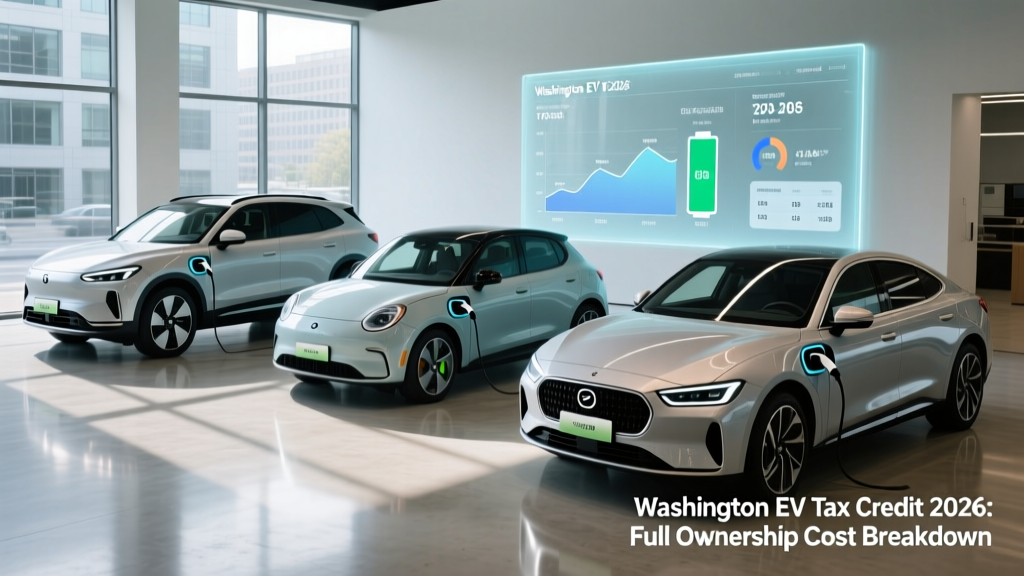
Washington State remains one of the most compelling places in the U.S. to own an electric vehicle — not because of a single headline-grabbing rebate, but because of a stacking effect: zero state income tax, relatively low electricity rates driven by abundant hydroelectric power, and access to the federal §30D Washington EV tax credit (more accurately, the federal clean vehicle credit available to Washington residents). Combined, these factors compress the total cost of ownership (TCO) for qualifying EVs well below comparable gas vehicles over a five-year horizon.
But the math only works if you understand the eligibility gates, the real-world fuel and maintenance deltas, and where EVs still cost more than their gas counterparts — insurance and depreciation chief among them. This guide breaks down every layer with 2026 figures so you can decide whether going electric in Washington pencils out for your household.
Federal §30D Clean Vehicle Credit: What Washington Buyers Actually Qualify For
The federal clean vehicle credit under IRS §30D offers up to $7,500 for qualifying new EVs and up to $4,000 for qualifying used EVs (§25E). Since 2024, buyers can elect to transfer the credit to the dealer at the point of sale, converting the tax credit into an immediate price reduction rather than waiting to claim it on your federal return. This is the single biggest structural improvement to the credit's practical value.
§30D Eligibility Checklist (2026 Tax Year)
- Income caps (Modified AGI): $300,000 joint filers / $225,000 head of household / $150,000 single — applies to the year of delivery or the prior year, whichever is lower
- MSRP caps: $80,000 for SUVs, vans, and pickups; $55,000 for sedans and other body styles
- Battery sourcing requirements: Critical minerals and battery components must meet escalating domestic/free-trade-partner sourcing thresholds — this eliminates some models that previously qualified
- Assembly: Final assembly must occur in North America
- Vehicle type: Must be a new qualifying plug-in EV (BEV) or fuel cell vehicle (FCV); PHEVs must have ≥7 kWh battery capacity
- One-time use: Credit is per VIN, not per buyer — a given vehicle can only generate the credit once
- Transfer option: Buyer may elect point-of-sale transfer to dealer, reducing purchase price directly; dealer must be IRS-registered
Washington has no state-level EV purchase tax credit as of 2026 — the former Washington state EV sales tax exemption expired and was not renewed at the same benefit level. However, some Washington utilities and local governments offer targeted rebates (detailed below), and the absence of a state income tax means the federal credit is never clawed back at the state level.
Washington Utility & Local Incentives (2026)
Utility rebates vary significantly by provider and are subject to funding availability. Always confirm with your utility before purchasing:
- Seattle City Light: Historically offers EV charger rebates (up to $500 for Level 2 home chargers) and off-peak charging rate programs
- Puget Sound Energy (PSE): Time-of-use rate plans that reduce per-kWh cost for overnight charging; occasional charger rebates
- Avista Utilities: Eastern Washington customers may qualify for EV charger rebates and discounted TOU rates
- Clark Public Utilities: Has offered rebates on EV purchases and charger installations in prior years — check current availability
- HOV lane access: Washington's Clean Vehicle HOV program provides single-occupant carpool lane access for qualifying EVs — a significant time-savings incentive for I-5 and I-405 commuters
For the most current state incentive data, consult the Alternative Fuels Data Center's Washington state page.
Five-Year Total Cost of Ownership: EV vs. Gas in Washington
To model real ownership costs, we're comparing a popular EV — the 2026 Tesla Model Y Long Range AWD (EPA 310 miles, 75 kWh usable battery, starting ~$44,990) — against a comparable gas SUV, the 2026 Toyota RAV4 AWD (EPA 30 MPG combined, starting ~$33,500). Both are in high-volume segments that Washington families actually shop.
| Cost Category | Tesla Model Y LR AWD | Toyota RAV4 AWD | Difference |
|---|---|---|---|
| Purchase price (base MSRP) | $44,990 | $33,500 | +$11,490 (EV) |
| Federal tax credit (§30D, if eligible) | −$7,500 | $0 | −$7,500 (EV) |
| Net purchase after credit | $37,490 | $33,500 | +$3,990 (EV) |
| WA sales tax (~10.3% avg, on net price) | $3,861 | $3,451 | +$410 (EV) |
| Fuel / electricity (60k mi) | $3,300 | $7,200 | −$3,900 (EV saves) |
| Maintenance (5 years) | $1,500 | $3,500 | −$2,000 (EV saves) |
| Insurance (5 years) | $11,500 | $8,500 | +$3,000 (EV costs more) |
| Depreciation (est. 5-yr) | $18,000 | $12,000 | +$6,000 (EV loses more) |
| Total 5-Year Cost | $75,651 | $68,151 | +$7,500 (EV) |
The EV's operating-cost advantages — roughly $5,900 in fuel and maintenance savings — partially offset its higher purchase price, insurance premiums, and steeper depreciation. Without the $7,500 federal credit, the gap widens to ~$15,000. With the credit, a Washington buyer who qualifies and drives 12,000 miles/year closes the gap substantially but doesn't fully erase it over five years on this particular comparison.
However, TCO is highly sensitive to your specific situation. Drive more miles? The EV's fuel savings scale linearly. Charge at home on off-peak rates instead of using DC fast chargers? Electricity costs drop further. Own beyond five years? Depreciation curves flatten and the EV's mechanical simplicity becomes a larger advantage. Buyers who keep vehicles 8–10 years often find the EV TCO crosses below the gas alternative.
Charging vs. Gas: Washington's Per-Mile Cost Advantage
Washington's electricity rates are among the lowest in the nation, averaging approximately $0.11/kWh for residential customers (Seattle City Light and hydro-heavy utilities can be even lower). This is the single biggest geographic advantage Washington EV owners enjoy compared to the national average of ~$0.17/kWh.
Cost Per Mile: EV vs. Gas (Washington, 2026)
| Metric | EV (Home Charging) | EV (DC Fast Charging) | Gas Vehicle (30 MPG) |
|---|---|---|---|
| Energy cost | $0.11/kWh | $0.40/kWh avg | $4.00/gallon |
| Efficiency | 3.5 mi/kWh (286 Wh/mi) | 3.5 mi/kWh | 30 MPG |
| Cost per mile | $0.031 | $0.114 | $0.133 |
| Annual fuel cost (12k mi) | $372 | $1,368 | $1,596 |
At Washington residential rates, home-charging an EV costs roughly 4.3× less per mile than fueling a 30 MPG gas vehicle. Even exclusive DC fast charging is slightly cheaper per mile than gas — though that scenario is unrealistic for daily driving and accelerates battery degradation.
The critical variable is home charging access. If you can install a Level 2 charger at home (a 240V outlet or hardwired unit delivering 7–11.5 kW), the vast majority of your charging happens at the cheapest rate. Washington owners who rely exclusively on public DC fast charging ( Electrify America, EVgo, Tesla Superchargers at ~$0.35–$0.45/kWh) see their fuel advantage shrink to near parity with gas. This is why Level 2 home installation is the single most impactful ownership decision you'll make.
Maintenance Savings: Where EVs Quietly Win
EVs have far fewer moving parts than internal combustion vehicles — no engine oil, no transmission fluid, no spark plugs, no timing belts, no exhaust system, and no emissions equipment. This translates to predictable, measurable savings.
| Service Item | EV Cost | Gas Vehicle Cost |
|---|---|---|
| Oil changes (6–8 over 5 years) | $0 | $400–$700 |
| Transmission fluid | $0 | $150–$300 |
| Brake pads (regenerative braking extends life 2–3×) | $0–$200 | $400–$800 |
| Engine air filter | $0 (cabin filter only) | $100–$200 |
| Coolant flush | $100–$150 (battery thermal system) | $150–$250 |
| Tire rotation / replacement (EVs are heavier, wear tires faster) | $800–$1,200 | $600–$900 |
| Cabin air filter | $100–$150 | $100–$150 |
| Washer fluid, wipers, misc. | $100 | $100 |
| Total estimate | $1,100–$1,800 | $2,000–$3,400 |
The net savings of roughly $1,500–$2,000 over five years is real but not dramatic on a per-month basis. The bigger advantage is predictability: EV maintenance is mostly tires, cabin filters, wiper fluid, and occasional brake fluid checks. You won't face surprise $1,200 water pump or $2,000 transmission repair bills that gas vehicles accumulate as they age.
One caveat worth flagging: tire costs are genuinely higher on EVs. The additional weight (a Model Y weighs ~4,400 lbs vs. a RAV4 at ~3,600 lbs) and instant torque accelerate tread wear. Budget for tire replacement every 30,000–40,000 miles rather than the 50,000+ miles typical for lighter gas vehicles. EV-specific tire compounds (like Michelin's e.Primacy line) help but carry a price premium.
The Insurance Reality: Why EVs Cost More to Insure
EV insurance premiums in Washington typically run 15–30% higher than equivalent gas vehicles. For our Model Y vs. RAV4 comparison, that translates to roughly $500–$700/year more, or $2,500–$3,500 over five years.
The reasons are structural, not arbitrary:
- Higher repair costs: Battery packs, power electronics, and specialized structural components cost more to replace after a collision. Even minor rear-end damage can trigger battery safety inspections costing thousands.
- Fewer qualified body shops: High-voltage system repairs require certified technicians, limiting the repair network and increasing labor rates.
- Total-loss thresholds: Insurers may total an EV for damage that a gas vehicle would survive, because battery replacement costs ($10,000–$20,000+) push repair estimates above the vehicle's actual cash value.
- Higher vehicle values: Even after the tax credit, the insured value of a $37,000+ EV generates higher comprehensive and collision premiums than a $33,500 gas SUV.
Some insurers now offer EV-specific policies with bundled home-charger coverage and battery protection riders. Shop at least three quotes — GEICO, Progressive, State Farm, and newer entrants like Lemonade and Root price EVs differently, and the spread can be $400+/year between the cheapest and most expensive quote.
Depreciation and Resale Value: The EV Wildcard
EV depreciation has been the most volatile ownership-cost variable over the past three years. After aggressive price cuts by Tesla in 2023–2024 rippled through the used market, many EVs depreciated faster than gas equivalents. By 2025–2026, the market has largely stabilized, but EVs still generally lose a larger percentage of their value in the first three years.
Current 5-year depreciation estimates for mainstream EVs range from 40–55% of original purchase price, compared to 35–45% for popular gas SUVs. For our comparison:
- Model Y (5-yr est.): ~40% depreciation on $44,990 MSRP = ~$18,000 lost
- RAV4 (5-yr est.): ~36% depreciation on $33,500 MSRP = ~$12,000 lost
Several factors influence where your specific EV lands:
- Battery health data: As more used EVs report State of Health (SoH) metrics, buyers can verify remaining capacity — well-maintained batteries retain value better.
- Charging standard convergence: The industry-wide shift to NACS (Tesla's connector standard, now adopted by Ford, GM, Hyundai, and others) reduces the risk that a used EV's charging port becomes obsolete.
- Price stability: New-EV MSRPs have stabilized after the 2023–2024 price war era, meaning used values aren't being undercut by constant new-car price drops.
- Tax credit effect: If you claimed the $7,500 credit, your effective cost basis was lower — so your dollar depreciation is smaller even if the percentage is higher.
For Washington buyers specifically, the strong regional demand for EVs (the state has one of the highest EV adoption rates in the U.S.) provides a modest resale-value tailwind compared to regions with weaker charging infrastructure.
Putting It Together: Who Saves and Who Doesn't
The Washington EV ownership equation isn't universally favorable — it depends on your driving profile, home setup, and financial situation. Here's a decision framework:
The EV Math Works Best When:
- You qualify for the full $7,500 §30D credit (income and vehicle both eligible)
- You can install Level 2 home charging (garage or dedicated parking with 240V access)
- You drive 12,000+ miles per year (fuel savings scale with mileage)
- You plan to keep the vehicle 6+ years (depreciation flattens, maintenance savings compound)
- Your utility offers off-peak TOU rates below $0.10/kWh
- You value HOV lane access for I-5/I-405 commuting
Consider Staying Gas or Going PHEV When:
- You cannot install home charging and would rely on public DC fast charging
- You drive under 8,000 miles/year (fuel savings don't offset the premium)
- You trade vehicles every 3 years (you absorb the steepest depreciation)
- Your income exceeds §30D caps, eliminating the $7,500 credit
- You frequently tow heavy loads or drive long rural routes in eastern Washington where charging infrastructure is sparse
Frequently Asked Questions
Does Washington State offer its own EV tax credit in 2026?
No. Washington does not currently offer a state-level EV purchase tax credit or rebate. The former sales tax exemption for EVs has expired. Washington buyers rely on the federal §30D credit (up to $7,500), utility-level rebates for chargers, and HOV lane access as the primary state-adjacent incentives. Always check the AFDC Washington page for updates, as legislation can change.
How much does it really cost to own an EV over 5 years in Washington?
For a mainstream EV like the Tesla Model Y, our modeling shows approximately $75,000–$76,000 in total 5-year costs (purchase after credit, fuel, maintenance, insurance, depreciation) compared to roughly $68,000 for a comparable gas SUV. The gap narrows significantly for higher-mileage drivers, those with cheap home electricity, and buyers who keep vehicles beyond five years. For vehicles in the $30,000–$35,000 range (like the Chevy Equinox EV or Hyundai Kona Electric), the TCO gap is smaller or may favor the EV.
Do I qualify for the federal $7,500 EV tax credit?
Eligibility depends on three gates: your income (≤$300k joint, ≤$150k single), the vehicle's MSRP (≤$80k for SUVs/trucks, ≤$55k for sedans), and the vehicle's battery sourcing compliance. The vehicle must also be assembled in North America. Check the official IRS §30D page and confirm with your tax professional — battery sourcing rules are model-specific and change periodically as automakers adjust supply chains.
How much do I save on fuel and maintenance with an EV?
In Washington, with average residential electricity at ~$0.11/kWh and gas at ~$4.00/gallon, an EV driver covering 12,000 miles/year saves approximately $1,200/year on fuel and $400/year on maintenance — roughly $1,600/year combined, or $8,000 over five years. These savings are largest for high-mileage drivers and those with access to the cheapest utility rates.
Are EVs more expensive to insure in Washington?
Yes, typically 15–30% more than comparable gas vehicles. For a $45,000 EV vs. a $33,500 gas SUV, expect to pay $500–$700 more per year in premiums. The primary drivers are higher repair costs, specialized labor requirements, and elevated total-loss risk from battery damage. Always compare quotes from multiple insurers — the spread between the cheapest and most expensive EV quote can be substantial.
How well do EVs hold their value compared to gas cars?
EVs currently depreciate faster in the first 3–5 years — roughly 40–55% value loss vs. 35–45% for popular gas vehicles. However, if you purchased with the $7,500 federal credit, your effective cost basis is lower, reducing your dollar-amount depreciation. Long-term retention depends on battery health, charging-standard relevance (NACS adoption helps), and new-EV price stability. Washington's high EV adoption rate provides slightly stronger used-EV demand than the national average.