Quick Answer: What Is Walmart EV Charging?
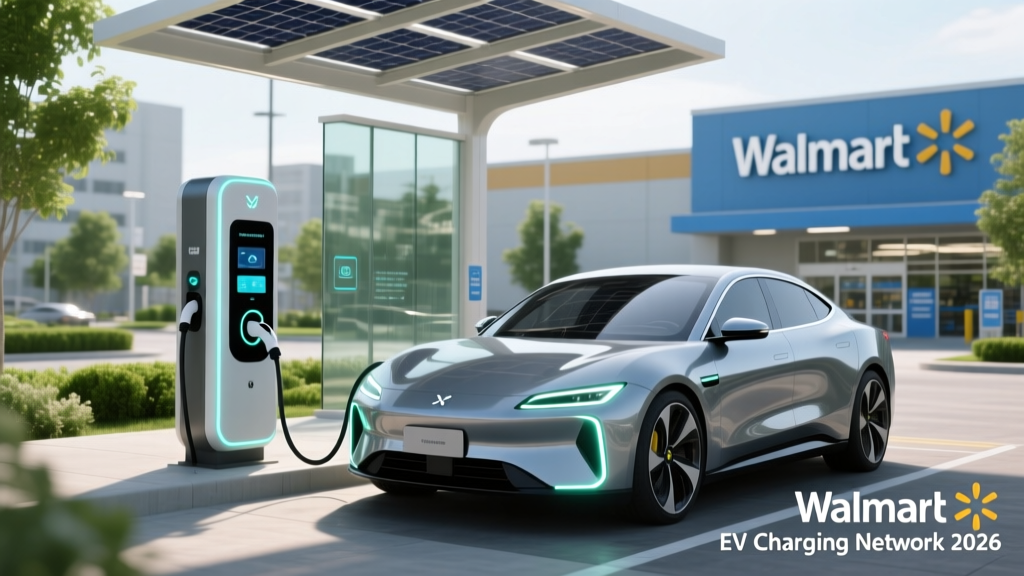
Walmart hosts one of the largest retail EV charging networks in the U.S., primarily through a partnership with Electrify America (EA). As of early 2026, roughly 1,300+ Walmart and Sam's Club locations across 48 states feature DC fast chargers, most delivering 150 kW to 350 kW peak power. Drivers pay per kWh (typically $0.31–$0.52/kWh depending on state and charger speed), and sessions at 350 kW stations can add 100–200 miles of range in 15–20 minutes on compatible vehicles. Walmart chargers are open to all EVs with CCS or NACS connectors; CHAdeMO vehicles have increasingly limited compatibility.
How the Walmart–Electrify America Network Works
Walmart doesn't operate its own charging hardware. Instead, it leases parking-lot space to Electrify America, which installs, owns, and maintains the chargers. This matters because it means your charging experience — app functionality, pricing, uptime — is governed by EA's platform, not Walmart's.
Most Walmart EA stations include a mix of:
- 350 kW CCS/NACS chargers (Ultrafast) — capable of charging a Hyundai Ioniq 5 (84 kWh, NMC) from 10–80% in approximately 18 minutes under ideal conditions
- 150 kW CCS/NACS chargers — sufficient for most current EVs that cap at 150–175 kW peak (e.g., Ford Mustang Mach-E, VW ID.4)
- CHAdeMO connectors — increasingly phased out; many newer EA installations omit them entirely, which affects older Nissan Leaf and Mitsubishi Outlander PHEV owners
To start a session, you can use the Electrify America app, an RFID card, or a credit card tap at the kiosk. The EA app offers a Pass+ subscription ($4.99/month) that reduces per-kWh rates by roughly 25%. For frequent Walmart chargers, the subscription pays for itself after about 60–80 kWh per month.
What It Actually Costs to Charge at Walmart
Pricing varies by state, utility rate structure, and charger tier. Here's a realistic breakdown based on published EA rates and real-world session data:
| Cost Factor | Walmart DC Fast Charger | Home Level 2 (Avg US) | Gas Station (Avg US) |
|---|---|---|---|
| Rate | $0.31–$0.52/kWh | $0.12–$0.18/kWh | $3.10–$3.80/gallon |
| Cost per 200 miles (250 Wh/mi avg) | $15.50–$26.00 | $6.00–$9.00 | $22.00–$28.00 (28 MPG avg) |
| Idle fee | $0.40/min after 10-min grace | None | N/A |
| Session fee (some states) | $1.00–$1.50 flat | None | None |
The numbers reveal a clear hierarchy: home Level 2 charging is 2–3× cheaper than Walmart DC fast charging, but Walmart DC fast charging is generally cheaper than gasoline on a per-mile basis — unless you live in a state with peak EA rates above $0.48/kWh and drive an inefficient EV like the GMC Hummer EV (500+ Wh/mi).
Walmart Charging vs. Gas: The Real Savings Math
Let's compare a realistic scenario: a 2026 Tesla Model Y Long Range (EPA 320 miles, ~260 Wh/mi) versus a 2026 Toyota RAV4 gas (28 MPG combined) over 15,000 annual miles.
| Metric | Tesla Model Y (Walmart DC + Home Mix) | Toyota RAV4 Gas |
|---|---|---|
| Annual energy/fuel cost | $1,450 (70% home, 30% Walmart DC) | $1,930 |
| Maintenance (annual) | $300–$500 | $800–$1,200 |
| Federal tax credit (§30D) | Up to $7,500 (subject to MSRP/income/sourcing rules) | $0 |
| 5-year total fuel + maintenance | ~$10,000–$12,000 | ~$14,000–$17,000 |
The EV wins on running costs, but the margin narrows significantly if you rely exclusively on Walmart DC fast charging with no home access. At $0.48/kWh and 260 Wh/mi, your annual fuel cost jumps to roughly $1,870 — nearly matching the gas car. This is the core trade-off for apartment dwellers and those without garage charging.
Real-World Charging Speeds: What to Actually Expect
Electrify America advertises 350 kW peak power, but sustained charging speed depends on your vehicle's charge curve, battery temperature, and state of charge (SoC). Here's what real-world testing at Walmart EA stations shows:
- Hyundai Ioniq 5 / Kia EV6 (800V architecture): Peak ~240 kW sustained, tapering to ~100 kW above 60% SoC. 10–80% in approximately 18–22 minutes.
- Tesla Model Y (NACS adapter on CCS charger): Peak ~170–250 kW depending on model year and battery preconditioning. 10–80% in approximately 20–28 minutes.
- Ford Mustang Mach-E (400V architecture): Peak ~115–150 kW, tapering sharply above 80%. 10–80% in approximately 35–45 minutes.
- Chevrolet Equinox EV: Peak ~150 kW. 10–80% in approximately 30 minutes.
Cold weather (below 32°F) adds 5–15 minutes to these times unless your vehicle has battery preconditioning enabled via navigation routing to the charger. Always precondition in winter — it can mean the difference between a 60 kW and a 150 kW peak pull.
Reliability and Common Complaints
Electrify America's uptime has improved since 2023, when EA reported network-wide availability above 90%. However, individual Walmart locations vary. Common issues reported on PlugShare and EV forums include:
- Broken screens or payment terminals — solvable by using the EA app, but frustrating for walk-up users
- Connector latch failures — CCS connectors occasionally fail to lock, requiring a retry
- Reduced power output — some 350 kW chargers deliver only 150–200 kW during peak grid demand or hot weather (above 95°F) due to thermal throttling of the charger cabinet
- ICEing — gas vehicles parked in EV spots remain a problem at high-traffic Walmart locations, though some stores have added signage and enforcement
Before driving to a specific Walmart charger, check the PlugShare or Electrify America app for real-time status and recent user check-in comments. This single habit eliminates most surprise downtime.
Decision Framework: Is Walmart EV Charging Right for You?
Choose Walmart DC Fast Charging as Your Primary Strategy If:
- You lack home charging access (apartment, street parking, no 240V outlet)
- Your weekly driving is under 200 miles, requiring only one 20-minute charge stop
- A Walmart with a functioning EA station is within 5 miles of your home or commute
- You can time charging during off-peak hours (early morning, late evening) to avoid crowds and ICEing
Prioritize Home Level 2 Charging and Use Walmart as Backup If:
- You have a garage or driveway where a Level 2 (240V, 32–48A) charger can be installed ($500–$2,000 including electrician, per DOE estimates)
- You drive more than 300 miles per week
- Your local EA rates exceed $0.45/kWh
- You live in a cold climate (below 20°F winters) where frequent DC fast charging accelerates battery wear and reduces session speed
Avoid Relying on Walmart Charging If:
- Your nearest station is 15+ miles away (the detour cost in time and energy negates savings)
- You drive a CHAdeMO vehicle and your local Walmart has phased out that connector
- Your EV lacks battery preconditioning and you live in a cold climate
Common Walmart EV Charging Misconceptions
| Myth | Fact |
|---|---|
| "Walmart chargers are free" | Some were free during early promotional periods (2019–2021). As of 2026, virtually all Walmart EA chargers require payment per kWh. |
| "Any EV can charge at any Walmart" | CHAdeMO connectors are disappearing. Tesla owners need a NACS-to-CCS adapter at older EA stations; newer EA chargers include native NACS cables. |
| "350 kW means my car charges at 350 kW" | Only a handful of 800V vehicles (Porsche Taycan, Ioniq 5, EV6, Lucid Air) can accept above 250 kW. Most EVs peak at 150–200 kW regardless of charger capability. |
| "DC fast charging destroys the battery" | Modern BMS (battery management systems) and thermal management mitigate degradation. EPA data and long-term fleet studies show less than 10% degradation over 100,000 miles for liquid-cooled batteries, even with frequent DC use. LFP batteries (Tesla Model 3 RWD, base Ford Mach-E) tolerate DC charging even better. |
| "I can charge to 100% at Walmart" | You can, but charging slows dramatically above 80% (the charge curve taper). Going from 80–100% can take as long as 10–80%. Plan to charge to 80% and move on. |
Tips for First-Time EV Buyers Using Walmart Chargers
If you're considering an EV and plan to use Walmart's charging network, keep these practical points in mind:
- Download the Electrify America app before your first session. Create an account, add a payment method, and consider the Pass+ subscription if you'll charge more than twice per month.
- Know your vehicle's peak charge rate in kW. This determines which charger to pick. If your EV peaks at 150 kW, don't wait for the 350 kW stall — the 150 kW unit will charge you just as fast.
- Check connector compatibility. As of 2026, the industry is mid-transition from CCS to NACS (Tesla's standard). Ford, GM, Rivian, and others now ship with NACS ports. Electrify America has committed to adding NACS cables to all new installations, but older Walmart stations may still be CCS-only. A CCS-to-NACS adapter (approximately $200–$250) solves this.
- Plan around the charge curve. Arrive at low SoC (10–20%) for the fastest charging. If you're at 50% when you plug in, your session will be slower and more expensive per mile added.
- Combine charging with shopping. The Walmart charging model works best when your 20–30 minute charge session overlaps with a grocery run. This turns dead time into productive time — a genuine advantage over gas station stops.
Federal Tax Credit and Ownership Cost Context
If you're buying an EV partly because of the IRS §30D federal tax credit, remember that eligibility depends on multiple factors current for 2026:
- MSRP caps: $80,000 for SUVs, pickups, and vans; $55,000 for sedans
- Buyer income limits: $150,000 single / $300,000 joint modified AGI
- Battery sourcing requirements: Critical minerals and battery components must meet escalating domestic/free-trade sourcing thresholds, which disqualify some trims
- Point-of-sale transfer: You can apply the credit (up to $7,500) as an immediate dealer discount rather than waiting for tax filing
Always verify eligibility on the IRS website or with a tax professional before purchase — rules shift annually, and trim-level qualification varies even within the same model.
How do I find a Walmart EV charger near me?
Use the Electrify America app or website, PlugShare, or A Better Routeplanner (ABRP). All three show real-time charger status, connector types, and pricing. Walmart locations are typically labeled clearly in these apps.
Can I charge a Tesla at a Walmart Electrify America station?
Yes. As of 2026, newer EA installations include native NACS connectors. At older CCS-only EA stations, Tesla owners can use a CCS-to-NACS adapter (sold by Tesla and third parties). Charge speeds will match your Tesla's peak acceptance rate — typically 170–250 kW depending on model and battery preconditioning.
Is frequent DC fast charging at Walmart bad for my EV battery?
Modern liquid-cooled battery packs with advanced BMS tolerate DC fast charging well. Long-term data shows under 10% capacity loss over 100,000 miles for NMC batteries and even less for LFP chemistry. The bigger degradation risk is consistently charging to 100% and leaving the vehicle at high SoC in hot weather — not the charging speed itself.
Why is my Walmart charger only delivering 60 kW when it's rated for 350 kW?
Several factors: your EV may not support 350 kW (most cap at 150–250 kW), the battery may be cold (below optimal charging temperature), you may have started at a high SoC (above 50%), or the charger cabinet may be thermally throttled in extreme heat. Preconditioning your battery via the vehicle's navigation system before arrival is the single most effective fix.
Are Walmart EV chargers open 24/7?
Most Walmart EA chargers are accessible 24 hours, but some locations in municipalities with overnight parking restrictions or in shopping centers with gated lots may have limited hours. Check the EA app for the specific station's posted hours before planning a late-night charge.