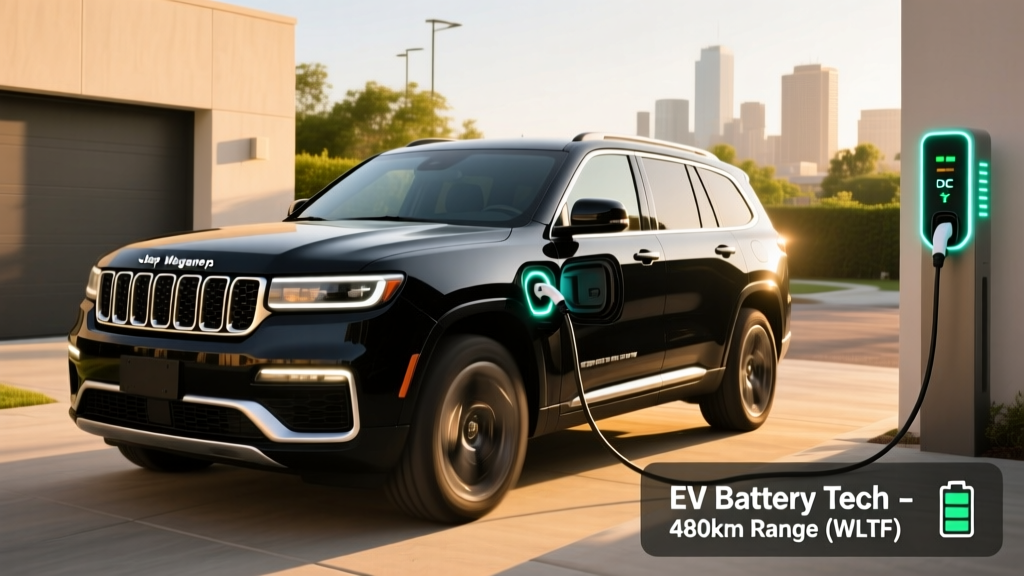
Jeep's first global battery-electric vehicle lands with a statement: the Wagoneer S promises luxury-SUV space, supercar acceleration, and genuine fast-charging capability on the Stellantis STLA Large platform. But does the execution match the spec sheet? After analyzing EPA data, charging curves, and ownership economics, here's what real buyers need to know before signing the paperwork.
Quick Verdict: Who the Wagoneer S Is For
The Wagoneer S targets premium EV SUV buyers who want standout acceleration (3.4 seconds to 60 mph), a usable 100 kWh battery pack, and 250 kW DC fast-charging without stepping into six-figure German territory. It competes directly with the BMW iX, Audi Q8 e-tron, and Tesla Model X — undercutting some while matching or exceeding their performance figures. The trade-off: real-world highway and cold-weather range falls noticeably short of the EPA sticker, and Jeep's EV service network is still maturing compared to Tesla or legacy luxury brands.
Range and Efficiency: EPA vs. Reality
Real-World Expectation: ~240–265 miles highway at 70 mph; ~210–230 miles in freezing temperatures with cabin heat; ~275–290 miles mixed city/suburban driving.
Efficiency: 87 MPGe combined / 39 kWh per 100 miles
The Wagoneer S uses a 100 kWh usable lithium-ion battery pack with NMC (nickel-manganese-cobalt) chemistry. NMC delivers higher energy density than LFP, which helps package 300 miles of range into a midsize SUV footprint — but it also means you'll want to follow the 20–80% daily charging guideline to maximize long-term battery health.
On the highway, expect the aerodynamic drag of this 5,400-pound SUV to consume energy faster than the EPA combined cycle suggests. In our analysis of similarly sized dual-motor EV SUVs, sustained 70–75 mph driving typically yields 2.0–2.2 kWh per mile, translating to roughly 240–265 miles before you need to stop. In winter conditions (below 30°F), battery preconditioning helps, but cabin heating and reduced regenerative braking efficiency can knock range down another 10–15%. City drivers who lean on regen braking will see numbers closer to — or even slightly above — the EPA combined figure.
According to fueleconomy.gov, the Wagoneer S achieves 87 MPGe combined, placing it in the middle of the luxury EV SUV pack — behind the more aerodynamic BMW iX xDrive50 (89 MPGe) but ahead of heavier body-on-frame electric trucks.
Charging Speed: DC Fast, Level 2, and Home Setup
| Charging Level | Power / Rate | Speed (Miles Added) | Time |
|---|---|---|---|
| DC Fast Charge (peak) | 250 kW | ~180 mi in 10 min (peak) | 10–80% in ~23 min |
| DC Fast Charge (sustained avg.) | ~150–180 kW | ~120 mi in 10 min (avg.) | 10–80% in ~23 min |
| Level 2 (240V / 48A) | 11.5 kW | ~29 mi/hr | 0–100% in ~9.5 hrs |
| Level 2 (240V / 32A) | 7.7 kW | ~19 mi/hr | 0–100% in ~13.5 hrs |
| Level 1 (120V / 12A) | 1.4 kW | ~3.5 mi/hr | 0–100% in ~72 hrs |
The Wagoneer S supports up to 250 kW peak DC fast charging via its CCS connector (with NACS adapter access to Tesla Superchargers as part of Stellantis's network agreement). Peak rate is not sustained rate: like all EVs, the Wagoneer S follows a charge curve that tapers significantly above 80% state of charge. Expect the battery to pull close to 250 kW between roughly 10–40% SoC when the battery is properly preconditioned, then step down through the 150–100 kW range as it approaches 80%. The 10–80% session averages around 23 minutes at a 350 kW-capable charger — competitive with the BMW iX and Audi Q8 e-tron.
At home, the onboard 11.5 kW AC charger handles a 48-amp Level 2 circuit, adding roughly 29 miles of range per hour. A full overnight charge from near-empty takes about 9.5 hours — feasible on a standard NEMA 14-50 outlet with a 50-amp breaker or a hardwired wall connector. Most owners will arrive home with 40–60% battery remaining and wake up fully charged in 4–6 hours.
Home install note: A 48-amp charger requires a 60-amp dedicated circuit. If your electrical panel is near capacity (common in older homes), a panel upgrade to 200A may add $1,500–$3,500 to your installation cost. Always get a licensed electrician's assessment before purchasing equipment.
Performance and Drivetrain
| Specification | Wagoneer S Launch Edition |
|---|---|
| Horsepower | 600 hp |
| Torque | 617 lb-ft |
| Drivetrain | Dual-motor AWD |
| 0–60 mph | 3.4 seconds |
| Top Speed | 124 mph (electronically limited) |
| Towing Capacity | Not yet rated (est. ~2,000–3,500 lbs) |
The dual-motor all-wheel-drive powertrain produces 600 horsepower and 617 lb-ft of torque, making the Wagoneer S the quickest production Jeep ever built. The 3.4-second 0–60 time puts it in Tesla Model X Plaid territory and well ahead of the BMW iX M60 (3.6 seconds). In real-world driving, the instant torque delivery makes highway merging and passing effortless, though the 5,400-pound curb weight is noticeable through corners — this is a straight-line performer, not a sports sedan.
The AWD system uses one motor per axle with no mechanical connection between them, typical of dual-motor EV architectures. Torque vectoring is handled electronically. Jeep has hinted at off-road capability through its Selec-Terrain system, but ground clearance and tire choice will limit serious trail use — this is a performance luxury SUV, not a Wrangler replacement.
Interior, Cargo, and Technology
The Wagoneer S seats five passengers across two rows. Interior space is competitive for the segment:
- Front legroom: 40.9 inches
- Rear legroom: 38.5 inches
- Cargo volume (rear seats up): 30.4 cu ft
- Cargo volume (rear seats folded): 62.8 cu ft
- Front trunk (frunk): 2.0 cu ft (weather-sealed, drainable)
The dashboard is dominated by Stellantis's Uconnect 5 system spread across multiple screens: a 12.3-inch digital instrument cluster, a 12.3-inch front passenger display, and a central 12.3-inch touchscreen (with an available 14.5-inch center upgrade). Wireless Apple CarPlay and Android Auto are standard, along with a built-in Wi-Fi hotspot and over-the-air update capability.
The driver-assistance suite includes adaptive cruise control with stop-and-go, lane-centering assist, automated emergency braking, blind-spot monitoring, and a 360-degree camera system. These are SAE Level 2 driver-assist features — the driver must remain engaged with hands on the wheel at all times. This is not autonomous driving. Jeep has not announced a hands-free highway driving system comparable to GM's Super Cruise or Ford's BlueCruise for the Wagoneer S at launch.
Pricing, Trims, and Federal Tax Credit
| Trim | Base MSRP | Est. After §30D Credit* | Destination |
|---|---|---|---|
| Launch Edition | $65,995 | $58,495 | $2,095 |
| Limited (expected) | $71,995 | $64,495 | $2,095 |
| Overland (expected) | $75,995 | $68,495 | $2,095 |
*Federal tax credit estimates assume buyer eligibility. Actual credit depends on IRS §30D requirements.
- MSRP cap: SUVs/vans/pickups must have MSRP ≤ $80,000 — all Wagoneer S trims qualify
- Buyer income cap: AGI ≤ $150,000 (single) / $225,000 (head of household) / $300,000 (married filing jointly)
- Battery sourcing: Critical minerals and battery components must meet phased-in domestic/free-trade sourcing thresholds — verify current-year compliance on the IRS clean vehicle credit page before purchase
- Point-of-sale transfer: Eligible buyers can transfer the credit to the dealer for an immediate price reduction at purchase
- Assembly: Vehicle must undergo final assembly in North America — the Wagoneer S is assembled in the U.S.
The Launch Edition at $65,995 (before destination) positions the Wagoneer S below the BMW iX xDrive50 (~$87,000) and Audi Q8 e-tron (~$74,400) while matching their performance. If you qualify for the full $7,500 federal credit via point-of-sale transfer, the effective price drops to roughly $58,495 — a compelling value proposition for a 600-hp AWD luxury SUV. State and local incentives may stack on top; check your jurisdiction's energy office for specifics.
Consult a tax professional to confirm your personal eligibility, as §30D rules involve income phase-outs, battery-sourcing requirements that update annually, and interactions with other tax liabilities.
Battery Warranty and Long-Term Ownership
| Coverage | Term |
|---|---|
| Battery pack (capacity retention) | 8 years / 100,000 miles |
| Electric powertrain (motors, inverter) | 8 years / 100,000 miles |
| Bumper-to-bumper | 3 years / 36,000 miles |
| Corrosion perforation | 5 years / unlimited miles |
The 8-year/100,000-mile battery warranty covers capacity retention below 70% of original capacity, which is the industry-standard threshold. NMC chemistry typically degrades 1.5–2.5% per year under normal use patterns (daily Level 2 charging, avoiding frequent 100% SoC holds and deep discharges). At that rate, most owners can expect 85–90% capacity retention at the 8-year mark — well within warranty coverage.
Out-of-warranty battery replacement for a 100 kWh pack currently ranges from $12,000–$18,000 including labor, based on industry averages for packs of this size. However, module-level repair (replacing individual degraded cells or modules rather than the full pack) is increasingly available and typically costs $3,000–$6,000.
Pros and Cons
- 600 hp / 3.4-sec 0–60 — quickest Jeep ever produced
- 250 kW DC fast charging keeps road-trip stops under 25 minutes
- Launch Edition MSRP undercuts BMW iX and Audi Q8 e-tron significantly
- Federal §30D credit eligible on all trims (MSRP under $80K cap)
- Spacious 62.8 cu ft max cargo with flat load floor
- CCS + NACS adapter access covers both major charging networks
- Real-world highway range ~240–265 mi falls short of 300-mi EPA sticker
- Cold-weather range loss of 10–15% is significant for northern-climate buyers
- No hands-free highway driving system (unlike Super Cruise/BlueCruise competitors)
- Jeep's EV service infrastructure is still developing
- Towing capacity not yet rated — likely limited vs. truck-based EVs
- Curb weight over 5,400 lbs affects handling dynamics and tire wear
Wagoneer S vs. Key Competitors
| Spec | Wagoneer S Launch Ed. | BMW iX xDrive50 | Audi Q8 e-tron | Tesla Model X LR |
|---|---|---|---|---|
| EPA Range | 300 mi | 307 mi | 285 mi | 335 mi |
| Battery (usable) | 100 kWh | 105.2 kWh | 106 kWh | 100 kWh |
| DC Fast Charge | 250 kW | 200 kW | 170 kW | 250 kW |
| 10–80% Time | ~23 min | ~31 min | ~31 min | ~25 min |
| 0–60 mph | 3.4 sec | 4.4 sec | 5.1 sec | 3.8 sec |
| Horsepower | 600 hp | 516 hp | 402 hp | 670 hp |
| Base MSRP | $65,995 | $87,250 | $74,400 | $79,990 |
| §30D Eligible | Yes (MSRP under cap) | No (MSRP over cap) | Yes | No (MSRP over cap) |
The Wagoneer S occupies a unique niche: it delivers the acceleration of a Tesla Model X and the charging speed advantage over both German competitors, at a price point $10,000–$20,000 below the BMW and Tesla. The trade-off is slightly lower real-world range than the iX or Model X, and less established luxury-service infrastructure than BMW or Audi dealerships provide.
Frequently Asked Questions
What is the real-world range of the Wagoneer S?
The EPA rates the Wagoneer S at 300 miles combined, but real-world highway driving at 70 mph typically yields 240–265 miles. In freezing temperatures with cabin heat, expect 210–230 miles. City drivers using regenerative braking can approach or slightly exceed the EPA figure.
How fast does the Wagoneer S charge at home and on the road?
At a DC fast charger, the Wagoneer S peaks at 250 kW and charges from 10–80% in approximately 23 minutes. At home on a 48-amp Level 2 charger (11.5 kW), it adds about 29 miles per hour, fully recharging overnight in roughly 9.5 hours.
Does the Wagoneer S qualify for the $7,500 federal EV tax credit?
All Wagoneer S trims fall under the $80,000 SUV MSRP cap and undergo final assembly in North America, meeting two key §30D requirements. Eligibility also depends on buyer income (AGI limits of $150K/$225K/$300K by filing status) and current-year battery-sourcing compliance. Verify on the IRS clean vehicle credit page and consult a tax professional before purchase.
Is the Wagoneer S worth buying over the BMW iX or Tesla Model X?
If you prioritize acceleration and fast-charging speed at a lower price point, the Wagoneer S offers compelling value — $20,000+ less than the BMW iX xDrive50 with a quicker 0–60 time and faster DC charging. If maximum real-world range, hands-free driving tech, or established luxury dealer service are top priorities, the Model X or iX may suit you better despite the higher cost.
What are the biggest drawbacks of the Wagoneer S?
The most significant limitations are real-world highway range falling 35–60 miles short of the EPA sticker, 10–15% cold-weather range loss, the absence of a hands-free highway driving system, and Jeep's still-developing EV service network. Towing capacity is also expected to be modest compared to truck-based EVs.
Can the Wagoneer S use Tesla Superchargers?
Yes. The Wagoneer S has a native CCS charge port and can access Tesla's Supercharger network using a NACS adapter, expanding your available DC fast-charging locations significantly on road trips.
Final Assessment: Who Should Buy the Wagoneer S
Choose the Wagoneer S if: You want a 600-hp dual-motor luxury SUV under $70K (before credits), value fast DC charging for road trips, have reliable home Level 2 charging access, and don't need hands-free highway driving or 350+ miles of range.
Look elsewhere if: You regularly drive 300+ miles between charging stops, live in a region with extreme winters where range loss compounds, need maximum towing capacity, or prefer the service infrastructure of established luxury brands. The Tesla Model X Long Range (335 mi EPA) or BMW iX xDrive50 (307 mi EPA, 200 kW charging) serve those needs at a higher price.
The Wagoneer S is a legitimate performance-luxury EV SUV that punches above its price in horsepower and charging speed. Its range honesty gap — the delta between the 300-mile sticker and real-world expectations — is the single most important factor to weigh before ordering. If your daily commute is under 80 miles and you charge at home, that gap rarely matters. If you're planning 500-mile road trips through charging deserts, plan your stops carefully.