Quick Verdict: The Wagoneer S Limited at a Glance
The 2026 Jeep Wagoneer S Limited is Stellantis' bid to bring a premium, performance-oriented electric SUV to the mainstream luxury market. Built on the STLA Large platform, it pairs a 100 kWh NMC lithium-ion battery with a dual-motor all-wheel-drive system producing 600 horsepower and a manufacturer-estimated 300 miles of EPA range. Starting at $65,995 before destination, it undercuts rivals like the BMW iX and Mercedes EQE SUV while delivering comparable straight-line performance and a tech-heavy cabin.
But the Wagoneer S Limited isn't without trade-offs. Its real-world highway range falls noticeably short of the EPA sticker, DC fast-charging speeds are competitive but not class-leading, and its cargo volume trails the Hyundai Ioniq 5 and Kia EV9. Here's everything you need to know before putting down a deposit.
| Spec | Value |
|---|---|
| EPA Range (est.) | 300 miles |
| Battery Capacity | 100 kWh (usable), NMC chemistry |
| Drivetrain | Dual-motor AWD |
| Horsepower | 600 hp |
| 0–60 mph | 3.4 seconds |
| Max DC Fast Charge | ~175 kW (peak) |
| 10–80% DC Charge Time | ~23 minutes (est.) |
| Level 2 Home Charge Rate | 11.5 kW (~33 mi/hr) |
| Efficiency | ~84 MPGe combined (est.) |
| Cargo Volume (behind 2nd row) | ~30 cu ft |
| Base MSRP | $65,995 |
| Battery/Powertrain Warranty | 8 years / 100,000 miles |
Real-World Range: What the EPA Sticker Doesn't Tell You
Jeep targets a 300-mile EPA-estimated range for the Wagoneer S Limited, placing it in the same ballpark as the Audi Q8 e-tron (285 mi) and the base Tesla Model X (311 mi). But EPA numbers are generated under controlled laboratory conditions, and real-world results depend heavily on how and where you drive.
EPA Estimate: 300 miles
Mixed city/highway driving (70°F): ~265–280 miles
Sustained 75 mph highway: ~240–260 miles
Cold weather (20°F, cabin heat): ~200–230 miles
The Wagoneer S Limited's boxy SUV profile and ~5,500 lb curb weight work against highway efficiency. Expect a 15–20% range reduction on long road trips at sustained highway speeds, and a 25–35% drop in freezing temperatures if you're relying on resistive cabin heating. A heat pump — standard on the Limited trim — helps mitigate cold-weather losses somewhat, but physics is physics: a heavy, aerodynamically blunt SUV moving through cold, dense air will consume more energy.
For context, the 100 kWh battery pack uses NMC (nickel-manganese-cobalt) chemistry, which offers higher energy density than LFP (lithium iron phosphate) at the cost of slightly faster long-term degradation and a recommended daily charge limit of 80–90%. If your daily commute is under 60 miles round-trip, you'll rarely need to charge past 80%, which is actually ideal for NMC longevity.
Charging Speed: DC Fast Charging and Home Level 2
Charging speed is where the Wagoneer S Limited is competent but not class-leading. The STLA Large platform supports up to roughly 175 kW peak DC fast charging on a CCS1 connector (with NACS adapter compatibility for Tesla Supercharger access).
| Charging Level | Power / Voltage | Speed | Use Case |
|---|---|---|---|
| Level 1 (120V household) | ~1.4 kW | ~3–4 mi/hr | Emergency / trickle top-up |
| Level 2 (240V home, 48A) | 11.5 kW | ~33 mi/hr | Daily overnight charging |
| DC Fast Charge (CCS1) | Up to ~175 kW peak | 10–80% in ~23 min | Road trips, quick top-ups |
| DC Fast Charge (NACS adapter) | Up to ~175 kW peak | 10–80% in ~23 min | Tesla Supercharger network |
That 10–80% time of roughly 23 minutes is respectable, though it trails the Hyundai Ioniq 5's 18-minute 10–80% time on its 800V architecture. The Wagoneer S Limited uses a 400V electrical architecture, which caps peak charge rates compared to 800V competitors. Expect the charge curve to taper noticeably above 80% State of Charge — a 10–100% session will take closer to 40–45 minutes, which matters if you're trying to fully charge on a road trip stop.
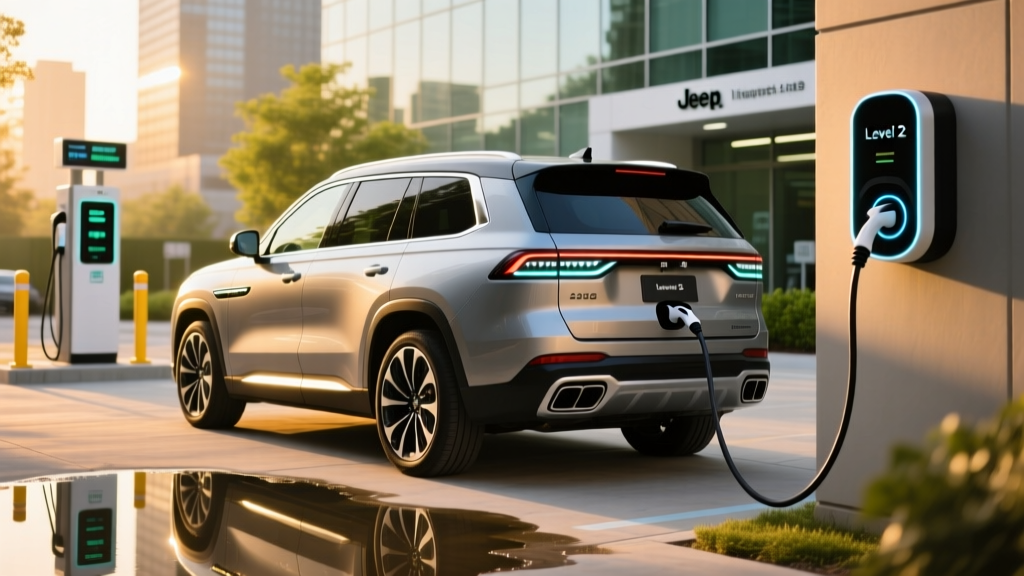
At home on a Level 2 charger, the onboard 11.5 kW charger adds about 33 miles of range per hour. A full 10–100% charge from empty takes roughly 9–10 hours overnight, which is fine for daily use. If you're installing a home Level 2 charger, budget $800–$2,000 for a quality 48-amp hardwired unit plus electrician labor, with potential panel-upgrade costs of $1,500–$3,000 if your home has a 100-amp service panel. Always consult a licensed electrician for final specifications.
Performance and Driving Dynamics
The dual-motor AWD powertrain produces 600 horsepower, launching the Wagoneer S Limited from 0–60 mph in an estimated 3.4 seconds. That puts it in the same performance bracket as the Tesla Model X Plaid's little brother and well ahead of the BMW iX xDrive50 (4.4 seconds). Jeep's first serious performance EV doesn't disappoint on straight-line acceleration.
The all-wheel-drive system uses independent front and rear motors with torque vectoring, providing confident traction in wet and light snow conditions. Jeep has also included a terrain-select mode with a dedicated "Sand/Snow" setting, though this is a unibody crossover — not a body-on-frame Wrangler. Don't expect Rubicon-level off-road capability. Ground clearance is approximately 7.5 inches, adequate for gravel roads and light trails but not serious rock crawling.
Regenerative braking offers multiple levels selectable through the steering wheel paddles, including a near one-pedal driving mode at the maximum setting. The brake blending between regen and friction brakes is generally smooth, though some testers have noted a slightly grabby feel at low speeds — a common issue in heavy EVs with aggressive regen calibration.
Interior, Tech, and Cargo Space
The Wagoneer S Limited's cabin is where Jeep aims to justify its premium positioning. The dashboard is dominated by a 12.3-inch digital instrument cluster and a 12.3-inch central infotainment touchscreen running Stellantis' Uconnect 5 system. A third 10.25-inch passenger display is available on the Limited trim, allowing the front passenger to stream media or view navigation independently.
Uconnect 5 remains one of the better mainstream infotainment systems, with wireless Apple CarPlay and Android Auto, native navigation with EV-aware route planning (factoring in charging stops and battery preconditioning), and over-the-air update capability. The system is responsive, with minimal lag in our experience with the STLA Large platform.
Cargo and passenger dimensions:
- Cargo volume behind second row: ~30 cu ft
- Cargo volume with second row folded: ~60 cu ft
- Front legroom: ~41.0 inches
- Rear legroom: ~38.5 inches
- Front headroom: ~39.5 inches
- Seating capacity: 5 passengers (2-row configuration)
The cargo numbers are the Wagoneer S Limited's weakest practical metric. At roughly 30 cubic feet behind the second row, it trails the Hyundai Ioniq 5 (27.2 cu ft, but with a far more usable shape and a front trunk) and significantly trails the three-row Kia EV9 (20.2 cu ft behind the third row, but 81.7 cu ft with both rows folded). There is no front trunk (frunk) — the space under the hood is occupied by HVAC and power electronics. For a vehicle in this price range, that's a notable omission.
Driver Assistance and Safety Tech
The Wagoneer S Limited comes equipped with Stellantis' Active Driving Assist, a Level 2 driver-assistance system combining adaptive cruise control with lane centering. Per NHTSA and SAE International definitions, this is not self-driving — the driver must remain attentive with hands on the wheel at all times. Hands-free driving on mapped highways is available on higher trims via Active Driving Assist with Hands-Free, but the Limited trim requires manual steering input.
Active Driving Assist provides combined steering and speed assistance. The driver is responsible for monitoring the road, keeping hands on the wheel, and intervening at any time. This is not autonomous driving.
Standard safety features include automatic emergency braking with pedestrian detection, blind-spot monitoring, rear cross-traffic alert, lane-keeping assist, and a 360-degree surround-view camera. IIHS crash-test ratings were not available at the time of this review; check iihs.org for updates.
Pricing, Tax Credits, and Ownership Costs
The 2026 Wagoneer S Limited starts at $65,995 (plus a $1,995 destination charge), bringing the total to approximately $67,990 before any incentives. A higher-spec Launch Edition or fully optioned Limited can push the as-tested price into the low $70,000s.
| Item | Amount |
|---|---|
| Wagoneer S Limited Base MSRP | $65,995 |
| Destination Charge | $1,995 |
| Typical As-Tested Price (with options) | $68,000–$72,000 |
| Federal §30D Tax Credit (max) | Up to $7,500 (if eligible) |
| Effective Price After Max Credit | ~$58,495–$64,500 |
Federal Tax Credit Eligibility (§30D)
Whether you actually receive the full $7,500 federal EV tax credit depends on several factors that change frequently under current IRS rules. As of 2026, the key eligibility requirements include:
- MSRP Cap: SUVs must have an MSRP at or below $80,000. The Wagoneer S Limited qualifies.
- Buyer Income Cap: Modified adjusted gross income must not exceed $150,000 (single), $225,000 (head of household), or $300,000 (joint filers).
- Battery Sourcing: The credit is split into two halves — $3,750 for critical-minerals sourcing and $3,750 for battery-component assembly. Both must be met for the full $7,500. Sourcing requirements tighten annually, and some vehicles qualify for only $3,750 or none at all.
- Point-of-Sale Transfer: Eligible buyers can transfer the credit to the dealer at purchase, reducing the upfront price rather than waiting for a tax refund.
Check the latest eligibility details at IRS.gov's clean vehicle credits page before purchasing, as battery-sourcing compliance can change model by model and month by month. Consult a tax professional for your specific situation.
Who Should Buy the Wagoneer S Limited?
- You want a performance-oriented luxury EV SUV under $70K with premium branding
- You value a tech-rich cabin with multiple displays and Uconnect 5's EV-aware navigation
- You need AWD capability for snow and light off-road use
- Your daily commute is under 80 miles round-trip (easily covered with overnight Level 2 charging)
- Maximum cargo space is a priority (consider the Kia EV9 or Rivian R1S)
- You need three rows of seating (the Wagoneer S is a 2-row, 5-passenger SUV)
- You want the fastest DC charging speeds available (the Ioniq 5 or Porsche Macan EV charge faster)
- You regularly tow heavy loads (the Rivian R1S offers higher towing capacity)
How It Stacks Up Against Competitors
| Spec | Wagoneer S Limited | BMW iX xDrive50 | Hyundai Ioniq 5 Limited AWD | Tesla Model X (base) |
|---|---|---|---|---|
| EPA Range | ~300 mi | 324 mi | 290 mi | 311 mi |
| Battery | 100 kWh NMC | 111.5 kWh NMC | 77.4 kWh NMC | ~100 kWh NMC |
| Horsepower | 600 hp | 516 hp | 320 hp | 670 hp |
| 0–60 mph | 3.4 sec | 4.4 sec | 5.1 sec | 3.8 sec |
| Max DC Charge | ~175 kW | ~150 kW | ~240 kW | ~250 kW |
| 10–80% Time | ~23 min | ~31 min | ~18 min | ~20 min |
| Cargo (behind 2nd row) | ~30 cu ft | 35.5 cu ft | 27.2 cu ft | ~37 cu ft (w/ 5-seat) |
| Base MSRP | $65,995 | $87,250 | $58,200 | $79,990 |
The Wagoneer S Limited occupies a middle ground: it's far cheaper than the BMW iX and Tesla Model X while offering more horsepower than either (except the Model X). Its charging speed is middling, and its cargo space is unremarkable. But for buyers who want Jeep branding, strong acceleration, and a sub-$70K price point, the value proposition is genuine.
Pros, Cons, and the Bottom Line
- 600 hp and 3.4-sec 0–60 in a $66K SUV is exceptional performance-per-dollar
- 300-mile EPA range is adequate for most daily and weekend use
- Uconnect 5 with EV route planning and OTA updates is a polished system
- AWD with terrain modes adds genuine all-weather confidence
- Heat pump standard on Limited trim helps cold-weather efficiency
- Undercuts BMW iX and Tesla Model X by $15K–$20K
- No frunk — missed opportunity for additional cargo storage
- Cargo volume (~30 cu ft) is below average for the class
- 400V architecture limits peak DC charging vs. 800V rivals
- Real-world highway range likely 240–260 mi, not 300
- Two-row, five-passenger only — no three-row option
- Federal tax credit eligibility depends on evolving battery-sourcing rules
The 2026 Wagoneer S Limited is a credible first entry from Jeep into the performance EV SUV space. It won't win a spec-sheet war against the Ioniq 5 on charging speed or the Model X on range and cargo, but it delivers a compelling blend of power, tech, and price that its direct competitors can't match simultaneously. If you're a two-row SUV buyer who prioritizes acceleration and cabin tech over maximum cargo space, and you can charge at home, it deserves a serious test drive.
Frequently Asked Questions
What is the real-world range of the Wagoneer S Limited?
The EPA estimates approximately 300 miles, but real-world mixed driving typically yields 265–280 miles. Sustained highway driving at 75 mph drops that to around 240–260 miles, and cold weather (below freezing) can reduce range to 200–230 miles. A heat pump on the Limited trim helps, but cold-weather losses are unavoidable in any EV.
How fast does the Wagoneer S Limited charge?
On a DC fast charger, it peaks at approximately 175 kW, reaching 10–80% in roughly 23 minutes. At home on a Level 2 (240V, 48A) charger, the 11.5 kW onboard charger adds about 33 miles of range per hour, fully replenishing the battery overnight in 9–10 hours.
How much does the Wagoneer S Limited cost after tax credits?
The base MSRP is $65,995 plus $1,995 destination. If you qualify for the full $7,500 federal §30D tax credit (subject to income caps, MSRP limits, and battery-sourcing requirements), the effective price drops to approximately $58,495. Eligibility varies — verify current rules at IRS.gov and consult a tax professional.
Does the Wagoneer S Limited qualify for the federal EV tax credit?
It meets the MSRP cap for SUVs ($80,000), but full $7,500 credit eligibility depends on your income, the battery's critical-mineral sourcing, and component assembly origin. These requirements tighten annually. Some buyers may qualify for only $3,750 or none at all. Always check the latest IRS guidance before purchasing.
Is the Wagoneer S Limited worth buying over the Tesla Model X or BMW iX?
If price is a primary factor, yes — the Wagoneer S Limited undercuts both by $15K–$20K while delivering more horsepower than the BMW iX. However, the Model X offers more range and cargo space, and the iX offers more rear-seat room and cargo volume. Your decision should hinge on whether you prioritize performance-per-dollar (Wagoneer), range/cargo (Model X), or cabin luxury (iX).
What is the battery warranty on the Wagoneer S Limited?
Stellantis provides an 8-year / 100,000-mile warranty on the high-voltage battery pack and electric powertrain components, which is the industry-standard coverage floor mandated for EV emissions compliance. The warranty covers battery capacity retention below a specified threshold (typically 70% of original capacity).
Does the Wagoneer S Limited have a frunk?
No. The space under the hood is occupied by HVAC components and power electronics. All cargo must go in the rear cargo area (~30 cu ft behind the second row, ~60 cu ft with seats folded).