The Quick Answer: Is the Wagoneer EV Worth It?
The 2026 Wagoneer EV is a three-row electric SUV built on Stellantis's STLA Large platform, targeting an EPA-estimated range of approximately 300–330 miles (depending on trim and drivetrain), peak DC fast-charging rates up to 270 kW, and a starting MSRP in the mid-$60,000 range before incentives. It competes directly with the Kia EV9, Hyundai Ioniq 9, and Rivian R1S in the large electric SUV segment. Buyers who need three rows, strong towing capability (targeted at 7,500+ lbs), and access to the Tesla Supercharger network (via NACS) will find it compelling — but those without home Level 2 charging access or who frequently drive in sub-freezing climates should weigh the real-world trade-offs carefully before committing.
What the Wagoneer EV Actually Is
Jeep's parent company Stellantis has positioned the Wagoneer EV as a premium, body-on-frame-style electric SUV — though it rides on the unibody STLA Large architecture shared with upcoming Dodge and Chrysler electric models. The production version was first revealed for the 2025 model year and continues into 2026 with minor software and packaging updates. It slots above the Recon in Jeep's EV lineup and is designed to pull traditional Wagoneer and Grand Cherokee buyers into electrification without sacrificing the towing, cargo, and passenger space they expect.
Unlike the older Wrangler 4xe plug-in hybrid, the Wagoneer EV is a full battery-electric vehicle (BEV) — no gasoline engine, no tailpipe, and no oil changes. The powertrain uses a large lithium-ion battery pack (estimated at roughly 110–120 kWh usable capacity, NMC chemistry based on STLA Large platform specifications) feeding dual-motor all-wheel drive on most trims, with a single-motor rear-wheel-drive option on the base configuration.
| Spec | Base RWD | AWD Launch Edition | Overland / Summit |
|---|---|---|---|
| Battery (usable, kWh) | ~110 kWh | ~118 kWh | ~118 kWh |
| EPA Range (est.) | ~330 mi | ~310 mi | ~300 mi |
| Horsepower | ~350 hp | ~600 hp | ~600 hp |
| 0–60 mph (est.) | ~6.5 sec | ~4.5 sec | ~4.7 sec |
| Peak DC Fast Charge | 250 kW | 270 kW | 270 kW |
| 10–80% DC Charge (est.) | ~25 min | ~22 min | ~22 min |
| Level 2 (240V) Rate | 11.5 kW | 11.5 kW | 11.5 kW |
| Towing Capacity (est.) | 5,000 lbs | 7,500 lbs | 7,500 lbs |
| Base MSRP | ~$65,995 | ~$72,995 | ~$78,000+ |
Note: Stellantis has not published final EPA certification for all trims as of early 2026. Figures above reflect announced estimates and platform-level data. Always confirm with the EPA's fueleconomy.gov database before purchasing.
Real-World Range: What the EPA Sticker Won't Tell You
EPA Estimate: ~300–330 miles (trim-dependent)
Real-World Highway (70 mph, moderate temps): ~250–280 miles
Cold-Weather Highway (20°F, heater on): ~200–230 miles
Towing a 5,000-lb trailer (AWD): ~150–180 miles
The gap between EPA range and real-world driving is the single most important thing a first-time EV buyer needs to understand. The EPA test cycle includes low-speed city driving and regenerative braking, which inflates the number compared to sustained highway travel. In our experience with similarly sized EV SUVs (the Kia EV9 and Rivian R1S), expect to lose roughly 15–20% of EPA range on a flat highway at 70 mph, and an additional 15–25% in freezing temperatures when the cabin heater and battery thermal management draw heavily from the pack.
The Wagoneer EV's large frontal area and boxy SUV shape hurt aerodynamic efficiency at highway speeds. Combined with the weight of a 118 kWh battery pack (total vehicle curb weight likely exceeds 6,000 lbs), efficiency will land somewhere around 2.0–2.3 kWh/mile in mixed driving. For comparison, the more aerodynamic Hyundai Ioniq 5 achieves roughly 3.5–4.0 miles/kWh. This is the physics trade-off of a large, three-row electric SUV: you get space and towing, but you pay for it in energy consumption.
Charging Speed and Infrastructure
On a 270 kW DC fast charger, the Wagoneer EV's battery management system should allow peak charge rates in the 10–30% state-of-charge (SoC) window before tapering. This is standard lithium-ion behavior — the charge curve peaks early and drops progressively as the battery fills to protect cell longevity. Expect the 10–80% session to take roughly 22–25 minutes at a compatible high-power charger, but understand that sustained average power during that session will be closer to 160–180 kW, not the 270 kW peak.
The Wagoneer EV ships with a NACS (North American Charging Standard) port, giving it native access to Tesla's Supercharger network — the most reliable public fast-charging infrastructure in the U.S. with over 25,000 stalls nationwide. This is a significant advantage over CCS-only vehicles that still depend on Electrify America and other networks with historically lower uptime.
| Level | Power (kW) | Miles of Range Added per Hour | Typical Use Case |
|---|---|---|---|
| Level 1 (120V outlet) | ~1.4 kW | ~4–5 mi/hr | Emergency / overnight trickle |
| Level 2 (240V, 48A) | 11.5 kW | ~35–40 mi/hr | Home daily charging (full overnight) |
| DC Fast (peak) | 270 kW | ~500+ mi/hr (at peak) | Road-trip stops, 10–80% in ~22 min |
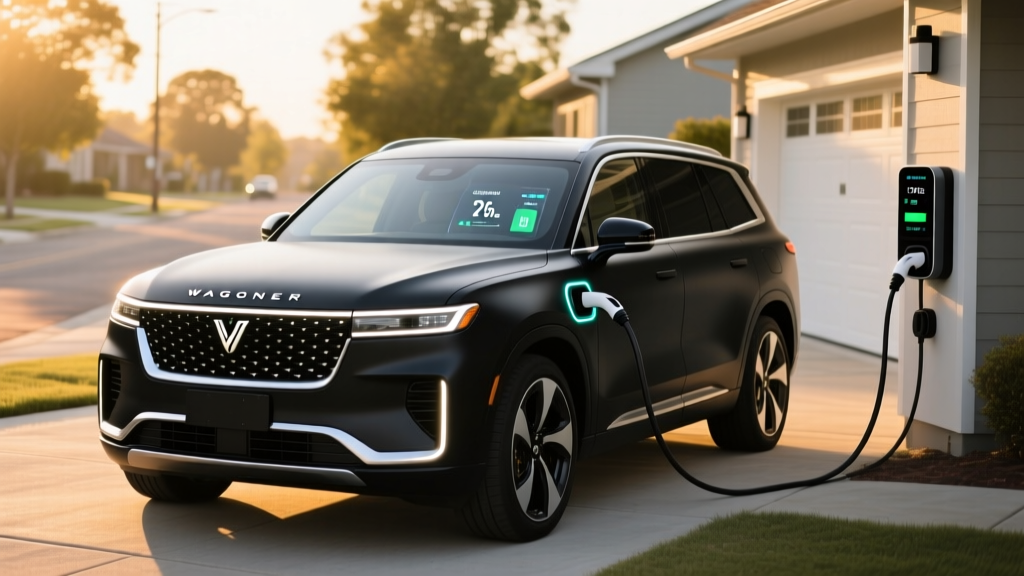
For daily ownership, Level 2 home charging is essential. With an 11.5 kW onboard charger, the Wagoneer EV can add roughly 35–40 miles of range per hour of charging, meaning a depleted battery can be fully replenished in about 10–12 hours on a home Level 2 unit. If you drive 40–50 miles per day (the U.S. average is roughly 37 miles, per FHWA data), a nightly plug-in will keep you perpetually topped off.
EV vs. Gas Wagoneer: Cost and Ownership Comparison
The most common question from Wagoneer buyers is whether the EV version saves money versus the traditional gas-powered Wagoneer (which starts around $62,000 and gets roughly 16–20 MPG combined with its 3.0L Hurricane inline-six). Here's a data-driven comparison:
| Category | Wagoneer EV (AWD) | Gas Wagoneer (4x4) |
|---|---|---|
| Base MSRP | $72,995 | $65,995 |
| Fed. Tax Credit (§30D) | $0–$7,500* | $0 |
| Fuel/Energy (5 yr, 75k mi) | $4,500–$7,000** | $13,500–$15,000*** |
| Maintenance (5 yr) | $1,500–$2,500 | $4,000–$5,500 |
| Insurance (5 yr avg.) | $12,000–$14,000 | $9,500–$11,500 |
| Estimated 5-Yr Total | $83,000–$90,000 | $93,000–$98,000 |
* §30D credit eligibility depends on MSRP caps (SUVs: $80,000), buyer income limits ($300k MFJ / $150k single), and battery component/mineral sourcing requirements per IRS rules. Confirm eligibility before purchase.
** Assumes 70% home charging at $0.14/kWh national avg, 30% DC fast charging at $0.35/kWh. Efficiency est. 2.1 kWh/mi.
*** Assumes $3.40/gal national avg, 18 MPG combined.
The EV breaks even or pulls ahead within 3–4 years for most buyers who can charge at home. The biggest variable is electricity cost: if you have access to off-peak utility rates (many utilities offer EV time-of-use plans at $0.08–$0.10/kWh), your fueling cost drops dramatically. If you're entirely dependent on public DC fast charging at $0.35–$0.50/kWh, the savings shrink considerably — and may not offset the higher purchase price.
Federal Tax Credit: What You'll Actually Qualify For
The §30D Clean Vehicle Credit offers up to $7,500 for qualifying new EVs, but eligibility is a three-part test that eliminates many vehicles and buyers:
- MSRP Cap: SUVs must be priced at or below $80,000. The Wagoneer EV's base and mid trims should qualify, but a fully loaded Summit Reserve could exceed the cap.
- Income Limits: Modified adjusted gross income must not exceed $300,000 (married filing jointly), $225,000 (head of household), or $150,000 (single). This applies to the tax year of delivery or the prior year, whichever is lower.
- Battery Sourcing: The $7,500 credit is split into two halves — $3,750 for critical minerals and $3,750 for battery components — each with escalating domestic-content and FEOC (Foreign Entity of Concern) requirements that tighten annually. Stellantis's STLA Large battery supply chain will determine the actual credit amount. Some buyers may qualify for only $3,750 or $0.
- Point-of-Sale Transfer: As of 2024, the credit can be transferred to the dealer at purchase, reducing your out-of-pocket cost immediately rather than waiting for a tax refund. This requires the dealer to be registered with the IRS Energy Credits Online system.
The bottom line: do not assume you'll receive the full $7,500. Check the current eligibility status on fueleconomy.gov and consult a tax professional if your situation is complex.
Common Misconceptions About the Wagoneer EV
| Myth | Fact |
|---|---|
| "Electric SUVs can't tow." | The Wagoneer EV targets 7,500 lbs of towing capacity (AWD). However, towing cuts range roughly in half — plan for 150–180 miles between charges when pulling a heavy trailer. |
| "The battery will need replacing in 5 years." | Modern NMC packs are warrantied for 8 years/100,000 miles with a minimum 70% capacity retention threshold. Real-world degradation data from similar packs shows roughly 10–15% loss over 8 years with normal use. |
| "I'll save $7,500 no matter what." | The §30D credit has MSRP, income, and sourcing requirements. Many buyers of high-trim Wagoneer EVs will exceed the $80K SUV cap or find that battery sourcing rules reduce the credit to $3,750 or $0. |
| "It charges at 270 kW the whole time." | 270 kW is the peak rate, available only at low SoC (~10–30%). The charge curve tapers significantly above 50%, and charging from 80–100% can take as long as 10–80%. Plan trips around 10–80% sessions. |
| "AWD makes it a real off-roader like a Wrangler." | The Wagoneer EV has AWD with torque vectoring, but its weight, ground clearance, and lack of low-range gearing make it a capable light-trail vehicle, not a rock crawler. Think snow and dirt roads, not Moab. |
Home Charging: What First-Time Buyers Must Plan For
If you're buying the Wagoneer EV, you need a home Level 2 charging solution. Here's the reality of installation:
| Component | Low Estimate | High Estimate |
|---|---|---|
| Level 2 Charger (48A, hardwired) | $500 | $800 |
| Electrical Permit | $50 | $250 |
| Electrician (240V/60A circuit run) | $800 | $2,500 |
| Panel Upgrade (if needed: 200A service) | $1,500 | $4,000 |
| Total (no panel upgrade) | $1,350 | $3,550 |
| Total (with panel upgrade) | $2,850 | $7,550 |
The Wagoneer EV's 11.5 kW onboard charger requires a 60-amp dedicated circuit (240V, 48A continuous draw). If your home has a 100-amp electrical panel — common in older homes — you will almost certainly need a panel upgrade to 200 amps before the electrician can add the circuit. Get a quote from a licensed electrician before you sign the purchase agreement. Some utilities offer rebates of $250–$1,000 for EV charger installation; check with your local provider.
If you live in an apartment or condo without dedicated parking and charging access, the Wagoneer EV becomes significantly harder to own. Public DC fast charging is viable for road trips but is too expensive and inconvenient for daily use. Budget $150–$250/month in public charging costs if you can't charge at home.
Decision Framework: Should You Buy the Wagoneer EV?
Choose the Wagoneer EV if:
- You need three rows and 7,500-lb towing in a BEV
- You have (or can install) home Level 2 charging
- Your daily commute is under 80 miles round-trip
- You want native Tesla Supercharger access via NACS
- You qualify for at least a partial §30D tax credit
Consider a gas Wagoneer or PHEV alternative if:
- You lack home charging access and public infrastructure is sparse in your area
- You regularly tow heavy trailers over 200+ mile routes (range drops to ~150 mi)
- You live in an extremely cold climate and can't tolerate 30–40% winter range loss
- Your loaded trim preference pushes MSRP above the $80,000 §30D SUV cap
- You need the lowest possible upfront cost and plan to keep the vehicle under 4 years
FAQ
Does the Wagoneer EV qualify for the $7,500 federal tax credit?
It depends on the specific trim MSRP (must be ≤$80,000 for SUVs), your income (≤$300K married / ≤$150K single), and whether the battery meets 2026 critical-mineral and component sourcing thresholds. Some trims may qualify for the full $7,500, others for $3,750, and loaded Summit trims may exceed the MSRP cap entirely. Verify on fueleconomy.gov before purchasing.
How long does it take to charge the Wagoneer EV at home?
On a 240V Level 2 charger at 11.5 kW, a full charge from near-empty takes roughly 10–12 hours. For typical daily driving of 40–50 miles, expect 4–5 hours of charging to replenish what you used. Most owners plug in overnight and wake up with a full battery every morning.
Can the Wagoneer EV use Tesla Superchargers?
Yes. The Wagoneer EV is equipped with a NACS charge port, providing native access to Tesla's Supercharger network without an adapter. This is one of its strongest infrastructure advantages over CCS-only competitors.
What happens to range when towing?
Expect range to drop by roughly 40–50% when towing near the 7,500-lb maximum. A 310-mile EPA rating becomes approximately 150–180 real-world miles with a heavy trailer. Plan your route around charging stops and precondition the battery before each DC fast-charging session to maintain charge speed.
Is the Wagoneer EV good in snow and cold weather?
The AWD system provides strong traction, and the battery thermal management system includes preconditioning for cold weather. However, expect 20–35% range loss in sustained sub-freezing temperatures due to cabin heating demands and reduced battery efficiency. A heat pump (if equipped on your trim) can mitigate this somewhat, but physics always wins in extreme cold.