Quick Answer: The 2026 Volkswagen ID. Tiguan (Volkswagen's electric replacement for the gas Tiguan) is expected to deliver up to 310 miles of EPA-estimated range, peak DC fast charging around 175 kW, and a starting MSRP near $39,995 before incentives. It seats five, offers roughly 25 cu ft of cargo space, and qualifies for evaluation under current IRS §30D federal tax credit rules — though battery-sourcing and buyer-income requirements will determine your actual eligibility. If you need a compact electric SUV with mainstream pricing and European driving dynamics, it's a strong contender. If you need three rows or tow heavy, look elsewhere.
What Is the VW Tiguan EV (ID. Tiguan)?
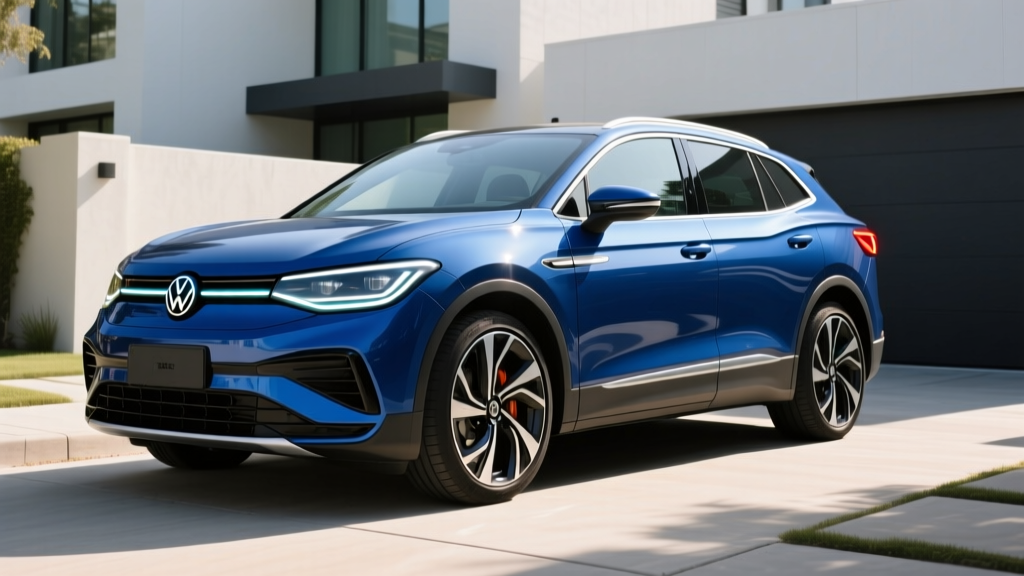
Volkswagen has not sold a vehicle officially badged "Tiguan EV" in the United States. Instead, the electric successor to the gas Tiguan is the Volkswagen ID. Tiguan, unveiled for the European market and expected to reach North American showrooms for the 2026 or 2027 model year. Built on VW's updated MEB+ platform (an evolution of the architecture underpinning the ID.4), the ID. Tiguan slots into the compact electric SUV segment alongside the Tesla Model Y, Hyundai Ioniq 5, Ford Mustang Mach-E, and the current ID.4.
For US buyers searching for a "VW Tiguan EV," the closest vehicle you can buy today is the Volkswagen ID.4, which shares much of the same DNA and occupies a nearly identical footprint. The ID. Tiguan represents VW's next-generation design language — sharper styling, a more upscale interior, improved infotainment, and potentially a larger usable battery — but confirmed US specs remain preliminary until Volkswagen of America finalizes the lineup.
Below, we'll use the confirmed European ID. Tiguan data and current US ID.4 specs to project what American buyers can realistically expect, clearly labeling what's confirmed versus estimated.
Range, Battery, and Real-World Efficiency
| Specification | ID. Tiguan (Estimated US) | Current ID.4 (2026 US) |
|---|---|---|
| Battery (usable) | ~77 kWh (NMC) | 77 kWh (NMC) |
| EPA Range (est.) | ~290–310 mi | 291 mi (Pro S AWD) |
| Efficiency | ~105 MPGe (est.) | 104 MPGe combined |
| Peak DC Charge Rate | ~175 kW | 175 kW |
| 10–80% DC Fast Charge | ~28 min (est.) | ~28 min |
| Level 2 (240V) Rate | 11 kW | 11 kW |
| Drivetrain Options | RWD / AWD | RWD / AWD |
| Horsepower (AWD) | ~295 hp (est.) | 295 hp |
| 0–60 mph (AWD) | ~6.5 sec (est.) | 6.4 sec |
The European ID. Tiguan is offered with battery packs ranging from 59 kWh to 77 kWh (usable). For the US market, Volkswagen will likely prioritize the larger pack to remain competitive with the Model Y Long Range (320 mi EPA) and Ioniq 5 (305 mi EPA with the larger battery).
EPA vs. Real-World Range: The projected 290–310 mile EPA figure assumes mixed driving at moderate temperatures. Expect approximately 250–270 miles on sustained highway driving at 70–75 mph, and 200–230 miles in sub-freezing winter conditions due to battery heating demands and reduced regenerative braking efficiency. VW's MEB+ platform includes a heat pump (standard on most trims), which mitigates cold-weather range loss compared to EVs without one, but a 20–25% reduction in extreme cold (below 20°F) is typical for NMC chemistry.
Charging-curve reality: the 175 kW peak rate applies only between roughly 10% and 30% State of Charge (SoC). Above 50%, the rate tapers to approximately 100–120 kW, and above 80% it drops further to protect battery longevity. A 10–80% session takes about 28 minutes at a functioning 175+ kW DC fast charger; a 10–100% session will take closer to 45 minutes. Plan road-trip stops accordingly.
Pricing, Trims, and Federal Tax Credit Eligibility
Projected US pricing for the ID. Tiguan, based on VW's current ID.4 pricing structure and European positioning:
- Base (S trim, RWD): ~$39,995 MSRP
- Mid (SE, AWD): ~$44,995 MSRP
- Top (Pro S, AWD): ~$49,995 MSRP
All projected trims fall under the IRS §30D MSRP cap of $80,000 for SUVs. However, qualifying for the full $7,500 federal tax credit depends on several factors that change annually:
- Buyer income cap: Modified AGI ≤ $150,000 (single), $225,000 (head of household), $300,000 (joint) — per IRS §30D guidelines
- MSRP cap: ≤ $80,000 for SUVs (all ID. Tiguan trims should qualify)
- Battery component sourcing: A percentage of battery components must be manufactured or assembled in North America (threshold increases annually)
- Critical minerals sourcing: A percentage of critical minerals must be sourced from the US or free-trade-agreement partners
- Point-of-sale transfer: Eligible buyers can transfer the credit to the dealer at purchase, reducing the out-of-pocket price immediately
- Filing requirement: You must file IRS Form 8936 with your tax return to claim the credit if not transferred at sale
Critical caveat: Volkswagen's battery supply chain for US-market vehicles will determine whether the ID. Tiguan qualifies for the full $7,500, a partial $3,750, or no credit at all. VW's US-built ID.4 (assembled in Chattanooga, TN) has historically qualified for at least partial credit. If the ID. Tiguan is imported from Emden, Germany, rather than built stateside, credit eligibility becomes less certain. Always verify current eligibility on fueleconomy.gov before purchasing.
ID. Tiguan vs. Gas Tiguan vs. Competitors: The Numbers
| Metric | ID. Tiguan (Est. AWD) | 2026 Gas Tiguan (AWD) | Tesla Model Y LR (AWD) |
|---|---|---|---|
| Base MSRP | ~$44,995 | ~$33,495 | $44,990 |
| After $7,500 Credit | ~$37,495 | N/A | $37,490 |
| EPA Range / Tank Range | ~300 mi | ~390 mi | 320 mi |
| Energy Cost per Mile | ~$0.045 (home) | ~$0.14 (gas at $3.50/gal, 26 MPG) | ~$0.04 |
| Annual Fuel/Energy (12k mi) | ~$540 | ~$1,680 | ~$480 |
| 5-Year Energy Cost | ~$2,700 | ~$8,400 | ~$2,400 |
| Estimated 5-Year Maintenance | ~$1,200 | ~$3,500 | ~$1,100 |
| 0–60 mph | ~6.5 sec | ~8.5 sec | 4.8 sec |
| Cargo (behind 2nd row) | ~25 cu ft | ~33 cu ft | 30 cu ft |
The ID. Tiguan's closest rival is the Tesla Model Y Long Range. The Model Y wins on range (320 mi), acceleration (4.8 sec to 60), and access to the Supercharger network. The ID. Tiguan's advantages center on build quality, a more conventional interior layout that appeals to VW loyalists, and potentially more competitive pricing on mid-tier trims.
Compared to the gas Tiguan, the ID. Tiguan costs roughly $11,500 more upfront before incentives, but saves approximately $5,700 in energy and $2,300 in maintenance over five years. Net 5-year cost advantage for the EV: roughly $3,500 after the federal credit, assuming home charging at $0.13/kWh and 12,000 miles per year. Without the tax credit, the gas Tiguan remains cheaper over five years for most buyers — a reality EV shoppers must weigh honestly.
Real-World Ownership: What First-Time EV Buyers Need to Know
Home Charging Access Is the Single Biggest Factor
If you can install a Level 2 home charger (240V, 32–48 amps), the ID. Tiguan's 11 kW onboard charger will replenish the battery at roughly 30–35 miles of range per hour. A full overnight charge (8 hours) adds approximately 250 miles — more than enough for daily driving. Installation costs vary widely:
| Item | Cost Range |
|---|---|
| Level 2 charger (hardware) | $400–$700 |
| Electrician (240V outlet or hardwire) | $500–$2,000 |
| Panel upgrade (if needed, 200A) | $1,500–$3,500 |
| Permits | $50–$200 |
| Total (typical install) | $1,000–$2,500 |
If your home electrical panel is already at 200 amps with available breaker slots, expect to pay around $1,000–$1,500 total. If you need a panel upgrade to support a 48-amp circuit, budget $2,500–$4,000. Always get a licensed electrician's assessment before committing to a vehicle purchase.
If you cannot charge at home (apartment, street parking), public DC fast charging at $0.30–$0.50/kWh raises your per-mile cost to $0.09–$0.14 — approaching or exceeding gasoline costs. EV ownership economics depend heavily on home charging access.
Insurance Costs
EV insurance premiums run 15–25% higher than comparable gas vehicles due to battery replacement costs and specialized repair requirements. Expect annual premiums of $1,800–$2,400 for the ID. Tiguan depending on your state, driving record, and coverage level — versus approximately $1,400–$1,800 for a gas Tiguan. Get quotes before purchasing.
Battery Longevity and Warranty
VW provides an 8-year/100,000-mile battery warranty guaranteeing at least 70% capacity retention. NMC batteries in the MEB platform typically show 8–12% degradation over the first 100,000 miles based on ID.4 fleet data. Out-of-warranty battery replacement costs range from $12,000 to $18,000 — a significant expense, though full replacements are rare within the first decade of ownership.
Common Misconceptions About the VW Tiguan EV
| Myth | Fact |
|---|---|
| "The Tiguan EV is available now in the US." | The ID. Tiguan is announced for Europe. US availability is expected for the 2027 model year at earliest. The current US electric VW is the ID.4. |
| "It charges in 10 minutes." | Peak rate is ~175 kW. A 10–80% session takes approximately 28 minutes under ideal conditions at a compatible DC fast charger. |
| "EVs cost more to own over 5 years." | With home charging and the federal tax credit, the ID. Tiguan can save ~$3,500 over 5 years vs. a gas Tiguan. Without the credit or home charging, the gas model is cheaper. |
| "The battery will need replacing in 5 years." | NMC batteries in modern EVs retain 85–92% capacity at 100,000 miles. Full replacements within 8–10 years are uncommon. |
| "You'll get the full $7,500 tax credit automatically." | Eligibility depends on your income, the vehicle's battery sourcing, and MSRP — all subject to annual changes in IRS rules. |
Decision Framework: Is the VW Tiguan EV Right for You?
Choose the ID. Tiguan (or current ID.4) if:
- You have Level 2 home charging access and drive under 80 miles per day
- You want a compact electric SUV with European build quality and driving dynamics
- You qualify for the federal tax credit (check income caps and battery sourcing)
- You prefer a conventional SUV interior layout over Tesla's minimalist approach
- You value VW's dealer network for service and warranty work
Look elsewhere if:
- You need three rows of seating (consider the Kia EV9 or VW ID. Buzz)
- You frequently tow more than 2,000 lbs (EV towing range drops 30–50%)
- You lack home charging and live in an area with sparse public DC infrastructure
- You need maximum range for regular 400+ mile road trips (Tesla Model Y or Hyundai Ioniq 5 offer slightly more)
- You need a vehicle today — the ID. Tiguan is not yet available in the US
Frequently Asked Questions
Can I buy the VW Tiguan EV in the United States right now?
No. The ID. Tiguan has been announced for the European market. US availability is anticipated for the 2027 model year. The closest current alternative from Volkswagen is the ID.4, which shares the MEB platform and similar dimensions.
How does the ID. Tiguan compare to the Tesla Model Y?
The Model Y Long Range offers slightly more range (320 mi vs. ~300 mi est.), faster acceleration (4.8 sec vs. ~6.5 sec), and access to the Supercharger network. The ID. Tiguan is expected to compete on interior quality, ride comfort, and potentially lower mid-trim pricing. Both vehicles should qualify for partial or full federal tax credits depending on sourcing rules at time of purchase.
What will it cost to charge the ID. Tiguan at home?
At the US average residential electricity rate of ~$0.16/kWh (per EIA data), a full charge of the 77 kWh battery costs approximately $12.30, yielding roughly 290 miles of range. That works out to about $0.042 per mile — roughly one-third the per-mile cost of gasoline at $3.50/gallon in a 26 MPG gas Tiguan.
Will the ID. Tiguan qualify for the $7,500 federal tax credit?
It depends on IRS §30D battery-sourcing requirements at the time of sale, your taxable income, and the vehicle's MSRP. If VW assembles the ID. Tiguan for the US market at its Chattanooga, TN plant (as it does the ID.4), eligibility improves. If imported, the credit may be reduced or unavailable. Always check fueleconomy.gov for the latest qualified vehicle list before purchasing.
How does cold weather affect the ID. Tiguan's range?
Expect a 20–25% range reduction in sustained sub-freezing temperatures (below 20°F). The MEB+ platform includes a heat pump to mitigate cabin-heating energy draw, and preconditioning the battery while plugged in before departure helps preserve range. A 300-mile EPA estimate translates to roughly 225–240 miles in harsh winter conditions.
What is the difference between kW and kWh?
kW (kilowatts) measures power — the rate at which energy flows, like the flow rate of a water hose. kWh (kilowatt-hours) measures energy — the total amount stored or consumed, like the volume of water in a tank. The ID. Tiguan's battery stores ~77 kWh of energy, and it can accept charging power at up to ~175 kW.