Quick Verdict: The EV Minivan America Has Been Waiting For
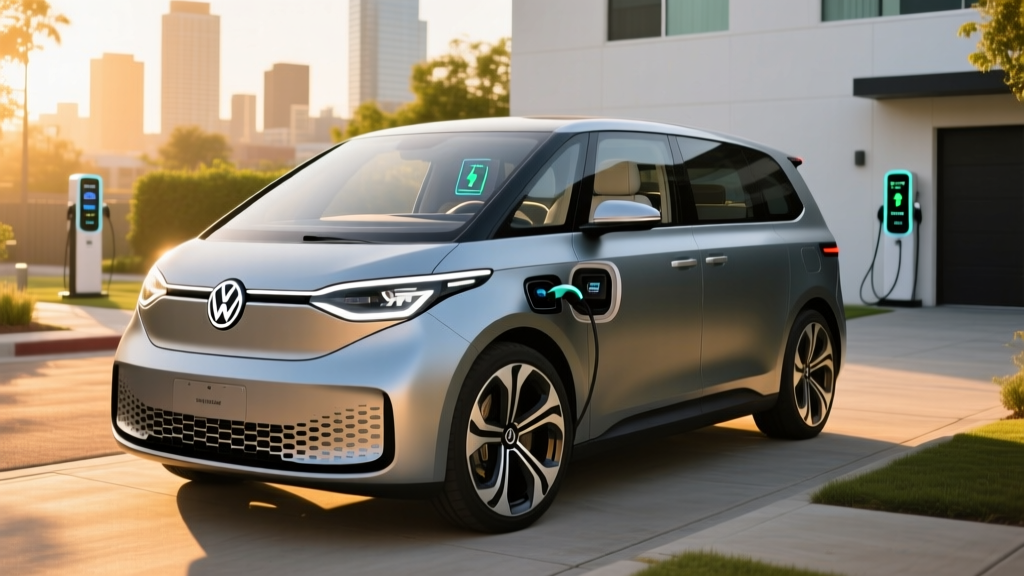
The Volkswagen ID. Buzz is the first all-electric three-row minivan sold in the United States since... well, ever. Arriving for the 2025 model year and carrying into 2026, it wraps a 91 kWh usable NMC battery pack in a retro-styled body that channels the classic Microbus while delivering modern EV practicality. With 286 horsepower, standard all-wheel drive on most trims, and seating for up to seven, it fills a gap no other automaker currently addresses in the electric space.
But nostalgia only gets you so far. Buyers spending $60,000+ need to know the real-world range, how quickly it charges on a road trip, whether it qualifies for the federal tax credit, and how it stacks up against large electric SUVs like the Kia EV9 and Rivian R1S. This review breaks down every number that matters.
Range, Battery, and Efficiency
| Spec | Value |
|---|---|
| Battery (usable) | 91 kWh |
| Chemistry | NMC (Nickel Manganese Cobalt) |
| EPA Range (AWD Pro S) | 234 miles |
| EPA Range (RWD Pro S) | 234 miles |
| Efficiency | 87 MPGe combined / 39 kWh/100 mi |
| Drivetrain | RWD single-motor or AWD dual-motor |
| Horsepower | 282 hp (RWD) / 332 hp (AWD) |
| 0–60 mph | 7.9 sec (RWD) / 5.7 sec (AWD) |
The ID. Buzz uses a 91 kWh usable battery pack built with NMC (nickel manganese cobalt) cells, which prioritize energy density over the cycle-life longevity of LFP chemistry. VW does not currently offer an LFP option for the ID. Buzz.
Real-World Range vs. EPA Sticker
EPA estimate: 234 miles (AWD and RWD trims)
Expect in practice: 200–215 miles at sustained 70 mph highway speeds in moderate temperatures. In cold weather (below 32°F), plan for 165–185 miles due to cabin heating loads and reduced battery efficiency. City driving with regenerative braking can push closer to 240+ miles.
Why the gap: The ID. Buzz is a tall, boxy vehicle with the aerodynamic profile of a bread loaf. Its drag coefficient works against it at highway speeds, where wind resistance dominates energy consumption. This is the single biggest factor separating real-world highway range from the EPA combined cycle.
At 39 kWh per 100 miles, the ID. Buzz is less efficient than sleeker crossovers like the Hyundai Ioniq 5 (around 30 kWh/100 mi), but that's the trade-off for three-row minivan interior volume. For context, that translates to roughly $0.13 per mile at the national average residential electricity rate of $0.17/kWh — compared to $0.15–$0.18 per mile for a gas minivan like the Chrysler Pacifica at 22 MPG combined.
Charging Speed: DC Fast and Home Level 2
Charging speed is where the ID. Buzz reveals one of its most significant limitations relative to newer competitors. The peak DC fast-charge rate is 170 kW — functional but not class-leading.
| Charge Type | Max Rate | Speed | Notes |
|---|---|---|---|
| Level 1 (120V) | 1.4 kW | ~3 mi/hr | Emergency/trickle only |
| Level 2 (240V, 48A) | 11 kW | ~26 mi/hr | Full charge in ~9.5 hours |
| DC Fast Charge | 170 kW peak | 10–80% in ~26 min | CCS1 connector; tapers sharply above 80% |
Charging curve reality: The 170 kW peak is not sustained. In real-world testing, the ID. Buzz holds near-peak rates only between roughly 10–40% state of charge, then ramps down progressively. Expect an average of around 110–120 kW across a full 10–80% session, which is why the 26-minute estimate is realistic. Above 80%, charging slows dramatically to protect the NMC cells — a 10–100% session can take 50+ minutes.
For home charging, an 11 kW onboard charger means a 48-amp Level 2 circuit (requiring a 60-amp breaker) will add roughly 26 miles of range per hour, or fully replenish the battery overnight in about 9.5 hours. Most owners charging from 20–80% daily will see a full session in under 5 hours.
The ID. Buzz uses the CCS1 connector in North America. VW has committed to adopting NACS (Tesla's connector) on future models, and ID. Buzz owners will gain access to Tesla Superchargers via a CCS-to-NACS adapter — but native NACS is not expected on the ID. Buzz until its next major refresh.
Pricing, Trims, and Federal Tax Credit Eligibility
The ID. Buzz is positioned as a premium electric family vehicle, and its pricing reflects that. Here's how the 2025/2026 lineup breaks down:
| Trim | Drivetrain | MSRP | Federal Credit Eligible? |
|---|---|---|---|
| Pro S (RWD) | Rear-wheel drive | $59,995 | See eligibility notes below |
| Pro S (AWD) | All-wheel drive | $63,495 | See eligibility notes below |
| Pro S Plus (AWD) | All-wheel drive | $69,995 | See eligibility notes below |
| 1st Edition (AWD) | All-wheel drive | $69,995 | See eligibility notes below |
Federal tax credit (IRS §30D) eligibility is complex and uncertain for the ID. Buzz. The full $7,500 credit requires the vehicle to meet battery-component and critical-mineral sourcing thresholds that phase in over time. As of the current tax year, buyers must also meet income caps ($150,000 single / $300,000 married filing jointly modified AGI), and the vehicle MSRP must not exceed $80,000 for SUVs/vans — all ID. Buzz trims clear that cap. The credit can now be transferred to the dealer at point of sale as an instant discount per IRS guidance.
However, the ID. Buzz is assembled in Hannover, Germany, and its battery sourcing has been a moving target under evolving §30D rules. Volkswagen has worked to qualify partial or full credits, but buyers should verify current eligibility on fueleconomy.gov before purchase, as the qualifying list updates frequently. Do not assume the full $7,500 applies — confirm with your dealer and a tax professional.
Interior Space, Cargo, and Passenger Comfort
This is where the ID. Buzz justifies its existence over a three-row SUV. The minivan form factor delivers genuine adult-sized seating in all three rows, something even large electric SUVs struggle with.
- Front headroom: 41.3 inches — commanding, upright driving position
- Second-row legroom: 39.6 inches (sliding bench)
- Third-row headroom: 38.8 inches — usable for adults on shorter trips
- Cargo behind 3rd row: 18.2 cu ft
- Cargo behind 2nd row (3rd row folded): 75.5 cu ft
- Max cargo (all rear seats folded): 131.2 cu ft
The flat floor (thanks to the skateboard-style EV platform) and tall roofline create a van-like interior that handles bulky cargo — strollers, camping gear, furniture — more easily than any electric SUV on the market. The available power-sliding doors and low step-in height make it especially practical for families with young children.
Drawbacks: the second-row seats fold but do not fold flat into the floor like a Chrysler Pacifica's Stow 'n Go system. Third-row access is good but not class-leading due to the battery floor height. And there is no front trunk (frunk) — the space under the hood houses HVAC and electronics components.
Tech, Driver Assistance, and Standout Features
The ID. Buzz runs VW's ID. Software 4.0 on a 12.9-inch touchscreen, a meaningful upgrade over the laggy ID.4 infotainment that frustrated early adopters. The system supports wireless Apple CarPlay and Android Auto, over-the-air updates, and a configurable digital cockpit display.
Standard driver assistance includes:
- Adaptive cruise control with stop-and-go
- Lane-keeping assist and lane-centering
- Automatic emergency braking with pedestrian detection
- Blind-spot monitoring with rear cross-traffic alert
- Park assist with surround-view camera
Driver Assistance ≠ Self-Driving
The ID. Buzz's IQ.DRIVE suite is a SAE Level 2 driver-assistance system. It can manage speed, following distance, and lane centering simultaneously, but the driver must keep hands on the wheel and eyes on the road at all times. It is not a hands-free system like GM's Super Cruise or Ford's BlueCruise. There is no Level 3 or Level 4 autonomous capability.
Standout features include the available panoramic fixed-glass roof (with electrochromic dimming on top trims), a heated windshield, a Harman Kardon premium audio system, and the iconic two-tone paint options that lean into the retro aesthetic. The ambient interior lighting offers 30 colors, and the available head-up display projects navigation and speed onto the windshield.
Battery Warranty and Long-Term Ownership
VW backs the ID. Buzz battery with an 8-year / 100,000-mile warranty covering defects and capacity loss below 70% of original capacity — the industry-standard threshold. The general vehicle warranty covers 4 years / 50,000 miles bumper-to-bumper.
For NMC chemistry specifically, owners can expect roughly 10–15% degradation over the first 100,000 miles under normal use, based on industry data from similar VW MEB-platform vehicles. Best practices for longevity include:
- Set daily charge limit to 80% for routine driving (use 100% only for road trips)
- Avoid leaving the vehicle at very high or very low state of charge for extended periods
- Use DC fast charging when needed, but rely on Level 2 home charging for daily replenishment
- Precondition the battery before fast charging in cold weather for optimal charge speed and cell health
Full battery replacement cost, should it be needed out of warranty, is estimated at $15,000–$22,000 based on current NMC pack pricing for vehicles in this capacity class — though prices are expected to decline as battery manufacturing scales.
Pros, Cons, and Who Should Buy the VW ID. Buzz
Pros
- Only electric minivan on the US market — no direct competitor in the segment
- Genuine three-row seating for adults with 131 cu ft max cargo
- AWD dual-motor available with 332 hp and 5.7-sec 0–60
- Distinctive retro styling that draws positive attention everywhere
- Sliding rear doors — essential for tight parking lots with kids
- Improved ID. Software 4.0 infotainment over earlier VW EVs
Cons
- 234-mile EPA range is short for a vehicle this size; highway real-world is ~200–215 mi
- 170 kW peak DC charging is slow vs. Kia EV9 (236 kW) and Hyundai Ioniq 5 (240 kW)
- Starting near $60,000 — premium pricing for the segment
- Federal tax credit eligibility is uncertain due to battery sourcing and assembly location
- No frunk; second-row seats don't fold flat into the floor
- Boxy shape creates wind noise and efficiency loss at highway speeds
Is the VW ID. Buzz Right for You?
Choose the ID. Buzz if: You need three rows and sliding doors, you charge at home nightly, your daily driving is under 150 miles, you value cargo versatility and distinctive design, and you want the only electric minivan available.
Look elsewhere if: You regularly drive 250+ miles between charges, you need the fastest possible DC charging for frequent road trips, you're budget-conscious (the Kia EV9 starts ~$5,000 less with more range), or you require a confirmed $7,500 federal tax credit at purchase.
Frequently Asked Questions
What is the real-world range of the VW ID. Buzz?
The EPA rates the ID. Buzz at 234 miles for both RWD and AWD trims. In real-world highway driving at 70 mph in moderate temperatures, expect 200–215 miles. In cold weather below freezing, plan for 165–185 miles. City driving with regenerative braking can stretch range closer to or slightly beyond the EPA figure.
How fast does the VW ID. Buzz charge?
On a DC fast charger, the ID. Buzz peaks at 170 kW and charges from 10–80% in approximately 26 minutes. The charge rate tapers significantly above 80%. At home on a 48-amp Level 2 charger (11 kW), it adds about 26 miles of range per hour, or a full charge in roughly 9.5 hours.
Does the VW ID. Buzz qualify for the $7,500 federal EV tax credit?
Eligibility depends on current IRS §30D rules regarding battery component sourcing, critical mineral content, buyer income limits ($150K single / $300K joint), and the $80,000 MSRP cap for vans (all trims qualify on price). Because the ID. Buzz is assembled in Germany and its battery supply chain has been under review, buyers should verify eligibility at fueleconomy.gov and consult a tax professional before assuming the full credit applies.
Is the VW ID. Buzz worth buying vs. the Kia EV9 or Rivian R1S?
It depends on your priority. The ID. Buzz offers sliding doors, a flat floor, and more usable third-row and cargo space than either SUV. The Kia EV9 delivers longer range (up to 304 miles), faster DC charging (236 kW), and a lower starting price. The Rivian R1S offers more range, faster charging, and off-road capability but starts above $75,000. If minivan practicality is non-negotiable, the ID. Buzz has no rival. If range and charging speed matter more, the EV9 is the stronger electric family hauler.
What is the towing capacity of the VW ID. Buzz?
The ID. Buzz is rated to tow up to 3,500 pounds with the AWD configuration — sufficient for a small utility trailer, a pair of dirt bikes, or a light pop-up camper, but not a large boat or travel trailer.
Does the ID. Buzz have a front trunk (frunk)?
No. The space under the hood is occupied by HVAC components, the 12V battery, and power electronics. All cargo must go behind the third row or in the main cabin with seats folded.