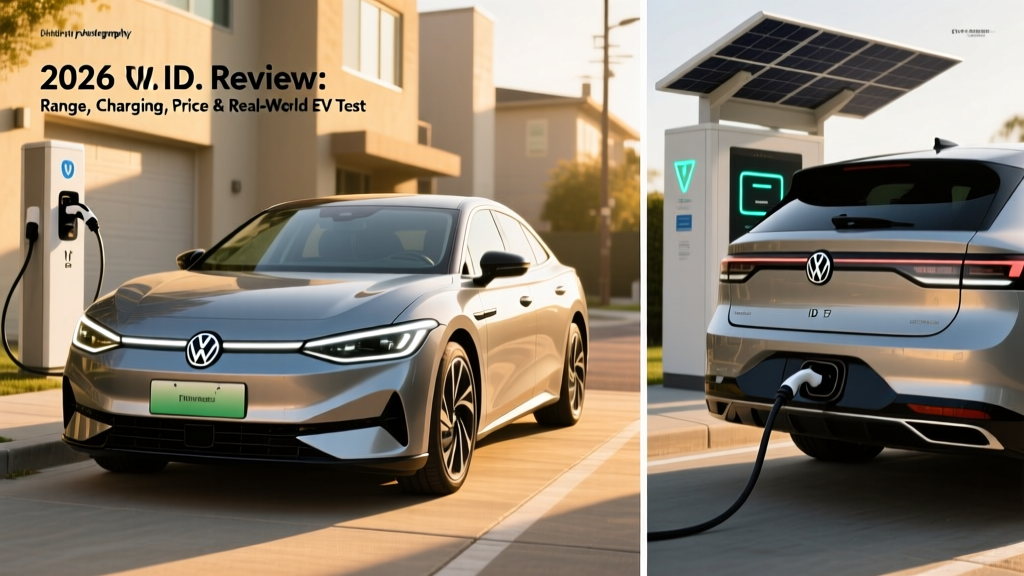
The Volkswagen ID.7 arrives in the U.S. as VW's flagship electric sedan — a direct shot at the Tesla Model 3 and Hyundai Ioniq 6 in the midsize EV sedan segment. Built on Volkswagen's MEB platform and positioned above the ID.4 crossover, the ID.7 promises executive-level comfort, strong efficiency, and the kind of highway range that makes road-tripping genuinely viable. After spending time with the specs, charging data, and real-world efficiency numbers, here is everything you need to know before putting down a deposit.
Range Reality Check
EPA Estimated Range: Up to 340 miles (Pro S trim, 86 kWh usable battery, RWD).
Real-World Expectation: Expect approximately 285–310 miles on mixed highway driving at 70–75 mph. In cold weather (below 30°F), plan for a 15–25% reduction, bringing effective range down to roughly 255–290 miles depending on cabin heating use and terrain. City driving with regenerative braking can push closer to the EPA sticker.
Specs at a Glance: 2026 VW ID.7
| Specification | ID.7 Pro (RWD) | ID.7 Pro S (RWD) | ID.7 AWD (AWD) |
|---|---|---|---|
| EPA Range | ~310 mi | ~340 mi | ~300 mi |
| Battery (Usable) | 77 kWh (NMC) | 86 kWh (NMC) | 86 kWh (NMC) |
| Horsepower | 282 hp | 282 hp | 335 hp |
| 0–60 mph | ~6.5 sec | ~6.5 sec | ~5.2 sec |
| Drivetrain | Rear-Wheel Drive | Rear-Wheel Drive | Dual-Motor AWD |
| Peak DC Fast Charge | 175 kW | 200 kW | 200 kW |
| 10–80% DC Charge | ~28 min | ~26 min | ~26 min |
| Level 2 Home Charge | 11 kW (~37 mi/hr) | 11 kW (~37 mi/hr) | 11 kW (~37 mi/hr) |
| MPGe (Combined) | ~115 MPGe | ~120 MPGe | ~105 MPGe |
| Base MSRP | ~$52,995 | ~$57,995 | ~$62,495 |
Range and Efficiency: The Real Numbers
The ID.7 Pro S with its 86 kWh usable NMC (nickel-manganese-cobalt) battery pack achieves an EPA-estimated 340 miles — putting it squarely in competition with the Tesla Model 3 Long Range (341 mi) and ahead of the Hyundai Ioniq 6 SE Long Range (361 mi). The standard Pro trim's 77 kWh pack delivers around 310 miles, which remains competitive for daily commuting and weekend trips.
Efficiency is where the ID.7's aerodynamic sedan profile pays dividends. With a drag coefficient of approximately 0.23, the ID.7 slices through air more cleanly than VW's ID.4 crossover, translating to roughly 28–30 kWh per 100 miles in mixed driving. That efficiency figure means cheaper charging costs — approximately $0.04–$0.06 per mile on a national average electricity rate of $0.16/kWh, compared to roughly $0.12–$0.15 per mile in a comparable gas sedan at $3.50/gallon.
On the highway at sustained 75 mph speeds, expect consumption to rise to around 32–34 kWh/100mi, which is typical for a vehicle of this weight (approximately 4,700 lbs for the Pro S). Cold-weather efficiency drops are unavoidable physics — battery internal resistance increases and cabin heating demands energy. VW includes a heat pump as standard equipment on U.S. trims, which mitigates some cold-weather range loss compared to resistance-heater systems, but plan conservatively in sub-freezing climates.
Charging Speed: DC Fast and Home Level 2
Charging speed is one of the ID.7's more nuanced stories. The Pro S and AWD trims support up to 200 kW peak DC fast charging on CCS-equipped public stations, while the standard Pro peaks at 175 kW. Volkswagen quotes a 10–80% charge time of approximately 26 minutes for the 86 kWh pack.
| Charging Level | Power / Rate | Speed (Miles Added) | Notes |
|---|---|---|---|
| Level 1 (120V) | ~1.4 kW | ~4–5 miles/hour | Emergency/trickle only |
| Level 2 (240V, 48A) | 11 kW | ~37 miles/hour | Full charge in ~8 hours |
| DC Fast (CCS) | Peak 200 kW | ~150+ miles in 10 min | 10–80% in ~26 min |
Here's the critical ownership detail that spec sheets bury: peak charge rate is not sustained charge rate. The ID.7's charging curve peaks near 200 kW at low state-of-charge (roughly 10–25% SoC) and tapers progressively. By 60% SoC, you'll likely see rates drop to 120–140 kW, and above 80%, the rate falls sharply to protect battery longevity. This means the 10–80% time of 26 minutes is a realistic road-trip figure, but charging from 80–100% will add another 30–40 minutes if you need a full pack.
For home charging, the 11 kW onboard charger means a full 0–100% session on a 48-amp Level 2 wallbox takes roughly 8 hours for the 86 kWh battery. This is perfectly suited to overnight charging — plug in at 10 PM, wake up to a full car at 6 AM. Installation of a Level 2 home charger typically runs $500–$1,500 for equipment and $800–$2,500 for electrician labor, depending on your panel capacity and run distance.
Note: The ID.7 uses the CCS1 connector for DC fast charging in North America. As Volkswagen has committed to transitioning to the NACS (Tesla Supercharger) connector for future models, check your specific model year's port configuration. Adapters may be available for Supercharger access depending on VW's adapter timeline.
Performance and Drivetrain
The ID.7 is not a sports sedan, and VW doesn't pretend otherwise. The single-motor rear-wheel-drive layout delivers 282 horsepower and a 0–60 mph time of approximately 6.5 seconds — brisk enough for confident highway merging and passing, but not in the same territory as a Tesla Model 3 Performance (3.1 seconds). The dual-motor AWD variant bumps output to 335 hp and drops the 0–60 to around 5.2 seconds, adding all-weather traction without dramatically sacrificing range.
Where the ID.7 earns its keep is ride refinement. The MEB platform's low center of gravity, rear-biased weight distribution, and multi-link rear suspension deliver a composed, quiet highway experience. Road noise insulation is a step above the ID.4, and the sedan's longer wheelbase (approximately 116.9 inches) smooths out imperfections. Regenerative braking offers adjustable levels, though VW does not offer true one-pedal driving with a full stop — you'll still need the brake pedal at intersections, which some EV converts find disappointing.
Interior, Cargo, and Technology
The ID.7 measures approximately 195.3 inches long with a 116.9-inch wheelbase, placing it in the midsize sedan class. Interior space is generous:
- Front legroom: ~41.5 inches
- Rear legroom: ~39.0 inches
- Trunk cargo volume: ~18.6 cubic feet (rear seats up)
- Cargo with rear seats folded: ~54 cubic feet
That trunk space beats the Tesla Model 3's 23 cu ft combined (frunk + trunk) for pure rear cargo accessibility, though the Model 3's front trunk adds flexibility. The Hyundai Ioniq 6's swooping roofline limits its trunk to roughly 11.2 cu ft, making the ID.7 a clear winner for cargo practicality among electric sedans.
Technology highlights include a 15-inch infotainment touchscreen running VW's latest ID. Software 4.0, wireless Apple CarPlay and Android Auto, a head-up display with augmented-reality navigation overlays, and a 30-color ambient lighting system. The driver-assistance suite, branded as IQ.DRIVE, includes adaptive cruise control with stop-and-go, lane-keeping assist, automatic emergency braking, and Travel Assist (a SAE Level 2 system that combines steering and speed control on highways). This is not self-driving — the driver must remain attentive and keep hands on the wheel.
A notable standout: the ID.7 offers an optional smart glass panoramic roof with electrically switchable opacity — it can turn opaque or transparent at the touch of a button, eliminating the need for a physical shade while reducing heat gain. It's a genuine conversation piece and functional feature.
Pros
- 340-mile EPA range (Pro S) among the best in its class
- Spacious rear seat and 18.6 cu ft trunk
- Standard heat pump for cold-weather efficiency
- Composed, quiet highway ride quality
- Smart glass panoramic roof (optional)
- Competitive efficiency at ~120 MPGe combined
Cons
- CCS connector limits Supercharger access (without adapter)
- Infotainment still lags Tesla and Hyundai in responsiveness
- No true one-pedal driving mode
- Starting price above $52K — tax credit eligibility uncertain
- 200 kW peak charge rate trails Hyundai's 350 kW capability
- Capacitive touch steering wheel controls frustrate some drivers
Pricing, Trims, and Federal Tax Credit
The 2026 VW ID.7 is expected in three primary U.S. trims:
| Trim | Base MSRP | Est. As-Tested | §30D Tax Credit Eligibility |
|---|---|---|---|
| ID.7 Pro (RWD, 77 kWh) | ~$52,995 | ~$55,500 | Unlikely — battery sourcing rules |
| ID.7 Pro S (RWD, 86 kWh) | ~$57,995 | ~$62,000 | Unlikely — battery sourcing rules |
| ID.7 AWD (Dual-Motor) | ~$62,495 | ~$67,000 | Unlikely — battery sourcing rules |
The IRS §30D federal tax credit offers up to $7,500 for qualifying new EVs, but eligibility hinges on three strict criteria that the ID.7 is unlikely to meet:
- MSRP Cap: Sedans must have an MSRP at or below $55,000. Only the base Pro trim potentially qualifies, and destination charges may push it over.
- Buyer Income Cap: Modified adjusted gross income must not exceed $150,000 (single), $225,000 (head of household), or $300,000 (joint).
- Battery Sourcing: Critical minerals and battery components must meet escalating domestic-sourcing percentages that increase annually. VW's MEB battery supply chain, largely sourced from LG Energy Solution and SK Innovation with significant Asian mineral content, has struggled to meet these thresholds.
As of the current tax year, buyers should assume the ID.7 does not qualify for the full $7,500 federal credit. Consult a tax professional and verify current eligibility on the IRS website before purchase. Some state-level incentives (California, Colorado, New York, and others) may still apply — check your state's energy office for details. The point-of-sale transfer option, if eligible, lets you apply the credit as a down payment reduction at the dealer.
Warranty and Battery Longevity
Volkswagen backs the ID.7 with the following warranty coverage:
- Limited Vehicle Warranty: 4 years / 50,000 miles
- Battery & Powertrain Warranty: 8 years / 100,000 miles
- Battery Capacity Guarantee: VW warrants that the high-voltage battery will retain at least 70% of its original usable capacity over the 8-year/100,000-mile period
The 70% capacity retention threshold is industry-standard, matching what Tesla, Hyundai, and Ford offer. For the 86 kWh pack, that means VW guarantees at least ~60 kWh of usable capacity after 8 years or 100,000 miles. Real-world NMC degradation data from MEB-platform vehicles (ID.4, ID. Buzz) suggests most owners will see 85–92% capacity retention at the 100,000-mile mark under normal use patterns — meaning the 70% floor is a conservative safety net rather than an expected outcome.
To maximize battery longevity, VW recommends routine charging to 80% for daily use and reserving 100% charges for road trips. The vehicle's battery management system includes active liquid cooling and heating to keep the pack in its optimal temperature window, which is essential for both longevity and fast-charge performance.
Who Should Buy the VW ID.7?
The ID.7 Is Right for You If:
- You want a comfortable, quiet electric sedan for highway commuting and road trips
- You need genuine rear-seat space for adults and a usable trunk for family gear
- You prioritize ride quality and refinement over sporty acceleration
- You have access to home Level 2 charging and CCS-compatible public fast chargers
- You're cross-shopping the Tesla Model 3 but want a more traditional sedan experience
Look Elsewhere If:
- You rely on the Tesla Supercharger network exclusively (unless VW confirms NACS adapter access)
- You want the fastest-accelerating EV in the segment (Tesla Model 3 Performance or Hyundai Ioniq 6 N)
- Budget is under $45,000 — consider the Chevy Equinox EV or Hyundai Ioniq 6 SE instead
- You need maximum fast-charge speed — the Hyundai Ioniq 6's 800V architecture charges at up to 350 kW
The ID.7's competitive set is tight. The Tesla Model 3 Long Range offers comparable range at a lower starting price with Supercharger access, though its interior space and ride comfort are a step down. The Hyundai Ioniq 6 charges faster and costs less, but its rear headroom and trunk are compromised by its dramatic styling. The BMW i4 is more engaging to drive but starts at a significantly higher price point and delivers less range.
Frequently Asked Questions
What is the real-world range of the VW ID.7?
The EPA rates the ID.7 Pro S at up to 340 miles. In real-world mixed highway driving at 70–75 mph, expect 285–310 miles. Cold weather (below 30°F) can reduce range by 15–25%, yielding roughly 255–290 miles. City driving with frequent regenerative braking can approach or match the EPA figure.
How fast does the VW ID.7 charge?
On a DC fast charger, the ID.7 Pro S and AWD trims peak at 200 kW, achieving a 10–80% charge in approximately 26 minutes. The standard Pro peaks at 175 kW with a 10–80% time of about 28 minutes. At home on a 48-amp Level 2 charger (11 kW), a full charge takes roughly 8 hours. The ID.7 uses the CCS1 connector, not NACS — Supercharger access depends on VW's adapter availability.
How much does the VW ID.7 cost after tax credits?
With a base MSRP starting around $52,995 for the Pro trim, the ID.7 is unlikely to qualify for the $7,500 federal §30D tax credit due to battery-sourcing requirements and the $55,000 sedan MSRP cap. Expect to pay close to sticker price minus any applicable state incentives. Always verify current eligibility on irs.gov and consult a tax professional.
Does the VW ID.7 qualify for the federal EV tax credit?
Most likely not for the full $7,500. The §30D credit requires the vehicle to meet battery critical-mineral and component sourcing thresholds, an MSRP cap of $55,000 for sedans, and buyer income limits. VW's current battery supply chain has not consistently met the domestic-sourcing requirements. State incentives may still apply independently.
Is the VW ID.7 worth buying vs. the Tesla Model 3 or Hyundai Ioniq 6?
The ID.7 wins on interior space, ride comfort, and trunk practicality. The Tesla Model 3 Long Range wins on price, Supercharger network access, and software. The Hyundai Ioniq 6 wins on charging speed (350 kW capable) and value pricing. Choose the ID.7 if you prioritize comfort and space over the lowest price or fastest charging.
What is the ID.7's battery chemistry and will it last?
The ID.7 uses NMC (nickel-manganese-cobalt) lithium-ion cells. VW warranties the battery for 8 years/100,000 miles with a 70% minimum capacity retention guarantee. Real-world MEB-platform data suggests most owners will retain 85–92% capacity at 100,000 miles with normal charging habits (daily 80% limit, occasional 100% for trips).
Does the ID.7 have a front trunk (frunk)?
No. Like most MEB-platform vehicles, the ID.7 does not include a front trunk. All cargo space is in the rear trunk (18.6 cu ft). This is a trade-off compared to the Tesla Model 3, which includes a small frunk.
What driver-assistance features does the ID.7 offer?
The ID.7 comes with VW's IQ.DRIVE suite, which includes Travel Assist (SAE Level 2 combined lane-keeping and adaptive cruise), automatic emergency braking, blind-spot monitoring, rear cross-traffic alert, and Park Assist. This is a driver-assistance system requiring active driver supervision — it is not autonomous driving.