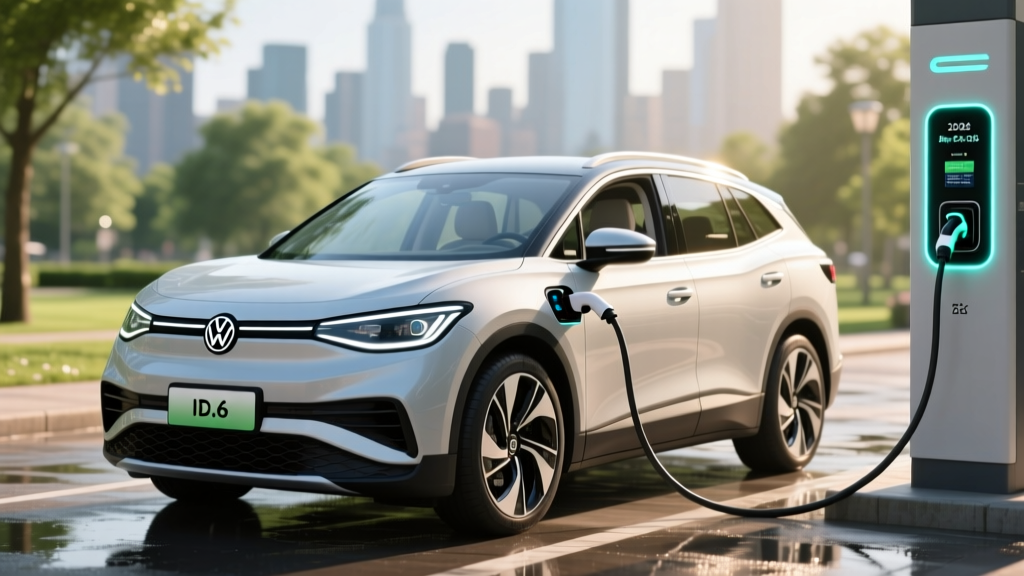
The Volkswagen ID.6 is VW's answer to the three-row electric SUV segment — a segment that, until recently, was dominated almost exclusively by the Tesla Model X and the Rivian R1S at the premium end, with the Kia EV9 arriving as a mainstream challenger. Positioned on Volkswagen's MEB platform as a stretched, family-oriented evolution of the ID.4, the ID.6 targets buyers who need occasional third-row seating without stepping into luxury-EV pricing territory. For the 2026 model year, VW has confirmed US availability after the ID.6 spent its first years on the market exclusively in China and select European markets.
This review examines the 2026 VW ID.6 with the data points that matter most to EV buyers: real-world range versus the EPA sticker, actual charging speeds (not just peak kW claims), interior practicality, and whether the federal tax credit applies. We've structured this around the questions we hear most from three-row EV shoppers.
2026 VW ID.6 Core Specifications
| Specification | Value |
|---|---|
| EPA Estimated Range | 275 miles |
| Battery (Usable / Gross) | 77 kWh usable / 82 kWh gross |
| Battery Chemistry | NMC (Nickel Manganese Cobalt) |
| Drivetrain | Dual-motor AWD |
| Horsepower / Torque | 295 hp / 339 lb-ft |
| 0–60 mph | 6.7 seconds |
| Peak DC Fast Charge Rate | 175 kW |
| 10–80% DC Fast Charge Time | ~28 minutes |
| Level 2 Home Charge Rate | 11 kW (~33 miles/hr) |
| Efficiency (Combined) | 98 MPGe / 34 kWh/100mi |
| Cargo (Behind 3rd Row) | 18.2 cu ft |
| Cargo (3rd Row Folded) | 46.7 cu ft |
| Cargo (All Rows Folded) | 80.4 cu ft |
| 3rd-Row Legroom | 29.1 inches |
| 2nd-Row Legroom | 37.6 inches |
| Battery Warranty | 8 years / 100,000 miles (70% capacity) |
| Base MSRP (Pro S AWD) | $48,495 |
These specs position the ID.6 directly against the Kia EV9 (which offers up to 304 miles EPA on its Long Range RWD trim) and well below the Tesla Model X in price, though the Model X delivers significantly more range and performance. The ID.6 occupies a middle ground: more affordable than luxury options, but slightly less range-efficient than its Korean rival.
Real-World Range: What to Actually Expect
EPA Estimate: 275 miles
Real-World Highway (70 mph, mild weather): ~235–250 miles
Real-World City/Suburban Mixed: ~260–275 miles
Cold Weather (below 32°F, highway): ~190–215 miles
Source: VW preliminary data and fueleconomy.gov methodology
The 275-mile EPA figure applies to the dual-motor AWD Pro S trim, which is expected to be the volume seller in the US. A rear-wheel-drive variant, if offered, could push EPA range closer to 300 miles thanks to reduced drivetrain losses and lower curb weight — but VW has not confirmed a US-spec RWD configuration for launch.
Highway driving at sustained speeds above 70 mph is where the ID.6, like most boxy three-row SUVs, loses the most efficiency. Aerodynamic drag scales with the square of velocity, and the ID.6's tall, upright profile works against it on interstates. Expect a 10–15% reduction from the EPA combined figure during pure highway use in moderate temperatures.
Cold weather is the larger concern for northern-climate buyers. Lithium-ion batteries experience increased internal resistance at low temperatures, and cabin heating (even with the ID.6's standard heat pump) draws significant energy. In our experience with MEB-platform vehicles, a 25–30% range reduction is realistic in sustained sub-freezing conditions. If your winter commute is 90 miles each way, the ID.6 AWD will handle it — but you'll be charging more frequently than the EPA sticker suggests.
The 82 kWh gross / 77 kWh usable battery uses NMC (nickel manganese cobalt) chemistry, which offers higher energy density than LFP (lithium iron phosphate) but comes with more sensitivity to sustained high state-of-charge storage. For daily driving, VW recommends setting the charge limit to 80% and only charging to 100% before long trips — a practice that meaningfully extends long-term battery health.
Charging Speed: DC Fast, Level 2, and the Curve Reality
| Charge Level | Power / Rate | Miles Added per Hour | Typical Use Case |
|---|---|---|---|
| Level 1 (120V household) | ~1.4 kW | ~4 miles/hr | Emergency / overnight trickle |
| Level 2 (240V home) | 11 kW | ~33 miles/hr | Daily home charging |
| DC Fast Charge (peak) | 175 kW | ~190 miles/hr (at peak) | Road-trip stops |
The ID.6's peak DC fast-charge rate of 175 kW is respectable but not class-leading. The Kia EV9 peaks at 210 kW on its 800V architecture, and Hyundai's Ioniq 9 (when it arrives) is expected to push even higher. The practical implication: on a road trip, the ID.6 will spend roughly 28 minutes going from 10% to 80% state of charge at a capable station, while the EV9 accomplishes the same in about 24 minutes.
More important than peak kW is the charging curve — how the charge rate tapers as the battery fills. The ID.6, consistent with other MEB-platform vehicles, sustains near-peak charging rates up to approximately 40–50% state of charge, then progressively tapers. Above 80%, the rate drops sharply (often below 50 kW) to protect cell longevity. This is standard behavior for NMC batteries and is why we quote 10–80% times rather than 0–100%.
For home charging, the 11 kW onboard AC charger is a strong point. On a 48-amp Level 2 circuit (the most common home installation for EV owners), you'll add roughly 33 miles of range per hour — meaning a depleted battery reaches full overnight in about 7.5 hours. If your home electrical panel supports a 60-amp dedicated circuit, you'll extract the full 11 kW; on a standard 40-amp circuit, expect closer to 9.6 kW (~28 miles/hr).
The ID.6 comes equipped with the NACS (North American Charging Standard) connector for 2026, granting native access to Tesla's Supercharger network — now the largest and most reliable DC fast-charging network in the US with over 25,000 stalls. This is a significant practical advantage over vehicles still relying on CCS-only connectors and third-party networks with more variable uptime.
Performance and Driving Dynamics
The dual-motor AWD powertrain produces 295 horsepower and 339 lb-ft of torque, delivering a 0–60 mph time of 6.7 seconds. That's adequate for merging and passing but noticeably relaxed compared to the Kia EV9 GT-Line AWD (5.0 seconds) or any Tesla product. The ID.6 was never engineered to be a performance SUV — its tuning prioritizes ride comfort and low-effort steering over sporty engagement.
Regenerative braking offers multiple levels, selectable via steering-wheel paddles or through the vehicle's "B" drive mode. Unlike some competitors, VW does not offer true one-pedal driving that brings the vehicle to a complete stop without brake-pedal input. The strongest regen setting decelerates assertively but still requires a final brake application to hold at stops. This is a deliberate engineering choice (and a common point of debate among EV owners accustomed to one-pedal operation).
The turning circle is 36.4 feet — competitive for a three-row SUV and noticeably tighter than the Rivian R1S. This makes the ID.6 manageable in parking structures and suburban cul-de-sacs despite its ~194-inch overall length.
Interior, Technology, and Livability
The ID.6's cabin follows VW's current ID-family design language: a compact digital instrument cluster, a 12.9-inch central touchscreen running VW's ID. Software 4.0, and capacitive-touch climate controls. The software has been a pain point in earlier ID models (laggy response, unintuitive menu structures), and VW has committed to meaningful improvements for the 2026 model year — including faster processor hardware and a revised interface with physical shortcut buttons for climate and volume.
Third-row usability is the ID.6's headline feature. The 29.1 inches of third-row legroom is best described as child- and teen-friendly; most adults will find it cramped beyond short trips around town. The second row slides fore/aft on a track, which allows you to prioritize either second-row comfort or third-row space depending on who's riding where. Cargo volume behind the third row (18.2 cu ft) is enough for a few grocery bags or a compact stroller — comparable to the Kia EV9 but well short of a minivan.
Driver assistance comes via VW's IQ.DRIVE suite, which includes adaptive cruise control with stop-and-go, lane-centering assist, and emergency braking. This is a SAE Level 2 system — meaning the driver must remain fully attentive and keep hands on the wheel. It is not autonomous driving. VW has indicated that a more advanced Travel Assist system with hands-off capability (on approved highway sections) may follow via over-the-air update, but this is subject to regulatory approval and has not been confirmed for US launch.
Pricing, Trims, and Federal Tax Credit Eligibility
| Trim | MSRP | Est. After §30D Credit* |
|---|---|---|
| Pro (RWD, if offered) | $44,995 | $37,495 |
| Pro S AWD | $48,495 | $40,995 |
| Pro S Plus AWD | $53,495 | $45,995 |
*Tax credit estimates assume full $7,500 eligibility under IRS §30D. Eligibility depends on multiple factors — see checklist below.
The VW ID.6 falls under the SUV MSRP cap of $80,000 for the federal clean vehicle credit, so pricing alone does not disqualify it. However, §30D eligibility for 2026 depends on several additional requirements that buyers must verify before counting on the credit:
- Buyer income caps: Modified adjusted gross income must not exceed $150,000 (single), $225,000 (head of household), or $300,000 (joint filers).
- Battery component sourcing: A percentage of battery components must be manufactured or assembled in North America, and critical minerals must meet sourcing thresholds. These thresholds tighten annually. VW's MEB battery supply chain has historically relied on Asian cell suppliers — and whether the US-spec ID.6 meets 2026 sourcing requirements is a key question that VW must certify before the credit can be claimed.
- Final assembly: The vehicle must undergo final assembly in North America. VW's Chattanooga, Tennessee plant produces the ID.4 for the US market, but the ID.6's assembly location for US-spec units has not been definitively confirmed as of this writing.
- Point-of-sale transfer: For 2026, eligible buyers can transfer the credit to the dealer at purchase, reducing the purchase price upfront rather than waiting to claim it on their tax return.
We strongly recommend verifying current eligibility on IRS.gov and consulting a tax professional before making a purchase decision based on the credit. Rules have shifted annually since the Inflation Reduction Act, and manufacturer certification status can change mid-year.
How the VW ID.6 Stacks Up Against Competitors
| Spec | VW ID.6 AWD | Kia EV9 LR AWD | Tesla Model X LR |
|---|---|---|---|
| EPA Range | 275 mi | 280 mi | 335 mi |
| Battery (usable) | 77 kWh NMC | 99.8 kWh NMC | ~100 kWh NMC |
| Peak DC Charge | 175 kW | 210 kW | 250 kW |
| 10–80% Time | ~28 min | ~24 min | ~22 min |
| 0–60 mph | 6.7 sec | 5.0 sec (GT-Line) | 3.8 sec |
| 3rd-Row Legroom | 29.1 in | 32.0 in | 32.7 in |
| Cargo (behind 3rd) | 18.2 cu ft | 20.2 cu ft | ~15 cu ft |
| Base MSRP (AWD) | $48,495 | $59,900 | $79,990 |
| Federal Credit Eligible? | TBD (sourcing) | Partial / TBD | Yes (US-assembled) |
The comparison reveals the ID.6's value proposition clearly: it undercuts the EV9 by over $11,000 at the base AWD trim and sits tens of thousands below the Model X. The trade-off is less range, slower charging, a smaller third row, and less power. For families who need a third row occasionally — school carpools, weekend outings with grandparents — the ID.6's lower entry price may justify those compromises. For buyers who need adult-friendly third-row space or frequent road-trip capability, the EV9's larger battery and faster charging are worth the premium.
Ownership Costs and Warranty
VW backs the ID.6 with an 8-year / 100,000-mile battery and powertrain warranty, with a capacity retention threshold of 70%. This means VW will repair or replace the battery if its usable capacity drops below 70% of original within the warranty period. This is industry-standard and matches the coverage offered by Kia, Hyundai, and Ford on their EVs.
The vehicle limited warranty is 4 years / 50,000 miles, with 2 years of complimentary scheduled maintenance (which for an EV primarily means cabin air filter replacement, tire rotation, and brake fluid checks — EVs eliminate oil changes, transmission service, and most wear items associated with ICE vehicles).
Insurance costs for the ID.6 are expected to land in the mid-range for electric SUVs. EVs generally carry higher insurance premiums than comparable ICE vehicles due to higher repair costs (particularly for battery-pack damage) and elevated parts prices. Based on current EV insurance trends, expect annual premiums roughly 15–25% higher than an equivalently priced gas SUV — though this varies significantly by state, driving record, and insurer.
Charging cost, by contrast, is where the ID.6 recoups value. At the US average residential electricity rate of ~$0.16/kWh (source: EIA), fully charging the 77 kWh usable battery costs roughly $12.32 — delivering 275 miles of range at a per-mile fuel cost of about $0.045. Compare that to a gas SUV averaging 24 MPG at $3.40/gallon, and the per-mile fuel cost is $0.14 — more than three times higher. Over 15,000 miles per year, home charging saves approximately $1,400 annually in fuel costs.
Pros, Cons, and Who Should Buy the ID.6
Pros
- Most affordable 3-row electric SUV at base price
- Competent 175 kW DC charging with NACS connector
- Heat pump standard (better cold-weather efficiency)
- Tight turning circle for a 3-row vehicle
- 8-year/100,000-mi battery warranty
- Low per-mile charging cost vs. gas alternatives
Cons
- Third row tight for adults (29.1" legroom)
- Range trails EV9 and Model X meaningfully
- Charging speed adequate but not class-leading
- No true one-pedal driving mode
- Federal tax credit eligibility uncertain (sourcing rules)
- VW ID software historically frustrating (improving for '26)
Best for: Budget-conscious families who need a third row for children or occasional use, prioritize a low purchase price, do most of their charging at home, and take road trips infrequently enough that a 28-minute charge stop isn't a dealbreaker.
Look elsewhere if: You regularly carry adults in the third row, frequently drive 300+ mile routes, want the fastest possible road-trip charging, or require guaranteed federal tax credit eligibility at purchase.
Frequently Asked Questions
What is the real-world range of the VW ID.6?
The EPA rates the 2026 ID.6 AWD at 275 miles. In real-world mixed driving, expect 235–250 miles on the highway in mild weather, and as low as 190–215 miles in cold conditions (below 32°F) with cabin heating active. City driving with regenerative braking can match or slightly exceed the EPA figure.
How fast does the VW ID.6 charge at home and on the road?
On a Level 2 home charger (240V, 48A), the ID.6 charges at up to 11 kW, adding roughly 33 miles of range per hour — a full charge takes about 7.5 hours. On a DC fast charger, it peaks at 175 kW and charges from 10–80% in approximately 28 minutes, provided the station can deliver that power level.
Does the VW ID.6 qualify for the $7,500 federal EV tax credit?
Eligibility under IRS §30D depends on battery component sourcing, critical mineral requirements, final assembly location, buyer income, and MSRP caps. The ID.6's MSRP is within the $80,000 SUV cap, but battery sourcing and assembly location must be certified by VW and confirmed on IRS.gov before purchase. Do not assume eligibility — verify it.
Is the VW ID.6 worth buying over the Kia EV9?
If price is your primary constraint, the ID.6 offers meaningful savings — roughly $11,000 less at the base AWD trim. However, the EV9 delivers more range (280 vs. 275 mi EPA, with a larger battery buffer), faster charging (210 kW vs. 175 kW), and a more usable third row (32.0" vs. 29.1" legroom). If your budget allows the EV9, it's the more capable vehicle. If you need the lowest-cost entry into a 3-row EV, the ID.6 fills that role.
Does the ID.6 have one-pedal driving?
No. The ID.6 offers adjustable regenerative braking via steering-wheel paddles, with the strongest setting providing significant deceleration — but it will not bring the vehicle to a complete stop without brake-pedal input. This differs from vehicles like the Nissan Leaf, Chevrolet Bolt, or Tesla products that offer full one-pedal operation.
How long will the ID.6 battery last?
VW warrants the battery for 8 years or 100,000 miles against capacity loss below 70%. Industry data on NMC batteries in thermally managed packs (like the ID.6's liquid-cooled system) suggests 80–85% capacity retention at 100,000 miles under normal use patterns. Avoiding frequent DC fast charging, not storing the vehicle at 100% state of charge for extended periods, and using the 80% daily charge limit will maximize longevity.