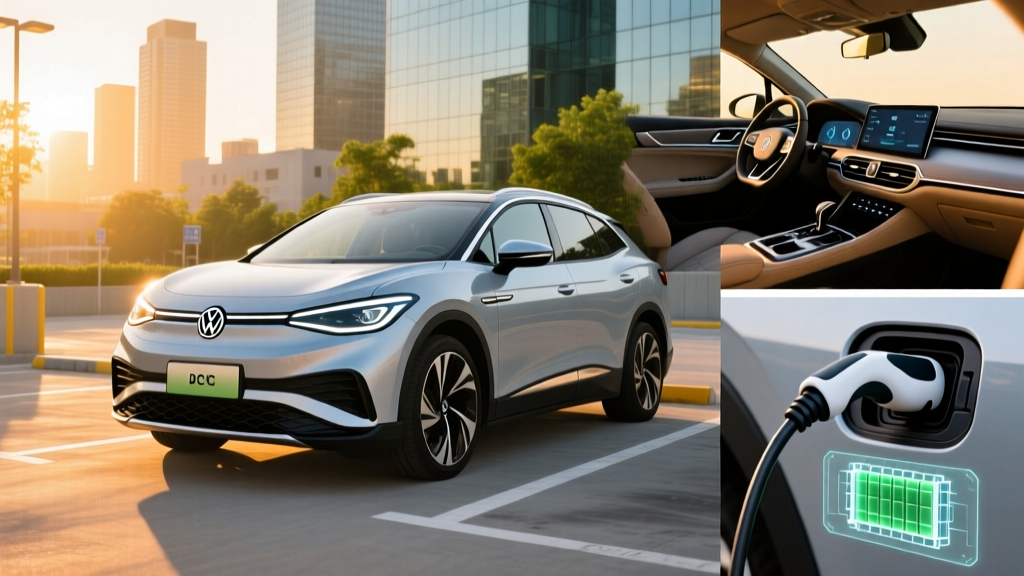
The VW ID.5 is Volkswagen's coupe-style electric crossover, slotted between the ID.4 and the larger ID.6 in the brand's MEB-platform lineup. For 2026, the ID.5 arrives in the U.S. market with a sloping roofline, a 77 kWh usable battery pack, and the same fundamental hardware as the ID.4 — but wrapped in a more aerodynamic shell that nudges range slightly higher. If you've been cross-shopping the ID.4, Hyundai Ioniq 5, or Tesla Model Y and want something with a bit more style without stepping up to a luxury badge, the ID.5 demands a closer look.
Below, we break down every number that matters: real-world range versus the EPA sticker, how the charging curve actually behaves at a DC fast charger, what you'll actually pay after federal incentives, and whether the ID.5's trade-offs make sense for your daily driving.
2026 VW ID.5 Core Specs at a Glance
| Spec | ID.5 Pro S (RWD) | ID.5 Pro S AWD |
|---|---|---|
| EPA Range | 291 miles | 268 miles |
| Battery (usable) | 77 kWh NMC | 77 kWh NMC |
| Powertrain | Single-motor RWD, 282 hp | Dual-motor AWD, 335 hp |
| 0-60 mph | 6.7 sec | 5.1 sec |
| Peak DC Fast Charge | 175 kW | 175 kW |
| 10-80% DC Time | ~28 min | ~28 min |
| Level 2 Charge Rate | 11 kW (~37 mi/hr) | 11 kW (~37 mi/hr) |
| MPGe (combined) | 104 MPGe | 95 MPGe |
| Efficiency | 32 kWh/100 mi | 35 kWh/100 mi |
| Base MSRP | $51,490 | $55,290 |
| Battery Warranty | 8 yr / 100,000 mi | 8 yr / 100,000 mi |
Real-World Range: What the EPA Sticker Doesn't Tell You
EPA estimate: 291 miles
Real-world highway (70-75 mph, moderate temps): ~245–265 miles
Real-world highway (winter, 30°F): ~210–230 miles
City/suburban mixed driving: ~275–290 miles
The ID.5's sloped roofline cuts drag compared to the ID.4, yielding a modest 10-15 mile EPA advantage. But highway speeds above 70 mph and cold temperatures still exact their usual toll on any NMC pack. Plan road trips around ~230 miles of usable range to maintain a comfortable buffer.
Volkswagen quotes 291 miles for the rear-wheel-drive ID.5 Pro S, per fueleconomy.gov. That figure holds up reasonably well in suburban and city driving, where regenerative braking recaptures energy and speeds stay moderate. On sustained highway runs at 72-75 mph in 65-80°F weather, expect to see roughly 245-265 miles before the pack is depleted — a 9-16% reduction from the sticker, which is typical for a crossover in this class.
Cold weather compounds the loss. At 30°F with the cabin heater active, the ID.5's heat pump (standard on 2026 Pro S trims) helps, but you'll still see range drop to roughly 210-230 miles on the highway. The ID.5 does not use an LFP battery — VW sticks with NMC (nickel manganese cobalt) chemistry across the ID. family for its higher energy density. That means better range-per-kWh but slightly more sensitivity to extreme cold compared to LFP packs found in some competitors.
Charging Speed: DC Fast Charging and Home Level 2
The ID.5 peaks at 175 kW on a DC fast charger. That's a respectable figure, though it trails the Hyundai Ioniq 5's 240 kW peak and the Kia EV6's 239 kW capability on 800V architectures. Here's how the ID.5's charging actually plays out in practice:
| Charging Level | Power | Miles Added per Hour | Notes |
|---|---|---|---|
| Level 1 (120V household) | ~1.4 kW | ~4-5 mi/hr | Emergency/trickle only |
| Level 2 (240V, 48A home charger) | 11 kW | ~37 mi/hr | Full charge in ~7.5 hours |
| DC Fast (175 kW peak) | 175 kW max | ~650 mi/hr (peak) | 10-80% in ~28 min |
On a 350 kW Electrify America or CCS-compatible station, the ID.5 ramps quickly to ~170-175 kW between 10-30% State of Charge (SoC), then tapers progressively. By 60% SoC, you're typically seeing 100-120 kW. Above 80%, the charge rate drops sharply to protect the NMC cells — often below 40 kW. This taper is why Volkswagen quotes 28 minutes for 10-80%, but a 10-90% session stretches closer to 40-42 minutes.
For home charging, the 11 kW onboard charger is a strong point. A full 0-100% session takes roughly 7.5 hours on a 48-amp Level 2 unit (like a ChargePoint Home Flex or Emporia Level 2), meaning you can arrive home at 10 PM with a near-empty battery and wake up fully charged. If your home electrical panel supports a 60-amp circuit (requiring a licensed electrician to install), you'll get the full 11 kW benefit. Homes with older 100-amp panels may need an upgrade — budget $1,500-$3,000 for that work on top of the $500-$900 charger hardware.
Connector note: The 2026 ID.5 ships with a CCS1 charge port in North America. Volkswagen has confirmed that future model years will transition to NACS (Tesla's connector), but for 2026, you'll use the CCS network — Electrify America, EVgo, and ChargePoint's CCS-equipped stations. A NACS-to-CCS adapter may be available from VW for Supercharger access; check with your dealer at purchase.
Performance and Driving Dynamics
The rear-wheel-drive ID.5 Pro S delivers 282 horsepower and 339 lb-ft of torque from its single rear-mounted AC permanent-magnet motor. The 0-60 mph sprint takes 6.7 seconds — brisk enough for confident highway merging and passing, though not sports-car territory. The dual-motor AWD variant bumps output to 335 hp and drops 0-60 to 5.1 seconds, which makes a meaningful difference if you regularly carry passengers or tackle mountain grades.
Ride quality is where the ID.5 earns its keep. The MEB platform's low center of gravity, combined with VW's tuned suspension, gives the ID.5 a composed, slightly firm ride that absorbs highway expansion joints without fuss. Steering is light but predictable — this is a cruiser, not a corner-carver. The turning radius is tight for its size, making it manageable in urban parking situations.
Regenerative braking in the ID.5 offers two modes: a coasting "D" mode that lets the car freewheel (VW's efficiency-maximizing philosophy), and a "B" mode that provides moderate regen for reduced brake pedal use. It does not offer true one-pedal driving to a complete stop like a Nissan Leaf or Tesla — the ID.5 blends friction brakes at very low speeds. Some EV enthusiasts find this frustrating; others prefer the natural feel.
Interior Space, Cargo, and Technology
The coupe roofline is the ID.5's defining design feature — and its primary compromise. Rear headroom drops roughly 1.5 inches compared to the ID.4, which taller passengers (6'2"+) will notice on longer trips. Legroom remains generous at 37.6 inches in the rear seat, and the panoramic glass roof (standard on Pro S) adds an airy feel that partially offsets the lower roofline.
Cargo volume behind the rear seats measures 27.1 cubic feet — about 3 cu ft less than the ID.4's boxier tail. Fold the 60/40 rear seats and you get 58.3 cu ft, which handles a week's worth of luggage for a family of four or a Costco run with room to spare. There is no front trunk (frunk) — the MEB platform's electronics occupy that space.
Infotainment runs VW's ID.Software 4.0 on a 12.9-inch touchscreen. The 2026 update addresses many of the earlier ID. family's software complaints: faster response times, improved voice recognition, and a more intuitive navigation interface. Wireless Apple CarPlay and Android Auto are standard. The 5.3-inch digital driver display is compact but legible, showing speed, range, and navigation directions.
Driver-assistance tech includes VW's IQ.DRIVE suite: adaptive cruise control with stop-and-go, lane-centering assist, blind-spot monitoring, and rear cross-traffic alert. This is an SAE Level 2 system — it assists with steering and speed but requires your hands on the wheel and eyes on the road at all times. It is not autonomous driving. The lane-centering works well on clearly marked highways but can hunt on faded lines, which is typical for the segment.
Pricing, Trims, and Federal Tax Credit Eligibility
| Trim | MSRP | Est. §30D Credit | Effective Price |
|---|---|---|---|
| ID.5 Pro S (RWD) | $51,490 | Up to $7,500* | ~$43,990* |
| ID.5 Pro S AWD | $55,290 | Up to $7,500* | ~$47,790* |
| ID.5 Pro S Plus (RWD) | $55,990 | Up to $7,500* | ~$48,490* |
*Federal tax credit eligibility depends on multiple factors. Consult a tax professional.
The ID.5's base MSRP of $51,490 for the Pro S RWD places it under the IRS §30D MSRP cap of $80,000 for SUVs/trucks (the ID.5 is classified as an SUV). However, qualifying for the full $7,500 credit is not guaranteed. Under current IRS rules, eligibility requires:
- Buyer income caps: Modified AGI ≤ $150,000 (single), ≤ $225,000 (head of household), ≤ $300,000 (joint)
- Battery sourcing: A percentage of critical minerals and battery components must be sourced from the U.S. or FTA-partner countries — these thresholds increase annually
- Final assembly: Vehicle must be assembled in North America
- Point-of-sale transfer: As of 2024, eligible buyers can transfer the credit to the dealer at purchase, reducing the purchase price directly rather than waiting for a tax refund
The ID.5 for the U.S. market is assembled at VW's Chattanooga, Tennessee plant, satisfying the North American final assembly requirement. Battery sourcing compliance depends on the specific production batch and current-year thresholds — your dealer should be able to confirm the exact credit amount available at the time of purchase. Do not assume the full $7,500 applies; partial credits ($3,750) are possible if only one of the two sourcing requirements is met.
How the ID.5 Stacks Up Against Competitors
- Strong real-world efficiency (104 MPGe combined)
- Composed ride quality and tight turning radius
- 11 kW Level 2 charging — faster overnight fills than some rivals
- Heat pump standard on Pro S trims
- U.S.-assembled (Chattanooga, TN)
- Panoramic glass roof standard
- 175 kW DC peak trails Ioniq 5 / EV6 (240 kW class)
- Coupe roofline cuts rear headroom and cargo vs ID.4
- No front trunk (frunk)
- Base price ~$6,000 higher than ID.4 Pro S
- CCS port only for 2026 — NACS adapter needed for Superchargers
- Infotainment still behind Tesla/Hyundai in responsiveness
The ID.5's most direct competitors are the Hyundai Ioniq 5 (310-mile range, 240 kW charging, ~$48,000 base), the Tesla Model Y (310-mile range, NACS native, ~$44,990 base), and VW's own ID.4 (291-mile range, more cargo, ~$45,290 base). The Ioniq 5 charges significantly faster on DC. The Model Y offers access to the Supercharger network natively and a more mature software experience. The ID.4 gives you more cargo room and a lower entry price on the same platform.
Where the ID.5 wins is in the intersection of style, efficiency, and ride refinement. If you don't need maximum cargo volume and you value a premium cabin feel without paying luxury-brand pricing, the ID.5 occupies a specific niche that none of these rivals fill identically.
Who Should Buy the VW ID.5?
- You want a stylish crossover that stands apart from the ID.4 and Model Y
- Your daily commute is under 80 miles round-trip and you can charge at home
- You prioritize ride comfort and cabin quietness over sporty handling
- You rarely carry tall rear-seat passengers or bulky cargo
- You value U.S. assembly and potential full §30D credit eligibility
- Fast DC charging is your top priority (see Ioniq 5 or EV6)
- You need maximum cargo space (see ID.4 or Model Y)
- You want native Tesla Supercharger access without adapters
- Your budget tops out around $45,000 (ID.4 or used EV market)
The ID.5 is best suited for couples or small families who primarily commute and take occasional road trips of 200-250 miles. Its 11 kW home charging makes overnight top-ups effortless, and the real-world range is sufficient for daily driving without range anxiety. For frequent 400+ mile road trips, the 175 kW charging speed means slightly longer stops than Ioniq 5 owners will experience — plan accordingly.
Battery Longevity and Warranty Coverage
Volkswagen backs the ID.5's NMC battery pack with an 8-year / 100,000-mile warranty against defects and excessive capacity loss (below 70% of original capacity, per VW's terms). This matches the industry standard set by most mainstream EV manufacturers and aligns with the minimum required by the EPA for §30D credit eligibility.
NMC chemistry in the MEB platform has shown moderate degradation in real-world usage data from European ID.4 fleets — typically 5-8% capacity loss over the first 60,000 miles, then a slower linear decline. The ID.5's thermal management system (liquid cooling with active heating) helps mitigate degradation in extreme climates. Best practices for longevity: avoid routinely charging to 100% for daily use (set the charge limit to 80-90%), and use DC fast charging sparingly — rely on Level 2 for the majority of your charging sessions.
Out-of-warranty battery replacement for the 77 kWh pack is estimated at $12,000-$16,000 based on current VW parts pricing, though this figure is expected to decline as battery costs continue their downward trend through the late 2020s.
Frequently Asked Questions
What is the real-world range of the 2026 VW ID.5?
The EPA rates the ID.5 Pro S (RWD) at 291 miles. In real-world highway driving at 70-75 mph in moderate temperatures, expect 245-265 miles. In winter conditions (around 30°F), highway range drops to approximately 210-230 miles. City and suburban driving with regenerative braking can approach the EPA figure.
How fast does the VW ID.5 charge?
The ID.5 peaks at 175 kW on a DC fast charger, achieving a 10-80% charge in approximately 28 minutes. Above 80%, the charge rate tapers significantly to protect the NMC battery. On a home Level 2 charger (240V, 48A), the ID.5 charges at 11 kW, adding roughly 37 miles of range per hour and fully recharging in about 7.5 hours.
Does the 2026 VW ID.5 qualify for the $7,500 federal EV tax credit?
The ID.5 is assembled in Chattanooga, TN, meeting the North American final assembly requirement, and its MSRP is below the $80,000 SUV cap. However, full $7,500 credit eligibility depends on your income (≤$150K single / ≤$300K joint), and the battery's critical-mineral and component sourcing meeting current-year IRS thresholds. Partial credits ($3,750) may apply. Confirm with your dealer and a tax professional before purchase. See IRS §30D guidelines for current rules.
Is the VW ID.5 worth buying over the ID.4 or Ioniq 5?
The ID.5 makes sense if you value its coupe styling, slightly better aerodynamic efficiency, and composed ride — and if you don't need the ID.4's extra cargo room. If DC fast-charging speed is your top priority for road trips, the Hyundai Ioniq 5 (240 kW peak, 10-80% in ~18 min) charges significantly faster. If you want the most cargo space on the MEB platform, the ID.4 is the more practical choice at a lower price.
Does the ID.5 have a frunk?
No. The MEB platform's power electronics occupy the space under the hood, leaving no front trunk. All cargo must go in the rear hatch area (27.1 cu ft behind the rear seats, 58.3 cu ft with seats folded).
What connector does the 2026 ID.5 use?
The 2026 ID.5 uses a CCS1 charge port for both Level 2 AC and DC fast charging. VW has indicated future model years will adopt NACS (Tesla's connector), but for 2026, you'll rely on CCS-compatible networks like Electrify America and EVgo. A NACS adapter for Tesla Supercharger access may be available — confirm with your dealer.