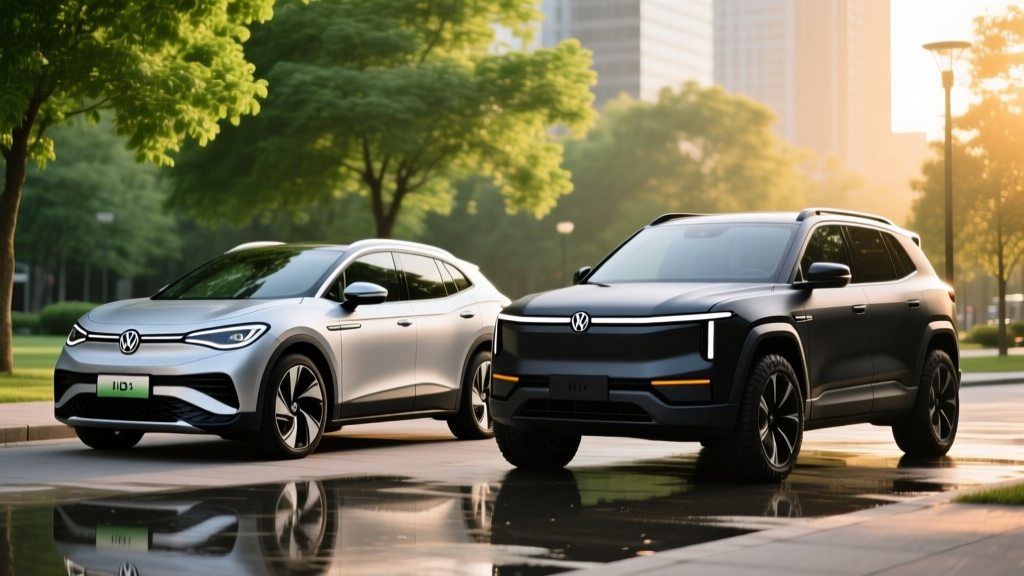
When shoppers search for vw rivian, they're usually weighing two very different philosophies in the electric SUV space. The Volkswagen ID.4 is a mass-market, globally engineered crossover aimed at practical families who want a straightforward EV with a modest price tag. The Rivian R1S is a premium, adventure-focused SUV with serious off-road chops and a performance-oriented powertrain. This review breaks down both vehicles across the metrics that matter most: real-world range, charging speed, total cost, and daily usability.
2026 VW ID.4: The Accessible Electric Crossover
Volkswagen's ID.4 enters the 2026 model year with continued refinement of its 82 kWh (usable) NMC lithium-ion battery pack and the availability of both rear-wheel-drive and all-wheel-drive configurations. Built on VW's MEB platform, the ID.4 targets buyers transitioning from compact gas crossovers like the Tiguan or Honda CR-V into their first EV.
EPA estimated: 291 miles (Pro S AWD) / 275 miles (AWD Pro). Rear-wheel-drive variants reach up to 291 miles EPA.
Real-world expectation: Plan for 230–260 miles on sustained highway driving at 70+ mph. In freezing temperatures (below 32°F), expect a 20–30% reduction, yielding roughly 190–220 miles of usable range. City driving with regenerative braking recovers more energy and pushes range closer to the EPA sticker.
| Specification | Pro (RWD) | Pro S AWD |
|---|---|---|
| EPA Range | 291 mi | 275 mi |
| Battery (usable) | 82 kWh NMC | 82 kWh NMC |
| Horsepower | 282 hp | 335 hp |
| 0–60 mph | 7.7 sec | 5.4 sec |
| Drivetrain | RWD | Dual-motor AWD |
| Max DC Fast Charge | 175 kW | 175 kW |
| 10–80% DC Charge | ~28 min | ~28 min |
| Level 2 Home Rate | 11 kW (~37 mi/hr) | 11 kW (~37 mi/hr) |
| MPGe (combined) | 107 MPGe | 101 MPGe |
| Cargo (rear seats up) | 30.3 cu ft | 30.3 cu ft |
| Cargo (rear seats folded) | 64.2 cu ft | 64.2 cu ft |
| Rear Legroom | 37.6 in | 37.6 in |
| Battery Warranty | 8 yr / 100,000 mi | 8 yr / 100,000 mi |
Charging & Efficiency
The ID.4 peaks at 175 kW on DC fast chargers, which is competitive but not class-leading. The charge curve holds above 125 kW until roughly 60% State of Charge (SoC), then tapers progressively. A 10–80% session takes approximately 28 minutes at a capable 350 kW station — though you'll see the same speed at any charger rated 175 kW or above. At home on a 48-amp Level 2 charger (11.5 kW), the ID.4 adds about 37 miles of range per hour, meaning a full overnight charge from 20% to 100% takes roughly 7–8 hours.
Pricing & Tax Credit
| Trim | Base MSRP | §30D Credit Eligible? | Effective Price |
|---|---|---|---|
| Standard | $39,735 | Yes (if sourcing rules met) | ~$32,235 |
| Pro | $43,735 | Yes | ~$36,235 |
| Pro S AWD | $49,735 | Yes | ~$42,235 |
The ID.4 qualifies for up to $7,500 under IRS §30D, but eligibility depends on the buyer's modified adjusted gross income (AGI cap: $150K single / $300K joint), the vehicle's MSRP (must be under $80,000 for SUVs — ID.4 clears this easily), and battery critical-mineral and component sourcing requirements. As of 2026, the point-of-sale transfer option lets dealers apply the credit directly to your purchase price. Verify current sourcing compliance on IRS.gov's eligible vehicle list before signing.
2026 Rivian R1S: The Premium Adventure SUV
The Rivian R1S is a three-row, body-on-frame electric SUV built on Rivian's skateboard platform. It targets buyers who want Land Rover–level capability with Tesla-level tech. For 2026, the R1S continues with Dual-Motor, Performance Dual-Motor, and the available Tri-Motor powertrain, paired with either a Standard (92 kWh usable, LFP) or Max battery pack (141 kWh usable, NMC).
EPA estimated: 270 miles (Dual-Motor Standard) / 352 miles (Dual-Motor Max Pack) / 410 miles (Tri-Motor Max Pack).
Real-world expectation: The heavy, boxy R1S loses efficiency at highway speeds. Expect 230–250 miles highway with the Standard pack and 300–325 miles with the Max Pack at 70 mph. Cold weather (sub-32°F) cuts range 25–35%, particularly on the LFP Standard pack, which is more sensitive to low temperatures than NMC chemistry.
| Specification | Dual-Motor Standard | Dual-Motor Max | Tri-Motor Max |
|---|---|---|---|
| EPA Range | 270 mi | 352 mi | 410 mi |
| Battery (usable) | 92 kWh LFP | 141 kWh NMC | 141 kWh NMC |
| Horsepower | 533 hp | 533 hp | 850 hp |
| 0–60 mph | 4.5 sec | 4.5 sec | 2.9 sec |
| Drivetrain | Dual-motor AWD | Dual-motor AWD | Tri-motor AWD |
| Max DC Fast Charge | 200 kW | 220 kW | 220 kW |
| 10–80% DC Charge | ~30 min | ~40 min | ~40 min |
| Level 2 Home Rate | 11.5 kW (~25 mi/hr) | 11.5 kW (~25 mi/hr) | 11.5 kW (~25 mi/hr) |
| MPGe (combined) | 73 MPGe | 76 MPGe | 70 MPGe |
| Cargo (behind 3rd row) | 10.6 cu ft | 10.6 cu ft | 10.6 cu ft |
| Cargo (all seats folded) | 91.6 cu ft | 91.6 cu ft | 91.6 cu ft |
| Front Trunk (Frunk) | 11.0 cu ft | 11.0 cu ft | 11.0 cu ft |
| 2nd-Row Legroom | 38.5 in | 38.5 in | 38.5 in |
| Battery Warranty | 8 yr / 175,000 mi | 8 yr / 175,000 mi | 8 yr / 175,000 mi |
Charging & Efficiency
The R1S Dual-Motor with Max Pack peaks at 220 kW on DC fast chargers, but the large 141 kWh battery means a 10–80% session still takes roughly 40 minutes. The charge curve is strong through 50% SoC, then tapers significantly above 80% — preconditioning via the Rivian app before arrival at a charger is essential to hit peak rates. On a home Level 2 charger at 48 amps (11.5 kW), the Max Pack adds roughly 25 miles per hour, meaning a full charge from near-empty requires 12+ hours. The Standard Pack's LFP chemistry charges slightly faster in percentage terms but peaks at a lower 200 kW.
Efficiency is the R1S's weak point. At 73–76 MPGe (roughly 45–47 kWh/100 mi), it consumes significantly more electricity per mile than the ID.4. This is the cost of a 7,000-pound, body-on-frame SUV with all-terrain tires and tri-motor performance.
Pricing & Tax Credit
| Configuration | Base MSRP | §30D Credit Eligible? | Effective Price |
|---|---|---|---|
| Dual-Motor Standard | $79,900 | Yes (under $80K cap) | ~$72,400 |
| Dual-Motor Max | $89,900 | No (exceeds $80K cap) | $89,900 |
| Tri-Motor Max | $99,900 | No (exceeds $80K cap) | $99,900 |
Only the base Dual-Motor Standard configuration of the R1S falls under the IRS §30D $80,000 MSRP cap for SUVs. Once you add the Max Pack or step up to the Tri-Motor, you lose the federal credit entirely. Income caps still apply ($150K single / $300K joint AGI), and battery-sourcing requirements must be met. Check the IRS eligible models list for current-year compliance.
Side-by-Side: ID.4 vs R1S at a Glance
| Category | VW ID.4 Pro S AWD | Rivian R1S Dual-Motor Std |
|---|---|---|
| Starting MSRP | $49,735 | $79,900 |
| EPA Range | 275 mi | 270 mi |
| Real-World Highway | ~230 mi | ~235 mi |
| Battery | 82 kWh NMC | 92 kWh LFP |
| DC Charge (10–80%) | ~28 min | ~30 min |
| 0–60 mph | 5.4 sec | 4.5 sec |
| MPGe (combined) | 101 MPGe | 73 MPGe |
| Cargo (max) | 64.2 cu ft | 91.6 cu ft |
| Seating | 5 passengers | 7 passengers |
| Towing Capacity | 2,700 lb | 7,700 lb |
| Off-Road Capability | Light (AWD only) | Serious (air suspension, wading) |
| Battery Warranty | 8 yr / 100K mi | 8 yr / 175K mi |
Tech, Interior & Driver Assistance
VW ID.4: The ID.4 runs VW's ID.Software 4.0 on a 12.9-inch touchscreen. It includes wireless Apple CarPlay and Android Auto, a configurable digital cockpit, and VW's IQ.DRIVE suite — which provides adaptive cruise, lane centering, and automatic emergency braking. This is a SAE Level 2 driver-assist system, meaning the driver must remain fully engaged at all times. The interior materials are a mix of soft-touch and hard plastics; the capacitive-touch steering wheel controls remain a common complaint among owners. The panoramic fixed glass roof is standard on Pro S trims and adds to the airy cabin feel.
Rivian R1S: The R1S features a 15.6-inch center display and a 12.3-inch digital driver display, powered by Rivian's proprietary software with over-the-air updates. The Driver+ package adds adaptive cruise with lane centering (also SAE Level 2 — not self-driving). Unique features include a built-in air compressor, camp kitchen accessory compatibility, gear tunnel storage, and an available electrochromic glass roof. The R1S's air suspension can raise the vehicle for off-road wading (up to 42.7 inches) or lower it for highway efficiency. Interior quality is a step above the VW, with vegan leather standard and genuine wood and aluminum accents.
Ownership Costs: 5-Year Outlook
| Cost Factor | VW ID.4 Pro S AWD | Rivian R1S Dual-Motor Std |
|---|---|---|
| Purchase (after credit) | ~$42,235 | ~$72,400 |
| Electricity (15K mi/yr) | ~$4,500 | ~$6,200 |
| Insurance (avg annual) | ~$1,800/yr | ~$2,400/yr |
| Maintenance (5 yr) | ~$1,200 | ~$1,800 |
| Estimated Depreciation | ~$18,000 | ~$28,000 |
| 5-Year Total | ~$75,000 | ~$120,400 |
Electricity costs assume a national average of $0.16/kWh for home charging and $0.35/kWh for public DC fast charging, with a 70/30 home-to-public split. The R1S's heavier weight and lower efficiency (47 kWh/100 mi vs the ID.4's 33 kWh/100 mi) drive higher fueling costs. Insurance premiums for Rivian tend to be higher due to repair costs and parts availability, according to industry data.
Pros and Cons
- Accessible pricing with full $7,500 credit eligibility
- Efficient: 101 MPGe keeps charging costs low
- Comfortable ride, easy to drive in urban settings
- Strong dealer network for service
- Competitive 175 kW DC charging speed
- Capacitive steering controls are frustrating
- Infotainment still lags behind rivals in responsiveness
- Modest 2,700-lb towing capacity
- No front trunk (frunk)
- Rear drum brakes (regenerative braking handles most stopping)
- Genuine off-road capability with air suspension
- 7,700-lb towing — best in electric SUV class
- Three-row seating for 7 passengers
- Excellent build quality and premium interior
- Industry-leading 8-yr/175,000-mi battery warranty
- Massive 91.6 cu ft cargo capacity with frunk
- Only base trim qualifies for federal tax credit
- Poor efficiency (73 MPGe) drives up electricity costs
- Heavy: 7,000+ lbs impacts tire wear and braking
- 40-minute DC fast charge with Max Pack
- Limited service center network vs legacy OEMs
- High starting price even before options
Decision Framework: Which Should You Choose?
Choose the VW ID.4 if:
- Your budget is under $50,000 and you want the full federal tax credit
- You commute 30–60 miles daily and rarely tow
- Efficiency and low charging costs are your top priorities
- You want a large, established dealer network for service
- You need a 5-seat crossover, not a 3-row SUV
Choose the Rivian R1S if:
- You need three-row seating and 7-passenger capacity
- You tow boats, trailers, or campers regularly (7,700-lb capacity)
- Off-road adventure is a genuine use case, not just a lifestyle image
- You're willing to pay a premium for performance and build quality
- You can charge at home and don't mind 40-minute fast-charge stops on road trips
Frequently Asked Questions
What is the real-world range of the VW ID.4 and Rivian R1S?
The VW ID.4 Pro S AWD delivers roughly 230–260 miles on the highway in moderate weather, dropping to 190–220 miles in sub-freezing temperatures. The Rivian R1S Dual-Motor Standard manages about 230–250 miles highway, with cold-weather range falling to 175–200 miles due to the LFP battery's greater cold sensitivity. Max Pack R1S models fare better in absolute terms (~300+ miles highway) but still lose 25–30% in cold weather. (fueleconomy.gov)
How fast do the ID.4 and R1S charge at home and on DC fast chargers?
The ID.4 peaks at 175 kW DC and charges 10–80% in about 28 minutes. The R1S peaks at 200–220 kW but takes 30–40 minutes for 10–80% due to its larger battery. At home on Level 2 (48-amp / 11.5 kW), the ID.4 adds ~37 miles per hour while the R1S adds ~25 miles per hour. Both vehicles require 7–12 hours for a full home charge depending on battery size.
Does the Rivian R1S qualify for the $7,500 federal EV tax credit?
Only the base Dual-Motor Standard configuration at $79,900 MSRP qualifies, as the IRS §30D credit caps SUV eligibility at $80,000. Any upgrade to the Max Pack, Performance Dual-Motor, or Tri-Motor pushes the MSRP above the cap and disqualifies the vehicle. Buyer income limits ($150K single / $300K joint AGI) and battery-sourcing rules also apply. The credit can be transferred to the dealer at the point of sale. Always confirm eligibility on IRS.gov.
Is the VW ID.4 worth buying over the Rivian R1S?
They serve different buyers. The ID.4 is the value pick — under $50K, efficient, and practical for commuting and family errands. The R1S is a premium, capability-first SUV for buyers who need towing, off-road performance, and three rows. If you don't need 7 seats or 7,700-lb towing, the ID.4 is the financially rational choice, saving $30,000+ in purchase price and $15,000+ in 5-year operating costs.
What are the biggest drawbacks of each vehicle?
The ID.4's main weaknesses are its frustrating capacitive-touch controls, average infotainment responsiveness, and limited towing capacity. The R1S's biggest cons are its poor efficiency (73 MPGe), high price that mostly excludes it from the federal credit, 40-minute fast-charge times with the Max Pack, and Rivian's still-growing service network.
How do battery warranties compare?
The VW ID.4 provides an 8-year/100,000-mile battery warranty with a 70% capacity retention threshold. The Rivian R1S offers a more generous 8-year/175,000-mile battery warranty, also at 70% retention. Both are industry-standard in structure, but Rivian's higher mileage cap provides more coverage for high-mileage drivers and those who tow frequently.