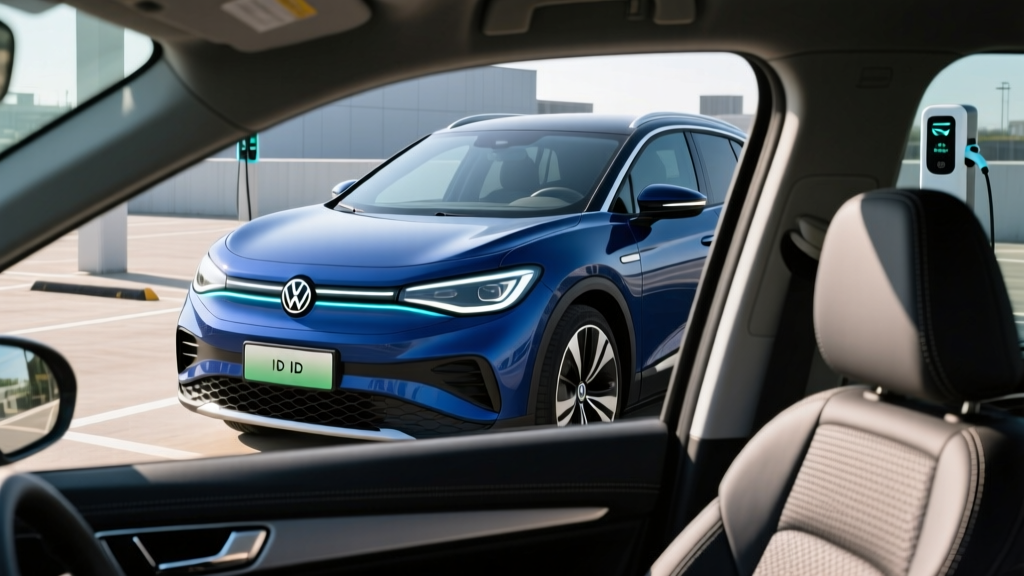
The Quick Answer: Does the 2026 VW ID.4 Have Ventilated Seats?
Yes — but only on higher trims. The 2026 Volkswagen ID.4 offers ventilated (cooled) front seats as standard equipment on the ID.4 Pro S and ID.4 Pro S Plus trims. The base Pro and Standard trims feature heated front seats but do not include ventilation. If you live in a hot-summer climate and consider cooled seats a must-have, you'll need to budget for at least the Pro S trim, which starts at approximately $43,735 (before destination and incentives).
Ventilated seats are more than a luxury in an EV. Unlike a gas car, an electric vehicle doesn't generate waste engine heat for cabin warming, so cabin cooling relies entirely on the high-voltage battery and the heat pump or A/C compressor. Cooled seats reduce the need to blast the cabin A/C at maximum, which can trim energy consumption on hot days and preserve a few extra miles of range. It's a small efficiency edge, but one that matters on long summer road trips.
| Spec | 2026 ID.4 Pro (RWD) | 2026 ID.4 Pro S AWD |
|---|---|---|
| EPA Range | 275 miles | 263 miles |
| Battery (usable) | 82 kWh (NMC) | 82 kWh (NMC) |
| Max DC Fast Charge | 170 kW | 170 kW |
| 10–80% DCFC Time | ~30 min | ~30 min |
| Level 2 Home Charge | 11 kW (~37 mi/hr) | 11 kW (~37 mi/hr) |
| 0–60 mph | 7.7 sec | 5.4 sec |
| Horsepower | 282 hp | 335 hp |
| Drivetrain | RWD (single motor) | AWD (dual motor) |
| MPGe (combined) | 104 MPGe | 98 MPGe |
| Ventilated Front Seats | Not available | Standard |
| Base MSRP | $39,735 | $46,235 |
Real-World Range: What to Expect Beyond the EPA Sticker
EPA Estimate: 275 miles (RWD Pro) / 263 miles (AWD Pro S)
Real-World Expectation: ~235–250 miles on highway road trips at 70–75 mph; ~200–220 miles in sustained cold weather (below 30°F) without preconditioning.
The ID.4's 82 kWh usable battery pack uses NMC (nickel manganese cobalt) chemistry, which offers strong energy density but is more sensitive to cold-weather range loss than LFP alternatives. In our experience and consistent with independent testing, the ID.4 RWD delivers around 240 miles at steady highway speeds of 70 mph in mild conditions. Push speeds above 75 mph or encounter sustained headwinds, and expect closer to 220–230 miles.
Cold weather hits the ID.4 harder than some competitors equipped with more advanced heat pump systems. Below freezing, range drops of 25–30% are typical if you don't precondition the battery and cabin while still plugged in. Preconditioning via the VW Car-Net app before departure is essential — it warms the battery pack for better efficiency and enables faster DC charging upon arrival at a fast charger.
For context, the EPA's fueleconomy.gov listing shows the RWD ID.4 at 104 MPGe combined (about 32 kWh/100 mi), which is competitive with the Hyundai Ioniq 5 and Toyota bZ4X but trails the Tesla Model Y's ~120 MPGe. Efficiency matters: a more efficient EV extracts more miles from the same battery, reducing charging frequency and cost.
Charging Speed: DC Fast, Level 2, and the Curve Reality
The 2026 ID.4 peaks at 170 kW on a DC fast charger — adequate but no longer class-leading. Competitors like the Hyundai Ioniq 5 and Kia EV6 push 235–240 kW, and the Tesla Model Y can sustain around 250 kW at V3 Superchargers. The ID.4's charging advantage is its relatively flat curve: it holds near peak rate longer than some rivals, meaning the 10–80% session takes approximately 30 minutes at a capable 350 kW station.
| Charging Level | Power | Speed / Notes |
|---|---|---|
| Level 1 (120V household) | ~1.4 kW | ~4–5 miles per hour — emergency/trickle only |
| Level 2 (240V home) | 11 kW (48A) | ~37 miles per hour; full charge in ~8.5 hours |
| DC Fast Charge (CCS) | Up to 170 kW peak | 10–80% in ~30 min; tapers significantly above 80% |
On Level 2 at home, the ID.4's 11 kW onboard charger is a strong point. If you have a 48-amp (or higher) Level 2 wall connector on a 60-amp circuit, you'll recover roughly 37 miles of range per hour — enough to fully replenish the 82 kWh pack overnight. Home charging installation typically runs $500–$1,500 for a straightforward setup, though older homes may need a panel upgrade ($1,000–$3,000 additional).
One practical note: the ID.4 uses the CCS1 connector for DC fast charging. Volkswagen has committed to transitioning to the NACS (Tesla-style) connector on future models, but as of the 2026 model year, the ID.4 still ships with CCS. You can access Tesla Superchargers using Volkswagen's approved CCS-to-NACS adapter, which expands your fast-charging network considerably. Check VW's official guidance for the specific adapter part number and compatibility.
Performance, Space, and Daily Livability
The RWD ID.4 Pro produces 282 horsepower from its rear-mounted permanent-magnet motor, reaching 60 mph in about 7.7 seconds. That's adequate for merging and passing, though it won't feel quick compared to the dual-motor AWD variant's 5.4-second sprint (335 hp). The AWD model adds an induction front motor that disengages during cruising to save energy — a smart efficiency measure.
Inside, the ID.4 is one of the roomier compact electric SUVs:
- Cargo volume: 30.3 cu ft behind the rear seats; 64.2 cu ft with rear seats folded
- Rear legroom: 37.6 inches
- Front headroom: 40.9 inches (with panoramic roof, slightly reduced)
- No frunk: Unlike the Ioniq 5 or Tesla Model Y, the ID.4 does not offer a front trunk
The cabin materials are solid but not luxurious. VW's infotainment system has improved over early ID.4 model years, with a 12.9-inch touchscreen on Pro S and above trims. Wireless Apple CarPlay and Android Auto are standard. However, the touch-capacitive steering wheel controls and climate slider bars remain a frequent complaint among owners — they're less intuitive than physical buttons, especially while driving.
On the driver-assistance front, the ID.4 includes Volkswagen's IQ.DRIVE suite with Travel Assist (adaptive cruise + lane centering), which qualifies as an SAE Level 2 system. It requires continuous driver supervision — hands on or near the wheel, eyes on the road. It's competent for highway cruising but is not a "self-driving" feature.
Pricing, Trims, and Federal Tax Credit Eligibility
| Trim | Base MSRP | Ventilated Seats? | Est. After §30D Credit* |
|---|---|---|---|
| Standard | $37,735 | No | ~$30,235 |
| Pro | $39,735 | No | ~$32,235 |
| Pro S | $43,735 | Yes (standard) | ~$36,235 |
| Pro S Plus (AWD) | $49,735 | Yes (standard) | ~$42,235 |
*Estimated prices assume full $7,500 federal tax credit eligibility. Actual credit depends on IRS §30D rules including MSRP caps, buyer income limits, and battery-sourcing requirements. Verify at irs.gov or with a tax professional. The credit can be transferred to the dealer at point of sale as an instant discount.
The ID.4's base MSRP falls under the IRS §30D $80,000 MSRP cap for SUVs, which is a necessary condition for credit eligibility. However, the full $7,500 credit also requires:
- Buyer income below thresholds: $300,000 MAGI for joint filers, $225,000 for heads of household, $150,000 for single filers
- Battery component and critical mineral sourcing meeting annual escalation requirements set by the IRS
- Vehicle assembly in North America — the ID.4 for the US market is assembled in Chattanooga, Tennessee, which satisfies this requirement
Critical-mineral and battery-component sourcing rules tighten each year. Always check the latest DOE/FuelEconomy eligible vehicle list before purchasing to confirm the specific trim and model year still qualifies for the full or partial credit.
Pros and Cons at a Glance
Pros
- Spacious cabin with 30.3 cu ft cargo and generous rear legroom
- 11 kW Level 2 onboard charger — among the best in class for home charging
- Comfortable, compliant ride quality; well-suited to daily commuting
- Ventilated seats standard on Pro S and above trims
- US-built (Chattanooga, TN) — supports §30D tax credit eligibility
- 3 years of complimentary Electrify America DC fast charging (limited kWh)
Cons
- 170 kW peak DC charging lags behind Ioniq 5, EV6, and Model Y
- No front trunk (frunk) — lost cargo opportunity
- Touch-capacitive controls and climate sliders frustrate many drivers
- Cold-weather range loss is above average without diligent preconditioning
- CCS connector requires adapter for Tesla Supercharger access
- Infotainment responsiveness still trails Hyundai/Kia and Tesla systems
Who Should Buy the ID.4 — And Who Should Look Elsewhere?
Choose the ID.4 if: You want a comfortable, roomy compact electric SUV for commuting and family duties; you charge mostly at home overnight; you value ride comfort over sporty handling; and you want a US-built EV likely eligible for the full federal tax credit.
Look elsewhere if: You frequently road-trip and need the fastest possible DC charging (Ioniq 5/EV6); you want access to the native Supercharger network without an adapter (Tesla Model Y); you need a frunk for gear separation; or you want cutting-edge infotainment and over-the-air feature updates (Tesla, Rivian).
The ID.4 is Volkswagen's volume EV play, and it shows in the best way: it's a competent, comfortable, practical electric SUV that does most things well. It won't win drag races or charging-speed contests, but it delivers where most buyers actually live — in daily comfort, cabin space, and predictable home-charging routines. If ventilated seats are on your must-have list, the Pro S trim at roughly $43,735 is the sweet spot, especially after applying the $7,500 point-of-sale credit.
Frequently Asked Questions
Does the base 2026 VW ID.4 have ventilated seats?
No. The base Standard and Pro trims include heated front seats but not ventilated (cooled) seats. Ventilation is standard starting on the Pro S trim.
What is the real-world highway range of the ID.4?
Expect approximately 235–250 miles at 70–75 mph in moderate temperatures. The EPA rates the RWD model at 275 miles, but sustained highway driving and cold weather reduce that figure meaningfully.
How long does the ID.4 take to charge at home?
On a Level 2 home charger at 11 kW (48 amps), the 82 kWh battery charges from empty to full in approximately 8.5 hours — easily overnight. On a standard 120V outlet (Level 1), expect 4–5 miles of range per hour, which is only practical for emergencies or very low daily mileage.
Does the 2026 ID.4 qualify for the $7,500 federal EV tax credit?
The ID.4 is assembled in Chattanooga, Tennessee, and its MSRP falls under the $80,000 SUV cap, meeting two key §30D requirements. However, full eligibility also depends on your taxable income, the vehicle's battery-sourcing compliance for the model year, and whether you've previously exceeded the lifetime credit limit. Verify current eligibility on irs.gov before purchase.
Is the ID.4 better than the Tesla Model Y or Hyundai Ioniq 5?
It depends on priorities. The ID.4 offers a more comfortable ride and traditional dealership service. The Model Y provides superior efficiency, faster charging, native Supercharger access, and a frunk. The Ioniq 5 charges faster (up to 240 kW) and has an 800V architecture. None is universally "best" — match the vehicle to your driving patterns and charging access.
What is the ID.4's battery warranty?
Volkswagen covers the high-voltage battery for 8 years or 100,000 miles (whichever comes first), with a capacity retention threshold of 70%. The limited vehicle warranty is 4 years/50,000 miles.