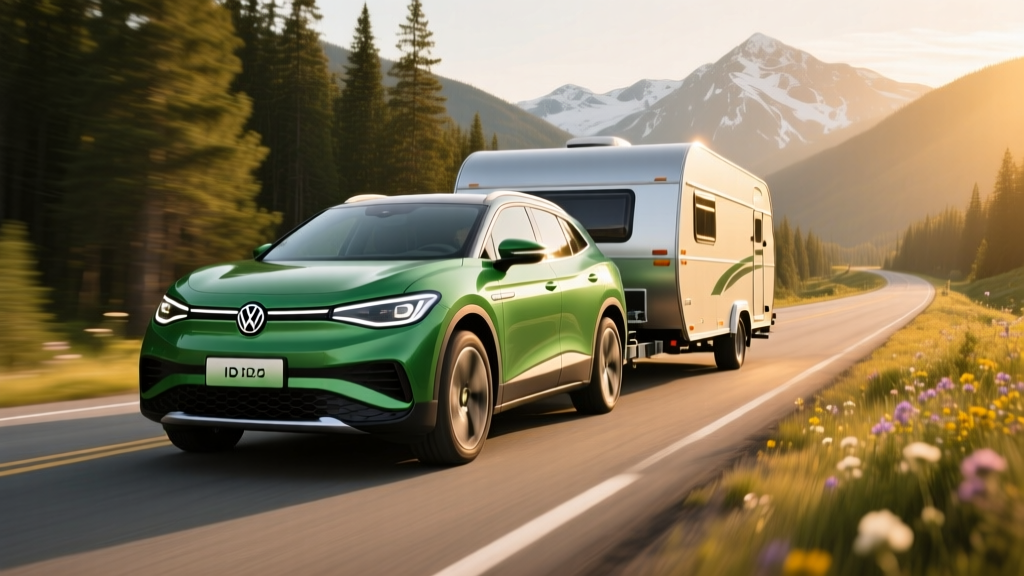
If you've been searching for ID.4 towing information or wondering what happens when you hitch a small trailer to Volkswagen's mainstream electric SUV, you're not alone. The VW ID.4 is one of the few compact electric crossovers that actually comes with a factory-rated towing capacity — something many competitors either don't offer or actively discourage. But towing with an EV introduces a unique set of trade-offs: range drops dramatically, charging stops become more frequent, and the math around trip planning changes entirely.
This review covers the 2026 VW ID.4 in full — its EPA range, battery specs, charging performance, pricing, federal tax credit status, and critically, what you can realistically expect when you hook up a trailer. Whether you're eyeing a lightweight camping trailer, a small utility hauler, or a pair of jet skis, here's the data you need before you buy.
2026 VW ID.4: Core Specs at a Glance
| Spec | ID.4 RWD (Standard Range) | ID.4 RWD (Pro) | ID.4 AWD (Pro S) |
|---|---|---|---|
| EPA Range | 206 mi | 291 mi | 263 mi |
| Battery (usable) | 62 kWh (LFP) | 82 kWh (NMC) | 82 kWh (NMC) |
| Horsepower | 201 hp | 282 hp | 335 hp |
| 0-60 mph | ~8.5 sec | ~7.2 sec | ~5.4 sec |
| Max DC Fast Charge | 140 kW | 175 kW | 175 kW |
| 10-80% DC Time | ~28 min | ~28 min | ~28 min |
| Level 2 Home Charge | 11 kW (~37 mi/hr) | 11 kW (~37 mi/hr) | 11 kW (~37 mi/hr) |
| Towing Capacity | 2,200 lbs | 2,700 lbs | 2,700 lbs |
| MPGe (combined) | 107 MPGe | 104 MPGe | 98 MPGe |
| Cargo (rear seats up) | 30.3 cu ft | 30.3 cu ft | 30.3 cu ft |
| Cargo (rear seats folded) | 64.2 cu ft | 64.2 cu ft | 64.2 cu ft |
| Starting MSRP | $38,995 | $43,995 | $49,495 |
Real-World Range: What the EPA Sticker Doesn't Tell You
EPA Estimated: 291 miles
Real-World Highway (70 mph, mild weather): ~245–260 miles
Real-World Highway (cold, below 30°F): ~195–220 miles
Real-World While Towing (light trailer, ~1,500 lbs): ~160–190 miles
Real-World While Towing (near max capacity, 2,500+ lbs): ~120–150 miles
The ID.4 Pro's 291-mile EPA estimate is competitive for the segment, but EPA testing uses a mix of city and highway driving at moderate speeds. On a sustained 70-mph highway run in 65°F weather, expect roughly 245 to 260 miles before you hit the buffer zone. In freezing temperatures, lithium-ion chemistry becomes less efficient and cabin heating draws significant power — count on losing 20-30% of your range, bringing that figure down to around 200 miles.
When you attach a trailer, the situation changes drastically. Towing increases aerodynamic drag and rolling resistance simultaneously. Even a lightweight teardrop camper around 1,500 pounds can cut your range to 160–190 miles. Near the ID.4's 2,700-pound maximum towing capacity, expect just 120–150 miles of real-world range in highway conditions. This means a 300-mile road trip with a trailer in tow will require at least two charging stops — something you need to plan around carefully, especially in areas with sparse DC fast-charging infrastructure.
The Standard Range model with its 62 kWh LFP (lithium iron phosphate) battery is rated at just 206 miles EPA, and towing with that variant is technically possible at 2,200 lbs but practically limiting. Most trailer-towing buyers should target the Pro or Pro S trims with the larger 82 kWh NMC (nickel manganese cobalt) pack.
Towing Capacity and What You Can Actually Pull
Volkswagen rates the ID.4 Pro and AWD Pro S at 2,700 pounds when equipped with the factory towing package, which includes a hitch receiver and wiring harness. The Standard Range RWD model is rated at 2,200 pounds. For context, here's what fits within those limits:
- Lightweight teardrop trailers (800–1,500 lbs) — well within capacity, moderate range loss
- Small utility trailers (1,000–2,000 lbs loaded) — common use case for hardware runs or landscaping
- Jet Ski or PWC trailer (1,200–1,800 lbs with two watercraft) — popular recreational fit
- Pop-up camper (1,500–2,500 lbs) — feasible but near the upper limit, significant range impact
- Small travel trailer (2,000–2,700 lbs) — technically possible but severely limits range and requires careful trip planning
One important caveat: the ID.4's towing capacity is modest compared to larger electric SUVs. The Ford Mustang Mach-E is not rated for towing at all in most trims, so the ID.4 does have an advantage there. But if you need to pull a 5,000-pound travel trailer, you'll need to look at the Rivian R1S, Tesla Model X, or a heavy-duty electric truck.
The AWD Pro S with its dual-motor setup and 335 hp is the more confident tow vehicle, especially on inclines and in wet conditions. The instant torque from the electric motors means acceleration with a trailer feels surprisingly capable — the ID.4 doesn't strain off the line the way a similarly sized gas crossover might.
Charging Speed: DC Fast, Level 2, and Trip Planning With a Trailer
| Charging Level | Power | Speed (approx.) | Notes |
|---|---|---|---|
| Level 1 (120V household) | 1.2 kW | ~4 mi/hr | Emergency/top-up only |
| Level 2 (240V home) | 11 kW | ~37 mi/hr | Full charge in ~8-9 hrs (82 kWh) |
| DC Fast Charge (peak) | 175 kW (Pro/AWD) | 10-80% in ~28 min | Tapers significantly above 80% |
| DC Fast Charge (Std Range) | 140 kW | 10-80% in ~28 min | Smaller battery offsets lower peak kW |
The ID.4 Pro and AWD models accept up to 175 kW on a DC fast charger, which translates to a 10-80% charge in roughly 28 minutes under ideal conditions. That "ideal conditions" qualifier matters: the battery must be preconditioned (warmed to optimal temperature), and you need to be plugged into a charger that can actually deliver that rate. On a 350 kW Electrify America station, the ID.4 will pull its peak rate initially, but like all EVs, it follows a charging curve that tapers as the state of charge rises. Above 80%, charging slows dramatically — going from 80% to 100% on DC can take as long as the 10-80% portion.
Towing-specific charging reality: When you're towing and only getting 130-180 miles of range, you'll be stopping every 90-120 miles to charge. Each stop will take 25-35 minutes (10-80%), meaning a 300-mile trip with a trailer can easily take 5-6 hours including driving and charging. This is the single biggest ownership compromise of towing with an EV.
At home, the 11 kW onboard charger is a strong point. On a properly installed 240V/48A Level 2 circuit, you'll add roughly 37 miles of range per hour, meaning a depleted 82 kWh battery refills overnight in about 8-9 hours. If you're using the ID.4 for local towing duties — hauling a utility trailer to the dump, taking jet skis to a nearby lake — home charging between trips is more than adequate.
For home charger installation, budget $800–$2,500 for a quality Level 2 unit plus electrician labor, with potential panel-upgrade costs of $1,500–$3,000 if your home's electrical service needs boosting. Always get a quote from a licensed electrician before purchasing equipment.
Pricing, Trims, and Federal Tax Credit Eligibility
| Trim | MSRP | Est. Federal Credit (§30D) | Effective Price |
|---|---|---|---|
| Standard Range RWD | $38,995 | Up to $7,500* | ~$31,495* |
| Pro RWD | $43,995 | Up to $7,500* | ~$36,495* |
| Pro S RWD | $47,495 | Up to $7,500* | ~$39,995* |
| AWD Pro | $47,495 | Up to $7,500* | ~$39,995* |
| AWD Pro S | $49,495 | Up to $7,500* | ~$41,995* |
| AWD Pro S Plus | $53,495 | Up to $7,500* | ~$45,995* |
*Federal tax credit eligibility under IRS §30D is not guaranteed. It depends on multiple factors that change frequently.
To qualify for the full $7,500 federal EV tax credit (available as a point-of-sale transfer since 2024), the following must all be true at time of purchase:
- MSRP cap: The vehicle must be an SUV (which the ID.4 is classified as) with an MSRP at or below $80,000 — all ID.4 trims clear this easily.
- Buyer income cap: Modified adjusted gross income must not exceed $150,000 (single), $225,000 (head of household), or $300,000 (joint filing).
- Battery sourcing: A percentage of critical minerals and battery components must be sourced from the U.S. or free-trade-agreement countries. These thresholds increase annually, and VW's supply chain compliance can vary by model year and production batch.
- Final assembly: The vehicle must undergo final assembly in North America. The ID.4 is built at VW's Chattanooga, Tennessee plant, which satisfies this requirement.
Critical note: Battery-sourcing rules tighten each year. A trim that qualified for the full $7,500 in 2025 may qualify for only $3,750 (or nothing) in 2026 depending on where the battery cells and critical minerals originate. Always verify current eligibility on the fueleconomy.gov credit lookup tool or consult a tax professional before relying on the credit in your purchase budget.
Interior, Cargo, and Daily Livability
With or without a trailer, the ID.4 needs to work as a daily driver. Here, it's genuinely competitive. The cabin is quiet, materials are solid if not luxurious, and the packaging is efficient thanks to VW's dedicated MEB electric platform — no transmission tunnel eating into floor space.
- Rear legroom: 37.6 inches — generous for the segment, enough for adult passengers on longer trips
- Cargo behind rear seats: 30.3 cu ft — comparable to a Toyota RAV4, fits a week's groceries or two large suitcases
- Cargo with seats folded: 64.2 cu ft — sufficient for camping gear, bikes (with front wheel removed), or a small furniture haul
- No frunk: Unlike the Hyundai Ioniq 5 or Ford Mach-E, the ID.4 does not offer a front trunk. The space under the hood houses electronics and the HVAC system.
The infotainment system uses VW's ID.Software platform with a 12.9-inch touchscreen on Pro S and above trims. It's improved significantly over the 2021-2023 generation's laggy interface, with faster response times and better voice recognition. Wireless Apple CarPlay and Android Auto are standard. However, the capacitive touch sliders for volume and climate remain a frustration point — they're unlit at night and lack tactile feedback.
On the driver-assistance front, VW's IQ.DRIVE suite includes adaptive cruise control with stop-and-go, lane centering, automatic emergency braking, and blind-spot monitoring. This is SAE Level 2 driver assistance — it can manage speed and steering on highways, but you must keep your hands on the wheel and eyes on the road at all times. It is not a "self-driving" system. VW's Travel Assist is competent for highway cruising but doesn't offer hands-free operation like GM's Super Cruise or Ford's BlueCruise on pre-mapped highways.
How the ID.4 Stacks Up Against Key Competitors
| Spec | 2026 VW ID.4 Pro AWD | 2026 Hyundai Ioniq 5 AWD | 2026 Tesla Model Y LR AWD | 2026 Kia EV6 AWD |
|---|---|---|---|---|
| EPA Range | 263 mi | 290 mi | 310 mi | 282 mi |
| Towing Capacity | 2,700 lbs | 2,300 lbs | 3,500 lbs | 2,700 lbs |
| Max DC Charge | 175 kW | 240 kW | 250 kW | 240 kW |
| 10-80% Time | ~28 min | ~18 min | ~22 min | ~18 min |
| Starting MSRP (AWD) | $47,495 | $50,500 | $48,990 | $49,900 |
| 0-60 mph | 5.4 sec | 5.0 sec | 4.8 sec | 5.1 sec |
The ID.4's primary advantage in this group is value and towing accessibility. It undercuts the Ioniq 5 and EV6 on price, matches the EV6's 2,700-lb tow rating, and is the only one with a proven factory towing package widely available at dealers. The Tesla Model Y tows more (3,500 lbs) and goes farther per charge, but Tesla's towing package availability has been inconsistent and the Model Y's ride quality with a trailer is notably harsher.
Where the ID.4 falls behind is charging speed. At 175 kW peak, it's meaningfully slower than the Ioniq 5 and EV6 (both on 800V architecture supporting 240 kW) and the Model Y (250 kW). That ~10-minute difference per charging stop adds up on road trips — and especially when towing, when you're stopping more often.
Battery Warranty and Long-Term Ownership
Volkswagen provides an 8-year/100,000-mile high-voltage battery warranty on the ID.4, which covers the battery pack if it degrades below 70% of its original capacity. This is in line with the industry standard — Hyundai, Kia, and Tesla offer similar 8-year terms (though Hyundai/Kia cover 100,000 miles while Tesla covers 120,000 on the Model Y).
The 82 kWh NMC battery in the Pro and AWD trims has proven reasonably durable in early fleet data. Real-world degradation for VW's MEB-platform vehicles appears to be in the range of 5-8% over the first 60,000 miles — nothing alarming, but not class-leading either. The LFP battery in the Standard Range model should theoretically offer better long-term cycle life (LFP chemistry tolerates more charge cycles and can be regularly charged to 100% without the same degradation concerns), but its smaller capacity means fewer total miles before you feel the pinch.
For buyers who plan to tow regularly, battery thermal management matters. The ID.4 uses a liquid-cooled battery pack with active thermal management, which helps during sustained high-load situations like towing in hot weather. However, repeated max-load towing in high ambient temperatures will accelerate battery wear over time — something to keep in mind if you're planning to haul a camper every summer weekend.
Pros and Cons: The Honest Verdict
- Factory-rated 2,700-lb towing (Pro/AWD) — rare in this segment
- Competitive pricing, especially after potential tax credit
- Comfortable ride quality, even when loaded
- Strong 11 kW Level 2 home charging
- Spacious cabin with generous rear legroom
- Built in the USA (Chattanooga, TN) — supports tax credit eligibility
- AWD available with strong dual-motor performance
- 175 kW DC peak is slow vs. 800V competitors (240 kW+)
- Range drops to 120-150 mi when towing near max capacity
- Infotainment touch sliders are frustrating, especially at night
- No front trunk (frunk) for extra storage
- Driver-assist is competent but not class-leading (no hands-free)
- Towing package not standard on all trims — must be optioned
- Real-world range falls noticeably short of EPA on highway
Who Should Buy the ID.4 — And Who Shouldn't
- You need a compact EV that can tow a light trailer (under 2,000 lbs) for weekend recreation or local utility
- You want the most affordable AWD electric SUV with a real tow rating
- Your towing is mostly local (under 100 miles one-way) where home charging covers the return trip
- You value ride comfort and interior space over peak performance or fastest charging
- You regularly tow a travel trailer over 200+ miles — range loss makes this impractical
- You need 3,500+ lbs of towing capacity (consider Tesla Model Y or an electric truck)
- Fastest possible DC charging is a priority (Ioniq 5 or EV6 on 800V are significantly faster)
- You want hands-free highway driving assistance (GM Super Cruise or Ford BlueCruise vehicles)
Frequently Asked Questions
What is the real-world range of the VW ID.4 while towing a trailer?
With a light trailer (1,000–1,500 lbs), expect roughly 160–190 miles from the 82 kWh Pro model. Near the 2,700-lb maximum, real-world highway range drops to approximately 120–150 miles in mild weather, and even less in cold conditions or mountainous terrain. Plan charging stops accordingly.
How fast does the ID.4 charge at home and on the road?
At home on a 240V Level 2 charger, the ID.4 charges at up to 11 kW, adding about 37 miles of range per hour — a full charge takes 8–9 hours for the 82 kWh battery. On DC fast chargers, the Pro and AWD models peak at 175 kW, reaching 10–80% in about 28 minutes under optimal conditions.
Does the 2026 VW ID.4 qualify for the $7,500 federal EV tax credit?
The ID.4 is assembled in Chattanooga, Tennessee (satisfying the North American final-assembly rule), is classified as an SUV under the $80,000 MSRP cap, and is within buyer income limits for most households. However, the critical-mineral and battery-component sourcing requirements under IRS §30D change annually and can affect whether you receive the full $7,500, a partial $3,750, or no credit at all. Verify current eligibility before purchase.
Is the ID.4 worth buying over the Tesla Model Y or Hyundai Ioniq 5 for towing?
If towing is your primary EV requirement and you're on a budget, the ID.4 AWD offers the best combination of tow rating (2,700 lbs), price (~$47,500 before credit), and comfort. The Model Y tows more (3,500 lbs) and has longer range, but costs more and has a firmer ride. The Ioniq 5 charges much faster but has a lower 2,300-lb tow rating. For frequent long-distance towing, none of these compact EVs are ideal — consider an electric truck instead.
Does the ID.4 have enough cargo space for camping gear?
With 30.3 cu ft behind the rear seats and 64.2 cu ft with seats folded, the ID.4 handles typical camping gear for a family of four. However, if you're towing a camper trailer, you'll mostly be using the cabin for passengers and the trailer for gear — which is the whole point of towing rather than packing everything inside.
What is the ID.4's battery warranty?
Volkswagen covers the ID.4's high-voltage battery for 8 years or 100,000 miles, whichever comes first. The warranty applies if the battery degrades below 70% of its original capacity during the coverage period. The basic vehicle warranty is 4 years/50,000 miles.