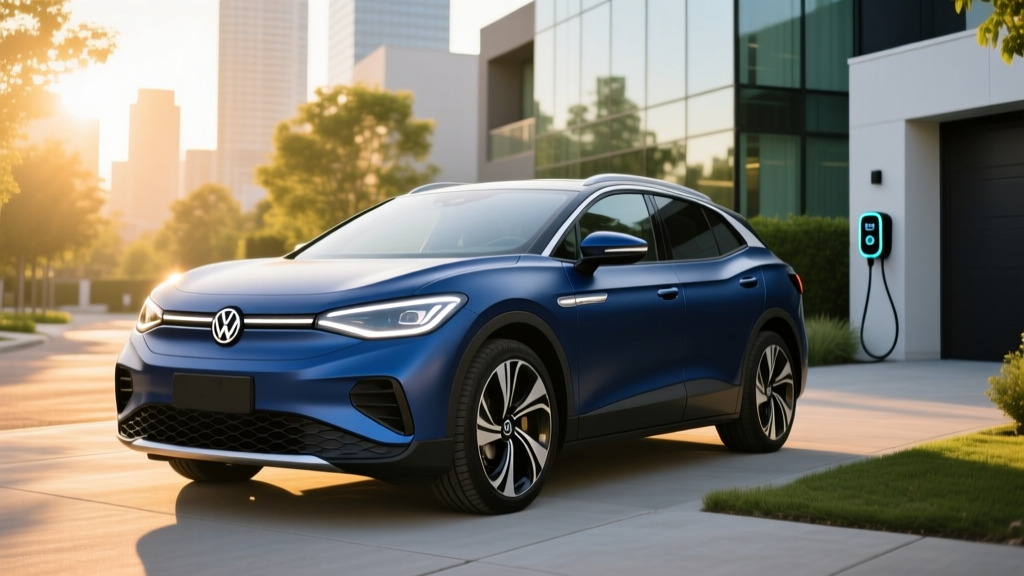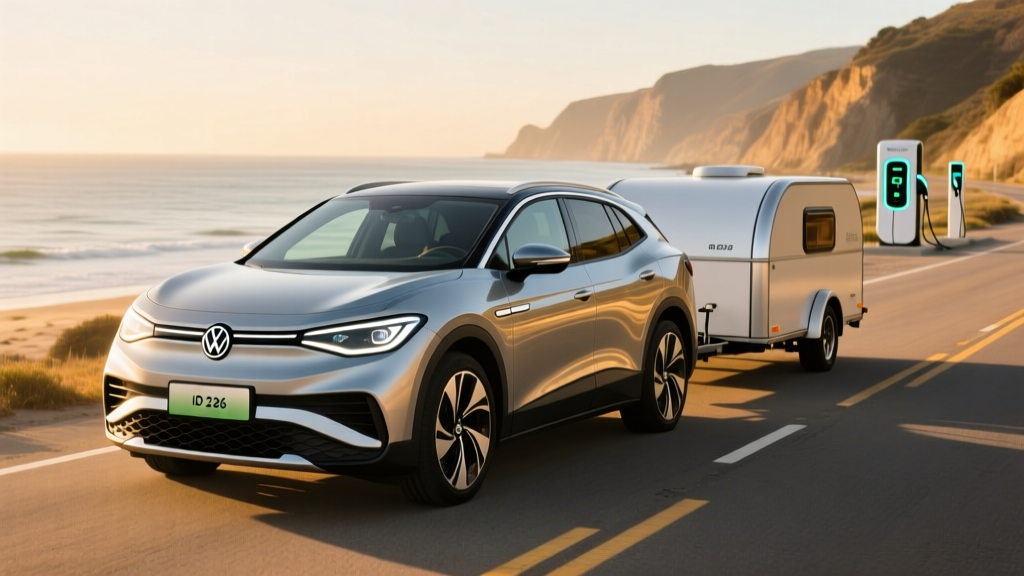
If you're cross-shopping compact electric SUVs and need to pull a small trailer, camper, or pair of jet skis, the Volkswagen ID.4 occupies a narrow but important lane. It's one of the few mainstream electric crossovers that actually publishes a tow rating — and at 2,700 pounds with the dual-motor AWD powertrain, it out-tows most of its direct rivals. But towing is just one chapter of the ID.4 story. Below, we break down the 2026 Volkswagen ID.4 with exact figures on range, charging speed, pricing, federal tax credit eligibility, and the real-world ownership trade-offs that spec sheets rarely surface.
Volkswagen ID.4 Towing Capacity: What You Need to Know
The headline number: the 2026 ID.4 with the AWD dual-motor drivetrain carries a maximum towing capacity of 2,700 pounds when properly equipped with the factory-installed tow hitch. That's enough for a lightweight teardrop trailer (typically 1,200–2,000 lbs loaded), a small boat on a single-axle trailer, a utility trailer with landscaping equipment, or a pair of personal watercraft.
Critical caveats that affect your real-world towing experience:
- AWD only. The rear-wheel-drive (RWD) ID.4 Pro S is not rated for towing. You must step up to the AWD trims (AWD Pro, AWD Pro S, or AWD Pro S Plus) to get the 2,700-lb rating.
- Factory hitch required. Volkswagen specifies the factory-installed towing package. Aftermarket hitches may not be validated for the ID.4's electrical architecture and could affect warranty coverage.
- Range reduction under load. Towing near the maximum rating typically cuts EV range by 40–60%. Expect roughly 120–160 miles of effective range when pulling 2,500+ lbs on a flat highway at 65 mph, depending on trailer aerodynamics. Plan charging stops accordingly.
- No trailer brake controller integrated. Unlike the Ford F-150 Lightning or Rivian R1S, the ID.4 does not offer a built-in trailer brake controller. Trailers over ~1,500 lbs with their own brakes will need an aftermarket controller installation.
Range, Efficiency, and the Real-World Reality Check
The 2026 ID.4 lineup uses a 82 kWh usable battery pack (91 kWh gross) with NMC (nickel manganese cobalt) lithium-ion chemistry, supplied primarily by SK On. Here's how the EPA numbers break down across trims:
| Trim | Drivetrain | EPA Range | MPGe (City/Hwy/Combined) | kWh/100 mi |
|---|---|---|---|---|
| Pro S (RWD) | RWD | 291 miles | 115 / 98 / 107 | 31 |
| AWD Pro | AWD | 263 miles | 104 / 90 / 97 | 35 |
| AWD Pro S / Pro S Plus | AWD | 263 miles | 104 / 90 / 97 | 35 |
- Highway-only at 70–75 mph: Expect ~220–240 miles (RWD) or ~200–215 miles (AWD) before hitting 10% SoC.
- Cold weather (below 32°F): Range drops 20–30% due to cabin heating and battery resistance. AWD trims may deliver as little as 185–200 miles in sustained sub-freezing highway driving.
- City/suburban commuting: You'll see results close to or slightly above the EPA estimate thanks to regenerative braking recovery in stop-and-go traffic.
Charging Speed: DC Fast Charging and Home Level 2
Charging remains one of the ID.4's practical strengths, particularly for owners with access to Electrify America's network (Volkswagen includes three years of complimentary 30-minute DC fast-charging sessions on EA as of the 2026 model year).
| Charging Level | Power / Rate | Time / Recovery | Connector |
|---|---|---|---|
| Level 1 (120V household) | 1.2 kW | ~3–4 mi/hr; 80+ hrs for full charge | J1772 |
| Level 2 (240V home/public) | 11 kW (48A onboard charger) | ~30 mi/hr; ~8.5 hrs from 10–100% | J1772 |
| DC Fast Charge | Peak 175 kW (CCS) | 10–80% in ~30 minutes | CCS1 |
Understanding the charge curve: The ID.4 peaks at 175 kW only at low states of charge (roughly 5–20% SoC) and with a preconditioned battery. Above 50% SoC, the rate tapers significantly — by 80%, you're typically seeing 50–60 kW. This is why the 10–80% time of ~30 minutes is the meaningful metric, not the peak kW number alone. The ID.4 does support battery preconditioning when you navigate to a charger via the built-in navigation, warming the pack for faster charging on arrival.
Connector note: The 2026 ID.4 sold in North America uses the CCS1 (Combined Charging System) connector. Volkswagen has announced a transition to the NACS (Tesla-style) connector for future model years, but as of 2026, the ID.4 ships with CCS. Adapters are available for Tesla Supercharger access (NACS-to-CCS), and VW has confirmed compatibility with select Supercharger stalls via adapter.
Performance, Drivetrain, and What It Feels Like to Drive
| Spec | RWD Pro S | AWD Pro / Pro S / Pro S Plus |
|---|---|---|
| Horsepower | 282 hp | 335 hp |
| Torque | 339 lb-ft | 339 lb-ft (front) + 339 lb-ft (rear) |
| 0–60 mph | ~7.7 seconds | ~5.4 seconds |
| Top Speed | 112 mph (electronically limited) | 112 mph |
| Towing Capacity | Not rated | 2,700 lbs |
The AWD dual-motor setup adds a front induction motor to the rear permanent-magnet synchronous motor. The result is confident acceleration — the 5.4-second 0–60 time puts it ahead of the Hyundai Ioniq 5 AWD (5.8 sec) and in the same neighborhood as the Tesla Model Y Long Range (5.0 sec). The instant torque delivery makes merging and passing effortless, and the low center of gravity (battery pack mounted under the floor) keeps body roll well-controlled through corners.
One dynamic trade-off: the ID.4's regenerative braking is relatively mild compared to competitors. It does not offer true one-pedal driving in the way a Nissan LEAF or Tesla does. The B (Brake) mode increases regen but still requires friction brake use for complete stops. Many owners appreciate this more natural feel, but if you want aggressive one-pedal deceleration, the ID.4 won't provide it.
Interior Space, Cargo, and Everyday Practicality
Volkswagen built the ID.4 on the MEB dedicated EV platform, which pushes the wheels to the corners and frees up interior volume. The result is a cabin that feels larger than its exterior footprint suggests.
- Cargo volume (behind 2nd row): 30.3 cu ft
- Cargo volume (2nd row folded): 64.2 cu ft
- Front headroom: 41.1 in
- Rear headroom: 38.6 in
- Rear legroom: 37.6 in
- Front legroom: 41.1 in
For comparison, the Tesla Model Y offers 30.2 cu ft behind the second row (76.2 cu ft folded — significantly more with the lower roofline folded flat), while the Hyundai Ioniq 5 provides 27.2 cu ft behind the rear seats. The ID.4 sits in a competitive sweet spot for a five-passenger family crossover.
Notable interior observations: the materials are durable but not premium — expect hard plastics on lower door panels and the center console base. The panoramic fixed glass roof (standard on Pro S and above) opens up the cabin visually but lacks a retractable shade, which can make the cabin warm in summer parking. The 12.9-inch infotainment touchscreen runs VW's latest ID. Software 4.0, which is a meaningful improvement over the laggy, frustrating ID. Software 2.x/3.x that plagued earlier model years. Wireless Apple CarPlay and Android Auto are standard.
Pricing, Trims, and Federal Tax Credit Eligibility
| Trim | MSRP (incl. destination) | Drivetrain | Est. After §30D Credit |
|---|---|---|---|
| Standard Range S (RWD) | ~$39,995 | RWD | ~$32,495* |
| Pro S (RWD) | ~$44,995 | RWD | ~$37,495* |
| AWD Pro | ~$47,495 | AWD | ~$39,995* |
| AWD Pro S | ~$50,495 | AWD | ~$42,995* |
| AWD Pro S Plus | ~$54,995 | AWD | ~$47,495* |
*Estimated after-credit pricing assumes full $7,500 federal tax credit eligibility. Actual credit amount and eligibility vary — see details below.
- MSRP cap: SUVs/wagons must be at or below $80,000. All ID.4 trims qualify.
- Buyer income cap: Modified adjusted gross income must not exceed $150,000 (single), $225,000 (head of household), or $300,000 (joint filing).
- Battery sourcing: The credit is split into two halves — $3,750 for critical minerals sourcing and $3,750 for battery component manufacturing. The ID.4's SK On battery pack (manufactured in Georgia) has historically qualified for the full $7,500, but sourcing requirements tighten annually. Verify current eligibility at IRS.gov qualified vehicle list.
- Point-of-sale transfer: As of 2024, buyers can transfer the credit to the dealer at purchase, reducing the purchase price upfront rather than waiting to claim it on their tax return.
- Foreign entity of concern (FEOC) restriction: Battery components from FEOC entities disqualify the $3,750 component half. Critical minerals from FEOC entities disqualify the minerals half. These rules tighten each year — confirm the specific VIN's eligibility before purchase.
Warranty, Safety, and Driver-Assistance Technology
Volkswagen backs the ID.4 with one of the better warranty packages in the mainstream EV segment:
- Battery warranty: 8 years / 100,000 miles (whichever comes first), covering capacity loss below 70% of original capacity.
- Powertrain warranty: 8 years / 100,000 miles.
- New vehicle limited warranty: 4 years / 50,000 miles.
- Roadside assistance: 4 years / 50,000 miles.
On the safety front, the ID.4 has earned the IIHS Top Safety Pick+ designation (when equipped with specific headlights) and a 5-star overall rating from NHTSA.
The ID.4 comes standard with VW's IQ.DRIVE suite, which includes:
- Travel Assist (adaptive cruise + lane centering) — this is an SAE Level 2 driver-assistance system. The driver must remain fully attentive, with hands on or near the wheel at all times. This is not autonomous or "self-driving" capability.
- Front Assist with automatic emergency braking and pedestrian detection
- Blind-spot monitor with rear traffic alert
- Lane Assist (lane-keeping)
- Park Assist with surround-view camera (Pro S and above)
Pros, Cons, and the Verdict: Who Should Buy the ID.4?
Pros
- 2,700-lb towing capacity (AWD) — bests Ioniq 5, Mach-E
- Competitive 291-mi EPA range (RWD)
- Spacious cabin with strong cargo volume (30.3 cu ft)
- Improved ID. Software 4.0 infotainment
- Complimentary Electrify America charging (3 years)
- Strong 8-yr/100k-mi battery warranty
- IIHS Top Safety Pick+ / NHTSA 5-star
- All ID.4 trims under $80K MSRP cap for full tax credit
Cons
- DC fast charging peaks at 175 kW — slower than Ioniq 5 (240 kW) and Model Y (250 kW)
- No true one-pedal driving
- RWD trims not rated for towing
- CCS connector (NACS adapter required for Supercharger access)
- No integrated trailer brake controller
- Interior materials feel budget-tier at $50K+ trims
- Panoramic roof lacks retractable shade
- Real-world highway range notably below EPA sticker
Decision Framework: Is the ID.4 Right for You?
Choose the VW ID.4 AWD if: You need a family-sized electric crossover with light towing capability (teardrop trailer, small boat), value a strong battery warranty, prefer a more traditional driving feel over aggressive regen, and want access to Electrify America's growing network.
Look at the Tesla Model Y if: You need higher towing capacity (3,500 lbs), want the fastest DC charging and Supercharger network access, and prioritize performance and software features over traditional dealer service.
Look at the Hyundai Ioniq 5 if: You want faster DC charging (240 kW peak), NACS connector availability, and don't need more than 2,300 lbs of towing. The Ioniq 5 also offers 800V architecture for superior sustained charge rates.
Skip the ID.4 if: You need heavy towing (5,000+ lbs — look at the Rivian R1S or F-150 Lightning), you can only charge at home on Level 1 (the 82 kWh pack charges painfully slowly on 120V), or you demand one-pedal driving as a daily convenience feature.
Frequently Asked Questions
What is the real-world range of the VW ID.4?
The EPA rates the RWD ID.4 Pro S at 291 miles and the AWD variants at 263 miles. In real-world highway driving at 70–75 mph, expect roughly 220–240 miles (RWD) or 200–215 miles (AWD). In cold weather below freezing, subtract another 20–30%, bringing AWD range down to approximately 185–200 miles. For daily commuting with regenerative braking, you'll likely match or slightly exceed the EPA figure.
How fast does the ID.4 charge at home and on the road?
At home on a 240V Level 2 charger, the ID.4's 11 kW onboard charger adds roughly 30 miles of range per hour, with a full 10–100% charge taking about 8.5 hours — ideal for overnight charging. On DC fast chargers, the ID.4 peaks at 175 kW and charges from 10–80% in approximately 30 minutes. That's slower than the Hyundai Ioniq 5's ~18-minute 10–80% at 240 kW, so road-trippers should factor in slightly longer stops.
Does the 2026 VW ID.4 qualify for the $7,500 federal EV tax credit?
All ID.4 trims fall under the $80,000 MSRP cap for SUVs. The ID.4's SK On battery (assembled in Georgia) has historically qualified for the full $7,500 under IRS §30D rules. However, eligibility depends on your income (must be under $150K single / $300K joint), the specific VIN's battery sourcing compliance with FEOC restrictions, and current-year rules that tighten annually. The credit can be transferred to the dealer at point of sale. Always verify eligibility on IRS.gov before purchasing.
Can I tow with the rear-wheel-drive ID.4?
No. Volkswagen does not rate the RWD ID.4 for towing. If towing is a priority, you must select one of the AWD trims (AWD Pro, AWD Pro S, or AWD Pro S Plus), which carry the 2,700-lb rating when equipped with the factory tow hitch.
How does the ID.4 compare to the Tesla Model Y for towing?
The Tesla Model Y is rated for 3,500 lbs — 800 lbs more than the ID.4 AWD. The Model Y also offers faster DC charging (250 kW peak), access to the Supercharger network natively, and a more extensive software ecosystem. However, the ID.4 offers a more traditional ride quality, stronger physical controls, IIHS Top Safety Pick+ certification, complimentary Electrify America charging, and a lower entry price on base trims. For towing between 1,500–2,700 lbs, the ID.4 is fully capable; above that, the Model Y or a larger electric SUV is the better choice.
What happens to the ID.4's battery over time?
The ID.4 uses NMC chemistry, which typically sees 10–15% capacity degradation over the first 100,000 miles based on industry-wide data for similar packs. Volkswagen warranties the battery for 8 years/100,000 miles against capacity loss below 70%. To maximize longevity, avoid routinely charging to 100% (set daily limit to 80%), use DC fast charging sparingly (rely on Level 2 for daily needs), and take advantage of the ID.4's battery preconditioning feature when navigating to DC chargers.