The VW ID.4 Towing Question: What 2,700 Pounds Actually Gets You
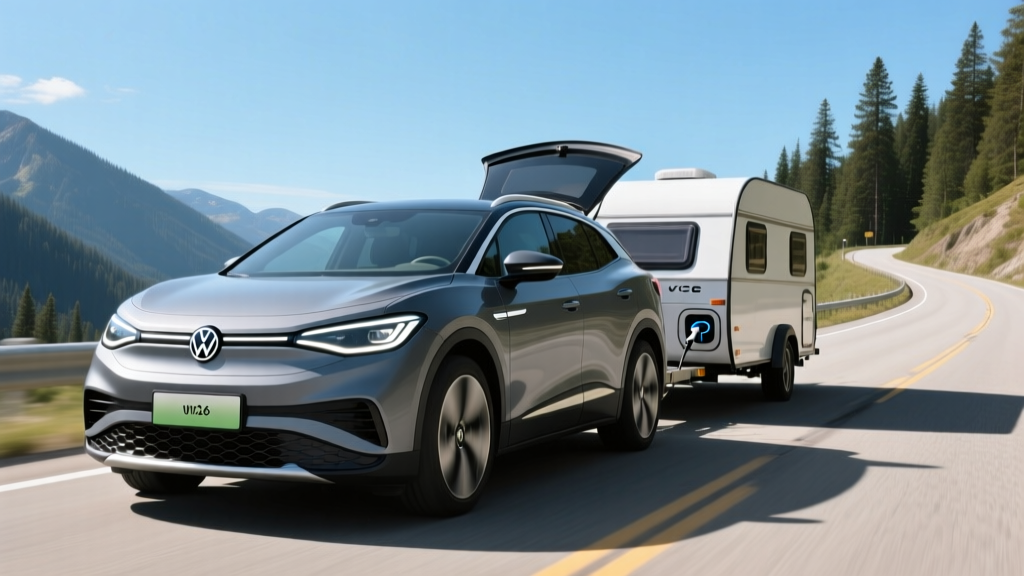
Search for "ID.4 tow capacity" and you'll find a lot of confusion. The 2026 Volkswagen ID.4 is rated to tow up to 2,700 pounds when equipped with the factory towing package and all-wheel drive — but that number tells only part of the story. Towing with any EV reshapes the ownership equation: range drops sharply, charging stops multiply, and the margin for error shrinks. This review breaks down the ID.4's towing capability alongside the specs that matter whether you're hitching a trailer or just commuting: EPA range, real-world efficiency, DC fast-charging behavior, battery chemistry, and the federal tax credit math that determines what you actually pay.
| Spec | Pro S (RWD) | Pro S AWD |
|---|---|---|
| EPA Range | 291 miles | 263 miles |
| Battery (usable) | 82 kWh (NMC) | 82 kWh (NMC) |
| Horsepower | 282 hp | 335 hp |
| Torque | 339 lb-ft | 339 lb-ft front / 339 lb-ft rear |
| 0-60 mph | 7.7 sec | 5.4 sec |
| Max Tow Capacity | Not rated (no hitch) | 2,700 lbs (w/ factory tow pkg) |
| Max DC Fast Charge | 175 kW | 175 kW |
| 10-80% DCFC Time | ~30 min | ~30 min |
| Level 2 Charge Rate | 11 kW (~37 mi/hr) | 11 kW (~37 mi/hr) |
| MPGe (combined) | 107 MPGe | 98 MPGe |
| kWh/100 mi | 31 kWh/100mi | 34 kWh/100mi |
| Cargo (behind 2nd row) | 30.3 cu ft | 30.3 cu ft |
| Cargo (seats folded) | 64.2 cu ft | 64.2 cu ft |
| Rear Legroom | 37.6 in | 37.6 in |
| Battery Warranty | 8 yr / 100,000 mi | |
| Base MSRP | $44,995 | $48,995 |
Real-World Range: Sticker vs. Highway vs. Towing
The EPA rates the AWD ID.4 Pro S at 263 miles. That figure assumes a mixed driving cycle — roughly 55% city, 45% highway. In practice, sustained 75-mph highway driving knocks that down to roughly 225–240 miles in mild weather, based on consistent real-world reports from owners and independent testers. Cold weather (below 32°F) compounds the loss: expect 20–30% reduction, bringing usable highway range down to approximately 180–200 miles on a full charge in winter conditions.
- EPA Sticker: 263 miles
- Highway (70-75 mph, 65°F): ~225–240 miles
- Highway (70-75 mph, 20°F): ~180–200 miles
- Towing (1,500 lb trailer, 65 mph, 65°F): ~140–170 miles
- Towing (2,500 lb trailer, 65 mph, 65°F): ~110–140 miles
Towing effectively halves your range. Plan charging stops accordingly — every 100–130 miles with a near-max load.
The 82 kWh usable battery uses NMC (nickel manganese cobalt) chemistry, which offers higher energy density than LFP but is more sensitive to sustained 100% state-of-charge storage. VW recommends daily charging to 80% for battery longevity, reserving 100% for road trips. This means your daily usable range is closer to 210 miles (AWD) before accounting for conditions.
Towing Deep Dive: 2,700 Pounds in Practice
The 2,700-lb tow rating applies only to the AWD ID.4 with the factory-installed towing package, which includes a 7-pin harness, hitch receiver, and trailer sway control integrated into the vehicle's stability system. The RWD model is not rated for towing in the US market. For context, 2,700 pounds covers:
- A small teardrop or pop-up camper (~1,500–2,000 lbs loaded)
- A utility trailer with an ATV or motorcycle (~1,200–2,200 lbs)
- A light boat on a single-axle trailer (~2,000–2,500 lbs)
What it does not cover: most travel trailers, enclosed car haulers, or any dual-axle camper. If your typical load exceeds 2,000 lbs, the ID.4's range penalty becomes severe enough that competitors with higher tow ratings (the Hyundai Ioniq 5 at 2,300 lbs is actually lower; the Ford Mustang Mach-E is not rated for towing at all; the Rivian R1S at 7,700 lbs is in a different price class) should be considered.
The ID.4's dual-motor AWD system provides adequate low-speed traction for launching a boat or pulling up a grade, and the 339 lb-ft of instant torque from the rear motor helps. However, the regenerative braking system is not calibrated for heavy trailer loads — you'll want to use the vehicle's brake hold and allow extra stopping distance. VW's trailer sway control intervenes via individual wheel braking, which works but is reactive rather than predictive.
Charging Speed: Home and DC Fast Charging
The ID.4's 175 kW peak DC fast-charge rate is midpack for 2026 — Hyundai/Kia's E-GMP platform hits 240+ kW, and the Tesla Model Y peaks around 250 kW on V3 Superchargers. But peak rate matters less than sustained rate, and the ID.4's charge curve holds reasonably well between 10% and 60% before tapering significantly above 80%.
| Charge Level | Power (kW) | Miles Added/Hour | 10-80% Time | Notes |
|---|---|---|---|---|
| Level 1 (120V) | 1.2–1.4 kW | ~4 mi/hr | ~55+ hours | Emergency/trickle only |
| Level 2 (240V, 48A) | 11 kW | ~37 mi/hr | ~7.5 hours | Standard home overnight |
| DC Fast (175 kW peak) | 175 kW (peak) | ~200+ mi/30 min | ~30 min | Tapers hard above 80% |
| DC Fast (50 kW station) | 50 kW | ~90 mi/hr | ~1.5 hours | Older CCS stations |
For home charging, the 11 kW onboard charger is competitive. A full Level 2 session (48-amp, 240V circuit) refills the battery in about 7.5 hours — adequate for overnight replenishment. Installation of a hardwired Level 2 charger typically costs $800–$2,000 depending on panel proximity and local permitting. If your electrical panel is at capacity, a panel upgrade adds $1,500–$3,000.
One important note for 2026: Volkswagen has begun equipping new ID.4 models with the NACS (North American Charging Standard) port, replacing the CCS1 connector. This grants access to Tesla's Supercharger network via native plug, a significant practical advantage for road tripping. Verify your specific build's connector with the dealer — transition-year vehicles may still carry CCS1, requiring a CCS-to-NACS adapter (approximately $200–$250) for Supercharger access.
Pricing, Trims, and Federal Tax Credit Eligibility
The 2026 ID.4 lineup spans multiple trims, with the AWD Pro S (the towing-capable variant) starting at $48,995 before destination. The towing package adds approximately $500. A well-equipped AWD Pro S Plus with the tow package lands around $52,000–$53,500 out the door.
| Trim | MSRP | §30D Credit (if eligible) | Effective Price |
|---|---|---|---|
| Standard (RWD) | $39,995 | Up to $7,500 | ~$32,495 |
| Pro S (RWD) | $44,995 | Up to $7,500 | ~$37,495 |
| Pro S AWD | $48,995 | Up to $7,500 | ~$41,495 |
| Pro S Plus AWD (w/ tow) | ~$53,495 | Up to $7,500 | ~$45,995 |
Federal tax credit eligibility under IRS §30D is not automatic. The full $7,500 credit requires the vehicle to meet critical-mineral sourcing and battery-component manufacturing thresholds that shift annually. Additionally:
- MSRP cap: SUVs must be under $80,000 — the ID.4 clears this easily.
- Buyer income cap: Modified AGI must not exceed $150,000 (single), $225,000 (head of household), or $300,000 (joint). Exceed these and you're ineligible regardless of the vehicle.
- Point-of-sale transfer: As of 2024, you can transfer the credit to the dealer at purchase, reducing your out-of-pocket cost immediately rather than waiting for tax filing.
Battery sourcing requirements have tightened through 2026. Check the fueleconomy.gov EV tax credit tool for the current eligibility status of the specific ID.4 trim you're considering — partial credits ($3,750) may apply if only one of the two sourcing requirements is met.
Interior, Tech, and Daily Livability
The ID.4's cabin prioritizes space over flash. Rear legroom at 37.6 inches beats the Hyundai Ioniq 5 (37.0 in) and rivals the Tesla Model Y (37.0 in). Cargo volume of 30.3 cu ft behind the second row expands to 64.2 cu ft with seats folded — adequate for a family road trip's worth of gear, though the Model Y's 76 cu ft (including the frunk) offers more. The ID.4's small frunk holds only the charging cable; it's not useful for cargo.
The 12.9-inch infotainment screen (upgraded from earlier 12-inch units) runs VW's ID. Software 4.0, which has improved responsiveness and voice recognition compared to the buggy 2022–2023 versions. Wireless Apple CarPlay and Android Auto are standard. However, the capacitive-touch steering wheel controls and the lack of physical climate buttons remain common complaints — the slider-based volume and temperature controls are imprecise while driving.
Driver assistance comes via VW's IQ.DRIVE suite, a SAE Level 2 system that includes adaptive cruise control, lane centering, and automatic emergency braking. Travel Assist handles highway steering and speed competently but requires hands on the wheel at all times. This is not autonomous driving — it's a driver-assist system, and you must remain engaged. The ID.4 does not offer hands-free driving like GM's Super Cruise or Ford's BlueCruise.
- Comfortable, quiet ride quality — among the best in the compact EV SUV class
- Spacious rear seat and competitive cargo volume
- 2,700-lb tow rating (AWD) covers light trailers and campers
- 175 kW DC charging is adequate; NACS port on 2026 builds unlocks Superchargers
- Federal tax credit eligible (verify sourcing rules at purchase)
- Strong 8-yr/100,000-mi battery and powertrain warranty
- Range drops to ~110–140 miles when towing near max capacity
- Infotainment still lags competitors in responsiveness; no physical climate controls
- Level 2 driver assist only — no hands-free highway driving option
- RWD model not tow-rated; AWD required for any towing
- Frunk is essentially useless for storage
- 175 kW peak charge rate trails Hyundai/Kia and Tesla
How the ID.4 Stacks Up Against Competitors
For buyers specifically researching tow capacity, the compact EV SUV segment is thin on options:
- Hyundai Ioniq 5 (AWD): Rated at 2,300 lbs — less than the ID.4. Superior DC charging (800V architecture, 10-80% in ~18 min at 240+ kW). Better infotainment. Slightly less rear seat room.
- Tesla Model Y (Long Range AWD): Rated at 3,500 lbs — the segment leader. Best charging network access natively. Firmer ride, less rear-seat comfort. Starting around $47,990.
- Ford Mustang Mach-E: Not rated for towing. Disqualified for this use case.
- Rivian R1S (Dual-Motor): 7,700-lb tow rating in a completely different weight and price class (~$75,000+). If you need serious towing, this is the EV answer — at nearly double the cost.
The ID.4 occupies a middle ground: more tow capacity than the Ioniq 5, less than the Model Y, at a price point that undercuts the Tesla when the federal credit applies. If your towing needs are light and occasional (weekend kayak trailer, small pop-up camper), the ID.4's comfort, space, and pricing make it a strong fit. If you tow regularly or near the 2,700-lb limit, the range penalty will frustrate you — consider the Model Y or reassess whether an EV is the right tow vehicle for your pattern.
Warranty and Long-Term Battery Outlook
VW backs the ID.4's battery and powertrain with an 8-year/100,000-mile warranty covering defects and capacity loss below 70% of original capacity. The NMC chemistry in the ID.4 has shown moderate degradation in real-world fleet data — owners typically report 5–8% capacity loss over the first 50,000 miles, with the curve flattening afterward. This is consistent with modern liquid-cooled NMC packs.
To maximize longevity:
- Set daily charge limit to 80% (configurable in the app and vehicle settings)
- Avoid repeated DC fast charging in extreme heat without preconditioning
- Don't leave the vehicle at 100% SoC for extended periods
- Use the vehicle's built-in battery preconditioning feature before DC fast charging in cold weather
Battery replacement cost, should it be needed out of warranty, is estimated at $12,000–$18,000 for the 82 kWh pack — though individual module replacement may be possible at lower cost depending on the failure mode.
Who Should Buy the ID.4 (And Who Shouldn't)
- You need light towing (under 2,000 lbs typical) a few times per year
- Rear-seat comfort and cargo space are priorities over sporty driving dynamics
- You can charge at home and want a quiet, compliant daily driver
- You want federal tax credit eligibility at a sub-$50,000 price point
- You tow regularly above 2,000 lbs — range loss will dominate your experience
- You need hands-free highway driving (consider GM Super Cruise or Ford BlueCruise vehicles)
- Fastest possible DC charging is a priority (Hyundai Ioniq 5 or Kia EV6)
- You need maximum cargo volume (Tesla Model Y)
Frequently Asked Questions
What is the real-world range of the VW ID.4 AWD?
The EPA rates it at 263 miles. Expect 225–240 miles in real-world highway driving at 70–75 mph in mild weather, and 180–200 miles in cold conditions (below 32°F). Towing reduces this further to roughly 110–170 miles depending on trailer weight.
How fast does the ID.4 charge at home and on the road?
At home on a 240V Level 2 charger (48 amps), the ID.4 charges at 11 kW, adding roughly 37 miles per hour — a full charge in about 7.5 hours. On a DC fast charger, it peaks at 175 kW and reaches 10-80% in approximately 30 minutes. Charging slows considerably above 80% to protect the battery.
How much does the ID.4 cost after the federal tax credit?
The AWD Pro S starts at $48,995. If you qualify for the full $7,500 §30D credit (based on income, battery sourcing, and MSRP requirements), the effective price drops to approximately $41,495. Eligibility is not guaranteed — verify current sourcing compliance on fueleconomy.gov and confirm your income falls within IRS limits before purchase.
Is the ID.4 worth buying vs. the Tesla Model Y or Ioniq 5?
For light towing, the ID.4's 2,700-lb rating beats the Ioniq 5 (2,300 lbs) but trails the Model Y (3,500 lbs). The ID.4 offers a more comfortable ride and better rear-seat comfort than the Model Y, while the Ioniq 5 charges significantly faster. Your priority — towing, comfort, or charging speed — determines the winner.
Does the 2026 ID.4 qualify for the federal EV tax credit?
Eligibility depends on current-year battery sourcing and critical-mineral requirements under IRS §30D, which tighten annually. The ID.4's MSRP is well under the $80,000 SUV cap. Buyer income must not exceed $150K single / $300K joint. Check the latest status on irs.gov or the fueleconomy.gov credit lookup tool before committing to a purchase.
Can I tow a camper with the ID.4?
Yes, but only light campers. A small teardrop or pop-up camper weighing under 2,000 lbs loaded is feasible. Most hard-sided travel trailers exceed the 2,700-lb limit or would reduce range to impractical levels (under 130 miles per charge). Always weigh your loaded trailer at a CAT scale before assuming you're within limits.
What is the ID.4's battery warranty?
Volkswagen covers the battery and powertrain for 8 years or 100,000 miles, whichever comes first. The warranty guarantees the battery will retain at least 70% of its original capacity during that period. Degradation below that threshold triggers a warranty claim for repair or replacement.