Quick Verdict: The ID.4 Grows Up, and So Does Its Aftermarket
The 2026 Volkswagen ID.4 enters its sixth model year with a critical advantage that few EVs can claim: it qualifies for the full $7,500 federal tax credit, can be applied at the point of sale, and starts under $40,000. That combination makes it one of the most accessible electric family SUVs in the United States. But beyond the spec sheet, something else is happening around the ID.4 — a growing body kit and accessory aftermarket that's transforming it from a sensible commuter into a platform for personal expression. In this review, we cover the 2026 ID.4's real-world range, charging behavior, ownership economics, and the emerging customization trends shaping how owners are modifying their EVs.
| EPA Range | 291 miles (AWD Pro S) / 275 mi (Standard trim) |
| Battery (usable) | 77 kWh net / 82 kWh gross, NMC (nickel-manganese-cobalt) |
| Max DC Fast Charge | 175 kW peak (CCS1); ~30 min 10–80% |
| Level 2 Home Charging | 11 kW (48A) — approx. 35 miles per hour of charging |
| 0–60 mph | 5.4 seconds (AWD dual-motor) / 7.7 sec (RWD) |
| Horsepower | 295 hp (AWD) / 201 hp (RWD) |
| Efficiency | 104 MPGe combined / 32 kWh/100 mi (AWD) |
| Cargo Volume | 30.3 cu ft (rear seats up) / 64.2 cu ft (folded) |
| Base MSRP | $39,995 (Pro RWD) — $51,595 (Pro S Plus AWD) |
| Battery Warranty | 8 years / 100,000 miles (70% capacity retention) |
Real-World Range: What the EPA Number Doesn't Tell You
The 2026 ID.4 Pro S with all-wheel drive carries an EPA-estimated 291 miles of range. That's competitive with the Hyundai Ioniq 5 (304 mi) and slightly ahead of the base Toyota bZ4X (252 mi). But as with every EV, the sticker number is a best-case blended scenario.
EPA: 291 miles (AWD Pro S)
Highway (70 mph, 75°F): Expect ~235–250 miles
Cold weather (30°F, highway): Expect ~185–210 miles (30–35% reduction)
City / stop-and-go: Often exceeds EPA due to regen — 290–310+ miles achievable
The ID.4 uses an NMC (nickel-manganese-cobalt) lithium-ion pack with a gross capacity of 82 kWh and roughly 77 kWh usable. Volkswagen applies a conservative buffer — about 5 kWh reserved at the top and bottom of the charge window — which protects long-term battery health but means you won't see every electron on the dashboard. In our experience, sustained highway driving at 75 mph with climate control running drops the ID.4's real range to approximately 240 miles. That's enough for most daily commutes and moderate road trips, but plan a charge stop for any trip exceeding 200 miles in winter conditions.
Efficiency lands at roughly 104 MPGe combined (32 kWh per 100 miles) for the AWD model, per fueleconomy.gov. The RWD variant is slightly more efficient at 107 MPGe, though most buyers opt for AWD for the added traction and power.
Charging Speed: 175 kW Peak, but Watch the Curve
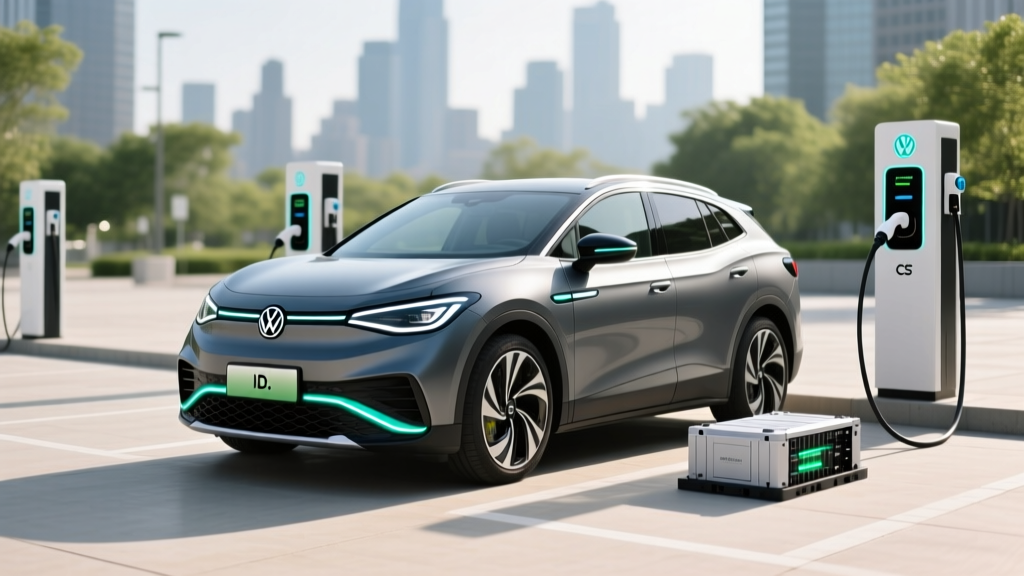
The 2026 ID.4 maxes out at 175 kW on a DC fast charger using the CCS1 connector. That's a meaningful improvement over the original 2021–2022 ID.4, which topped out at 125 kW. On a 350 kW Electrify America or compatible station, Volkswagen claims a 10–80% charge time of approximately 30 minutes.
| Level | Power | Speed | Notes |
|---|---|---|---|
| Level 1 (120V) | ~1.4 kW | ~4 mi/hr | Emergency/top-off only |
| Level 2 (240V, 48A) | 11 kW | ~35 mi/hr | Full charge in ~8 hours |
| DC Fast (CCS1) | 175 kW peak | ~190 mi in 30 min (10–80%) | Tapers sharply above 80% SoC |
Here's the charging-curve reality that spec sheets don't show: the ID.4 holds close to its 175 kW peak only between roughly 10% and 30% state of charge. From 30–60%, it settles to around 130–150 kW, and above 80% it drops below 50 kW. This is normal behavior for NMC packs with active thermal management, but it means charging from 80–100% at a DC station is painfully slow. For road trips, the optimal strategy is to charge from 10–80% and move on — don't wait for a full top-up.
At home, the ID.4 accepts 11 kW on a Level 2 charger (240V, 48 amps). A full charge from empty takes about 8 hours. If your home charger is limited to 32 amps (7.7 kW), expect closer to 11 hours — still fine for overnight charging. Volkswagen includes a mobile charging cable with the vehicle, though most owners will want a dedicated ChargePoint, Emporia, or Wallbox unit hardwired by a licensed electrician.
Performance and Driving Impressions
The AWD ID.4 pairs a front asynchronous motor with a rear permanent-magnet synchronous motor for a combined 295 horsepower and 339 lb-ft of torque. The 0–60 mph time of 5.4 seconds is brisk enough for confident highway merging but won't challenge a Tesla Model Y Performance (3.5 sec). The RWD variant makes 201 hp and hits 60 mph in 7.7 seconds — adequate for commuting but noticeably softer off the line.
Ride quality is where the ID.4 earns its keep. The suspension tuning is firm but compliant, absorbing highway expansion joints without crashing through to the cabin. Steering is light and low-effort, ideal for parking lots but lacking the feedback that driving enthusiasts want. The turning circle is tight at 31.5 feet, making the ID.4 surprisingly maneuverable for a compact SUV.
Regenerative braking is adjustable via steering-wheel paddles or the shift selector's B mode. However, the ID.4 does not offer true one-pedal driving to a complete stop in all conditions — the regen tapers off below roughly 5 mph, requiring the friction brakes for the final halt. This is a common complaint among EV enthusiasts accustomed to Nissan Leaf or Tesla behavior.
Interior, Cargo, and Standout Technology
Inside, the 2026 ID.4 retains Volkswagen's 12.9-inch touchscreen infotainment system running the latest ID. Software 4.x. The interface is snappier than early ID.4 model years (which suffered from laggy, frustrating software), and wireless Apple CarPlay and Android Auto are standard. Physical climate controls remain absent — temperature and fan speed are managed via touch-sensitive sliders below the screen, which continue to draw criticism for accidental inputs and lack of backlighting.
Passenger space is generous for the segment: 41.1 inches of front legroom and 37.6 inches in the rear. The flat floor (no transmission tunnel) makes the middle rear seat genuinely usable for adults on shorter trips. Cargo volume measures 30.3 cubic feet behind the second row and 64.2 cubic feet with the 60/40 split rear seats folded. There is no front trunk (frunk) — the space under the hood houses the HVAC system and power electronics.
Driver assistance comes via Volkswagen's IQ.DRIVE suite, which includes adaptive cruise control with stop-and-go, lane centering, automatic emergency braking, and blind-spot monitoring. This is an SAE Level 2 system, meaning the driver must remain attentive with hands on the wheel at all times. It is not autonomous driving. The system is competent on highways but less refined than GM's Super Cruise or Ford's BlueCruise in hands-free scenarios — Volkswagen does not currently offer a hands-free driving mode in the ID.4.
2026 Body Kit and Accessory Market Trends
The ID.4's clean, rounded design has historically been a polarizing choice — some owners love the minimalist aesthetic, while others find it too anonymous. That tension has fueled a growing body kit and accessory aftermarket heading into 2026. Here's what we're seeing in the customization space:
- Aero cladding and side skirt kits: Polyurethane and ABS plastic side skirts and front lip spoilers from brands like Maxton Design, Zunsport, and aftermarket VW specialists are gaining traction. These are largely cosmetic but appeal to owners wanting a sportier, more aggressive stance. Expect pricing from $300–$900 for a full side-skirt set.
- Roof rack and cargo solutions: The ID.4's flush roof rails accept aftermarket crossbars from Thule and Yakima. Rooftop cargo boxes and bike racks are popular among outdoor-oriented owners, though adding a roof box reduces highway range by roughly 8–12% due to aerodynamic drag.
- Wheel upgrades: Aftermarket 20-inch and 21-inch wheels are available from companies like Vossen, TSW, and HRE. Lighter forged wheels can marginally improve efficiency by reducing unsprung weight, but larger diameters typically reduce range by 3–5% compared to the stock 19-inch aero wheels.
- Paint protection film (PPF) and ceramic coatings: The ID.4's matte-black plastic cladding is prone to scuffing, and owners are increasingly applying PPF to high-impact zones (front bumper, hood, mirrors). Full-body PPF installations run $3,000–$5,500 depending on shop and coverage.
- Lighting mods: Sequential turn-signal modules and smoked LED tail-light overlays are popular in enthusiast forums. Note that some lighting modifications may not be DOT-compliant in all states — check local regulations before installing.
The body kit market for the ID.4 remains smaller than for the Tesla Model Y or Model 3, but it's growing at an estimated 20–30% year-over-year as the vehicle's installed base expands. The key driver: owners who bought the ID.4 for its practicality and tax-credit value now want to differentiate their vehicle from the increasing number of identical ID.4s in their neighborhoods and parking lots.
One important caveat for body kit buyers: any modification that alters the vehicle's aerodynamics or weight can affect range, and modifications that interfere with the ID.4's sensor suite (radar behind the front emblem, cameras in the windshield and mirrors) can compromise IQ.DRIVE functionality. Always confirm fitment with the kit manufacturer and avoid covering or relocating any ADAS sensors.
Pricing, Tax Credits, and Total Cost of Ownership
| Trim | Drivetrain | MSRP | Est. After $7,500 Credit |
|---|---|---|---|
| Pro | RWD | $39,995 | ~$32,495 |
| Pro S | RWD | $44,495 | ~$36,995 |
| Pro S | AWD | $47,895 | ~$40,395 |
| Pro S Plus | AWD | $51,595 | ~$44,095 |
The 2026 ID.4 qualifies for the full $7,500 federal EV tax credit under IRS §30D. Volkswagen assembles the ID.4 at its Chattanooga, Tennessee plant, which satisfies the North American final-assembly requirement. The battery sourcing and critical-minerals requirements are met for the 2026 model year. However, eligibility depends on your personal tax situation:
- Vehicle MSRP must not exceed $80,000 for SUVs (all ID.4 trims qualify)
- Buyer modified adjusted gross income: ≤ $300,000 (joint), ≤ $225,000 (head of household), ≤ $150,000 (single)
- Vehicle must be new, assembled in North America
- Battery components and critical minerals must meet phased-in sourcing thresholds (met for 2026 ID.4)
- Credit can be transferred to the dealer at point of sale for an immediate price reduction — you do not need to wait until tax filing
- You must have sufficient tax liability to claim the credit if not using point-of-sale transfer
Consult a tax professional and verify current rules at irs.gov before purchasing. State and local incentives vary by jurisdiction.
On a five-year total-cost-of-ownership basis, the ID.4 benefits from lower fueling costs (electricity at $0.14/kWh averages about $4.50 per 100 miles vs. $12–14 for a comparable gas SUV at 25 MPG) and reduced maintenance (no oil changes, fewer brake replacements due to regen). Insurance costs, however, tend to run 10–20% higher than equivalent gas-powered compact SUVs. Depreciation has been steeper than Tesla or Hyundai/Kia EVs, though the Chattanooga-built ID.4 has held value better than the earlier imported models.
Pros and Cons
- Full $7,500 federal tax credit eligibility (point-of-sale)
- Comfortable ride quality and quiet cabin
- Competitive real-world range (235–250 mi highway)
- Spacious rear seat and generous cargo area
- Built in USA (Chattanooga, TN)
- Growing body kit and accessory aftermarket
- Touch-sensitive climate controls are frustrating
- No one-pedal driving to a full stop
- DC charging (175 kW) lags behind Hyundai Ioniq 5 (240 kW)
- No front trunk (frunk)
- IQ.DRIVE is competent but not class-leading
- Infotainment still less intuitive than competitors
Who Should Buy the 2026 VW ID.4?
The ID.4 is best suited for families and daily commuters who prioritize ride comfort, interior space, and value over sporty dynamics or cutting-edge tech. If you want a practical electric SUV with a strong tax-credit position and don't need the fastest charging or the most advanced driver-assist system, the ID.4 delivers solid, well-rounded transportation at a compelling after-incentive price.
It's less ideal for road-trip enthusiasts who want the fastest possible DC charging (look at the Hyundai Ioniq 5 or Kia EV6 with their 800V architecture), or tech-forward buyers who want hands-free highway driving (GM's Super Cruise or Ford's BlueCruise). Towing capacity is limited to 2,700 pounds — adequate for a small utility trailer but not for boats or campers.
Choose the ID.4 if: You want a comfortable, spacious electric SUV under $35,000 (after credit), built in America, with strong dealer support and a growing customization scene.
Look elsewhere if: You need 300+ miles of real highway range, sub-25-minute DC charging, hands-free driving features, or a sporty driving experience.
Frequently Asked Questions
What is the real-world range of the 2026 VW ID.4?
The EPA estimates 291 miles for the AWD Pro S. In real-world highway driving at 70 mph, expect 235–250 miles. In cold weather (below freezing), that drops to roughly 185–210 miles. City driving with regenerative braking can match or slightly exceed the EPA number.
How fast does the ID.4 charge at home and on the road?
At home on a Level 2 charger (240V, 48A), the ID.4 adds approximately 35 miles of range per hour and fully charges in about 8 hours. On a DC fast charger, it peaks at 175 kW and charges from 10–80% in roughly 30 minutes. Charging slows significantly above 80% state of charge.
Does the 2026 VW ID.4 qualify for the $7,500 federal tax credit?
Yes. The ID.4 is assembled in Chattanooga, Tennessee, and meets the battery sourcing and critical-minerals requirements for 2026. Buyer income must fall under IRS thresholds ($150K single, $300K joint). The credit can be applied at the point of sale as an immediate price reduction. Verify details at irs.gov.
How much does the ID.4 cost after incentives?
The base Pro RWD starts at $39,995 and drops to approximately $32,495 after the $7,500 federal credit. The popular Pro S AWD is $47,895 MSRP, roughly $40,395 after credit. State and utility incentives may reduce the cost further — check your local programs.
Is the ID.4 worth buying vs. the Hyundai Ioniq 5 or Tesla Model Y?
The ID.4 wins on ride comfort, tax-credit accessibility, and dealer network breadth. The Ioniq 5 charges faster (240 kW, 10–80% in ~18 min) and has a slightly longer range. The Model Y offers more range (320+ mi), faster Supercharger access, and more advanced driver-assist tech, but costs more and doesn't qualify for the full federal credit on all trims. Your choice depends on priorities: comfort and value (ID.4), charging speed (Ioniq 5), or tech and range (Model Y).
Can I install a body kit on the ID.4 without affecting warranty?
Cosmetic body kits (side skirts, front lips, spoilers) generally do not void the vehicle warranty as long as they don't interfere with mechanical systems, sensors, or the battery/cooling system. However, any modification that damages a component during installation may not be covered. Avoid covering the front-mounted radar sensor or any camera locations. Consult your VW dealer if uncertain.
What is the ID.4's battery warranty?
Volkswagen covers the ID.4's high-voltage battery for 8 years or 100,000 miles, whichever comes first. The warranty guarantees at least 70% of original capacity retention. If the battery degrades below that threshold within the warranty period, VW will repair or replace it at no cost.