Quick Verdict: The Practical Family EV That Plays It Safe
The 2026 Volkswagen ID.4 occupies a specific niche in the electric crossover market: competent, spacious, and deliberately unflashy. While rivals chase 0-60 times and futuristic styling, VW's electric compact SUV prioritizes interior space, ride comfort, and a starting price that — when paired with the federal tax credit — undercuts most competitors by several thousand dollars. It won't win drag races or turn heads at Cars & Coffee, but for a household transitioning from a gas compact SUV to their first EV, the ID.4 makes the math work.
After spending time with the 2026 model year lineup, the ID.4's strengths and compromises are clear. The 82 kWh (77 kWh usable) NMC battery delivers strong real-world range in mild conditions, DC fast charging is adequate if not class-leading, and the interior volume genuinely competes with midsize crossovers despite the ID.4's compact footprint. Where it stumbles is infotainment responsiveness, a soft suspension tune that trades sportiness for comfort, and a charging curve that tapers noticeably past 80% state of charge.
Range, Efficiency, and the Real-World Reality Check
The 2026 ID.4 Pro S with rear-wheel drive carries an EPA-estimated range of 291 miles, while the AWD Pro S Plus drops to 263 miles due to the added weight and drag of the front motor. These are competitive numbers for the segment, but EPA stickers tell only part of the story.
| Configuration | EPA Range | Real-World Highway (70 mph) | Cold Weather (20°F, mixed) |
|---|---|---|---|
| Pro S RWD | 291 mi | ~245–260 mi | ~195–220 mi |
| Pro S Plus AWD | 263 mi | ~220–235 mi | ~175–200 mi |
Highway driving at sustained speeds above 70 mph reduces range by roughly 10–15% compared to the EPA combined figure. Cold weather below freezing compounds this with an additional 20–30% reduction due to battery heating demands and cabin climate use. The ID.4's standard heat pump helps mitigate winter losses compared to EVs without one, but physics still wins in deep cold.
Efficiency for the RWD model comes in at 104 MPGe combined (32 kWh/100 mi) according to EPA data on fueleconomy.gov. That's mid-pack for the segment — the Hyundai Ioniq 5 and Tesla Model Y both edge ahead in efficiency — but the ID.4's efficiency is respectable for a vehicle with its interior volume and curb weight of approximately 4,680 lbs (RWD).
Charging: DC Fast, Level 2, and the Curve That Matters
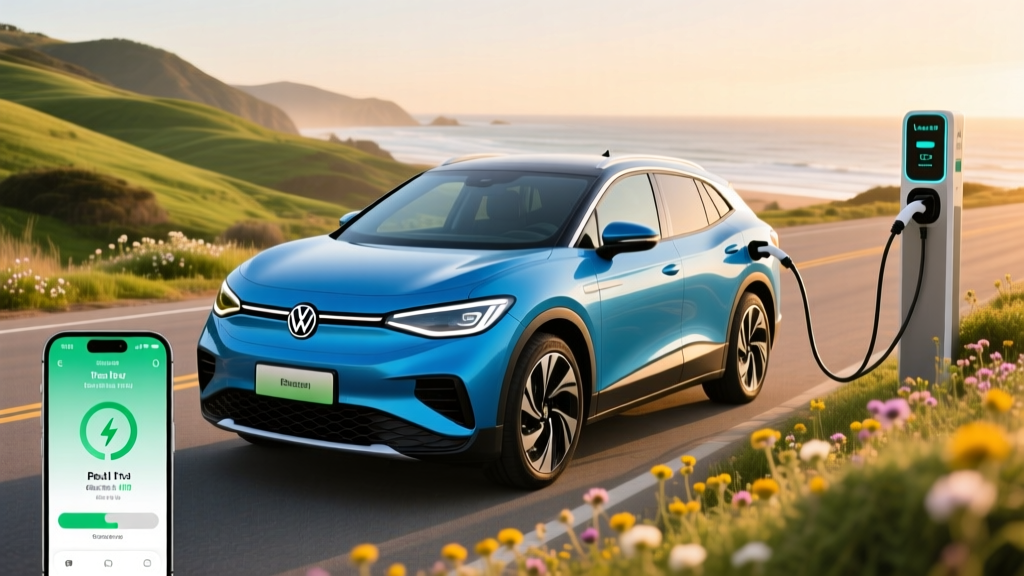
Charging speed is where the ID.4 is competent without being exceptional. The 2026 model supports a peak DC fast-charge rate of 175 kW on CCS-equipped vehicles (VW has been transitioning to NACS for 2025+ models, so 2026 ID.4 vehicles ship with the NACS port natively and can access Tesla Superchargers without an adapter).
| Charging Level | Power | Time / Rate | Notes |
|---|---|---|---|
| Level 1 (120V) | ~1.4 kW | ~3–4 mi/hr | Emergency/trickle only |
| Level 2 (240V, 48A) | 11.5 kW | ~33 mi/hr; 0–100% in ~8.5 hr | Home charger; requires 60A circuit |
| DC Fast Charge | Peak 175 kW | 10–80% in ~30 min | Sustained rate ~120 kW avg; tapers above 80% |
The critical number for road trippers isn't the 175 kW peak — it's the charging curve. The ID.4 holds strong charging power from roughly 10% to 55% state of charge, then begins a gradual taper. From 55% to 80%, average power drops to approximately 100–120 kW. Above 80%, the taper becomes aggressive, and charging from 80% to 100% on DC fast charge can add another 25–30 minutes. For practical road-trip planning, plan your stops around the 10–80% window and you'll average roughly 30-minute stops at 150+ kW chargers.
Home Level 2 charging at 11.5 kW is a strong point. With a properly installed 240V/60A circuit and a quality Level 2 charger (ChargePoint Home Flex, Emporia V2, or similar), you'll recover a full battery overnight. Most daily drivers who plug in at home will never need DC fast charging except on road trips.
Performance and Drivetrain: Adequate, Not Thrilling
The 2026 ID.4 offers two powertrain configurations:
| Spec | Pro / Pro S (RWD) | AWD Pro S / Pro S Plus |
|---|---|---|
| Drivetrain | Rear-wheel drive, single motor | Dual-motor AWD |
| Horsepower | 282 hp | 335 hp |
| Torque | 339 lb-ft | 339 lb-ft (front) + 339 lb-ft (rear) |
| 0–60 mph | 7.7 sec | 5.4 sec |
| Top Speed | 112 mph (electronically limited) | 112 mph |
| Towing Capacity | 2,200 lbs (braked) | 2,700 lbs (braked) |
The RWD model's 7.7-second 0–60 time is perfectly adequate for highway merging and daily driving but won't impress anyone coming from a Tesla Model Y Long Range (5.0 seconds). The AWD model's 5.4-second sprint is noticeably quicker and provides the all-weather traction that northern-climate buyers need, though it costs you 28 miles of EPA range and adds roughly $3,800 to the price.
Ride quality is a deliberate choice by VW: soft, compliant, and tuned for comfort over sportiness. The suspension absorbs bumps well but exhibits noticeable body roll in corners. The steering is light and numb — fine for parking lots, less engaging on back roads. This is a crossover designed for families who value quiet comfort over driving dynamics, and judged by that standard, it succeeds.
Battery, Warranty, and Long-Term Ownership
The ID.4 uses a 82 kWh gross (77 kWh net usable) lithium-ion battery pack with NMC (nickel-manganese-cobalt) chemistry. VW reserves approximately 5 kWh as a buffer below 0% displayed state of charge and a small buffer above 100% to protect long-term battery health. This buffer strategy is standard industry practice and helps slow degradation over time.
Volkswagen backs the battery and electric drivetrain with an 8-year / 100,000-mile warranty, covering defects and capacity loss below 70% of original capacity. This matches the industry standard set by most mainstream EV manufacturers and aligns with EPA/DOE guidance on battery durability expectations.
Real-world degradation data for the ID.4 platform (shared with the MEB-based ID.3, ID.5, and Audi Q4 e-tron) suggests approximately 5–8% capacity loss over the first 100,000 miles under normal use patterns. Owners who frequently DC fast-charge in extreme heat or regularly charge to 100% and let the vehicle sit may see slightly higher degradation. For daily driving with home Level 2 charging and an 80% daily charge limit, the battery should comfortably outlast the vehicle's useful life.
Interior Space, Cargo, and Daily Practicality
This is where the ID.4 quietly excels. Despite riding on a compact-class platform, VW's MEB architecture pushes the wheels to the corners and eliminates the transmission tunnel, yielding interior volume that rivals midsize crossovers.
- Front headroom: 41.1 in
- Front legroom: 41.1 in
- Rear headroom: 38.4 in
- Rear legroom: 37.6 in
- Cargo (behind rear seats): 30.3 cu ft
- Cargo (rear seats folded): 64.2 cu ft
Two adults in the rear seat will find ample legroom and a flat floor — no hump to straddle. The 30.3 cubic feet of cargo space behind the second row comfortably holds a double stroller, several grocery bags, or two large suitcases. Fold the 60/40 split rear seats and you get 64.2 cubic feet, enough for furniture-store runs or camping gear.
Notably, the ID.4 does not have a front trunk (frunk). The space under the hood is occupied by power electronics and the HVAC system. This is a missed opportunity compared to the Ford Mustang Mach-E and Hyundai Ioniq 5, both of which offer small frunks for charging cables or groceries.
Pricing, Trims, and Federal Tax Credit Eligibility
The 2026 VW ID.4 lineup starts at a competitive price point, and when the federal tax credit applies, the effective cost drops into territory that makes the value proposition very compelling.
| Trim | Drivetrain | MSRP | Est. After §30D Credit* |
|---|---|---|---|
| Pro | RWD | $39,735 | ~$32,235 |
| Pro S | RWD | $43,235 | ~$35,735 |
| AWD Pro S | AWD | $47,035 | ~$39,535 |
| AWD Pro S Plus | AWD | $51,535 | ~$44,035 |
*Federal §30D credit up to $7,500, subject to eligibility. All 2026 ID.4 trims fall under the $80,000 MSRP cap for SUVs. Buyer income must not exceed $150,000 (single) / $300,000 (joint). Battery sourcing and critical-mineral requirements apply and change periodically — verify current-year rules at irs.gov. The credit may be transferred to the dealer at point of sale as an instant rebate under current IRS rules.
Key standard equipment on the base Pro includes 19-inch wheels, heated front seats, a 12.9-inch infotainment display, wireless Apple CarPlay/Android Auto, adaptive cruise control, lane-keeping assist, and automatic emergency braking. The Pro S adds a panoramic fixed glass roof, 20-inch wheels, and a heated steering wheel. The AWD Pro S Plus tops the range with leatherette seats with ventilation, a head-up display, and a 360-degree camera system.
Tech, Driver Assists, and the Infotainment Frustration
The ID.4 ships with VW's IQ.DRIVE suite of Level 2 driver-assistance features (SAE Level 2 — the driver must remain fully engaged with hands on the wheel and eyes on the road). This includes:
- Travel Assist (adaptive cruise + lane centering)
- Front Assist (automatic emergency braking with pedestrian detection)
- Lane Assist (lane-keeping)
- Side Assist (blind-spot monitoring with rear cross-traffic alert)
- Park Assist (semi-automated parallel/perpendicular parking)
The infotainment system remains the ID.4's most consistent criticism. The 12.9-inch touchscreen runs VW's latest ID. Software 4.0, which is faster than earlier versions but still exhibits occasional lag when navigating between menus. The capacitive touch sliders for volume and temperature lack backlighting at night (a carryover complaint VW has not fully addressed) and require precise finger placement. Wireless CarPlay and Android Auto work reliably and are how most owners interact with navigation and media.
Pros and Cons at a Glance
Pros
- Spacious interior and cargo area rivaling midsize crossovers
- Competitive pricing, especially after the $7,500 federal tax credit
- Comfortable ride quality well-suited to daily commuting
- Strong Level 2 home charging at 11.5 kW
- NACS port standard on 2026 models — native Tesla Supercharger access
- Standard heat pump for improved cold-weather efficiency
- Comprehensive IQ.DRIVE safety suite included on all trims
Cons
- Infotainment responsiveness and touch-slider ergonomics frustrate
- No front trunk (frunk) for cable storage
- DC fast-charge curve tapers noticeably past 55% SoC
- Soft suspension tuning sacrifices handling engagement
- RWD 0–60 time of 7.7 sec feels sluggish vs. key rivals
- Cold-weather range loss is significant (~30%) despite heat pump
- Base Pro trim's 10.4-inch screen feels dated vs. 12.9-inch on higher trims
Who Should Buy the VW ID.4 — and Who Should Look Elsewhere
- You prioritize interior space and ride comfort over performance
- You want a mainstream-brand EV with a dealer network for service
- Your daily commute is under 60 miles round-trip and you can charge at home
- You want to leverage the full $7,500 federal tax credit on a sub-$45K vehicle
- You live in a moderate climate or value the standard heat pump for winter
- You want class-leading DC fast-charge speeds (consider Hyundai Ioniq 5 at 350 kW peak)
- You need sporty handling and quick acceleration (Tesla Model Y, Ford Mustang Mach-E GT)
- You rely heavily on infotainment UX (the ID.4's system trails competitors)
- You need a frunk for charging cable organization
- You frequently road-trip in extreme cold and need maximum range retention
Frequently Asked Questions
What is the real-world range of the 2026 VW ID.4?
The EPA rates the RWD ID.4 Pro S at 291 miles and the AWD Pro S Plus at 263 miles. In real-world highway driving at 70 mph, expect roughly 245–260 miles (RWD) or 220–235 miles (AWD). In freezing temperatures, range drops an additional 20–30%, putting winter real-world range at approximately 195–220 miles for the RWD model.
How fast does the ID.4 charge at home and on DC fast chargers?
At home on a 240V Level 2 charger (48 amps), the ID.4 charges at 11.5 kW, adding roughly 33 miles of range per hour and filling the battery from empty in about 8.5 hours. On DC fast chargers, it peaks at 175 kW and charges from 10% to 80% in approximately 30 minutes, though the charging curve tapers above 55% state of charge.
Does the 2026 VW ID.4 qualify for the $7,500 federal EV tax credit?
All 2026 ID.4 trims fall under the $80,000 MSRP cap for SUVs under IRS §30D rules. However, eligibility also depends on buyer income (under $150,000 single / $300,000 joint filer), battery component and critical-mineral sourcing requirements that change periodically, and your tax liability. The credit can be transferred to the dealer at point of sale as an instant price reduction. Always verify current sourcing rules at irs.gov and consult a tax professional before relying on the credit.
Is the VW ID.4 worth buying over the Hyundai Ioniq 5 or Tesla Model Y?
It depends on your priorities. The Ioniq 5 offers faster DC charging (up to 350 kW on 800V architecture), more distinctive styling, and a frunk — but at a slightly higher starting price. The Model Y leads in performance, efficiency, and Supercharger network access, though its ride is firmer and its starting price is higher. The ID.4 wins on value (especially after the tax credit), interior space, and comfort. For a family prioritizing budget and practicality over flash, the ID.4 is a strong choice.
What is the biggest complaint from ID.4 owners?
The most consistent owner complaints center on the infotainment system: slow response times, frustrating capacitive touch sliders for volume and climate, and a learning curve to the menu structure. VW has improved the software with over-the-air updates, and ID. Software 4.0 is noticeably better than launch-year versions, but it still trails the responsiveness of systems in the Ioniq 5, Model Y, and Rivian R1S. Most owners mitigate this by relying on wireless Apple CarPlay or Android Auto for daily use.
How much does it cost to charge the ID.4 at home vs. public chargers?
At the US average residential electricity rate of approximately $0.16/kWh, a full home charge (77 kWh usable) costs roughly $12.30, yielding a cost of about $0.04–0.05 per mile. Public DC fast charging averages $0.35–0.48/kWh depending on the network and location, making a 10–80% road-trip charge approximately $20–$28. For comparison, a gas compact SUV averaging 28 MPG at $3.40/gallon costs roughly $0.12 per mile.