The Bottom Line on VW ID.4 Lease Specials in 2026
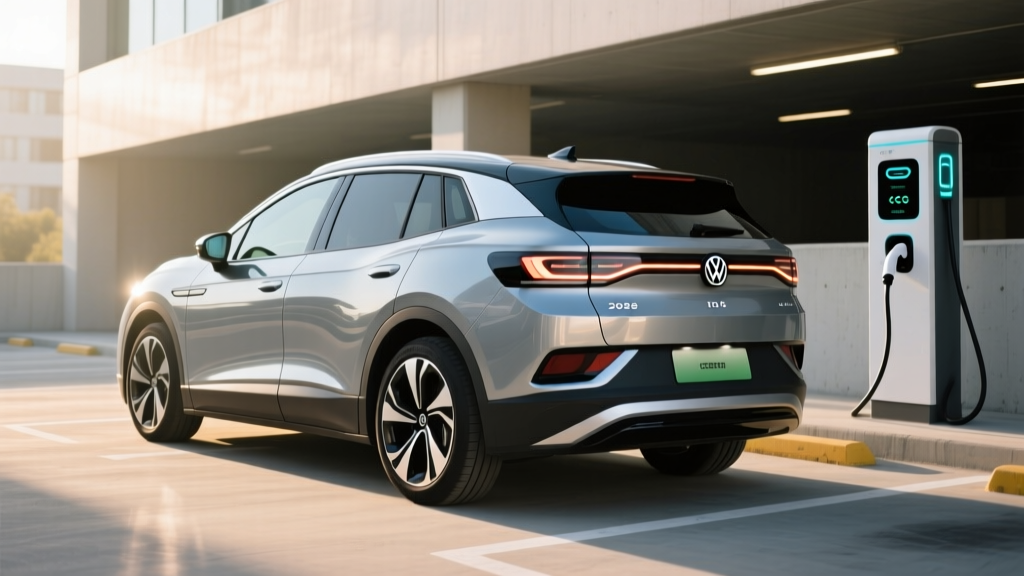
If you've been scanning dealer lots or Volkswagen's website for VW ID.4 lease specials, you're not alone. The ID.4 has become one of the most aggressively discounted electric SUVs on the market, with lease deals frequently undercutting rivals like the Hyundai Ioniq 5, Ford Mustang Mach-E, and Tesla Model Y. For 2026, Volkswagen continues to offer the ID.4 with a usable 82 kWh battery, a refined infotainment system (the much-maligned touch sliders are gone), and a starting MSRP that positions it as one of the most accessible compact electric SUVs available.
But a low lease payment only matters if the vehicle actually fits your life. Below, we break down exactly what you're getting — real-world range, charging speeds, cargo practicality, tax-credit eligibility, and the ownership trade-offs that don't show up in a monthly payment calculator.
Range and Efficiency: What the EPA Sticker Doesn't Tell You
The 2026 VW ID.4 Pro (rear-wheel drive) carries an EPA-estimated range of 291 miles on its 82 kWh usable battery pack (91 kWh gross capacity). The dual-motor ID.4 AWD Pro drops to an EPA 263 miles due to the added weight and drivetrain losses of the front motor. Efficiency for the RWD model is rated at 107 MPGe combined, or roughly 31 kWh per 100 miles, per fueleconomy.gov.
EPA Sticker: 291 miles (RWD) / 263 miles (AWD)
Highway driving (70-80 mph): Expect ~235-255 miles. The ID.4's boxy SUV shape and 4,600+ lb curb weight hurt efficiency at sustained highway speeds.
Cold weather (below 32°F): Plan for 195-220 miles. The ID.4's heat pump (standard on AWD, optional on RWD trims) helps, but lithium-ion chemistry and cabin heating still consume significant energy.
Mixed city/suburban commuting: 270-285 miles is achievable thanks to regenerative braking and lower average speeds.
The ID.4's battery uses NMC (nickel manganese cobalt) chemistry, which offers higher energy density than LFP but is more sensitive to sustained 100% state-of-charge storage. For daily driving, VW recommends setting the charge limit to 80% — which effectively gives you ~230 usable miles on the RWD model before you need to plug in.
Charging Speed: DC Fast, Level 2, and the Curve Reality
Charging is where lease shoppers need to look past the peak kW number. The 2026 ID.4 supports a maximum DC fast-charge rate of 170 kW on RWD models and 175 kW on AWD trims. Volkswagen claims a 10-80% charge time of approximately 28 minutes under ideal conditions.
| Charge Level | Power | Connector | Speed / Time |
|---|---|---|---|
| Level 1 (120V household) | ~1.4 kW | J1772 / NACS (adapter) | ~3-4 miles per hour |
| Level 2 (240V home/public) | 11 kW (onboard charger) | J1772 / NACS | ~28-30 miles per hour; full charge in ~8.5 hrs |
| DC Fast Charge | 170-175 kW peak | CCS1 / NACS | 10-80% in ~28 min; tapers sharply above 80% |
Here's the reality check on that 28-minute claim: the ID.4's charge curve peaks briefly near 170 kW between roughly 10-30% state of charge, then steps down progressively. From 50-80%, you're averaging closer to 90-110 kW. If you're road-tripping and charge from 20-80%, expect the session to take 30-35 minutes in practice — slower than the Hyundai Ioniq 5's 800V architecture (10-80% in ~18 minutes at 240 kW) but competitive with the Ford Mach-E and Nissan Ariya.
For 2026, Volkswagen has completed its transition to the NACS (Tesla-style) charge port on new ID.4 models, granting access to Tesla Supercharger stations (now open to non-Tesla EVs) in addition to Electrify America's CCS network. If you're considering a used or CPO ID.4 from 2023-2024, those will still have CCS1 ports and will require an adapter for Supercharger access.
Performance and Drivetrain: Adequate, Not Thrilling
The ID.4 was never designed to chase Tesla Model Y Performance lap times, and that shows in the numbers:
| Specification | ID.4 Pro (RWD) | ID.4 AWD Pro |
|---|---|---|
| Drivetrain | Rear-wheel drive, single motor | Dual-motor AWD |
| Horsepower | 282 hp | 335 hp |
| Torque | 339 lb-ft | 339 lb-ft (front) + rear combined |
| 0-60 mph | 7.7 seconds | 5.4 seconds |
| Top Speed | 112 mph (electronically limited) | 112 mph |
| Towing Capacity | 2,200 lbs | 2,700 lbs |
The RWD model's 7.7-second 0-60 time is perfectly fine for merging and city driving, but it feels leisurely compared to the Mach-E Extended Range (5.1 sec) or Model Y Long Range (4.8 sec). The AWD variant's 5.4 seconds is more respectable and provides genuine all-weather traction — a meaningful advantage if you live in the Snow Belt.
Ride quality is where the ID.4 earns its keep. The suspension tuning is compliant and quiet, with minimal road noise at highway speeds. The turning circle is surprisingly tight (33.5 feet) thanks to the rear-mounted motor and lack of front drivetrain hardware, making it genuinely easy to park in urban environments.
Pricing, Lease Specials, and Tax Credit Eligibility
Volkswagen has been aggressive with ID.4 incentives, and 2026 is no exception. Here's the current MSRP structure before destination charges:
| Trim | MSRP (excl. destination) | Typical Lease Special* | Federal Tax Credit |
|---|---|---|---|
| Standard Range S | $38,790 | $299-$349/mo (36 mo, $3,999 due) | Up to $7,500 (see eligibility) |
| Pro | $42,790 | $349-$399/mo (36 mo, $3,999 due) | Up to $7,500 |
| Pro S | $46,290 | $399-$449/mo (36 mo, $4,499 due) | Up to $7,500 |
| AWD Pro | $46,790 | $399-$459/mo (36 mo, $3,999 due) | Up to $7,500 |
| AWD Pro S Plus | $52,290 | $469-$529/mo (36 mo, $4,999 due) | Up to $7,500 |
*Lease specials vary by region, dealer, credit tier, and current VW promotional calendar. Always confirm the exact money factor, residual value, and due-at-signing amount with your dealer. VW Credit frequently applies the federal tax credit as a capitalized-cost reduction on leases, which is how they achieve the lower monthly payments.
Federal EV Tax Credit: The §30D Checklist
The ID.4 qualifies for the IRS §30D Clean Vehicle Credit of up to $7,500, but eligibility is not automatic. Here's what you must satisfy:
- MSRP cap: The ID.4 is classified as an SUV, so the cap is $80,000 — all trims qualify.
- Buyer income cap: Modified AGI must not exceed $150,000 (single), $225,000 (head of household), or $300,000 (joint filers).
- Battery sourcing: The ID.4's battery is assembled in Chattanooga, TN. Critical-mineral and battery-component thresholds must be met for the full $7,500; partial credits ($3,750) apply if only one requirement is satisfied. VW has confirmed most 2026 ID.4 trims meet both thresholds for the full credit, but always verify the specific VIN's eligibility on the DOE's qualifying vehicle list.
- Point-of-sale transfer: You can elect to transfer the credit to the dealer at purchase, reducing your out-of-pocket cost immediately — or claim it on your tax return.
- Lease loophole: On a lease, the credit goes to the lessor (VW Credit), who typically passes it through as a cap-cost reduction. This means lessees who exceed the income cap can still benefit — a key advantage of leasing over buying.
Interior, Cargo, and Daily Livability
The ID.4's cabin is one of its strongest selling points for families. Passenger volume is generous, and the flat floor (no transmission tunnel) makes the rear seat feel airy:
- Front headroom: 41.1 inches
- Rear legroom: 37.6 inches — more than the Ioniq 5 (37.1 in) and competitive with the Model Y (36.5 in)
- Cargo behind rear seats: 30.3 cubic feet
- Cargo with rear seats folded: 64.2 cubic feet
- Frunk: None — the ID.4 does not offer a front trunk, which is a missed opportunity for charging-cable storage.
For 2026, VW has finally addressed the most-criticized interior element: the capacitive touch sliders for volume and climate. These have been replaced with backlit physical buttons and a redesigned steering wheel with tactile controls. The 12.9-inch infotainment touchscreen now runs VW's latest software with improved responsiveness, wireless Apple CarPlay/Android Auto, and a more logical menu structure.
Driver-assistance tech includes VW's IQ.DRIVE suite — adaptive cruise control with stop-and-go, lane-centering assist, front and rear automatic emergency braking, and blind-spot monitoring. This is an SAE Level 2 system: it can manage steering and speed on highways, but you must keep your hands on the wheel and eyes on the road at all times. It is not self-driving.
Warranty and Long-Term Ownership
Volkswagen provides competitive warranty coverage for the ID.4's electric powertrain:
- Battery warranty: 8 years / 100,000 miles (whichever comes first), covering defects and capacity loss below 70% of original capacity.
- Powertrain warranty: 8 years / 100,000 miles
- Bumper-to-bumper: 4 years / 50,000 miles
- Complimentary maintenance: 2 years / 20,000 miles (covers cabin air filter, brake fluid, tire rotation — EVs need far less routine service than ICE vehicles)
- Free Electrify America charging: Some 2026 trims include 3 years of unlimited 30-minute DC fast-charging sessions at Electrify America stations. Confirm with your dealer as this promotion changes periodically.
For lease holders on a 36-month term, the battery warranty is largely irrelevant — you'll return the vehicle well before any meaningful degradation occurs. But if you plan to purchase at lease-end or buy outright, that 70% retention threshold at 100,000 miles provides reasonable peace of mind. Independent fleet data from sources like Recurrent Auto suggests modern NMC packs with active thermal management typically retain 85-90% capacity at 100,000 miles under normal use.
VW ID.4 vs. Key Competitors: Where It Wins and Loses
- Aggressive lease pricing undercuts most rivals by $50-$100/month
- Spacious rear seat and cargo area for the compact SUV class
- Comfortable, quiet ride quality ideal for commuting
- NACS port on 2026 models grants Supercharger access
- Federal tax credit eligibility reduces effective cost
- Tight turning circle, easy urban maneuverability
- DC fast-charging at 170 kW is slower than Ioniq 5, EV6, and Model Y
- No front trunk (frunk) for cable storage
- RWD 0-60 time of 7.7 sec feels sluggish for the price
- Real-world highway range drops to ~240 miles, limiting road-trip comfort
- Residual values historically weaker than Toyota/Hyundai — matters if you buy at lease-end
- Infotainment, while improved, still lags Tesla and Hyundai in responsiveness
Choose the ID.4 If:
Choose the VW ID.4 if: You want the lowest monthly payment on a practical, comfortable electric SUV for commuting and errands; you charge primarily at home; you value ride comfort over sporty acceleration; and you can benefit from the lease structure to capture the federal tax credit regardless of income.
Choose the Hyundai Ioniq 5 instead if: You road-trip frequently and need faster DC charging (240 kW, 10-80% in ~18 min), want V2L capability to power devices, or prefer a more distinctive design.
Choose the Tesla Model Y if: You want the longest real-world range (~310+ mi highway), the most mature Supercharger network experience, or the strongest resale value in the EV segment.
Frequently Asked Questions About VW ID.4 Lease Specials
What is the real-world range of the 2026 VW ID.4?
The EPA rates the RWD ID.4 at 291 miles and the AWD at 263 miles. In real-world mixed driving, expect 250-270 miles. Highway-only trips at 75+ mph will net roughly 235-255 miles, and cold-weather driving below freezing can drop range to 195-220 miles. Setting your daily charge limit to 80% (recommended for NMC battery longevity) gives you approximately 230 usable miles on the RWD model.
How fast does the ID.4 charge at home and on the road?
At home on a Level 2 (240V, 48A) charger, the ID.4 accepts up to 11 kW, adding roughly 28-30 miles of range per hour — a full 10-100% charge takes about 8.5 hours, easily done overnight. On DC fast chargers, it peaks at 170-175 kW, reaching 10-80% in approximately 28 minutes under ideal conditions. Real-world sessions (accounting for charge-curve taper and station availability) typically take 30-35 minutes.
Does the 2026 VW ID.4 qualify for the $7,500 federal tax credit?
Yes, most 2026 ID.4 trims qualify for the full $7,500 IRS §30D credit, as the vehicle is assembled in Chattanooga, TN, and meets battery-sourcing requirements. However, buyer income caps apply ($150K single / $300K joint for purchases). On a lease, the credit goes to the lessor and is typically applied as a capitalized-cost reduction, meaning even high-income lessees can benefit — a significant leasing advantage.
Is the VW ID.4 lease a better deal than buying?
For most buyers in 2026, leasing the ID.4 is the smarter financial play. VW's lease specials are heavily subsidized, the federal credit is baked into the lower monthly payment, and you avoid the risk of EV depreciation (which has been steep for the ID.4 historically — resale values trail the Model Y and Ioniq 5). If you drive under 12,000-15,000 miles per year and want to upgrade in 3 years, leasing is the clear winner. If you drive high mileage or plan to keep the vehicle 8+ years, purchasing and claiming the credit directly may be preferable.
How does the ID.4 compare to the Tesla Model Y on a lease?
The ID.4 typically leases for $50-$120 less per month than a comparably equipped Model Y, depending on current Tesla incentives. The trade-off is shorter real-world range (~250 vs ~310+ miles highway), slower DC charging (170 vs 250 kW), and a less seamless public-charging experience. If monthly cost is your top priority, the ID.4 wins. If range and road-trip capability matter more, the Model Y justifies the premium.
What should I check before signing an ID.4 lease?
Confirm the exact money factor (ideally below 0.0025), residual percentage (typically 52-58% for 36-month ID.4 leases), and total due-at-signing amount. Verify that VW Credit is applying the $7,500 federal credit as a cap-cost reduction. Check whether your dealer includes complimentary Electrify America charging. And always confirm the specific VIN's tax-credit eligibility on the DOE's qualifying vehicle list before signing.