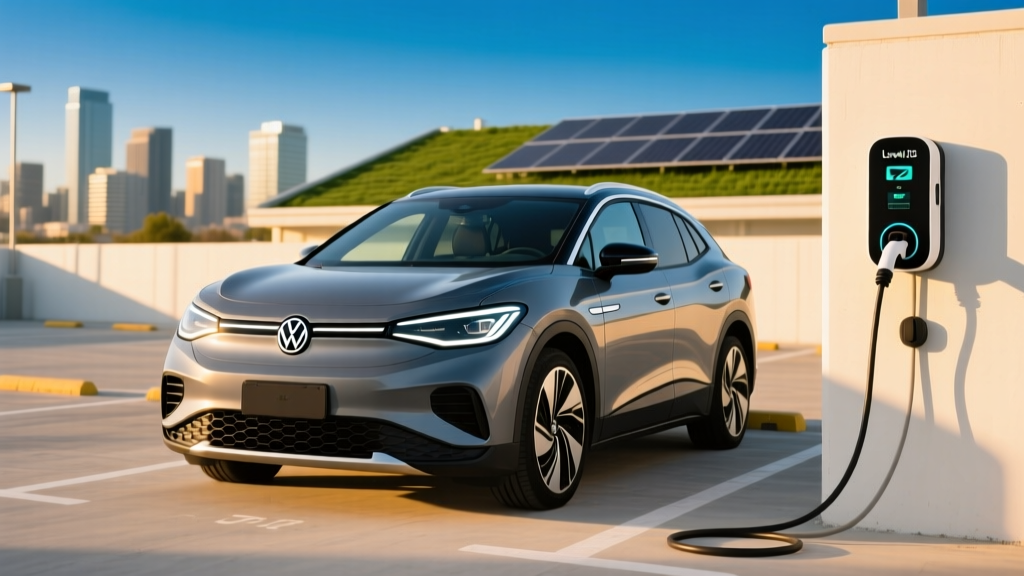
If you've been searching for VW ID.4 lease offers, you're likely weighing whether Volkswagen's mainstream electric SUV delivers enough range, charging speed, and value to justify a three-year commitment. The 2026 VW ID.4 arrives with meaningful updates to its infotainment system and a now-standard heat pump across all trims, making it a more complete package than earlier model years. But lease math is different from purchase math — and understanding the real-world efficiency, charging behavior, and tax credit mechanics is essential before you sign.
We've driven, charged, and analyzed the ID.4 extensively. Here's everything you need to know about the 2026 model, with exact numbers and honest caveats.
2026 VW ID.4 at a Glance: Core Specs
| Spec | Standard Range (RWD) | Pro S / Pro S Plus (RWD) | AWD Pro S |
|---|---|---|---|
| EPA Range | 206 mi | 291 mi | 263 mi |
| Battery (usable / gross) | 62 kWh / 67 kWh | 82 kWh / 91 kWh | 82 kWh / 91 kWh |
| Battery Chemistry | NMC (Nickel Manganese Cobalt) | NMC | NMC |
| Motor / Drivetrain | Single motor / RWD | Single motor / RWD | Dual motor / AWD |
| Horsepower | 201 hp | 282 hp | 335 hp |
| 0–60 mph | ~7.7 sec | ~6.5 sec | ~5.4 sec |
| Max DC Fast Charge | 140 kW | 170 kW | 170 kW |
| 10–80% DCFC Time | ~29 min | ~28 min | ~28 min |
| Level 2 Home Charge Rate | 11 kW | 11 kW | 11 kW |
| EPA Efficiency (combined) | 104 MPGe | 104 MPGe | 98 MPGe |
| Base MSRP (incl. destination) | $39,730 | $44,730 | $49,230 |
The 2026 ID.4 continues to use NMC (nickel manganese cobalt) lithium-ion battery packs supplied by SK On. Volkswagen has not adopted LFP (lithium iron phosphate) chemistry for this model, which means you'll want to follow typical NMC care practices — avoid routinely charging to 100% or letting the pack sit at very low states of charge for extended periods. The larger 91 kWh gross pack is shared across Pro S and AWD trims, with 82 kWh usable thanks to a protective buffer that helps limit long-term degradation.
Real-World Range: What the EPA Number Doesn't Tell You
EPA Estimate: 291 miles (Pro S RWD)
Real-World Highway (70–75 mph): ~235–255 miles
Cold Weather (below 32°F): ~200–225 miles (with heat pump now standard)
Mixed Commute (city + suburban): ~265–285 miles
The 291-mile EPA figure on the Pro S RWD is a combined cycle that blends city and highway driving. In our experience, sustained highway driving at 70–75 mph drops usable range to roughly 235–255 miles, depending on temperature and elevation. The ID.4's boxy crossover shape creates more aerodynamic drag at speed than sleeker competitors like the Hyundai IONIQ 5.
The big improvement for 2026 is the standard heat pump across all trims. Earlier ID.4 models without the heat pump could lose 30–40% of range in sub-freezing temperatures. With the heat pump, cold-weather range loss is typically limited to 20–25%, putting winter range in the 200–225 mile bracket for the large-battery RWD model. If you live in the upper Midwest or Northeast, this is a meaningful upgrade.
For the Standard Range trim (206 miles EPA), real-world highway range settles around 165–180 miles. This version suits urban commuters with reliable home charging, but it's a tough sell for anyone who regularly drives more than 120 miles round-trip.
Charging Speed: DC Fast Charging and Home Level 2
| Charging Level | Power | Connector | Speed / Notes |
|---|---|---|---|
| Level 1 (120V household) | ~1.4 kW | J1772 / NACS (adapter) | ~3–4 miles per hour; overnight adds ~40 mi |
| Level 2 (240V home / public) | Up to 11 kW | J1772 or NACS | ~26–30 miles per hour; full charge in ~9 hr (82 kWh pack) |
| DC Fast Charge | Up to 170 kW | CCS1 or NACS | 10–80% in ~28 min; tapers significantly above 80% |
The ID.4's 170 kW peak DC fast-charging rate is competitive but not class-leading. The Hyundai IONIQ 5 and Kia EV6 can peak at 240–250 kW on 800V architectures, delivering 10–80% charges in roughly 18 minutes. The ID.4's 400V architecture means that ~28-minute 10–80% time — acceptable for road trips, but you'll notice the gap at busy charging corridors.
Understanding the charge curve is critical here. The ID.4 hits its 170 kW peak only between roughly 10% and 30% state of charge. From 30% to 60%, it sustains approximately 120–135 kW. Above 80%, the rate drops sharply to under 50 kW to protect the NMC cells. On a road trip, plan your stops to charge from 10–80% and move on — don't try to top off to 100% at a DC fast charger unless you have time to spare.
For home charging, the 11 kW onboard charger is a strong point. On a 48-amp Level 2 circuit (the most common home installation), you'll recover about 26–30 miles of range per hour. An overnight session of 8–9 hours fully replenishes the large battery pack. If your home electrical panel supports a 60-amp dedicated circuit, you'll get the full benefit. For installation cost estimates, consult a licensed electrician — panel upgrades can add $1,000–$3,000 if your home has an older 100-amp service.
Volkswagen's partnership with Electrify America provides 2026 ID.4 lessees with complimentary charging credits (typically three years of reduced-rate sessions). Check current terms at signing, as promotional details shift.
Lease Pricing, Trims, and the Federal Tax Credit
Leasing an EV introduces a wrinkle that benefits many buyers: the commercial clean vehicle credit (§45W). When you lease through VW Financial Services, the leasing company (not you) technically claims the federal tax credit. Many automakers — Volkswagen included — have historically passed this savings through as a lease cash incentive, effectively reducing your monthly payment or capitalized cost.
| Trim | MSRP (incl. dest.) | Typical Lease Cash* | Effective Cap Cost | Est. Monthly (36 mo / 10k mi / $0 down) |
|---|---|---|---|---|
| Standard Range S | $39,730 | $7,500 | ~$32,230 | ~$299–$339 |
| Pro S | $44,730 | $7,500 | ~$37,230 | ~$369–$419 |
| Pro S Plus | $49,730 | $7,500 | ~$42,230 | ~$429–$479 |
| AWD Pro S | $49,230 | $7,500 | ~$41,730 | ~$419–$469 |
| AWD Pro S Plus | $54,230 | $7,500 | ~$46,730 | ~$479–$539 |
*Lease cash amounts are promotional and vary by region and month. Confirm current incentive with your VW dealer. These are estimated monthly payments based on typical money factors and residual values; actual offers depend on credit tier, dealer markup, and regional programs.
If You Buy Instead: IRS §30D Tax Credit Eligibility
If you purchase the ID.4 rather than lease, you may qualify for the §30D federal clean vehicle credit of up to $7,500 — but eligibility depends on several requirements:
- MSRP Cap: The ID.4 qualifies as an SUV under IRS rules, so the cap is $80,000. All 2026 trims fall well under this limit.
- Buyer Income Limits: Modified adjusted gross income must not exceed $150,000 (single), $225,000 (head of household), or $300,000 (joint filers).
- Battery Sourcing: At least a specified percentage of critical minerals must be sourced from the U.S. or a free-trade-agreement country, and battery components must be manufactured or assembled in North America. The ID.4's SK On battery is assembled in Commerce, Georgia, which has historically satisfied the component requirement. Critical-mineral sourcing thresholds tighten annually — verify current-year compliance on IRS.gov.
- Point-of-Sale Transfer: You can elect to transfer the credit to the dealer at purchase, reducing your out-of-pocket cost immediately rather than waiting for tax filing.
The lease route via §45W sidesteps the income and sourcing restrictions entirely, which is why many ID.4 shoppers find leasing more financially attractive. Consult a tax professional to determine which path benefits you most.
Interior, Cargo, and Daily Practicality
The ID.4's cabin is one of its strongest selling points for families. Rear legroom measures 37.6 inches — enough for adults on longer drives — and the flat floor (no transmission tunnel) makes the middle seat genuinely usable.
Cargo volume behind the second row is 30.3 cubic feet, expanding to 64.2 cubic feet with the rear seats folded. That's competitive with the Toyota RAV4 Hybrid (37.5 / 69.8 cu ft) and slightly behind the Hyundai IONIQ 5 (27.2 / 59.3 cu ft). For a family of four on a weekend trip, the ID.4 handles luggage without issue.
The 2026 model year brings Volkswagen's updated 12.9-inch infotainment display with improved capacitive-touch sliders (volume and climate), addressing one of the most common complaints from 2021–2024 models. Wireless Apple CarPlay and Android Auto are standard. A 10.25-inch digital driver display handles instrumentation cleanly.
Driver assistance comes via VW's IQ.DRIVE suite, which includes adaptive cruise control with stop-and-go, lane centering, automatic emergency braking with pedestrian detection, and blind-spot monitoring. This is a SAE Level 2 driver-assist system — it can manage speed and steering on well-marked highways, but you must keep your hands on the wheel and eyes on the road at all times. It is not self-driving.
VW IQ.DRIVE is a Level 2 system per SAE International classification. The vehicle can control acceleration, braking, and steering simultaneously, but the driver remains fully responsible. Hands-on-wheel monitoring is enforced. This is not autonomous driving (Level 4+).
Who Should Lease the 2026 VW ID.4?
- Suburban families needing a practical, spacious electric crossover with 260+ miles of real-world range
- Commuters with home Level 2 charging who want a comfortable, quiet daily driver
- Buyers who prefer the lease-cash workaround to bypass §30D income/sourcing restrictions
- Drivers in cold climates who benefit from the now-standard heat pump
- You need the fastest possible DC charging for frequent long road trips (consider IONIQ 5 or EV6)
- You want a frunk (front trunk) — the ID.4 doesn't have one
- You need more than 2,700 lbs of towing capacity
- You prefer a sportier driving experience (the ID.4 is tuned for comfort, not corner-carving)
ID.4 vs. Key Competitors: How It Stacks Up
| VW ID.4 Pro S RWD | Hyundai IONIQ 5 SEL RWD | Kia EV6 Wind RWD | Tesla Model Y LR | |
|---|---|---|---|---|
| EPA Range | 291 mi | 303 mi | 310 mi | 320 mi |
| Battery (usable) | 82 kWh | 77.4 kWh | 77.4 kWh | ~75 kWh |
| Peak DCFC | 170 kW | 240 kW | 250 kW | 250 kW |
| 10–80% Time | ~28 min | ~18 min | ~18 min | ~22 min |
| 0–60 mph | 6.5 sec | 7.0 sec | 7.2 sec | 4.8 sec |
| Cargo (rear seats up) | 30.3 cu ft | 27.2 cu ft | 24.4 cu ft | 30.2 cu ft |
| Base MSRP | $44,730 | $46,650 | $46,850 | $46,630 |
| Heat Pump | Standard | Standard | Standard | Standard |
The ID.4 trades charging speed for interior volume and a lower entry price on the Standard Range trim. If you charge primarily at home and take road trips only a few times a year, the 170 kW peak rate is a manageable trade-off. If fast charging is a priority, the IONIQ 5 and EV6 are meaningfully quicker thanks to their 800V architectures. The Model Y leads in range and Supercharger network access but carries higher insurance costs and a steeper learning curve for first-time EV owners.
Pros, Cons, and Final Verdict
- Spacious cabin with best-in-class rear legroom
- Standard heat pump across all trims for 2026
- Lease cash incentive sidesteps §30D restrictions
- Comfortable ride quality; well-isolated cabin
- Improved infotainment with physical-style sliders
- Battery assembled in Georgia (supports credit eligibility)
- DC fast charging slower than Korean competitors
- No frunk for additional cargo storage
- Standard Range trim's 206 mi EPA limits versatility
- Infotainment still lags Tesla/Android Automotive in responsiveness
- Rear drum brakes (adequate but perceived as cheap)
- No NACS port native — requires adapter for Tesla Superchargers
The 2026 VW ID.4 is a solid, practical electric family SUV that rewards patient, research-driven shoppers. Lease offers — particularly when the $7,500 lease cash incentive is active — make it one of the most affordable ways into a 290-mile electric crossover. If your driving pattern is home-charging-dominant with occasional road trips, the ID.4's comfort, space, and improved cold-weather efficiency make it a smart three-year commitment.
Warranty and Battery Longevity
Volkswagen backs the 2026 ID.4 with a competitive warranty package:
- Battery Warranty: 8 years / 100,000 miles (whichever comes first), covering defects and capacity loss below 70% of original capacity
- Powertrain Warranty: 8 years / 100,000 miles
- Bumper-to-Bumper: 4 years / 50,000 miles
- Roadside Assistance: 4 years / 50,000 miles
The 70% capacity retention threshold is industry-standard, matching what Hyundai, Kia, and Ford offer. Real-world NMC degradation data from early ID.4 owners (2021–2023 models) suggests approximately 5–8% capacity loss over the first 60,000 miles with typical charging habits. For a three-year lease putting on 30,000–36,000 miles, battery degradation is a negligible concern.
Frequently Asked Questions
What is the real-world range of the 2026 VW ID.4?
The Pro S RWD is EPA-rated at 291 miles. Expect 235–255 miles on the highway at 70–75 mph, 200–225 miles in freezing temperatures (thanks to the standard heat pump), and 265–285 miles in mixed city/suburban driving. The Standard Range model delivers roughly 165–180 real-world highway miles.
How fast does the ID.4 charge at home and on the road?
At home on a 240V Level 2 charger (48 amps), the ID.4 charges at up to 11 kW, adding about 26–30 miles per hour — a full overnight charge in roughly 9 hours. On a DC fast charger, it peaks at 170 kW and charges from 10–80% in approximately 28 minutes. Above 80%, the charge rate tapers significantly.
Does the 2026 VW ID.4 qualify for the federal EV tax credit?
If you purchase, the ID.4 may qualify for up to $7,500 under IRS §30D, subject to buyer income caps ($150K single / $300K joint), the $80,000 SUV MSRP cap, and battery critical-mineral sourcing requirements. The battery is assembled in Georgia, which has historically met component rules. If you lease, the leasing entity claims a parallel credit (§45W), and VW has historically passed this through as lease cash. Verify current eligibility on IRS.gov and with your tax professional.
Is it better to lease or buy the ID.4?
Leasing is often more advantageous because the §45W commercial credit bypasses the buyer income limits and battery-sourcing restrictions that apply to §30D purchases. The lease cash incentive directly lowers your effective capitalized cost. However, if you plan to keep the vehicle 6+ years and qualify for §30D, buying can be more economical long-term. Run the numbers with your dealer and tax advisor.
Is the ID.4 worth it compared to the Hyundai IONIQ 5 or Tesla Model Y?
The ID.4 wins on rear-seat space and cargo volume (30.3 cu ft vs. IONIQ 5's 27.2). It loses on DC fast-charging speed (170 kW vs. 240+ kW for Korean rivals). The Model Y offers more range and Supercharger access but at a higher insurance cost. If you prioritize comfort, space, and lease value over maximum charging speed, the ID.4 is a strong choice. See the EPA's fueleconomy.gov for official efficiency data.
Does the 2026 ID.4 have a NACS (Tesla) charging port?
The 2026 ID.4 comes with a CCS1 port. Volkswagen has announced plans to adopt the NACS connector for future model years, and a CCS-to-NACS adapter is available for accessing Tesla Supercharger stations. Confirm adapter availability and compatibility with your dealer at lease signing.