The ID.4 Cabin: Where Volkswagen's EV Pragmatism Shows
The Volkswagen ID.4 has always positioned itself as the sensible electric crossover — not the flashiest, not the quickest, but a competent, roomy family hauler with a mainstream price tag. For 2026, VW has continued refining the formula with incremental infotainment and material updates, but the core question remains: does the VW ID.4 interior deliver the space, technology, and everyday usability that EV buyers demand when cross-shopping against the Tesla Model Y, Hyundai IONIQ 5, and Ford Mustang Mach-E?
After spending time with the latest ID.4 — measuring cargo capacity, evaluating the updated software, and tracking real-world charging behavior — the answer is nuanced. The cabin is genuinely spacious and thoughtfully laid out for families, but material quality and some software quirks keep it from matching the best in the segment. Here's everything you need to know, with exact numbers.
Spec Sheet: 2026 Volkswagen ID.4 at a Glance
| Specification | Value |
|---|---|
| EPA Range | 291 miles (AWD Pro S); up to 291 mi (RWD Standard) |
| Battery (usable) | 82 kWh (91 kWh gross), NMC chemistry |
| Peak DC Fast Charge | 175 kW (CCS1); ~28 min 10–80% |
| Level 2 Home Charging | 11 kW onboard; ~36 mi/hr at 48A |
| 0–60 mph | 5.7 sec (AWD); 7.7 sec (RWD) |
| Horsepower | 295 hp (AWD); 201 hp (RWD) |
| Drivetrain | RWD (single motor) or AWD (dual motor) |
| EPA Efficiency | 104 MPGe combined / 32 kWh/100 mi (AWD) |
| Cargo Volume | 30.3 cu ft (rear up); 64.2 cu ft (rear folded) |
| Rear Legroom | 37.6 inches |
| Base MSRP | $39,735 (RWD Standard); $46,485 (AWD Pro S) |
| Battery/Powertrain Warranty | 8 years / 100,000 miles |
Inside the VW ID.4: Space, Materials, and Layout
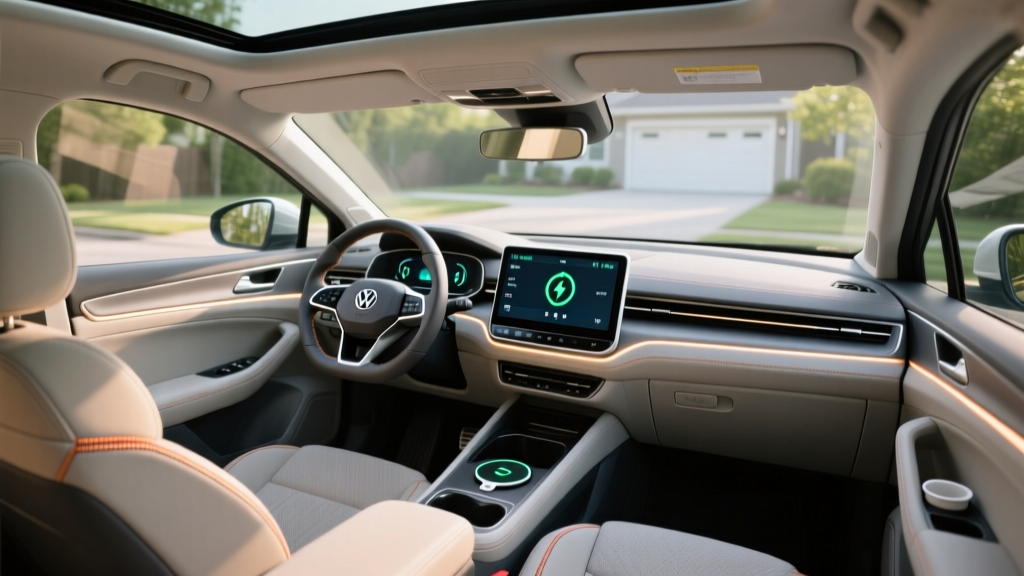
The first thing you notice stepping into the ID.4 is how airy the cabin feels. Volkswagen's MEB platform places the battery pack low in the chassis, freeing up interior volume that competes favorably with midsize gas crossovers. The flat floor — no transmission tunnel — means the rear middle seat is genuinely usable for an adult on longer trips, not just a penalty perch.
Passenger Room That Punches Above Its Class
Front-seat occupants get 41.1 inches of legroom and 40.9 inches of headroom, while rear passengers enjoy 37.6 inches of legroom. That rear figure beats the Hyundai IONIQ 5 (36.4 in) and sits close to the Tesla Model Y (36.5 in). In practice, a six-foot adult behind a six-foot driver has comfortable knee clearance and a supportive seatback angle. The panoramic fixed-glass roof (standard on Pro S and above) amplifies the sense of openness, though it does eat roughly an inch of headroom compared to the solid-roof trims.
Materials: Honest Plastics Meet Incremental Upgrades
This is where the ID.4 interior draws its most frequent criticism. The dashboard and door uppers use soft-touch materials, but the lower door panels, center console sides, and rear-seat surrounds are hard, glossy plastics that show scuffs quickly. For 2026, VW has added a revised center console with a padded knee bolster and an updated wireless charging pad that's recessed rather than perched on the surface — a welcome fix for phones sliding off during cornering.
The seats on the Pro S trim feature a leatherette called V-Tex that's durable and easy to clean, though it lacks the breathability of real leather or the premium synthetic found in Hyundai's H-Tex. Heated front seats are standard across all trims; ventilated front seats and a heated steering wheel arrive on the Pro S Plus.
Cargo Capacity: A Genuine Family Hauler
Behind the rear seats, you get 30.3 cubic feet — enough for a full week of family luggage or two large strollers without removing wheels. Fold the 60/40 split rear bench and capacity expands to 64.2 cubic feet. That trails the Model Y's ~76 cu ft but exceeds the IONIQ 5's 56.2 cu ft. The load floor is relatively flat, though there's a slight lip at the cargo opening.
Notably, the ID.4 has no front trunk (frunk). The space under the hood houses the drive electronics and HVAC components, so you're limited to a small cubby for the charging cable. For buyers accustomed to the Model Y's generous frunk, this is a meaningful trade-off.
Infotainment and Driver-Assist Technology
The 2026 ID.4 centers its technology around a 12.9-inch touchscreen running VW's ID. Software 4.0 — a meaningful upgrade from the laggy, confusing ID. Software 3.x that plagued early models. Response times are noticeably quicker, the navigation maps render without the multi-second delays of prior years, and the voice assistant ("Hello ID.") handles natural-language requests like "I'm cold" or "Find a charger on my route" with reasonable accuracy.
What Works
- Wireless wireless: Wireless Apple CarPlay and Android Auto are standard — no cable needed.
- Augmented-reality HUD: Available on Pro S Plus, the head-up display overlays navigation arrows onto the road ahead. It's genuinely useful at highway interchanges.
- IQ.DRIVE suite: Standard across all trims, including adaptive cruise control with stop-and-go, lane-centering assist, automatic emergency braking with pedestrian detection, and rear cross-traffic alert.
What Still Frustrates
- Capacitive touch sliders: Volume and temperature are controlled by touch-sensitive strips below the screen. They lack backlighting at night and are prone to accidental inputs — a persistent complaint VW has yet to address with physical controls.
- Window switch oddity: The driver's door has only two window switches plus a "REAR" touch button to toggle control to the back windows. It's a cost-saving measure that confuses every new passenger.
- Climate controls in the screen: While basic fan and temperature shortcuts live at the bottom of the display, vent direction and detailed climate settings require tapping through menus while driving.
Range, Efficiency, and the Real-World Reality Check
EPA sticker: 291 miles (AWD Pro S, 82 kWh usable)
Expect in practice: ~240–260 miles on a highway-heavy road trip at 70–75 mph; ~220–240 miles in sub-freezing winter conditions with cabin heat; up to ~280 miles in mild-weather city/suburban driving with regenerative braking.
The ID.4's efficiency of 32 kWh/100 mi (AWD) is respectable but trails the Model Y's ~28 kWh/100 mi, meaning you'll use more energy per mile on long trips.
The 82 kWh usable battery uses NMC (nickel-manganese-cobalt) chemistry, which prioritizes energy density — important for fitting meaningful range into a crossover-sized pack. The trade-off versus LFP (lithium iron phosphate) is that NMC degrades slightly faster over time and shouldn't be held at 100% state of charge daily. VW recommends setting the charge limit to 80% for everyday use and reserving 100% for road trips. The battery management system includes active liquid cooling and heating, which helps preserve long-term health and enables consistent fast-charging speeds across seasons.
According to fueleconomy.gov, the AWD ID.4 achieves 104 MPGe combined, which translates to roughly $0.044 per mile at the national average electricity rate of $0.17/kWh — compared to $0.13–0.16/mile for a comparable gas crossover at 25 MPG combined.
Charging Speed: DC Fast Charging and Home Setup
Charging speed remains one of the ID.4's weaker competitive points, and it's an area where buyers comparing against 800V-architecture vehicles like the IONIQ 5 or Kia EV6 will notice a gap.
| Charge Level | Power | Speed / Time |
|---|---|---|
| Level 1 (120V household) | ~1.4 kW | ~4 mi/hr — overnight top-up only |
| Level 2 (240V home, 48A) | 11 kW | ~36 mi/hr; full charge in ~8.5 hrs |
| DC Fast Charge (peak) | 175 kW | 10–80% in ~28 min; 70 mi in 10 min |
The Charging Curve Reality
The 175 kW peak is achievable only between roughly 10–30% state of charge at an optimal battery temperature (above 68°F / 20°C). Above 50% SoC, the rate tapers to ~100 kW, and above 80% it drops to ~50 kW or below. This is normal for NMC packs, but it means a 10–90% session takes closer to 40 minutes, not 28. On a road trip, the practical strategy is charging from 10–80% and moving on — that last 20% isn't worth the wait.
The ID.4 uses the CCS1 connector natively. With the North American charging landscape consolidating around NACS (Tesla's connector), VW has confirmed that future models will adopt NACS, but for 2026 the ID.4 still ships with CCS1. A CCS-to-NACS adapter (available from VW and third parties) enables access to Tesla Supercharger stalls that support non-Tesla vehicles — expanding your DC fast-charging network significantly on road trips.
For home Level 2 charging, the 11 kW onboard charger is a strong point. On a 48-amp / 240V circuit, you'll add roughly 36 miles of range per hour of charging, meaning a typical overnight session (8–10 hours) easily refills the battery from 20% to 100%. Installation of a hardwired Level 2 charger typically runs $800–$2,000 depending on your electrical panel's capacity and the distance from panel to garage. Always have a licensed electrician evaluate your panel — a 200-amp service is usually sufficient, but older homes with 100-amp panels may need an upgrade ($1,500–$3,000+).
Pricing, Trims, and Federal Tax Credit Eligibility
| Trim | Drivetrain | MSRP | Est. After §30D Credit |
|---|---|---|---|
| Standard | RWD | $39,735 | ~$32,235* |
| Pro | RWD | $43,735 | ~$36,235* |
| Pro S | AWD | $46,485 | ~$38,985* |
| Pro S Plus | AWD | $51,535 | ~$44,035* |
*Estimated prices assume full $7,500 federal tax credit eligibility. Actual credit depends on IRS §30D requirements.
Federal EV Tax Credit: Do You Qualify?
The ID.4 qualifies for the IRS §30D clean vehicle credit — up to $7,500 — but eligibility is not automatic. Here's what determines whether you can claim it:
- MSRP cap: The vehicle must have an MSRP at or below $80,000 for SUVs. All ID.4 trims clear this threshold.
- Buyer income cap: Modified adjusted gross income must not exceed $150,000 (single), $225,000 (head of household), or $300,000 (married filing jointly).
- Battery sourcing: At least a specified percentage of critical minerals and battery components must be sourced from the U.S. or free-trade-agreement countries. VW builds the ID.4 in Chattanooga, Tennessee, and has worked to qualify its battery supply chain — but sourcing requirements tighten annually. Verify current-year compliance on the IRS qualified vehicles list before purchasing.
- Point-of-sale transfer: As of 2024, you can transfer the credit to the dealer at purchase, effectively reducing your out-of-pocket price by $7,500 at the dealership rather than waiting to claim it on your tax return.
Consult a tax professional to confirm your personal eligibility. State and local incentives may stack on top — check afdc.energy.gov for your jurisdiction.
How the ID.4 Stacks Up Against Key Rivals
| Spec | 2026 VW ID.4 AWD | 2026 Tesla Model Y LR AWD | 2026 Hyundai IONIQ 5 AWD |
|---|---|---|---|
| EPA Range | 291 mi | 320 mi | 290 mi |
| Battery (usable) | 82 kWh (NMC) | 78 kWh (NMC) | 77.4 kWh (NMC) |
| Peak DC Charge | 175 kW | 250 kW | 238 kW |
| 10–80% Time | ~28 min | ~22 min | ~18 min |
| 0–60 mph | 5.7 sec | 4.8 sec | 5.1 sec |
| Cargo (rear up) | 30.3 cu ft | 30.2 cu ft | 27.2 cu ft |
| Rear Legroom | 37.6 in | 36.5 in | 36.4 in |
| Base AWD MSRP | $46,485 | $48,990 | $50,850 |
| Connector | CCS1 | NACS | CCS1 |
The ID.4's advantage is clear in the price column — it undercuts both competitors by $2,500–$4,000 at the AWD level, and the gap widens further after tax credits. Its rear-seat legroom also leads the group. Where it falls behind is charging speed (the IONIQ 5's 800V architecture delivers meaningfully faster DC sessions) and range efficiency (the Model Y extracts more miles per kWh).
Choose the Tesla Model Y if: You road-trip frequently and want Supercharger network access without adapters, maximum efficiency per kWh, and over-the-air updates that add features over time.
Choose the Hyundai IONIQ 5 if: DC fast-charging speed is a priority, you prefer the retro-futuristic design, and you want 800V architecture that makes 10–80% stops genuinely quick.
Pros and Cons: The Honest Verdict
Pros
- Class-leading rear legroom (37.6 in) and flat floor
- Competitive pricing — undercuts rivals by $2,500+
- Strong 11 kW Level 2 onboard charger for fast home refills
- IQ.DRIVE suite standard on every trim
- U.S.-built (Chattanooga, TN) — supports §30D credit eligibility
- Smooth, quiet ride quality that prioritizes comfort over sportiness
Cons
- 175 kW peak DC charge lags IONIQ 5 (238 kW) and Model Y (250 kW)
- Interior hard plastics don't match the price point
- Capacitive touch sliders for volume/climate are frustrating
- No frunk — cargo cable storage is a small cubby only
- CCS1 connector requires adapter for Tesla Supercharger access
- Efficiency (32 kWh/100 mi) trails Model Y (~28 kWh/100 mi)
Who the VW ID.4 Is For
The ID.4 is the right call for suburban families and daily commuters who prioritize interior space and ride comfort over charging speed and performance. If your routine involves home Level 2 charging overnight, school runs, grocery hauls, and the occasional 200-mile weekend trip, the ID.4 handles all of it without drama — and at a lower entry price than its rivals.
It's less ideal for frequent road-trippers who'll feel the 28-minute 10–80% charge time on multi-state drives, or performance-oriented buyers who want sub-5-second acceleration. If you regularly tow (the AWD ID.4 is rated for 2,700 lbs — adequate for a small trailer but not a boat), the efficiency hit under load will compress range noticeably.
Frequently Asked Questions
What is the real-world range of the VW ID.4?
The EPA rates the AWD ID.4 at 291 miles, but expect 240–260 miles on highway-heavy trips at 70–75 mph, and 220–240 miles in freezing winter weather with cabin heat running. City and suburban driving in mild weather can approach the EPA figure.
How fast does the ID.4 charge at home and on the road?
At home on a 240V / 48A Level 2 charger, the ID.4 adds about 36 miles per hour and fully charges in roughly 8.5 hours. On a DC fast charger, it peaks at 175 kW and reaches 10–80% in approximately 28 minutes under ideal conditions — though the rate tapers significantly above 50% state of charge.
How much does the ID.4 cost after the federal tax credit?
The base RWD Standard starts at $39,735 and could drop to roughly $32,235 with the full $7,500 §30D credit applied at the point of sale. The popular AWD Pro S starts at $46,485, or ~$38,985 after credit. Eligibility depends on your income, the vehicle's battery sourcing compliance, and MSRP caps — verify on the IRS qualified vehicle list before purchasing.
Is the VW ID.4 worth buying over the Tesla Model Y or Hyundai IONIQ 5?
If your priority is cabin space (especially rear legroom), a lower purchase price, and a conventional dealer service experience, the ID.4 is a strong value. If fast-charging speed matters most, the IONIQ 5 wins. If Supercharger access and efficiency-per-kWh are top of mind, the Model Y leads. All three are competent — the choice depends on which trade-offs you're willing to make.
Does the ID.4 have a frunk?
No. The ID.4 does not have a front trunk. The space under the hood contains drive electronics and climate-control hardware. There's a small cubby suitable for storing the mobile charging cable, but no sealed cargo compartment.
What is the battery warranty on the ID.4?
Volkswagen covers the ID.4's high-voltage battery and electric powertrain for 8 years or 100,000 miles, whichever comes first. The warranty guarantees the battery will retain at least 70% of its original capacity during that period — a standard threshold for the industry.