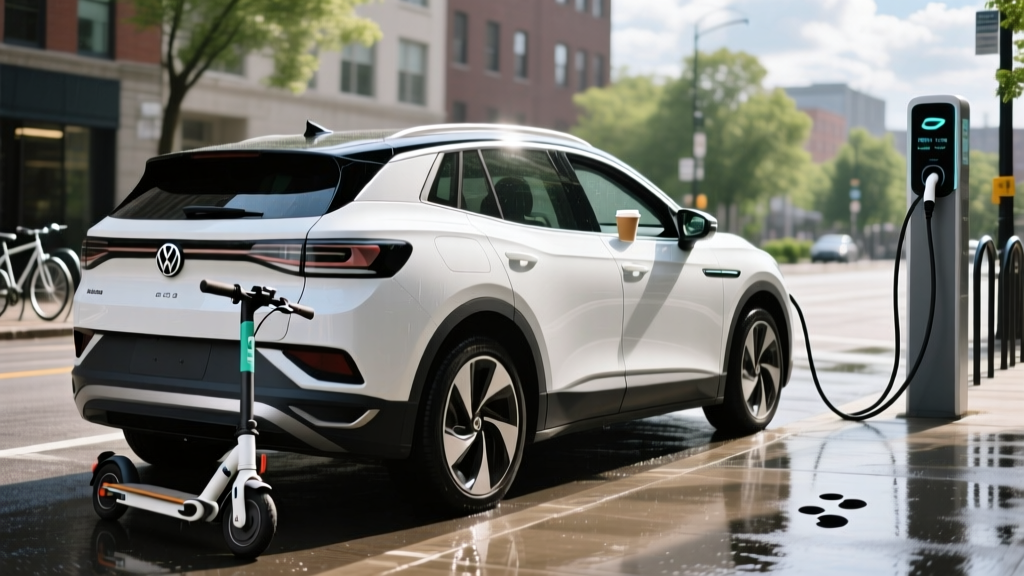
If you've spent any time browsing an ID.4 forum, you already know the Volkswagen ID.4 inspires strong opinions. Owners praise its ride comfort, spacious cabin, and competitive pricing, while critics point to its middling DC fast-charging speed and occasionally finicky infotainment. As a 2026 model-year vehicle, the ID.4 has matured considerably since its U.S. launch, with software improvements, refined battery management, and a broader charging network via the NACS adapter rollout.
At AutoEdgeView, we don't just read manufacturer spec sheets — we cross-reference them with thousands of real-world owner reports from forums, road-trip logs, and cold-weather testing threads. This review synthesizes official EPA data with the collective ownership intelligence of the ID.4 community to give you the most accurate picture of what it's actually like to live with this electric compact SUV.
2026 VW ID.4 at a Glance: Full Spec Breakdown
| Specification | ID.4 Standard (RWD) | ID.4 AWD Pro |
|---|---|---|
| EPA Range | 291 miles | 263 miles |
| Battery (Usable) | 77 kWh (NMC) | 77 kWh (NMC) |
| Max DC Fast Charge | 170 kW | 170 kW |
| 10–80% DC Charge Time | ~28 minutes | ~28 minutes |
| Level 2 Home Charge Rate | 11 kW (~37 mi/hr) | 11 kW (~37 mi/hr) |
| 0–60 mph | 7.7 seconds | 5.4 seconds |
| Horsepower | 201 hp | 295 hp |
| Drivetrain | Rear-Wheel Drive | Dual-Motor AWD |
| MPGe (Combined) | 107 MPGe | 98 MPGe |
| Efficiency | 31 kWh/100 mi | 34 kWh/100 mi |
| Cargo Volume (rear seats up) | 30.3 cu ft | 30.3 cu ft |
| Cargo Volume (rear seats down) | 64.2 cu ft | 64.2 cu ft |
| Rear Legroom | 37.6 inches | 37.6 inches |
| Battery Warranty | 8 yr / 100,000 mi | 8 yr / 100,000 mi |
| Starting MSRP | $39,735 | $45,735 |
Real-World Range: What the EPA Sticker Doesn't Tell You
Real-World Expectation: Forum owners consistently report 240–270 miles on mixed highway trips at 70–75 mph. In cold weather (below 35°F), expect a 15–25% reduction, bringing usable range to roughly 200–230 miles for the RWD model. City driving with regen braking can exceed the EPA figure, with some owners reporting 295–310 miles in stop-and-go conditions.
The ID.4's 77 kWh usable NMC (nickel-manganese-cobalt) battery pack provides a solid baseline, but real-world results depend heavily on driving style and conditions. One of the most cited findings across every major EPA-tested EV is that highway speeds above 70 mph erode range significantly. The ID.4 is no exception.
Forum threads tracking 10,000+ mile ownership logs show that the RWD Standard model averages about 3.0–3.2 miles per kWh on the highway, which translates to roughly 231–246 miles from a full charge. That's a meaningful gap from the 291-mile sticker. However, the ID.4's heat pump (standard on 2026 models) significantly reduces cold-weather cabin-heating energy draw compared to earlier model years — a point frequently praised in winter ownership threads from Minnesota, Colorado, and New England owners.
For AWD buyers, the efficiency penalty is real: 34 kWh/100 miles versus 31 kWh/100 miles for RWD. That 10% energy cost buys you substantially quicker acceleration and all-weather traction, but it does compress your road-trip range envelope.
Charging Speed: DC Fast, Level 2, and the Curve Reality
| Charging Level | Power / Rate | Miles Added per Hour | Typical Use Case |
|---|---|---|---|
| Level 1 (120V) | ~1.4 kW | ~4–5 mi/hr | Overnight top-up, emergencies |
| Level 2 (240V, 48A) | 11 kW | ~37 mi/hr | Home garage, workplace |
| DC Fast Charge | Peak 170 kW | ~620 mi/hr (at peak) | Road trips, highway corridors |
The ID.4's 170 kW peak DC fast-charging rate is the single most debated topic on any ID.4 forum. Here's why: competitors like the Hyundai Ioniq 5 (peak 240 kW) and Tesla Model Y (peak ~250 kW) charge substantially faster at their peak. But peak rate isn't the whole story.
The ID.4's charge curve is relatively flat in a good way — it sustains close to 170 kW from about 5% to roughly 30% state of charge (SoC), then gradually tapers. The 10–80% time of approximately 28 minutes is competitive, even if the peak number doesn't match class leaders. Where the ID.4 falls behind is the 80–100% top-off: tapering above 80% SoC is aggressive, and a full charge from 10% can take 45–50 minutes if you wait for 100%.
Practical road-trip advice from forum veterans: Plan stops around the 10–80% window. Preconditioning the battery (available via the vehicle's navigation-based preconditioning when you route to a charger) is essential for achieving peak charge rates, especially in cooler weather. Without preconditioning, owners report peak rates of only 90–120 kW at cold-soaked batteries.
At home on a Level 2 charger, the 11 kW onboard charger replenishes roughly 37 miles of range per hour. A full charge from 10% takes about 7–8 hours — easily accomplished overnight. For home charging installation, a licensed electrician will typically need a 240V/60A circuit to deliver the full 48A (11 kW) rate. Budget $800–$2,000 for a quality Level 2 wallbox installation depending on your panel capacity and run distance.
The 2026 ID.4 ships with a NACS adapter, granting access to Tesla Supercharger stations — a significant network advantage that forum owners rate as one of the most impactful updates Volkswagen has made. Always check fueleconomy.gov for the latest efficiency and charging data.
Performance and Drivetrain: Adequate RWD, Genuinely Quick AWD
The RWD ID.4's 201 hp and 7.7-second 0–60 time won't win drag races, but they're perfectly adequate for merging, passing, and daily commuting. The instant torque delivery (229 lb-ft from 0 RPM) makes the ID.4 feel punchier around town than the 0–60 number suggests.
The dual-motor AWD variant is a different animal. With 295 hp and 339 lb-ft, the 5.4-second 0–60 time puts it in the same acceleration bracket as a Volkswagen GTI. Forum owners who opted for AWD overwhelmingly cite winter traction and confident highway merging as justification for the ~$6,000 price premium and 28-mile range trade-off.
Ride quality is where the ID.4 genuinely excels and is consistently praised across owner communities. The suspension tuning is soft and compliant — closer to a traditional comfort-oriented crossover than the firmer sport suspensions found on the Tesla Model Y or Ford Mustang Mach-E. Road noise insulation is above average for the segment.
Pricing, Trims, and Federal Tax Credit Eligibility
| Trim | MSRP | Est. After §30D Credit* | Key Features |
|---|---|---|---|
| Standard (RWD) | $39,735 | ~$32,235 | 12" touchscreen, heat pump, IQ.DRIVE, heated seats |
| Pro (RWD) | $43,735 | ~$36,235 | Panoramic roof, power liftgate, 12" display |
| Pro S (RWD) | $47,235 | ~$39,735 | Leatherette, premium audio, 20" wheels |
| AWD Pro | $45,735 | ~$38,235 | Dual-motor, 295 hp, AWD traction |
| AWD Pro S Plus | $52,235 | ~$44,735 | Top trim, ventilated seats, head-up display |
*Federal §30D tax credit eligibility requires meeting all of the following criteria. Estimated prices assume full $7,500 credit qualification. Consult a tax professional or IRS guidance for your specific situation.
- MSRP Cap: SUVs must be at or below $80,000 MSRP — all ID.4 trims qualify.
- Buyer Income Cap: Modified AGI must not exceed $150,000 (single) / $300,000 (married filing jointly).
- Battery Sourcing: Critical minerals and battery components must meet phased-in domestic/FAT-content requirements. The ID.4's battery sourcing has evolved — verify current-year compliance on the IRS clean vehicle credit list.
- Point-of-Sale Transfer: Eligible buyers can transfer the credit to the dealer at purchase for an immediate price reduction rather than waiting for a tax refund.
- Assembly: The ID.4 for the U.S. market is assembled in Chattanooga, Tennessee — meeting the North American final assembly requirement.
The Chattanooga assembly is a significant advantage: it eliminates the import tariff uncertainty that has plagued some European-built EVs and helps the ID.4 maintain competitive pricing. Forum buyers frequently note that the ID.4 Standard at ~$32,000 after the credit is one of the most affordable ways into a 290-mile-range electric SUV with a spacious interior.
Cargo Space, Interior, and Daily Livability
With 30.3 cubic feet behind the rear seats and 64.2 cubic feet with them folded, the ID.4 matches or beats most compact crossovers in its class. For context, that's slightly more than the Hyundai Ioniq 5 (27.2 cu ft rear up) and comparable to the Tesla Model Y (30.2 cu ft rear up, though the Model Y adds a frunk).
The ID.4 notably lacks a front trunk (frunk). The space under the hood is occupied by power electronics and the HVAC system. For most owners, this is a minor inconvenience — but it's a frequent complaint on forums from buyers who expected one.
Rear-seat legroom at 37.6 inches is generous and accommodates adults comfortably on longer trips. The flat floor (no transmission tunnel) makes the middle rear seat usable, a practical advantage for families. ISOFIX/LATCH anchors are easily accessible for child seats.
The cabin materials are a mix of soft-touch surfaces and harder plastics on lower door panels and the center console. Forum owners are split: some find it acceptable for the price point, while others expect more premium finishes at the $45,000+ trim levels.
Tech, Driver Assistance, and Software: Improved but Still Debated
The 2026 ID.4 runs Volkswagen's latest ID.Software 4.x, which has addressed many of the lag and stability complaints that plagued earlier model years. The 12-inch touchscreen (12.9 inches on Pro S and above) is responsive, and wireless Apple CarPlay and Android Auto are standard across all trims.
However, the touch-capacitive steering wheel controls remain one of the most universally criticized features on every ID.4 forum. Owners report accidental activations, inconsistent response, and a preference for physical buttons. Volkswagen has acknowledged the feedback, and the upcoming ID.4 refresh is expected to return to tactile controls — but for the 2026 model year, the touch sliders persist.
The IQ.DRIVE suite is VW's Level 2 (SAE) driver-assistance system, including:
- Adaptive cruise control with stop-and-go
- Lane-keeping assist with centering
- Travel Assist (combined lane + speed assist for highway driving)
- Front Assist with automatic emergency braking
- Park Assist with surround-view camera
Forum owners rate Travel Assist highly for highway commuting, noting smooth lane centering and predictable adaptive cruise behavior. It doesn't match the lane-change confidence of GM's Super Cruise on compatible highways, but it's competitive with Toyota Safety Sense and Honda Sensing systems.
Pros, Cons, and the Forum Verdict
What Owners Love
- Comfortable, quiet ride quality — best in class for suspension compliance
- Competitive pricing, especially Standard trim after §30D credit
- Spacious interior with adult-friendly rear seats
- Heat pump standard — improved cold-weather efficiency
- NACS adapter access to Tesla Supercharger network
- U.S.-built (Chattanooga) — supports domestic manufacturing and tariff stability
- Strong battery warranty: 8 years / 100,000 miles at 70% capacity retention
Common Complaints
- 170 kW DC fast-charging peak trails class leaders (Ioniq 5, Model Y)
- Touch-capacitive steering controls prone to accidental input
- No front trunk (frunk)
- Infotainment learning curve; some menus deeply nested
- AWD range penalty (~28 miles less than RWD)
- Harder plastics in lower cabin areas at higher trim prices
- Regen braking is modest — no true one-pedal driving mode
Who Should Buy the VW ID.4 — And Who Shouldn't
- You prioritize ride comfort and cabin quietness over sporty handling
- Your budget is $35,000–$45,000 after incentives for a practical family EV
- You need strong rear-seat space for children or adult passengers
- You want access to the Supercharger network via NACS without being locked into a Tesla
- You value a strong battery warranty and U.S. assembly
Look elsewhere if:
- You frequently road-trip and need the fastest possible DC charging (consider Ioniq 5 or Model Y)
- You want one-pedal driving with aggressive regen (consider Nissan Ariya or Chevrolet Equinox EV)
- You need a frunk for additional storage
- You prioritize cutting-edge infotainment or large-screen experiences (consider Tesla or Rivian)
- You need more than 300 miles of EPA range for your commute pattern
The ID.4 occupies a specific niche: it's the comfort-oriented, value-driven electric compact SUV for buyers who want something mainstream, spacious, and well-supported without paying premium prices. It won't set the internet on fire with 0–60 times or charging records, but it will quietly serve a family well for years — which is exactly what the majority of forum owners report.
Frequently Asked Questions from the ID.4 Community
What is the real-world range of the 2026 VW ID.4?
Expect 240–270 miles on highway trips at 70–75 mph for the RWD model, versus the EPA's 291-mile sticker. City driving with regenerative braking can match or slightly exceed the EPA number. In cold weather below 35°F, plan for 200–230 miles of usable range. The AWD model loses roughly 10% efficiency across all conditions.
How fast does the ID.4 charge at home and on the road?
At home on a Level 2 (240V, 48A) charger, the ID.4 adds about 37 miles of range per hour, fully charging from 10% in 7–8 hours. On DC fast chargers, it peaks at 170 kW and charges from 10–80% in approximately 28 minutes — but battery preconditioning via navigation routing is essential to achieve these speeds, particularly in cool weather.
Does the 2026 ID.4 qualify for the $7,500 federal EV tax credit?
It can, but eligibility depends on your income (under $150K single / $300K joint), the specific trim's MSRP (all trims are under the $80K SUV cap), and current battery-sourcing compliance verified on the IRS clean vehicle credit list. The credit can be transferred to the dealer at point of sale for an immediate price reduction. Always verify current-year eligibility with a tax professional.
Is the ID.4 worth buying vs. the Hyundai Ioniq 5 or Tesla Model Y?
The ID.4 wins on ride comfort, rear-seat space, and value pricing (especially Standard trim after incentives). The Ioniq 5 charges faster (240 kW peak) and has a more distinctive design. The Model Y offers superior range, Supercharger-native access, and a more advanced (but more expensive) tech ecosystem. Your priority — comfort vs. charging speed vs. tech — determines the right choice.
Does the ID.4 have a frunk (front trunk)?
No. The ID.4 does not have a front trunk. The under-hood space is occupied by power electronics and climate-control components. All cargo storage is in the rear, where 30.3 cubic feet (seats up) and 64.2 cubic feet (seats folded) are available.
How long will the ID.4 battery last?
Volkswagen warranties the battery for 8 years or 100,000 miles against degradation below 70% of original capacity. Real-world forum data from high-mileage owners (60,000+ miles) shows typical degradation of 5–8% over 3–4 years, which is in line with industry norms for NMC chemistry. Proper care — avoiding frequent 100% charges, minimizing DC fast-charging in extreme heat, and using battery preconditioning — can extend long-term battery health.
Can the ID.4 tow?
Yes. The ID.4 is rated for up to 2,700 pounds of towing capacity (with factory hitch). This is sufficient for a small utility trailer, bike rack, or lightweight camping trailer, but it's not suited for heavy boat or large camper towing. Towing will reduce range by an estimated 30–50% depending on trailer weight and aerodynamics.
Sources: U.S. EPA / fueleconomy.gov, IRS §30D Clean Vehicle Credit, NHTSA. All pricing and specifications reflect 2026 model-year data at time of publication. Verify current tax credit eligibility with the IRS and a qualified tax professional.