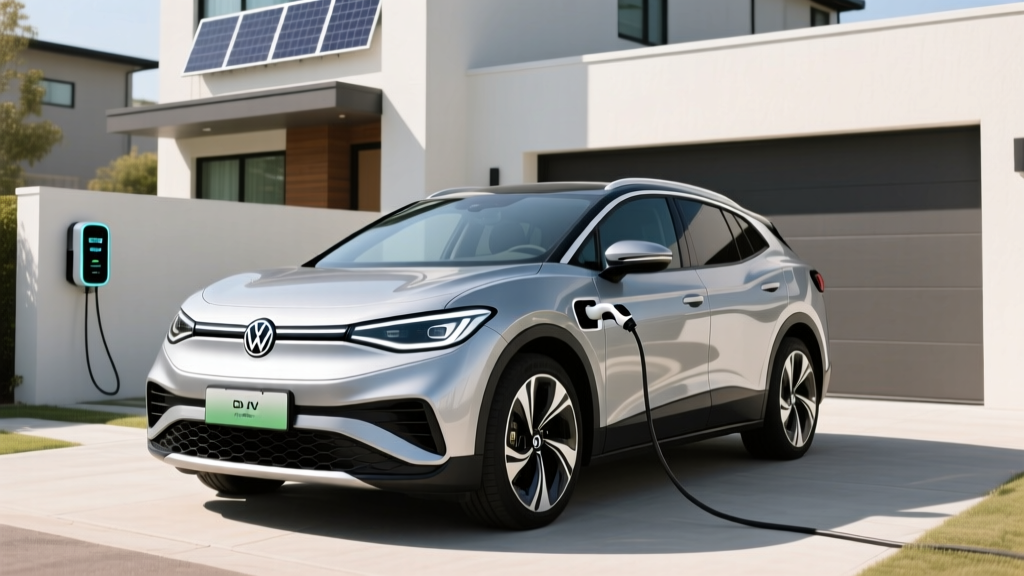
The Volkswagen ID.4 occupies a specific niche in the electric-vehicle market: it is one of the few mainstream, two-row electric crossovers that attempts to balance European driving dynamics with American practicality. For buyers researching VW ID.4 finance options, the calculus involves more than just the sticker price. Between shifting federal tax credit rules under IRS §30D, variable state incentives, and the total cost of ownership compared to internal combustion rivals, financing an ID.4 in 2026 requires a clear-eyed look at the numbers.
This profile breaks down the 2026 VW ID.4 across the metrics that matter to owners: real-world range versus EPA estimates, charging speed and infrastructure compatibility, performance data, and a detailed look at how to structure a purchase or lease. Volkswagen has streamlined the lineup for 2026, but the fundamental question remains — is this the right electric SUV for your budget and driving habits?
2026 VW ID.4: Core Specifications at a Glance
| Specification | Standard Range (RWD) | Pro S (RWD) | Pro S Plus (AWD) |
|---|---|---|---|
| Base MSRP | $44,000 | $49,500 | $54,500 |
| EPA Range | 206 miles | 275 miles | 263 miles |
| Battery (Usable) | 62 kWh (NMC) | 82 kWh (NMC) | 82 kWh (NMC) |
| Max DC Fast Charge | 140 kW | 170 kW | 170 kW |
| 10–80% DC Charge | ~28 min | ~28 min | ~28 min |
| Level 2 Home Charge | 11 kW (~22 mi/hr) | 11 kW (~22 mi/hr) | 11 kW (~22 mi/hr) |
| Horsepower | 201 hp | 282 hp | 335 hp |
| 0–60 mph | 7.7 sec | 6.5 sec | 5.4 sec |
| Drivetrain | Rear-Wheel Drive | Rear-Wheel Drive | Dual-Motor AWD |
| EPA Efficiency | 104 MPGe | 107 MPGe | 101 MPGe |
Real-World Range: Beyond the EPA Sticker
The EPA range estimate is a useful baseline, but it does not reflect how most people actually drive. The ID.4 Pro S carries an EPA-estimated 275 miles of range from its 82 kWh (usable) NMC lithium-ion battery pack. However, real-world efficiency varies significantly based on conditions.
- City / Suburban Driving: 260–285 miles (regenerative braking recovers energy in stop-and-go traffic)
- Highway (70–75 mph): 230–250 miles (aerodynamic drag dominates at sustained speed)
- Cold Weather (below 32°F): 190–220 miles (battery chemistry loses efficiency; cabin heating draws from the pack)
- Cold + Highway Combined: 175–200 miles (worst-case scenario for winter road trips)
Volkswagen equips the ID.4 with a heat pump on most trims, which reduces cold-weather range loss compared to resistive heating, but physics still applies. Expect a 20–30% range reduction in freezing temperatures.
For context, the Standard Range RWD model's 206-mile EPA rating drops to roughly 175 miles in mixed cold-weather highway use. This makes the Standard Range trim best suited for commuters with home charging and shorter daily drives, while the Pro S is the more versatile choice for road trips and four-season climates.
Charging Speed and Infrastructure
Charging speed is where the ID.4 shows its age relative to newer competitors built on 800-volt architectures. The ID.4 uses a 400-volt platform, which caps its DC fast-charging rate at 170 kW peak for the Pro S and AWD models, and 140 kW for the Standard Range.
| Charging Level | Power / Rate | Time / Range Added |
|---|---|---|
| Level 1 (120V Household) | ~1.2 kW | ~3–4 miles per hour |
| Level 2 (240V Home / Public) | 11 kW max | ~22 miles per hour; full charge in ~8 hrs |
| DC Fast Charge (Pro S) | 170 kW peak | 10–80% in ~28 min; ~210 mi in 30 min (ideal conditions) |
| DC Fast Charge (Std Range) | 140 kW peak | 10–80% in ~28 min; ~150 mi in 30 min |
A critical detail for road-trip planning: the 170 kW rate is a peak, not a sustained average. The ID.4's charge curve tapers significantly above 80% state of charge. Charging from 80–100% can take nearly as long as 10–80%. For highway driving, plan stops around the 10–80% window to minimize time at the charger.
The ID.4 uses the CCS1 connector natively. However, Volkswagen has confirmed NACS adapter compatibility for access to Tesla's Supercharger network, expanding the ID.4's usable fast-charging footprint considerably. According to fueleconomy.gov, DC fast-charging infrastructure continues to expand, and the ID.4's CCS/NACS dual compatibility is a meaningful advantage for owners who travel outside major metro corridors.
Performance and Driving Dynamics
The ID.4 was engineered to feel like a Volkswagen first and an EV second. The rear-wheel-drive layout gives it a more natural steering feel than many front-drive electric crossovers, and the turning radius is remarkably tight for its size — helpful in urban environments.
The RWD Pro S delivers 282 hp and a 6.5-second 0–60 mph time, which is adequate for merging and passing but not thrilling. The dual-motor AWD Pro S Plus bumps output to 335 hp and drops the 0–60 to 5.4 seconds. Neither figure is class-leading — the Hyundai Ioniq 5 and Tesla Model Y both offer quicker acceleration in their top trims — but the ID.4 prioritizes ride comfort and composure over outright speed.
Regenerative braking in the ID.4 is modest compared to one-pedal-driving competitors. The B mode increases regen but does not bring the vehicle to a full stop, meaning you still need the brake pedal in most situations. Drivers accustomed to strong one-pedal driving from a Tesla or Chevrolet Bolt may find the ID.4's regen feel underwhelming.
Interior, Cargo, and Daily Practicality
The ID.4's interior is where opinions diverge. The cabin materials are solid if not premium, and the minimalist design philosophy removes most physical buttons in favor of touchscreen and touch-capacitive controls. This includes the controversial touch-sensitive steering wheel controls and slider-based climate and volume adjustments, which many owners report as a source of frustration while driving.
Where the ID.4 excels is space:
- Cargo Volume: 30.3 cu ft behind the rear seats; 64.2 cu ft with the rear seats folded
- Rear Legroom: 37.6 inches (competitive with midsize gas crossovers)
- Front Headroom: 41.1 inches (panoramic glass roof on Pro S trims adds airiness)
- Frunk: None — the ID.4 does not offer a front trunk, a missed opportunity for charging cable storage
The 12-inch infotainment touchscreen (upgraded from earlier 10-inch units) runs Volkswagen's latest software. Wireless Apple CarPlay and Android Auto are standard. The available head-up display with augmented-reality navigation is a standout feature, projecting turn-by-turn directions into the driver's sightline in a way that genuinely reduces distraction.
Driver assistance comes via Volkswagen's IQ.DRIVE suite, which includes adaptive cruise control with stop-and-go, lane-keeping assist, and automatic emergency braking. This is an SAE Level 2 driver-assist system — it requires continuous driver supervision and is not a self-driving system. It performs adequately on highways but does not match the hands-free capability of GM's Super Cruise or Ford's BlueCruise on mapped roads.
Pricing, Trims, and VW ID.4 Finance Breakdown
Understanding VW ID.4 finance options in 2026 requires mapping the trim structure against current incentive eligibility and typical loan terms.
| Trim | MSRP | Est. Federal Credit (§30D) | Effective Price | Est. Monthly (72-mo, 5.5% APR, $5k Down) |
|---|---|---|---|---|
| Standard Range RWD | $44,000 | $3,750–$7,500* | $36,500–$40,250 | $530–$580 |
| Pro S RWD | $49,500 | $3,750–$7,500* | $42,000–$45,750 | $590–$640 |
| Pro S Plus AWD | $54,500 | $3,750–$7,500* | $47,000–$50,750 | $660–$715 |
*Federal tax credit amounts depend on battery sourcing, critical mineral content, buyer income, and MSRP caps under IRS §30D rules. The ID.4 is assembled in Chattanooga, Tennessee, which helps with domestic content requirements, but the battery cell sourcing determines whether the full $7,500 or a partial $3,750 credit applies. Always verify current-year eligibility with a tax professional.
Income Caps (2026): Modified adjusted gross income must not exceed $150,000 (single), $225,000 (head of household), or $300,000 (joint filers) to qualify for the federal credit.
MSRP Cap: SUVs and trucks must have an MSRP at or below $80,000. All ID.4 trims fall well under this threshold.
Point-of-Sale Transfer: As of 2024, buyers can transfer the federal tax credit to the dealer at the point of sale, effectively reducing the purchase price upfront rather than waiting to claim it on a tax return. This is available for the ID.4 and significantly improves the financing picture by reducing the amount borrowed.
Leasing Consideration: Leased EVs fall under a different commercial credit provision (§45W), which does not carry the same buyer income, MSRP, or battery-sourcing restrictions. If you do not qualify for the purchase credit due to income or sourcing rules, leasing may still allow the dealer to pass through a $7,500 incentive as a capitalized cost reduction. Confirm with your VW dealer how they structure lease incentives.
Total Cost of Ownership: ID.4 vs. Gas Crossover
Financing an EV is not just about the monthly payment — it is about the total cost over the ownership period. Let's compare a 2026 ID.4 Pro S against a comparably priced gas crossover (e.g., Toyota RAV4 AWD, ~$38,000 MSRP) over five years and 75,000 miles.
| Cost Factor | VW ID.4 Pro S | Gas Crossover (AWD) |
|---|---|---|
| Purchase Price (after credit) | ~$43,000 | ~$38,000 |
| Fuel / Electricity (75k mi) | ~$2,600 (home charging at $0.14/kWh) | ~$7,500 (28 MPG avg, $3.50/gal) |
| Maintenance (5 yr) | ~$1,200 (no oil changes, fewer brake replacements) | ~$3,500 (oil, filters, brakes, transmission fluid) |
| Insurance (5 yr avg) | ~$9,500 | ~$7,800 |
| Estimated Depreciation | ~$22,000 | ~$18,000 |
| Total 5-Year Cost | ~$78,300 | ~$74,800 |
The ID.4 costs more upfront and carries higher insurance premiums (typical for EVs), but fuel and maintenance savings close the gap significantly. If you charge primarily at home on off-peak electricity rates, the ID.4 can break even or come out ahead, especially if your state offers additional rebates or HOV lane access. Public DC fast-charging at $0.40–$0.60/kWh narrows the fuel-cost advantage considerably — home charging is where the economics work best.
Battery Warranty and Long-Term Ownership
Volkswagen provides an 8-year / 100,000-mile battery warranty on the ID.4, covering defects and capacity loss below 70% of original capacity. This is in line with industry standards (most competitors offer 8 years / 100,000 miles).
The 82 kWh NMC pack has demonstrated reasonable degradation in early fleet data. Most ID.4 owners report 3–5% capacity loss over the first 40,000 miles, with the curve flattening after the initial break-in period. NMC chemistry offers higher energy density than LFP (lithium iron phosphate), which is why the ID.4 achieves its competitive range in a relatively compact package. However, NMC batteries are more sensitive to sustained high state-of-charge storage. Best practice: set the charge limit to 80% for daily use and only charge to 100% before long trips.
The vehicle limited warranty covers 4 years / 50,000 miles, and roadside assistance is included for the same period. VW also provides 2 years of complimentary scheduled maintenance (limited scope for an EV, but covers cabin air filter and tire rotation).
Pros and Cons
- Comfortable ride quality and composed handling for the class
- Spacious cabin with competitive cargo volume (30.3 cu ft)
- CCS + NACS adapter compatibility for broad charging access
- Tight turning radius; easy to maneuver in cities
- Competitive range (275 mi EPA on Pro S)
- Augmented-reality head-up display on higher trims
- Chattanooga assembly aids domestic content for tax credit
- Touch-capacitive controls are frustrating while driving
- 170 kW peak DC charging is slower than 800V competitors (Hyundai Ioniq 5: 240 kW)
- No front trunk (frunk) for cable storage
- Regenerative braking is mild; no true one-pedal driving
- Infotainment software, while improved, still lags behind Tesla/Hyundai in responsiveness
- AWD performance trim is priced into luxury crossover territory
Who Is the VW ID.4 For?
The ID.4 is best suited for families and commuters who prioritize ride comfort, interior space, and brand familiarity over cutting-edge tech or maximum charging speed. If you have access to home Level 2 charging, drive fewer than 200 miles per day, and take occasional road trips where DC fast-charging is available, the ID.4 Pro S is a strong value — particularly when the federal tax credit brings the effective price below $43,000.
It is not the best choice for drivers who regularly tow (1,200-lb towing capacity is minimal), who live in extreme cold climates without garage parking (range loss is significant), or who want the fastest possible road-trip charging (look to the Hyundai Ioniq 5 or Kia EV6 for 800V architecture and 240+ kW charging).
Frequently Asked Questions
What is the real-world range of the VW ID.4?
The EPA rates the ID.4 Pro S RWD at 275 miles. In real-world highway driving at 70–75 mph, expect 230–250 miles. In cold weather (below 32°F), range can drop to 190–220 miles. The Standard Range model delivers approximately 170–190 real-world miles in mixed use.
How fast does the ID.4 charge at home and on the road?
At home on a 240V Level 2 charger, the ID.4 accepts up to 11 kW, adding roughly 22 miles of range per hour and reaching a full charge in about 8 hours. On a DC fast charger, the Pro S peaks at 170 kW and charges from 10–80% in approximately 28 minutes under ideal conditions.
How much does the VW ID.4 cost after tax credits?
With the base MSRP starting at $44,000 and the federal tax credit potentially reducing the effective price by $3,750–$7,500 (depending on battery sourcing and buyer eligibility), the ID.4 can cost as little as $36,500 before state incentives. The Pro S RWD, the most popular trim, drops to roughly $42,000–$45,750 after the credit.
Does the VW ID.4 qualify for the federal EV tax credit?
The ID.4 is assembled in the United States (Chattanooga, TN) and falls under the $80,000 MSRP cap for SUVs. Eligibility for the full $7,500 or partial $3,750 credit depends on battery cell and critical mineral sourcing, as well as buyer income limits ($150k single / $300k joint). Check current IRS §30D guidelines and consult a tax professional before purchasing.
Is the VW ID.4 worth buying over the Hyundai Ioniq 5 or Tesla Model Y?
The ID.4 offers a more comfortable ride and traditional driving feel than either competitor, plus strong interior space. However, the Ioniq 5 charges significantly faster (240 kW peak vs. 170 kW), and the Model Y offers more range, a more responsive infotainment system, and access to the Supercharger network natively. If charging speed and tech are top priorities, look at the Ioniq 5. If ride quality and dealer service familiarity matter most, the ID.4 is a compelling choice.
What are the biggest drawbacks of the ID.4?
The touch-sensitive controls and capacitive sliders are the most common owner complaint. The 170 kW charging speed, while adequate, is falling behind newer 800V competitors. The lack of a frunk is a missed opportunity, and the regenerative braking is weaker than many EV buyers expect.